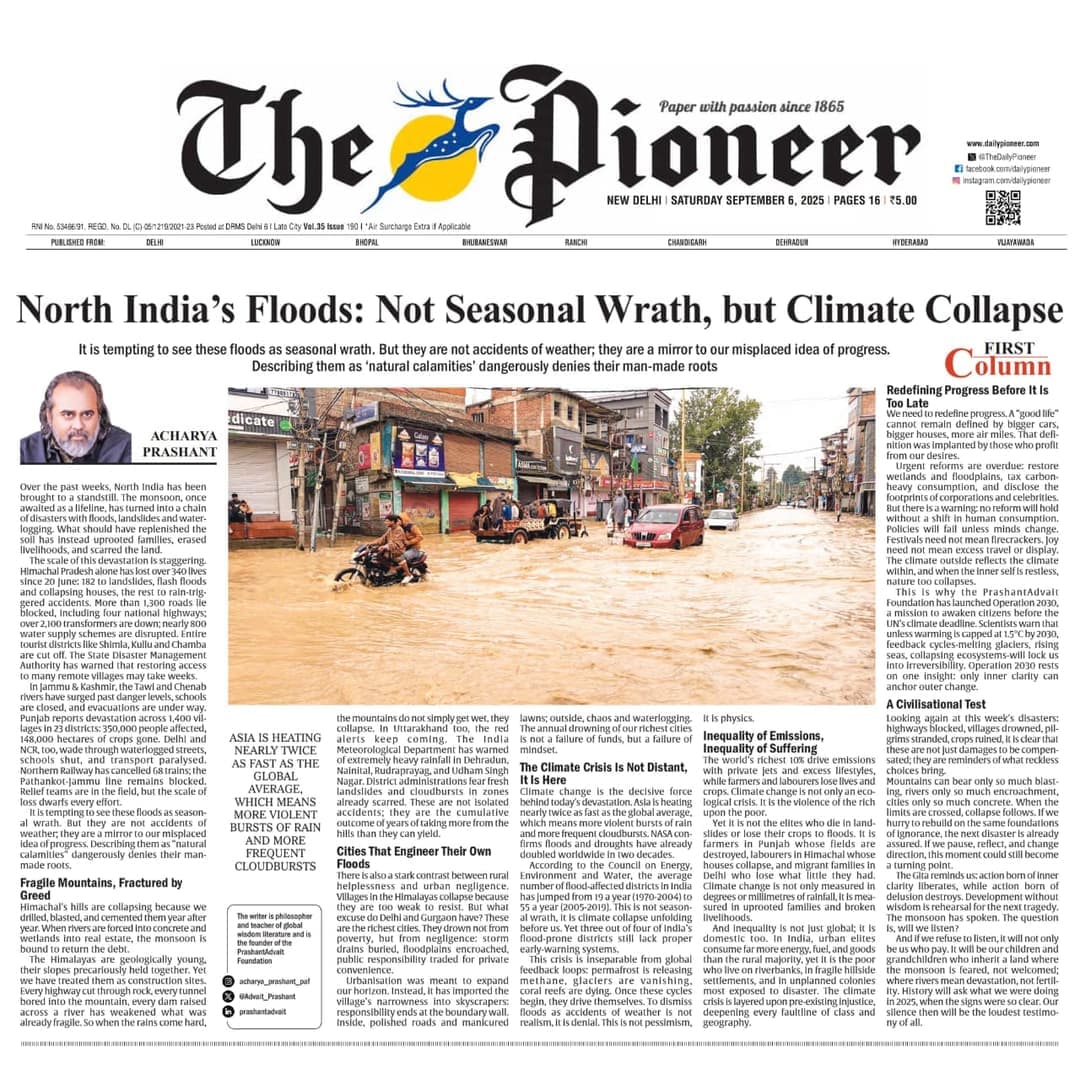
There is also a stark contrast between rural helplessness and urban negligence. Villages in the Himalayas collapse because they are too weak to resist. But what excuse do Delhi and Gurgaon have? These are the richest cities. They don't come from poverty, but from negligence: storm drains are buried, floodplains are encroached, and public responsibility is traded for private convenience.
This summary is AI-generated. Please read the full article for complete understanding.
Originally published in The Pioneer on 6 sep '25.
Over the past weeks, North India has been brought to a standstill. The monsoon, once awaited as a lifeline, has turned into a chain of disasters with floods, landslides and waterlogging. What should have replenished the soil has instead uprooted families, erased livelihoods, and scarred the land.
The scale of this devastation is staggering. Himachal Pradesh alone has lost over 340 lives since 20 June: 182 to landslides, flash floods and collapsing houses, the rest to rain-triggered accidents. More than 1,300 roads lie blocked, including four national highways; over 2,100 transformers are down; nearly 800 water supply schemes are disrupted. Entire tourist districts like Shimla, Kullu and Chamba are cut off. The State Disaster Management Authority has warned that restoring access to many remote villages may take weeks.
In Jammu & Kashmir, the Tawi and Chenab rivers have surged past danger levels, schools are closed, and evacuations are underway. Punjab reports devastation across 1,400 villages in 23 districts: 350,000 people affected, 148,000 hectares of crops gone. Delhi and NCR, too, wade through waterlogged streets, schools shut, and transport paralysed. Northern Railway has cancelled 68 trains; the Pathankot-Jammu line remains blocked. Relief teams are in the field, but the scale of loss dwarfs every effort.