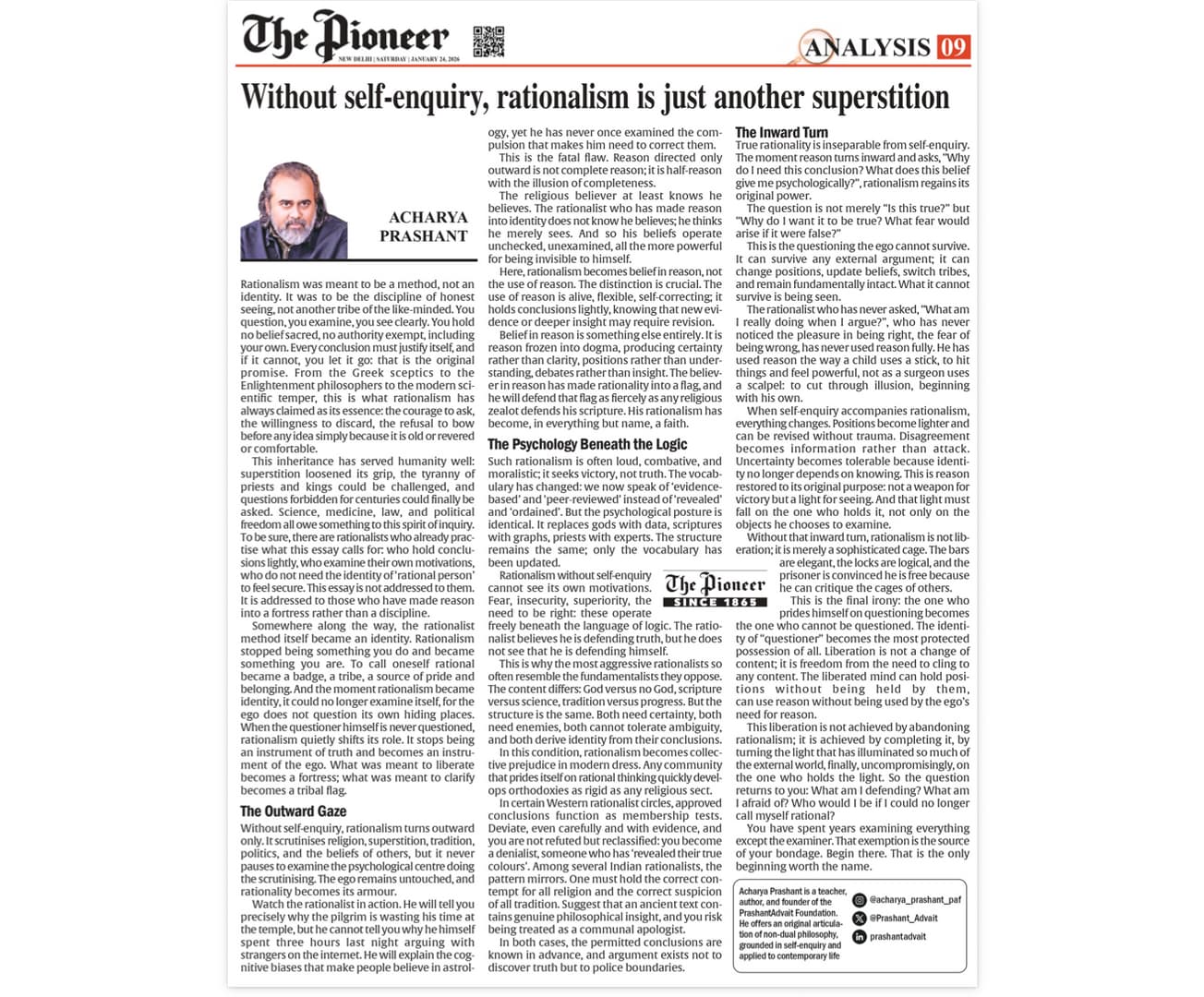
Rationality is incomplete if it only questions the world outside while leaving the questioner untouched. True enquiry must examine not just beliefs, traditions, and superstitions, but also the ego, fear, insecurity, and hidden motives behind one’s own thinking. Without self-awareness, even reason can become another rigid identity and a subtle form of bondage.
This summary is AI-generated. Please read the full article for complete understanding.
Originally published in The Pioneer on 24 jan '26
Rationalism was meant to be a method, not an identity. It was to be the discipline of honest seeing, not another tribe of the like-minded. You question, you examine, you see clearly. You hold no belief sacred, no authority exempt, including your own. Every conclusion must justify itself, and if it cannot, you let it go: that is the original promise. From the Greek sceptics to the Enlightenment philosophers to the modern scientific temper, this is what rationalism has always claimed as its essence: the courage to ask, the willingness to discard, the refusal to bow before any idea simply because it is old or revered or comfortable.
This inheritance has served humanity well: superstition loosened its grip, the tyranny of priests and kings could be challenged, and questions forbidden for centuries could finally be asked. Science, medicine, law, and political freedom all owe something to this spirit of inquiry. The courage to question rather than blindly obey, to examine rather than merely accept: this is what allows the mind to mature and society to remain free.