Originally published in The Sunday Guardian on 29 mar '26
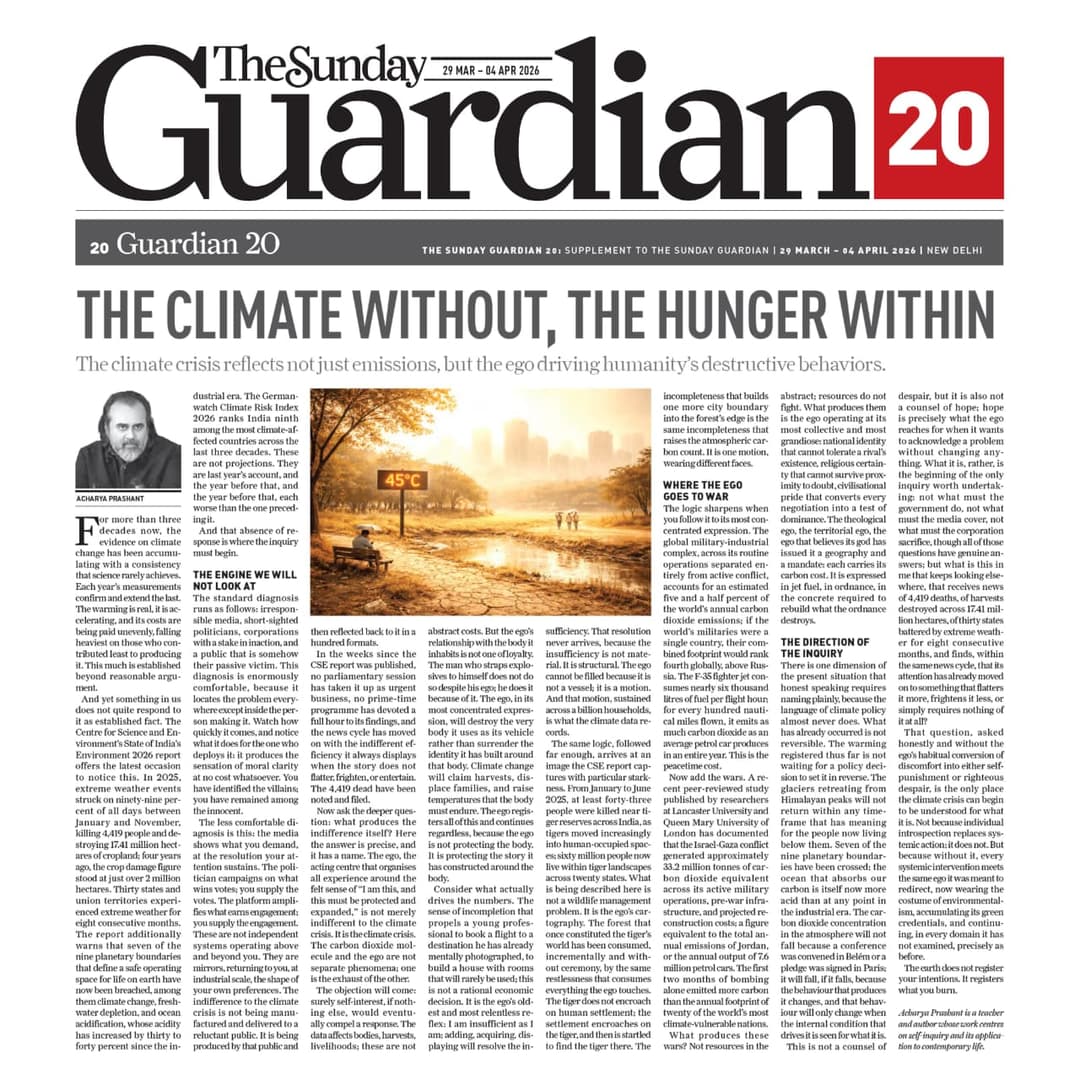
For more than three decades now, the evidence on climate change has been accumulating with a consistency that science rarely achieves. Each year’s measurements confirm and extend the last. The warming is real, it is accelerating, and its costs are being paid unevenly, falling heaviest on those who contributed least to producing it.
This much is established beyond reasonable argument. And yet something in us does not quite respond to it as established fact. The Centre for Science and Environment’s State of India’s Environment 2026 report offers the latest occasion to notice this. In 2025, extreme weather events struck on ninety-nine percent of all days between January and November, killing 4,419 people and destroying 17.41 million hectares of cropland; four years ago, the crop damage figure stood at just over 2 million hectares. Thirty states and union territories experienced extreme weather for eight consecutive months.
The report additionally warns that seven of the nine planetary boundaries that define a safe operating space for life on earth have now been breached, among them climate change, freshwater depletion, and ocean acidification, whose acidity has increased by thirty to forty percent since the industrial era. The German watch Climate Risk Index 2026 ranks India ninth among the most climate-affected countries across the last three decades. These are not projections. They are last year’s account, and the year before that, and the year before that, each worse than the one preceding it. And that absence of response is where the inquiry must begin.