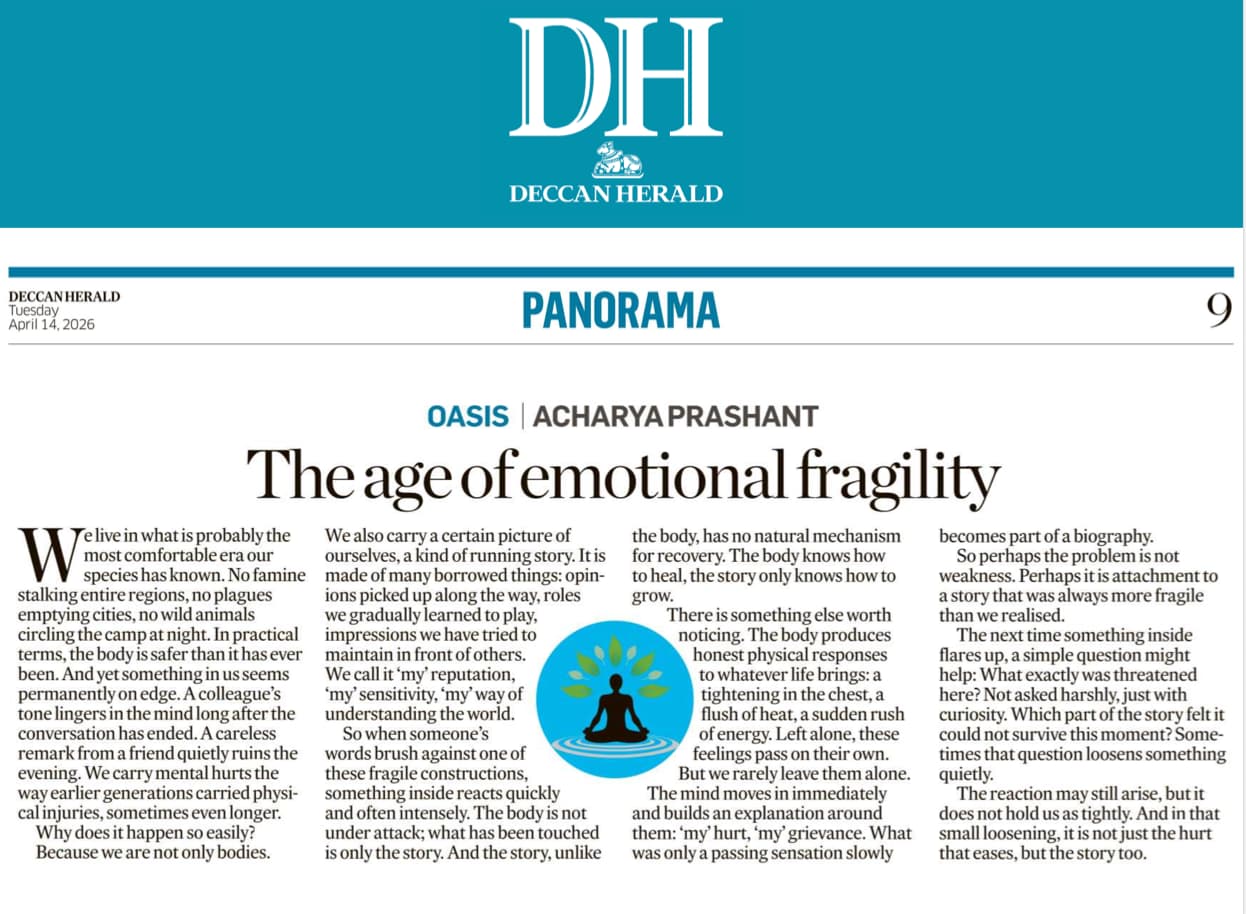
Emotional fragility arises because we live through borrowed self-images and fragile stories about who we are. Words and reactions do not truly wound the body, but threaten the identity we keep protecting. Real ease begins when we ask what exactly felt threatened, and see that the hurt belongs less to reality than to the story.
This summary is AI-generated. Please read the full article for complete understanding.
Originally published in Deccan Herald on 14 apr '26
We carry mental hurts the way earlier generations carried physical injuries, sometimes even longer.
We live in what is probably the most comfortable era our species has known. No famine stalking entire regions, no plagues emptying cities, no wild animals circling the camp at night. In practical terms, the body is safer than it has ever been. And yet something in us seems permanently on edge. A colleague’s tone lingers in the mind long after the conversation has ended. A careless remark from a friend quietly ruins the evening. We carry mental hurts the way earlier generations carried physical injuries, sometimes even longer.
Why does it happen so easily?
Because we are not only bodies. We also carry a certain picture of ourselves, a kind of running story. It is made of many borrowed things: opinions picked up along the way, roles we gradually learned to play, impressions we have tried to maintain in front of others. We call it ‘my’ reputation, ‘my’ sensitivity, ‘my’ way of understanding the world.