

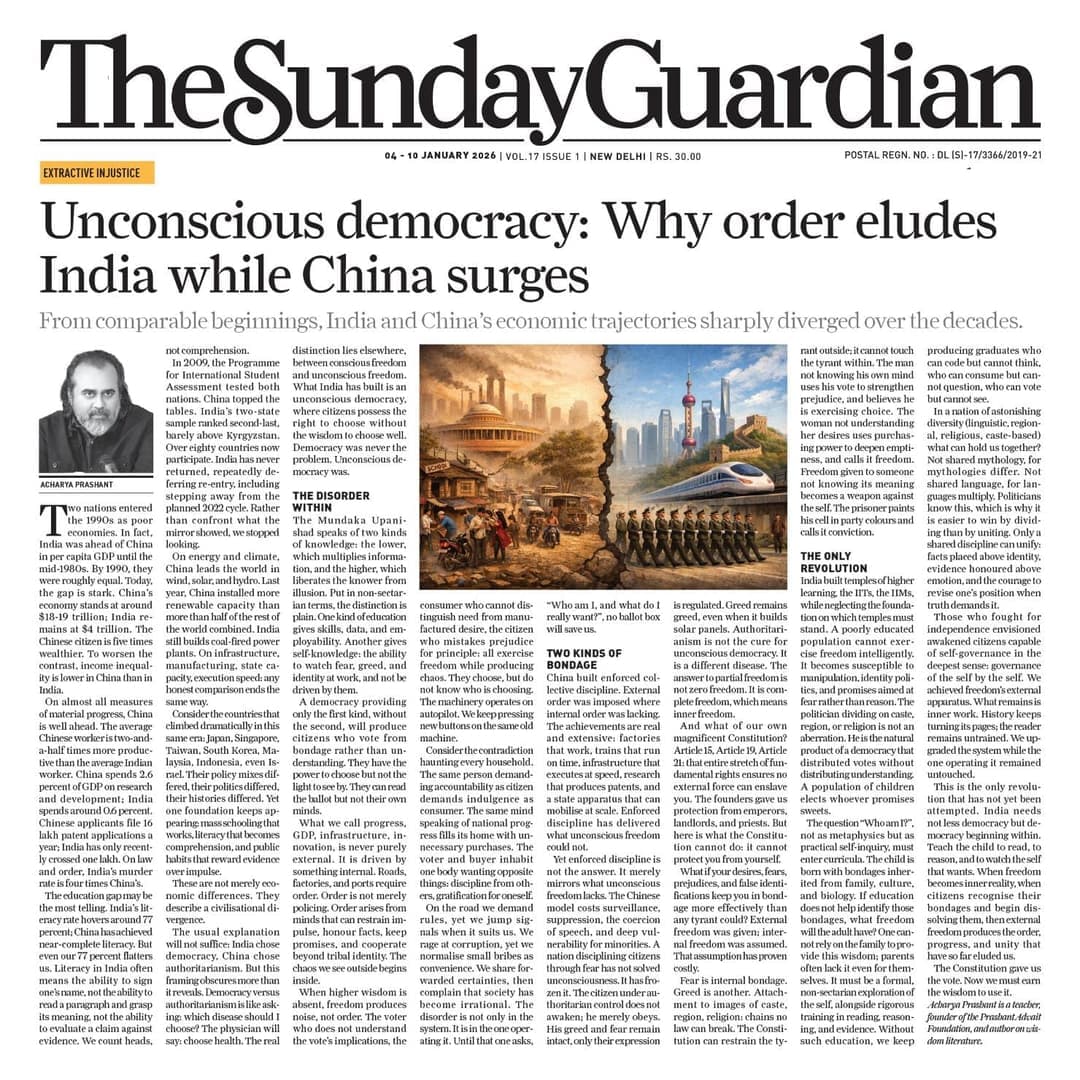
Two nations entered the 1990s as poor economies. In fact, India was ahead of China in per capita GDP until the mid-1980s. By 1990, they were roughly equal. Today, the gap is stark. China’s economy stands at around $18–19 trillion; India remains at $4 trillion. The Chinese citizen is five times wealthier.
This summary is AI-generated. Please read the full article for complete understanding.
Originally published in The Sunday Guardian on 4 jan '26
Two nations entered the 1990s as poor economies. In fact, India was ahead of China in per capita GDP until the mid-1980s. By 1990, they were roughly equal. Today, the gap is stark. China’s economy stands at around 4 trillion. The Chinese citizen is five times wealthier. To worsen the contrast, income inequality is lower in China than in India.
On almost all measures of material progress, China is well ahead. The average Chinese worker is two-and-a-half times more productive than the average Indian worker. China spends 2.6 percent of GDP on research and development; India spends around 0.6 percent. Chinese applicants file 16 lakh patent applications a year; India has only recently crossed one lakh. On law and order, India’s murder rate is four times China’s. The education gap may be the most telling. India’s literacy rate hovers around 77 percent; China has achieved near-complete literacy. But even our 77 percent flatters us. Literacy in India often means the ability to sign one’s name, not the ability to read a paragraph and grasp its meaning, not the ability to evaluate a claim against evidence. We count heads, not comprehension.