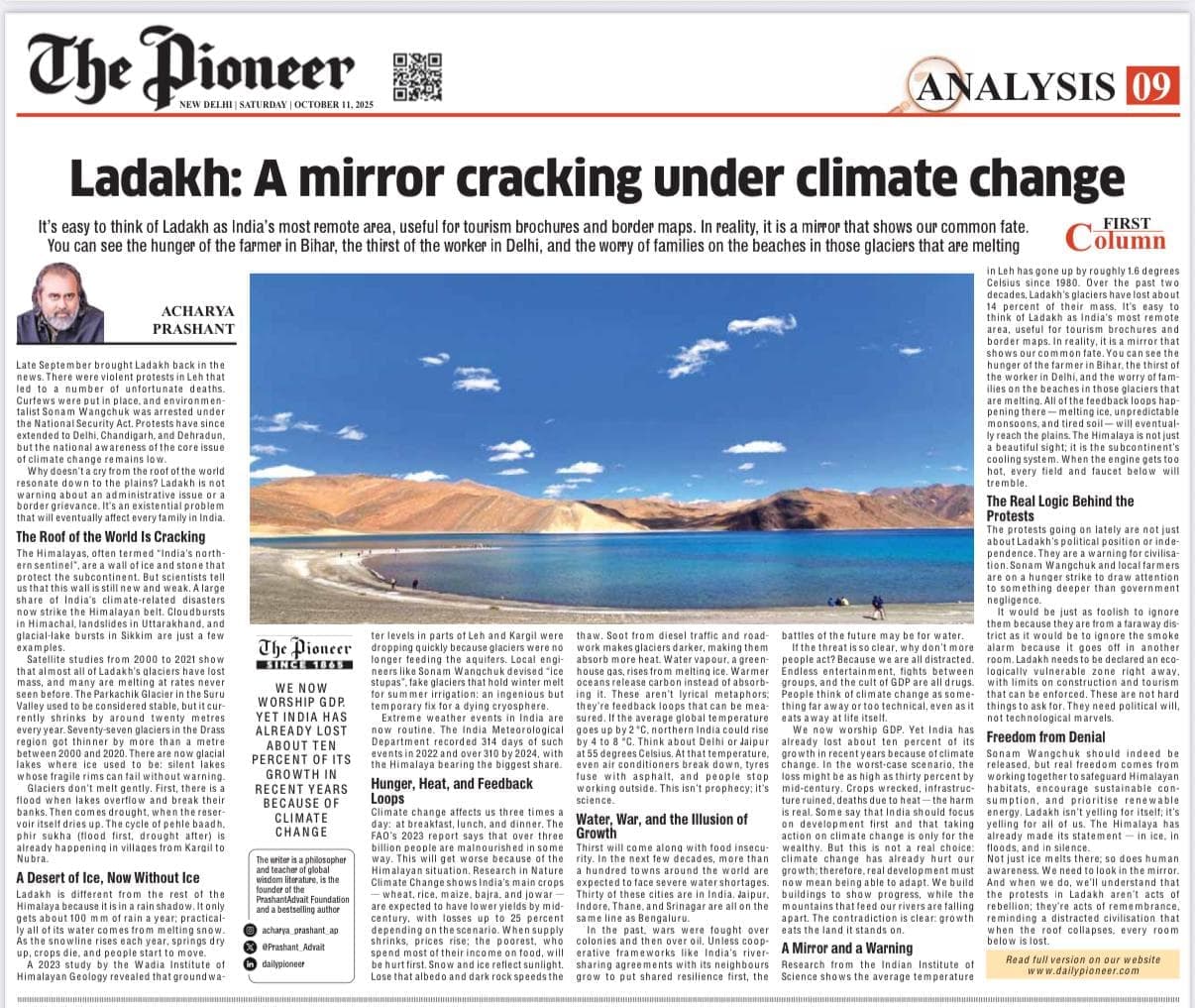
It’s easy to think of Ladakh as India’s most remote area, useful for tourism brochures and border maps. In reality, it is a mirror that shows our common fate. You can see the hunger of the farmer in Bihar, the thirst of the worker in Delhi, and the worry of families on the beaches in those glaciers that are melting.
This summary is AI-generated. Please read the full article for complete understanding.
Originally published in The Pioneer on 11 oct '25.
Late September brought Ladakh back in the news. There were violent protests in Leh that led to a number of unfortunate deaths. Curfews were put in place, and environmentalist Sonam Wangchuk was arrested under the National Security Act. Protests have since extended to Delhi, Chandigarh, and Dehradun, but the national awareness of the core issue of climate change remains low.
Why doesn’t a cry from the roof of the world resonate down to the plains? Ladakh is not warning about an administrative issue or a border grievance. It’s an existential problem that will eventually affect every family in India.
The Roof of the World Is Cracking
The Himalaya, often termed “India’s northern sentinel,” is a wall of ice and stone that protects the subcontinent. But scientists tell us that this wall is still new and weak. A large share of India’s climate-related disasters now strikes the Himalayan belt. Cloudbursts in Himachal, landslides in Uttarakhand, and glacial-lake bursts in Sikkim are just a few examples. Ladakh is also seeing the same pattern.