Switzerland’s rejection of a population cap was not simply a vote on immigration but a reflection of a deeper difficulty: defining what is “enough.” Despite wealth, stability, and low birth rates, economic interdependence made limiting growth politically and practically costly. The episode highlights a broader human tendency, individual and collective, to keep expanding goals and expectations, while rarely questioning the endless pursuit of more or asking where growth should finally stop.
This summary is AI-generated. Please read the full article for complete understanding.
Originally published in The Pioneer on 20 jun '26
A referendum asks a society to do what a person is almost never asked about her own life: name a number and stop. Not a target, revised upward the moment reached, but a ceiling the system agrees in advance never to cross.
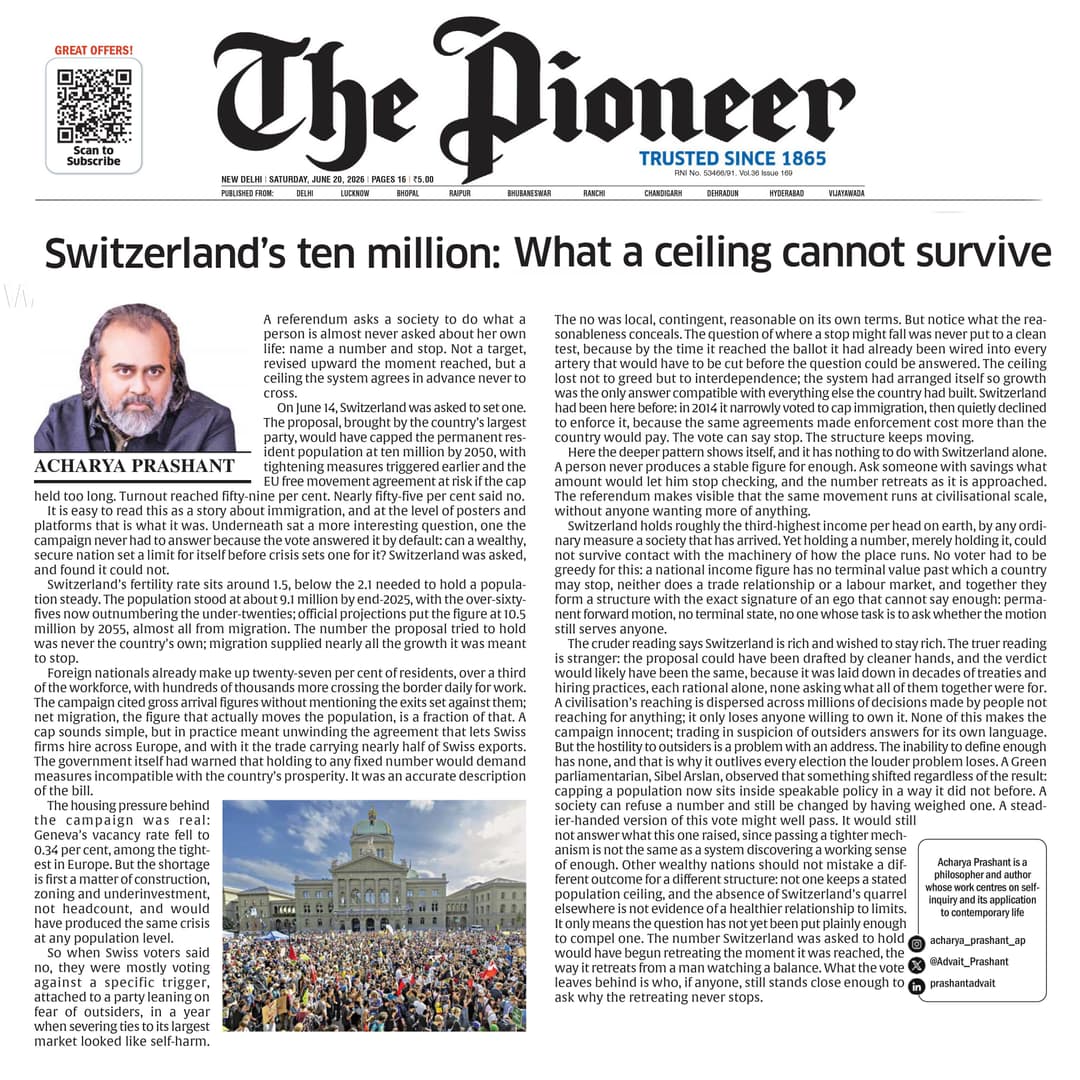
On June 14, Switzerland was asked to set one. The proposal, brought by the country’s largest party, would have capped the permanent resident population at ten million by 2050, with tightening measures triggered earlier and the EU free movement agreement at risk if the cap held too long. Turnout reached fifty-nine per cent. Nearly fifty-five per cent said no.
It is easy to read this as a story about immigration, and at the level of posters and platforms, that is what it was. Underneath sat a more interesting question, one the campaign never had to answer because the vote answered it by default: can a wealthy, secure nation set a limit for itself before crisis sets one for it? Switzerland was asked, and found it could not.