

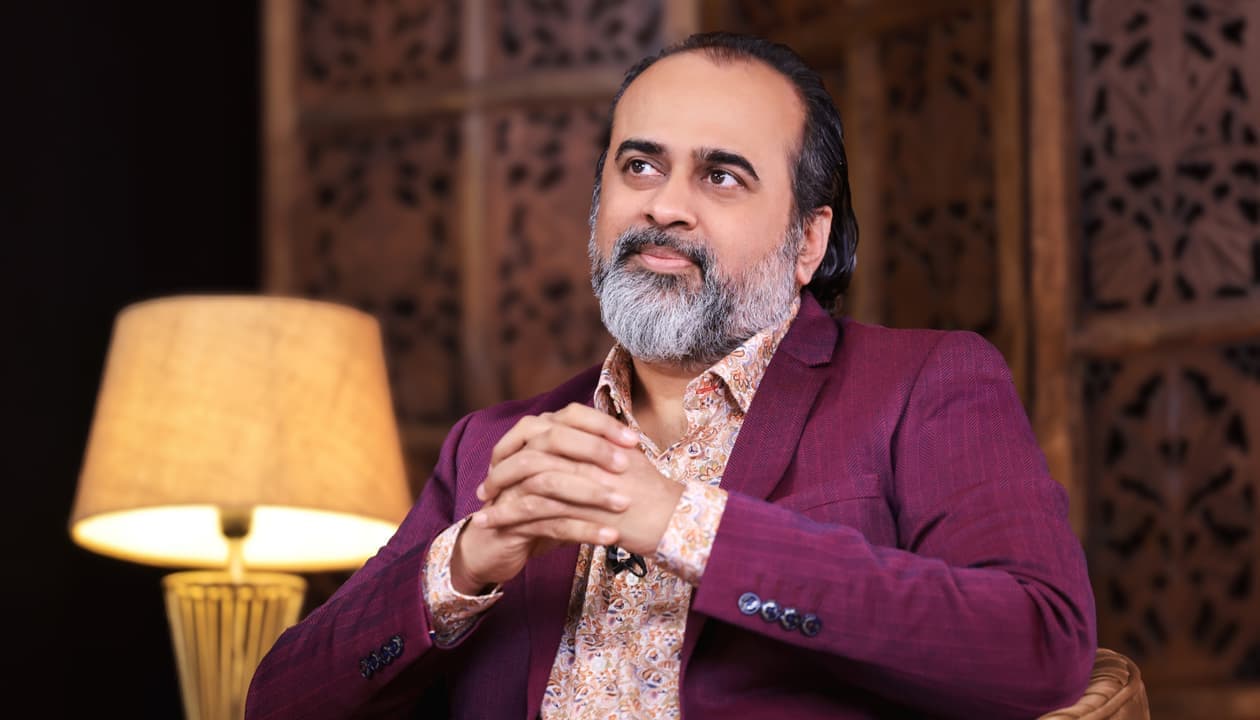
In the name of yagya, if you continue to burn wood, you are doing no good to anybody. Yagya must be understood in its true spirit. Shri Krishna says, “Do not act for yourself or for your personal gain. Act for a higher cause; higher than yourself, beyond yourself. Do that action that takes you to your Niyati, which is your end. Yagya is that which dissolves you; that which reduces you.”
This summary is AI-generated. Please read the full article for complete understanding.
यज्ञार्थात्कर्मणोऽन्यत्र लोकोऽयं कर्मबन्धनः ।
तदर्थं कर्म कौन्तेय मुक्तसंगः समाचर ।। 3.9 ।।
yajñārthāt karmaṇo ’nyatra loko ’yaṁ karma-bandhanaḥ
tad-arthaṁ karma kaunteya mukta-saṅgaḥ samāchara
This man becomes bound by actions other than that action meant for God.
Without being attached, O son of Kunti, you perform actions for Him.
~ Shrimad Bhagavad Gita, Chapter 3, Verse 9
✥ ✥ ✥
Questioner: What are the actions that one must perform for the God that Shri Krishna seems to be pointing at? What can act as a litmus test to determine that a particular action has been done for God?
Acharya Prashant: Actually, the translation is not quite solid. The verse does not recommend action towards God. The verse talks of ‘yagya’. There is a difference.
Acting in the spirit of yagya is action in dissolution; you are acting to give up something. That's what yagya is.
And, acting for the sake of God appears more like acting towards some formal, affirmative, deterministic entity. So, that's not exactly what the shloka is saying here. The shloka is saying, "All your actions, karma have to be like yagya."
What is yagya? I give up what I have for the sake of something higher. That is yagya.
Shri Krishna says, "That is the only real way of acting. Do not act for yourself, do not act for your personal gain or pleasure. Act for a higher cause, higher than yourself, beyond yourself."
That's what he is recommending.
So, the questioner says, “What are the actions that one must perform for the God that Shri Krishna seems to be pointing at?” Shri Krishna is not really pointing at any God. Shri Krishna is only pointing at that which is ungodly within us.
So, there is the fire — you know, the yagyavedi (fire altar)? You know how the place where the yagya ceremonies are performed looks? You know how that looks, right? There is the yagyavedi, then there is a samhita (the solution), the stuff that you put in the fire, and then you offer the ahuti (oblation). Right? "So, this is what I have, and I give it up; I give it up to fire. Now it's gone." And then, symbolically, it is said that, “Now I have given this up, and the fire god will take it to that god, and this god, and this god.”
But what is really happening? What is really happening is that you have something right now, and the next moment you have given it up; it's gone.
Shri Krishna is saying, "That is the only right spirit of action; action for the sake of dissolution." He puts it beautifully. He says, “Niyataṁ kuru karma tvaṁ.” That is right action.
Do that action that takes you to your niyati; niyat karma.
'Niyat karma' does not mean predetermined karma. Niyat karma does not even mean karma that is sanctioned by the scriptures. When he says, "You have to do niyat karma," that means — do that which takes you to your niyati; which is your end. And your end is dissolution.
So, what is yagya then? That which dissolves you; that which reduces you.
In chapter 3, there are two or three major points that Shri Krishna is making.
One: You will have to act, you cannot avoid action.
Second: Most of the people are acting just under the influence of the forces of Prakriti, and that keeps them trapped and in misery.
Third: Since you have to act, therefore, you must act without the expectation of any consideration for yourself.
That's the spirit of this chapter. Are you getting it?
(Repeating the question) So, what can act as a litmus test to determine that a particular action has been done for God?
No, there is no litmus test to determine whether a particular action is for God. But you can surely test whether that action is for your own personal sake. That is the only thing that you can test, and that can be readily tested. Ask yourself, “Why am I doing, what am I doing?” And it's easy. If you do not get a clear answer, just see what you will do with that which you will get from the action you do. We do not just act, right? We act, and then we live to consume the fruit of action, right?
We live on. We wait for the future. The future will bring with it the rewards of what we have done right now. See what those rewards are; see what is it that you are waiting for; see what is it that you are really expecting; see what is the intention. If it is money that your actions will bring, to what use would you put the money? Why do you really need the money?
Are you getting it?
It is an exercise in utter caution. It is an exercise in not allowing oneself to keep blindly flowing with the forces of Prakriti, in the stream of time. You are not to allow things to just happen to you. You have to know what's really going on. And if you know what's really going on, then you are free of what's going on.
Don't just let things pass under the cover of them appearing “natural”, within quotes. We do things, and when asked for an explanation, we simply say, “Oh, there is no explanation! There is no real reason or intention; it's just natural!” Or, “Isn't it obvious?” No, it's not obvious. You have to ask yourself. And it is an annoying exercise to keep asking oneself.
You are getting ready to go to the office, your workplace; don't let that be a mechanical exercise. You have just had your breakfast, you have just taken your bath, now you are tying your shoelaces, and soon you would be pulling out your car and driving straight into the morning traffic. And we do it very-very mechanically, without asking ourselves “Why am I taking bath at 7:30 a.m.?” No, not that there is something wrong with 7:30 a.m., but you need to ask. You cannot just do it like a dead man or a programmed machine.
"Why am I facing so much traffic?"
"Why am I swiping my card?"
"Why am I logging in into this computer system?"
I understand that these questions, as we said, are irritants, and they will slow you down. When they slow you down, you face the risk of getting left behind in the race of material progress, right? So you don't want to ask these questions. There is the other fellow on the adjacent workstation, and he does not ask any questions. He just comes, logs in, and starts slogging. And he is inching ahead of you. And what are you doing? You are busy asking yourself, “But why am I logging in?” Obviously, you are getting left behind. But it's worth it.
You must ask these questions.
Who is doing? What is he doing? What will he really get from it? These are dangerous questions, you know. They upset your daily order, daily routine; therefore, most people do not take the risk of asking. We just go about our daily life, as if everything is hunky-dory, right? As if it’s all well settled and concluded. “Oh, we know! We know it has to be this way!” That's our usual attitude. No, it doesn't have to be this way. And you too know that it doesn't have to be this way. And isn't that why you so fiercely avoid asking the fundamental questions? You are afraid. That's why you don't want to confront yourself. And you are afraid because somewhere you know the truth. You know that you are leading a false life. You know that you are wasting this life.
The mark of the honest man is the willingness to question himself at every stage, at every step. He never takes himself for granted.
You should be the last entity you should trust. Trust anything, anybody, but yourself. And do not trust anybody you find trustworthy, because you cannot trust your own judgement.
Now, that puts you in a vacuum with no ground beneath your feet, right? One needs something to stand on, otherwise one feels so insecure. "If there is nothing to be trusted, how do I live?" (Whimpers sarcastically) Maybe this question is not to be trusted. Question the question.
Questioner: You were talking about yagya, it is about giving something for a higher purpose. A few days back, I heard from one of the volunteers that yagya is giving ahuti; ahuti of your ego, pride, and all.
But these days, in many temples, I see that yagya is being conducted as burning those setups, and giving ahuti of ghee and wheat, and all that. And it has been practised for thousands of years, and has been carried till now as it is. I see this performing everywhere, I expect it to bring about some changes.
But now, after listening about the yagya, I feel that it's not about the literal action which should be carried out, it should be the principle or the message behind that action which is needed to be carried. And that is what brings changes. Am I thinking in the right direction?
Acharya Prashant: Yes.
In the name of yagya, if you still continue to burn wood, you are doing no good to anybody. Yagya has to be understood in its right spirit. Yagya has to be understood in the spirit of Chapter 3 of Shrimad Bhagavad Gita.
Here, when you see that Shri Krishna is talking of selfless action, or action without concern for reward, nishkam karma, and in the same breath, he is talking of yagya, then you immediately realize what 'yagya' really means.
Questioner: So, in today's time, it is not relevant to practise that kind of yagya, the ceremonial yagya?
Acharya Prashant: It was symbolic even in those times.
You see, man’s constitution is such that he needs symbols. Even at those times, the burning of wood etc. was just symbolic. What was the real thing? The real thing is there in the Gita. Read the Gita and you will know what the real meaning of yagya is.
Maybe today the symbol needs to be changed. We need a better symbol. We need a more contemporary symbol. In the times of heavy carbon accumulation in the atmosphere, when the climate catastrophe is staring at us, I do not think it makes sense to burn something — especially organic material — in the name of a divine ceremony.
Questioner: So, after analyzing this, I come to a point that the yagya which was performed at that time was about giving the ahuti of ghee and grains, items that were luxurious at that time. So they were symbolizing that we are giving something, and it is not to be valued that much.
Acharya Prashant: You could interpret it that way.
Questioner: And now it is just carried as it is.
Acharya Prashant: Yes.
Questioner: Whereas, nobody wants to give the actual luxurious.
Acharya Prashant: No, it is not that nobody understands the real meaning of it. Even today, there are thousands of people who really know what yagya means. But unfortunately, they are just in thousands. The ones who do not know the real meaning and intention of yagya are in millions, maybe in billions.
We often defend a bad choice by pointing to a worse one: stay dishonest or starve, keep the wrong grip or stop playing. But the real trouble is not the option we picked. It is the option we never let ourselves see. Action does not need greed or attachment to find its energy. The third way begins by rejecting both false choices, without knowing what comes next. Which of our everyday choices are really false dilemmas?

The climate crisis is not merely an external environmental problem but a reflection of inner human greed, desire, and psychological disorder. Drawing from the Gita’s idea of yagya as desireless action, it says real ecological healing requires inner transformation. Outer pollution, exploitation, and destruction mirror the ego’s inner confusion, making personal consciousness and planetary health deeply inseparable.
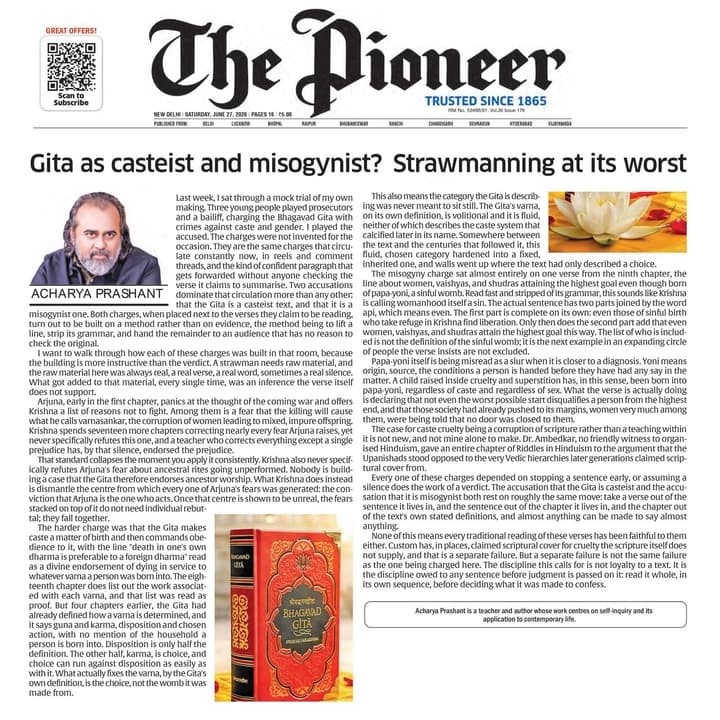
The Bhagavad Gita is often accused of supporting caste and misogyny through selective quotations that ignore context, grammar, and the text's central teachings. A closer reading shows that its emphasis is on inner qualities, conscious action, and spiritual equality rather than birth-based hierarchy or gender discrimination. Misinterpretations arise when isolated verses are detached from their broader meaning, while the Gita consistently points toward self-knowledge, freedom from ego, and the universal possibility of liberation for every human being.
Shri Krishna is saying: the mind is conditioned to move towards objects and perceive only their surface, periphery, or form. Develop the practice of penetrating further. Let Truth be your practice. The moment you would look at something, and you are in no position not to look at things being embodied, you would look at things. Nobody said that you have to practice lust. Lust just comes. You might be a total fool, an utter retard, and still you will find yourself getting sexually excited once you reach a particular age. Did you need some practice? No, you didn’t. It just happened. But if you are to understand lust, if you are to cross over, if you are to be a master of your body, then it will require a lot of practice, and that will necessarily and obviously tell you about your predicament.
Drop the center of confusion, come to the center of clarity. Drop what the masses practice, come to the direct route of self-realization. That’s what it means.
For you to benefit from the darshan of Shri Krishna's statue, you should already have a relationship with Shri Krishna and the Gita. If you have had no prior connection with the Gita, then darshan makes no sense. Darshan is a great way to immediately bring back all that has been hidden under the dust of time. You could either re-read the entire Gita or simply look at Shri Krishna’s statue. It’s a fantastic method — but only for Gita lovers.
Victory is not decided by the trophy you hold but by the battle you choose to fight. Real strength lies in making the right decisions, staying true to your deepest values, and refusing to be ruled by fear or circumstances. When your actions arise from clarity rather than ambition, the outcome loses its power over you. The moment you choose the right path, you have already won.
Karma is a reflection of who you are. You are the doer. Karma means action. You are the actor. The principle of karma is: do not focus on karma; focus on karta, the doer, the actor. That is karma, that’s all. There is nothing mystical about it.

Can you go to the past and choose something or unchoose something? And life is happening right now. So your power to respond to life is right now. But the moment you say it is happening due to the past, then you have surrendered your power to choose, because you cannot do anything with the past. You cannot change the past. You can’t choose the past. You can’t unchoose the past. You can’t modify it. You can do nothing.