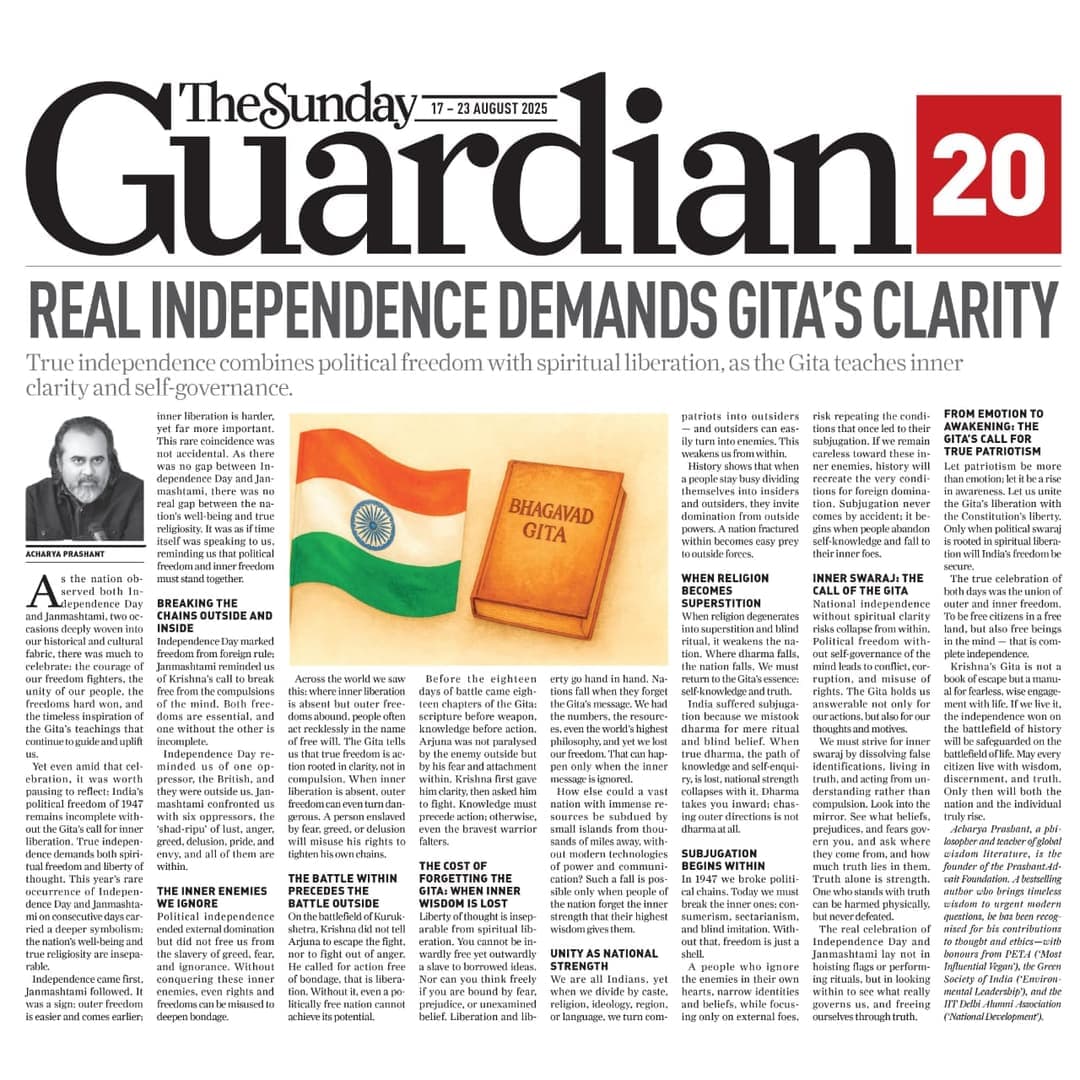
This year’s rare occurrence of Independence Day and Janmashtami on consecutive days carried a deeper symbolism: the nation’s well-being and true religiosity are inseparable. Independence came first, Janmashtami followed. It was a sign: outer freedom is easier and comes earlier; inner liberation is harder, yet far more important. This rare coincidence was not accidental. As there was no gap between Independence Day and Janmashtami, there was no real gap between the nation’s well-being and true religiosity. It was as if time itself was speaking to us, reminding us that political freedom and inner freedom must stand together.
This summary is AI-generated. Please read the full article for complete understanding.
Originally published in The Sunday Guardian on 17 aug '25.
True independence combines political freedom with spiritual liberation, as the Gita teaches inner clarity and self-governance.
As the nation observed both Independence Day and Janmashtami, two occasions deeply woven into our historical and cultural fabric, there was much to celebrate: the courage of our freedom fighters, the unity of our people, the freedoms hard won, and the timeless inspiration of the Gita’s teachings that continue to guide and uplift us.
Yet even amid that celebration, it was worth pausing to reflect: India’s political freedom of 1947 remains incomplete without the Gita’s call for inner liberation. True independence demands both spiritual freedom and liberty of thought. This year’s rare occurrence of Independence Day and Janmashtami on consecutive days carried a deeper symbolism: the nation’s well-being and true religiosity are inseparable.