

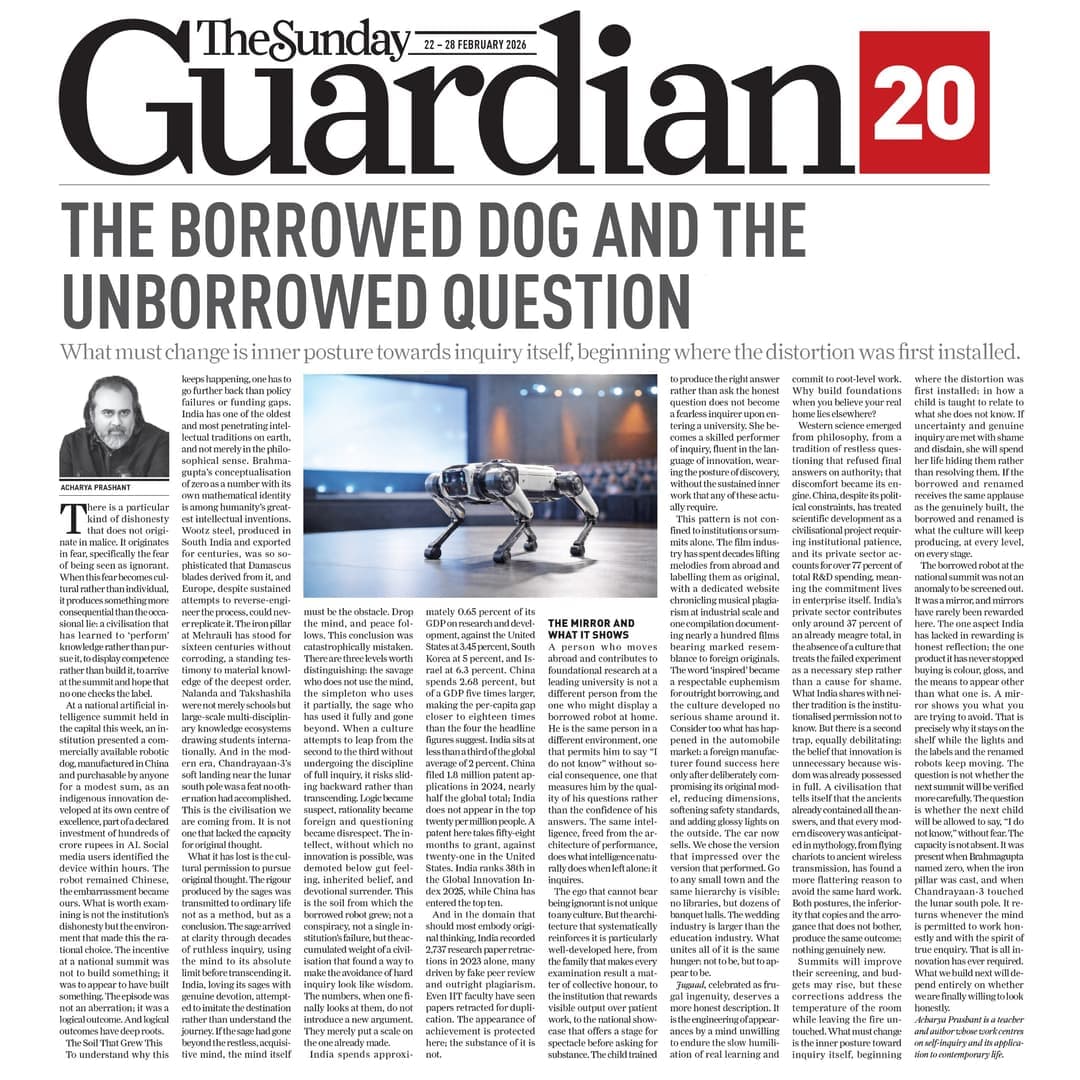
There is a particular kind of dishonesty that does not originate in malice. It originates in fear, specifically the fear of being seen as ignorant. The ego that cannot bear being ignorant is not unique to any culture. What India shares with neither tradition is the institutionalised permission not to know. But there is a second trap, equally debilitating: the belief that innovation is unnecessary because wisdom was already possessed in full. What must change is inner posture towards inquiry itself, beginning where the distortion was first installed.
This summary is AI-generated. Please read the full article for complete understanding.
Originally published in The Sunday Guardian on 22 feb '26
There is a particular kind of dishonesty that does not originate in malice. It originates in fear, specifically the fear of being seen as ignorant. When this fear becomes cultural rather than individual, it produces something more consequential than the occasional lie: a civilisation that has learned to ‘perform’ knowledge rather than pursue it, to display competence rather than build it, to arrive at the summit and hope that no one checks the label.
At a national artificial intelligence summit held in the capital this week, an institution presented a commercially available robotic dog, manufactured in China and purchasable by anyone for a modest sum, as an indigenous innovation developed at its own centre of excellence, part of a declared investment of hundreds of crore rupees in AI. Social media users identified the device within hours. The robot remained Chinese, the embarrassment became ours. What is worth examining is not the institution’s dishonesty but the environment that made this the rational choice. The incentive at a national summit was not to build something; it was to appear to have built something. The episode was not an aberration; it was a logical outcome. And logical outcomes have deep roots.