Gita can be brought to anybody, and Arjunas are not always available. Sometimes, Duryodhanas have to be turned into Arjunas. It’s just that it’s relatively easier with an Arjuna. As long as somebody has even the faintest remnant of consciousness left, Gita can be brought to that person — but it will be tough. Nobody really deserves the Gita. You can only be grateful to the Gita if it comes to you.
Acharya Prashant: A quiver full of the best of arrows but no bow, how do you fight the battle of life? Can you imagine the amusing as well as tragic situation of the person who has a great arrow without a bow? He will be sharpening and sharpening his weapon,
Since childhood we have been told about effort as a duty, hard work as an obligation, and a result oriented investment. We are told, “Work hard so that you can have dividends later on.”
Questioner (Q): I have heard you say that no two human beings are equal. But if that is the case, then how can the possibility of liberation exist on a larger scale? We have adapted and evolved in various fields throughout history, but can the same happen when it comes…
Many Indian parents keep their children, and especially their daughters, away from sport, even where coaches and facilities exist. The barrier is often not outside but in the parent’s own ideas: poor returns, uncertainty, and fixed notions of what a girl’s life must be. Blaming our own parents does not help either; our life is now our responsibility. Parenting is a decision of the greatest responsibility, and it begins with self-love. Can we love a child if we cannot love ourselves?
Success never quiets the anxiety underneath it. Hustle culture runs on karma — a restless cycle of chasing the next job, package, or achievement in hopes of filling an inner void. Young professionals in Bangalore who've "succeeded" on paper remain fearful, ashamed, and unsettled within, proof that success is a liar: it promises liberation but delivers only debt. Anxiety itself traces not to the future but to a present that's been neglected, and real freedom from restlessness begins only by turning inward.
The balance between order and disorder should not be decided by personal likes or dislikes, but by what the task at hand requires. Sometimes a project demands discipline and order; at other times, more important work requires leaving things messy. The right action comes from responding to the actual need, not personal preference. Even sacrifice can be meaningful when it serves something important, but “staying backstage” should never become an excuse to avoid what one cannot tolerate.
True love is not a biological instinct, emotional attachment, or social conditioning. Biology and science explain the body's drives, but they cannot explain the self that seeks freedom. Love is the inner restlessness to move from ignorance and bondage toward truth and liberation. Religion is not rituals or inherited beliefs but this personal journey of understanding. Freedom—not possession or conformity—is the essence of both love and religion.
Real love is not measured by comfort, agreement, or preserving relationships at any cost. It is revealed when one has the courage to challenge falsehood, embrace uncomfortable truths, and even risk a relationship for another's freedom and growth. Truth is not a fixed destination but a continuous rejection of illusion. Genuine relationships, mature guidance, and authentic scriptures all serve as mirrors that help us see and dissolve our own falseness.
Truth cannot be forced upon anyone, but neither should falsehood be entertained. Genuine love is not about preserving relationships at any cost; it is about helping oneself and others break free from illusion, even if that means risking the relationship itself. Spiritual growth begins by questioning conditioning, examining falsehood without bias, and choosing authenticity over comfort. Real relationships are built on the courage to seek freedom, not convenience.
The biggest weakness of modern education is not that it fails to keep pace with technology, but that it neglects self-knowledge. Students are trained to build identities around qualifications and careers, making them rigid in a world that demands constant change. Real adaptability, innovation, and lifelong learning come not from acquiring more skills, but from understanding oneself and letting go of fixed identities.
Humanity's greatest crisis arises from the imbalance between immense external progress and inadequate inner understanding. While technology, wealth, and knowledge have expanded unprecedentedly, unchecked desires and ignorance continue to fuel conflict, inequality, and environmental destruction. Sustainable change requires mass-based education of the self so individuals understand their motives and use science, technology, capital, and power with wisdom, responsibility, and inner clarity rather than unconscious craving.
Innovation is born from research, creativity, critical thinking, scientific temper, and original thinking—not imitation or appearances. A society that values honest inquiry over validation creates genuine progress. India's future depends on nurturing a culture that encourages questioning, respects originality, and pursues truth with intellectual honesty instead of settling for superficial success and empty displays.
Search
We say, “It was just sheer grace that the Buddha encountered sights of the old man, the sick man, the destitute, and was transformed.” But — was the Buddha the only one who encountered such sights? Grace is available to everybody; it was only the Buddha who decided that it’s time to take action. Grace is that which comes to you unconditionally, but people reject grace. Even grace respects your choice.
1
The question should be which one is relevant to you? What will you do by enquiring about Shri Krishna’s grace? That’s Shri Krishna’s prerogative, right? Shri Krishna will take care of his grace if he has to offer grace. Whatever he has to do, we do not know what grace is. We do not know who Shri Krishna is. How does it concern us to go into matters of his grace? What is it that’s in your control? Your own preparation, your own willingness. So, you take care of that.
…
Speaker:
What happens when I am looking for Bliss?
Listener 1: I don’t have to look anywhere, because you can look for somebody…
Speaker: But, I have been told that human lives must attain to Bliss, because that is our nature. I have been told that *Sat Chit Anand*swabhav…
Excerpts from Articles
ज्योतिष कितना सच है? कुंडली, ग्रह-नक्षत्र: इनका क्या अर्थ है?
वेदांत को केवल इसलिए सही या श्रेष्ठ नहीं माना जा सकता कि वह किसी विशेष परंपरा से आता है। विज्ञान जहाँ भौतिक जगत की वस्तुनिष्ठ जाँच करता है, वहीं अद्वैत वेदांत सीधे मनुष्य के ‘मैं’, उसके दुख, बंधन और मुक्ति की पड़ताल करता है। इसकी कसौटी वैज्ञानिक प्रमाण नहीं, बल्कि अपने जीवन में इसकी सच्चाई को देख पाना है। किसी दर्शन को मान लेना नहीं, बल्कि उससे स्वयं को मुक्त करना ही उसका वास्तविक उद्देश्य है।
Justice Without Boundaries: Why Compassion Cannot Stop at Species
Oppression should not see caste, gender, creed or colour, and it should not see species either. The moral threshold is sentience, not intelligence. An animal feels pain as fully as a human does, whether or not it can explain its suffering.
Struggling to choose between a secure job and the path you actually feel drawn to? This isn't really a question about careers. It's about why other people's opinions have so much power over you in the first place. Real clarity doesn't come from finding the 'right' choice. It comes from honestly looking at your own fear, again and again, until it stops running the decision for you.
कई तरह के डर—अकेले पड़ने, छवि खोने या छोटा समझे जाने—की जड़ अक्सर अतीत में बनी पहचान और कहानियों में होती है। शरीर की हाइट जैसी चीज़ों को समस्या मानकर उनसे जूझने के बजाय उनकी अप्रासंगिकता को समझकर आगे बढ़ना चाहिए। अतीत को दबाने से मुक्ति नहीं मिलती; उसके करीब जाकर अपनी स्मृतियों, धारणाओं और पुराने पैटर्न को निष्पक्षता से देखना ज़रूरी है।
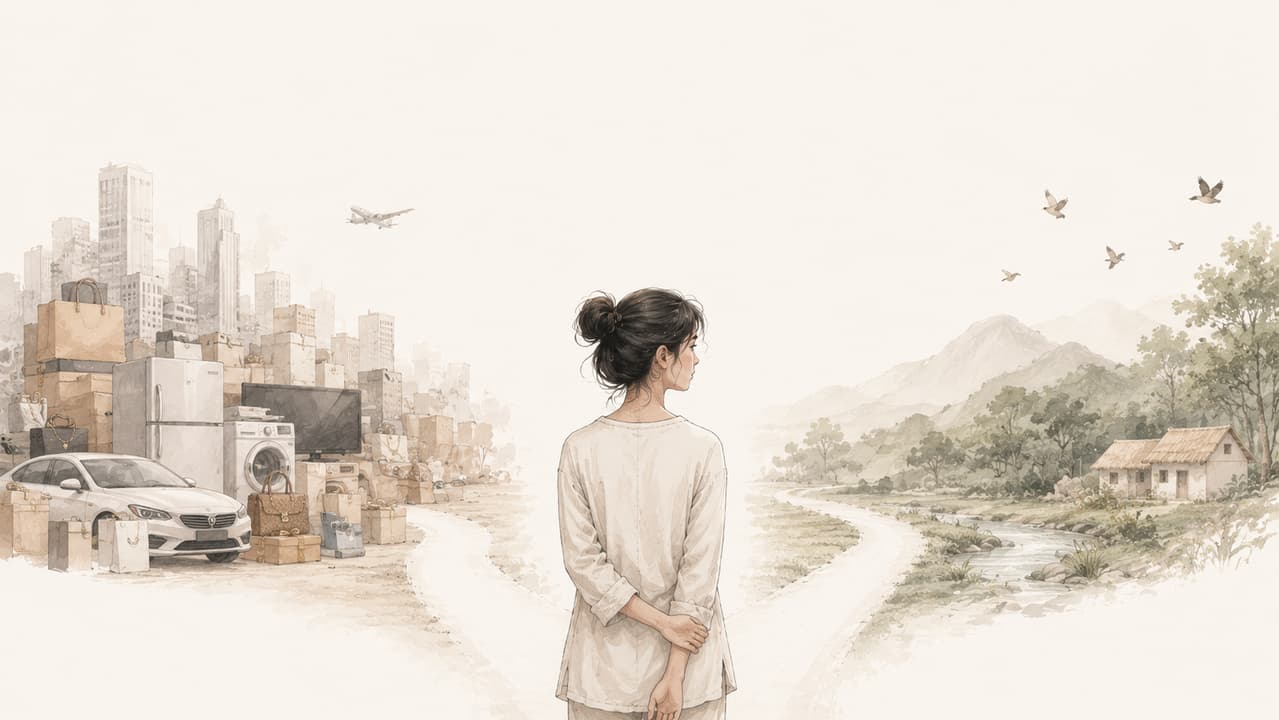
Climate change is more than an environmental crisis—it is a crisis of human choices. Our patterns of consumption, consumerism and endless pursuit of more are putting increasing pressure on the planet. But meaningful change does not necessarily begin with new technology or stricter policies. It begins with a deeper question: what are we willing to change within ourselves?
Question: These days I feel like running away from Advait. I feel that I am not going to gain anything here. But, at the same time I find myself pulled here yet again. I know what you are saying is true and that you mean well for me, but I…
you enslaved me,
In Grace entered me,
and out of Love
melted my mind.
~ Lalleshwari ~
Acharya Prashant: “On that day when you looked at me, you enslaved me, In Grace entered me, and out of Love melted my mind.”…
1
Question: Acharya Ji, I am finding for the last few months that when we are honest and move in the right direction, things get aligned to help us move in that direction.
For instance, coming across your videos and watching them was pure luck. It doesn’t look like that I…
1
Questioner (Q): It has been a long time that I have been listening to you and I have been engaged with a lot of words and everything. And so many words and so many misunderstandings have come and gone but still, the restlessness remains; but still, the will to consume…
Question:
Sir, I have to do daily practice to bring myself back to the centre but for some people, it seems that it happens immediately. Why is it so?
Acharya Prashant: Lady, what is your name?
L1: Noorie.
AP: If you want something with all your heart, would you want…
1
prakṛtyā śūnyacitto yaḥ pramādād bhāvabhāvanaḥnidrito bodhita iva kṣīṇasaṁsmaraṇo hi saḥ.
(Ashtavakra Gita 14.1)
Translation: He indeed has his recollections of worldly life extinguished – who becomes void-minded spontaneously, who thinks of sense objects only by chance, and who is, as it were, awake though physically asleep.
Question: Why is it…
I am reading a book named ‘the philosophy of the Buddha’ to understand the Buddhist thought. I found this book quite enriching in its academic rigor. However
…
Question:
Acharya Ji, I am a regular participant of the camps, I have attended Month of Awakening(MAG)Program. I regularly watch Satsangs broadcasted live. I read Scriptures.
How do I bring the same intensity of the camp, in my daily life?
Acharya Prashant Ji: Just be grateful for the period when…
By delay, you mean time, to put it ahead in time. Man uses time itself for gratification. When you say delay gratification, you only mean, that I am expecting more gratification by the use of
…
In one of your videos, you said that you should be thankful if things are happening in your life in a fast-forward mode. Please shed some light on it.
Acharya Prashant (AP): First of all, this attitude is putting a condition upon grace and gratitude.…
Happiness is the key to success, correct. But does happiness exclude hard work?
If happiness excludes…
Remember that all that you have is not necessary to be had. You will remain humble.
Remember…
Share
2
वेदांत को केवल इसलिए सही या श्रेष्ठ नहीं माना जा सकता कि वह किसी विशेष परंपरा से आता है। विज्ञान जहाँ भौतिक जगत की वस्तुनिष्ठ जाँच करता है, वहीं अद्वैत वेदांत सीधे मनुष्य के ‘मैं’, उसके दुख, बंधन और मुक्ति की पड़ताल करता है। इसकी कसौटी वैज्ञानिक प्रमाण नहीं, बल्कि अपने जीवन में इसकी सच्चाई को देख पाना है। किसी दर्शन को मान लेना नहीं, बल्कि उससे स्वयं को मुक्त करना ही उसका वास्तविक उद्देश्य है।
2
We often call something “help” or “love” while secretly expecting something in return. When that return does not come, we feel hurt, revealing that the relationship was a trade, not genuine help. The ego, being unfulfilled, cannot truly love or share. Likewise, desperation to be loved makes us controllable. Real love emerges when we stop seeking validation, work on ourselves, and become so inwardly fulfilled that we no longer need to be loved.
2
Knowledge alone cannot transform life; it can become another object of the ego. True knowledge is self-knowledge—a mirror that exposes and destroys false ideas about oneself. Ravana may have been knowledgeable, but without self-knowledge, knowledge can become a tool for exploitation. Wisdom is not something to acquire; it is innate. Self-knowledge is the process of unbecoming unwise by clearing away the nonsense we have gathered.
2
We often believe we are living freely, while our desires, dreams, beliefs, and choices are shaped by physical, social, cultural, religious, and psychological scripts. These scripts offer comfort and security, making us reluctant to examine our bondage. Freedom does not begin by imagining what lies beyond the script, but by deeply observing the cage we already live in, without fear, desire, or attachment.
1
Question: Why do I feel lost?
Acharya Prashant: Because, you are asking this question.
We ‘think’ that we are lost, equally, we ‘think’ that we are not lost. The same place from where the thought, the perception of being lost, or not lost arises, that place is the same place…
2
Friendships naturally change as people follow different paths in life. When you remain focused on your true purpose, you stop clinging to those who only accompany you briefly. Instead of dwelling on memories or fearing others' intentions, examine your own expectations and self-deception first. Honest self-awareness brings clarity, wiser relationships, and the freedom to move forward without resentment or attachment.
Victory is not decided by the trophy you hold but by the battle you choose to fight. Real strength lies in making the right decisions, staying true to your deepest values, and refusing to be ruled by fear or circumstances. When your actions arise from clarity rather than ambition, the outcome loses its power over you. The moment you choose the right path, you have already won.
1
True learning is not built on memorizing answers but on understanding reality. Memory may help in examinations, but life constantly presents new questions that demand clarity, presence, and intelligence. Education becomes meaningful only when knowledge is deeply understood and lived, not merely remembered. Real understanding frees us from dependence on rote learning and enables us to respond wisely to every new situation.
The Bhagavad Gita is not a separate spiritual path or an escape from everyday life - it is a mirror that reveals the truth of your present life. Real spirituality begins with self-observation, not rituals or temporary practices. Lasting transformation comes when work, relationships, career, and personal growth become one integrated life driven by awareness, love, and freedom rather than ego, fear, money, or social pressure.
Superstition does not begin with rituals alone; it begins with unquestioned beliefs about the self. Science can remove many false beliefs, but complete freedom requires Self-knowledge. Vedanta, philosophy and meditation help expose the ego, making awakening possible. Religion becomes meaningful only when it encourages Self-knowledge rather than blind belief. Real freedom comes not from accepting inherited ideas but from understanding oneself through direct observation and awareness.
Society has a role in practical matters, but it should never decide love, marriage, happiness, or the purpose of life. Real freedom begins when personal choices are guided by understanding instead of social pressure. While social norms help maintain order, they become harmful when they dictate relationships, career, or inner values. True happiness and love arise from freedom, not conformity, making every love story meaningful only when it is authentically one's own.
The ego is not a real, independent entity but a bundle of conditioning that creates the illusion of a separate "I" and becomes the source of suffering. Self-observation is not introspection or analysis but moment-to-moment honesty about what is happening within. Real freedom comes when this false center is seen through, allowing life to function naturally without the burden of psychological ownership.
Love is not a special emotion reserved for selected people or relationships but a way of relating free from self-interest, possession, and psychological dependence. Most relationships become transactions driven by insecurity, where the ego seeks completion through ownership and exchange. Genuine companionship arises without the urge to control or claim another, allowing affection to exist naturally, freely, and without conditions or expectations.
Life cannot be transformed by knowledge of the external world alone; it also requires understanding the one who experiences it. Science, technology, and logic are powerful, but they remain incomplete without self-knowledge and inner honesty. Lasting solutions to personal and global crises emerge when the same rigor used to study the world is turned inward, examining one's motives, intentions, and consciousness with equal seriousness.
Most people move through life unconsciously, mistaking inherited beliefs, ambitions, and social conditioning for personal choice. Careers, relationships, goals, and even identities often arise more from habit and circumstance than from conscious understanding. Real freedom begins by questioning the actor rather than the action, examining the assumptions behind one’s choices, and awakening from the psychological “coma” in which life is merely happening rather than being consciously lived.
Materialism and emotionality are not opposites; emotions themselves often arise from material desires, fears, and biological conditioning. The real distinction is between the material-emotional world and spiritual understanding. Spirituality is not another belief, emotion, or acquisition but the clear observation of thoughts, desires, and assumptions. Many personal and social crises stem from unexamined beliefs, and meaningful change begins by questioning them, speaking truthfully, and paying attention to what occupies the mind.
Modern relationships often create more insecurity, not less, because people are conditioned to seek completion, validation, and identity through another person. Social institutions, media, culture, and tradition continuously reinforce the idea that fulfillment lies in romantic attachment. As a result, relationships become driven by dependence rather than love. Real companionship becomes possible only when one is inwardly at peace and not using another person to fill an inner void.
Freedom begins when a person stops handing over the authority of life to others. Society, family, and tradition can offer opinions, rewards, or disapproval, but they cannot truly stop someone unless there is inner dependence on their approval. Many conflicts that appear external are rooted in psychological dependence, fear, greed, obligation, or the desire for validation. Clarity does not come from controlling every outcome; it comes from ensuring that decisions are not driven by inner confusion, and then allowing life to unfold naturally.
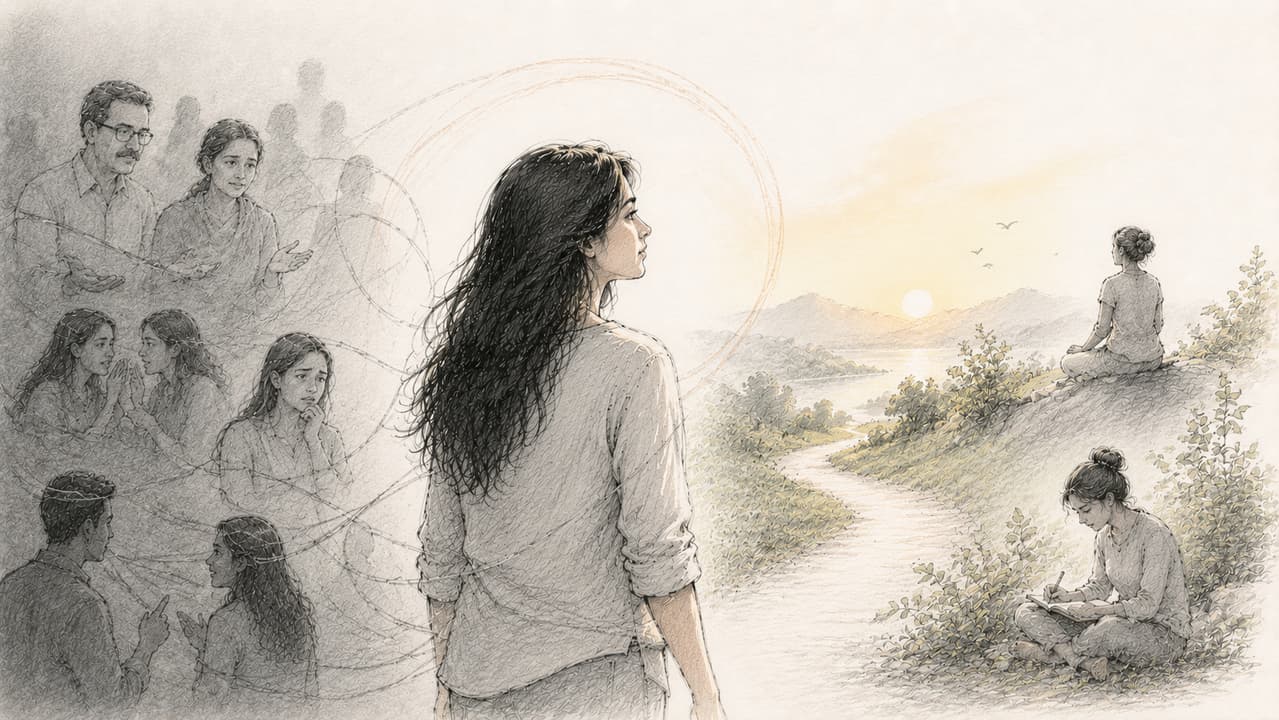
Inner freedom becomes impossible when identity is borrowed from family, friends, or social expectations. Fear, guilt, and pressure arise because people allow others to define their worth and choices. Relationships become healthy only when they support growth rather than control it. Real autonomy comes from self-understanding, continuous inner inquiry, and the courage to act from clarity rather than conformity. When there is inner certainty, labels, criticism, and social judgment lose their power.
Love is not attraction, possession, dependency, or a transaction driven by personal gain. As long as relationships arise from insecurity, ownership, or the desire for psychological completion, they remain centered on the ego. Love is simple, natural, and free of self-interest, flowing without preference or exclusion. The ego seeks security, continuity, and suffering because they preserve its identity, while freedom and joy threaten its existence. A meaningful life begins when one stops repeating old patterns, accepts uncertainty, and chooses freedom over the comfort of familiar cages.
Climate change, population policies, and social conflicts often arise from a common source: narrow love. People, communities, and nations justify actions that benefit their own group while overlooking broader consequences for humanity and the planet. True care is not exclusive or identity-based; it is expansive and inclusive. Even motherhood, patriotism, and family concern can become limiting when reduced to narrow self-interest rather than guided by wisdom, freedom, and universal responsibility.
Gen Z isn't rebellious or individualistic - they're simply following their generation's conditioning, just as previous generations followed theirs. Real rebellion begins with honest inquiry into why you live as you do. The primitive restlessness driving all humans remains unchanged; only its expression differs. True freedom requires questioning borrowed desires, recognizing that your ambitions, tastes, and choices aren't genuinely yours. Vedanta teaches this: stop chasing false questions and confront who you actually are beneath all conditioning.
You are not truly young, you carry centuries of inherited beliefs, prejudices, and conditioning. Youth is the ability to change and create the new, not follow fixed patterns. Before asking what to do next, question and free yourself from the past. Only by breaking from inherited constraints can genuine freshness emerge.