Dialogue with Rupert Spira · London
Dialogue·7 July 2026
In London Dialogue, Acharya Prashant and Rupert Spira Turn Non-Duality Toward the One Who Suffers
Two teachers who approached the same question from opposite ends: what a person actually is beneath the story they have been told about themselves.
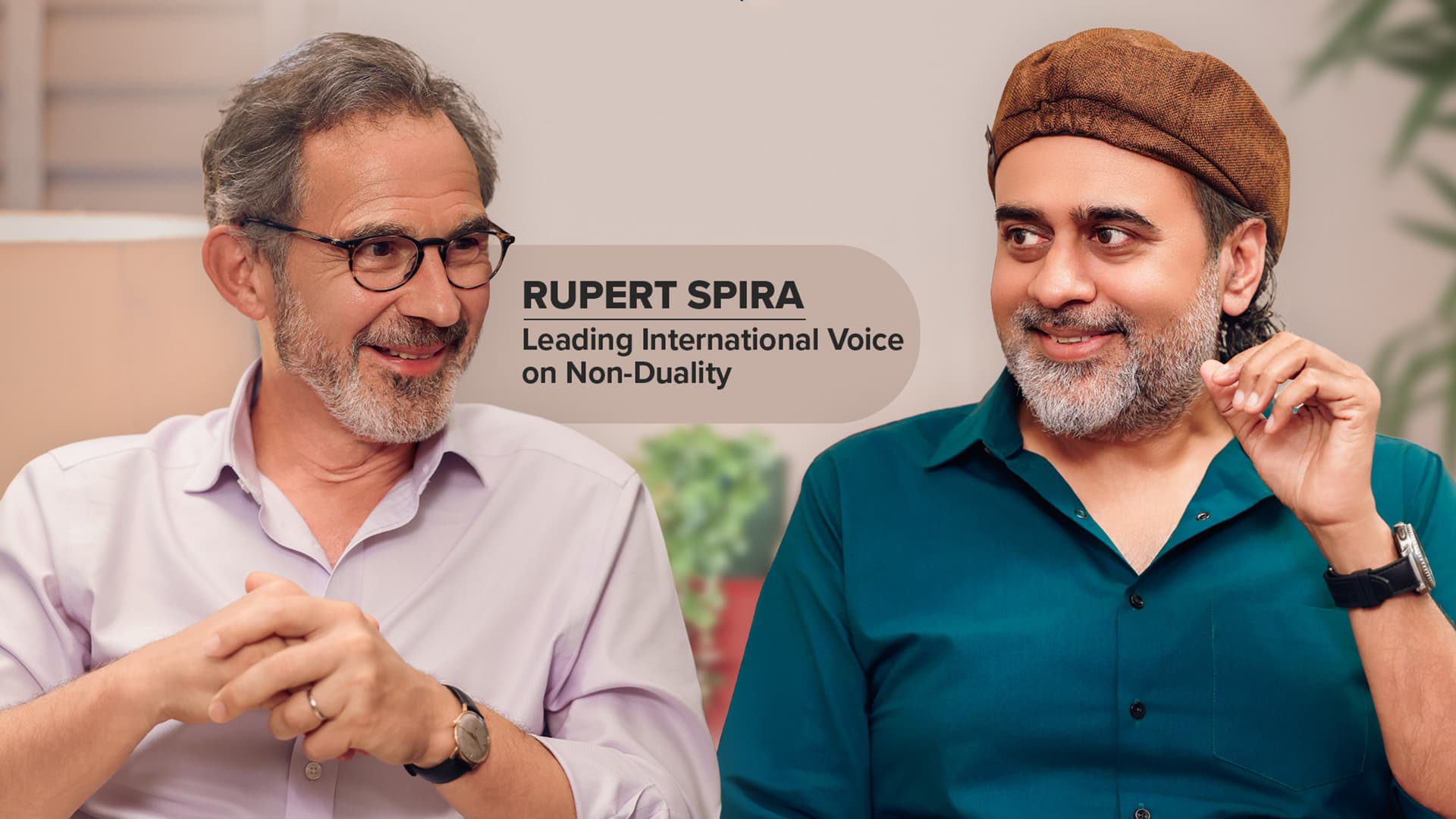
Philosopher and author Acharya Prashant and Rupert Spira, a popular teacher of non-duality in the West, held a public dialogue in London on Tuesday on suffering, the self, and the meaning of non-duality. The moderated conversation brought together two speakers who have approached the same question from opposite ends: what a person actually is beneath the story they have been told about themselves.
Spira opened by locating the human problem in suffering on the inside and conflict on the outside. Both, he said, follow from what he called the paradigm of separation. He offered the non-dual understanding as an alternative, summarising it in a single line: “peace and happiness are the nature of our being, and we share our being with everyone and everything.”
Acharya Prashant agreed with the diagnosis but shifted its centre. The problem, he said, is not suffering but the sufferer. “The sufferer is the problem,” he said. “The sufferer is the ego.” He described the ego as an entity with two universes to hide in, the external world of objects and the internal world of spiritual concepts, and cautioned that lofty words such as truth, liberation and enlightenment can become fresh places for the sufferer to conceal itself. “Truth is food to the ego,” he said.
The two diverged most clearly on the nature of awareness. Spira described awareness as unconditioned, ever present and changeless, the one self that all beings share. Acharya Prashant declined to grant awareness that standing without inquiry. He said the only entity that ever declares “I am” is the ego. His preferred method was self-knowledge, what the Indian tradition calls adhyatma, the honest observation of the ego by itself. “The seer does not survive the seeing,” he said.
The conversation turned more personal on why philosophical seeking so often fails to end. Acharya Prashant drew a distinction between immersion and intoxication. “Immersion is a thinning down of the self,” he said, describing intoxication, by contrast, as the self growing heavier. Entertainment, money, power, travel and endless shopping, he said, are intoxicants that briefly relieve the seeker without touching the source of the seeking, and he linked this pattern directly to the environmental crisis: “this cult of happiness is what is destroying the planet.”
The dialogue closed on a note of agreement. Spira offered a summary line that both speakers repeated back to each other: “No questioner, no teaching.” Acharya Prashant answered it with a phrase from the Zen tradition: “No moon, no lake.”
“The sufferer is the problem. The sufferer is the ego. The seer does not survive the seeing.”Acharya Prashant, with Rupert Spira
View full media coverage →
For media enquiries: Dr. Anupam Chatterjee · [email protected] · +91 93165 46673