Queen Mary University of London · London
Dialogue·7 July 2026
At Queen Mary University of London, Acharya Prashant and Prof. Lars Chittka Discuss Ego and the Roots of the Ecological Crisis
A wide-ranging conversation that moved from the inner life of bees to the human ego and the origins of the climate crisis.
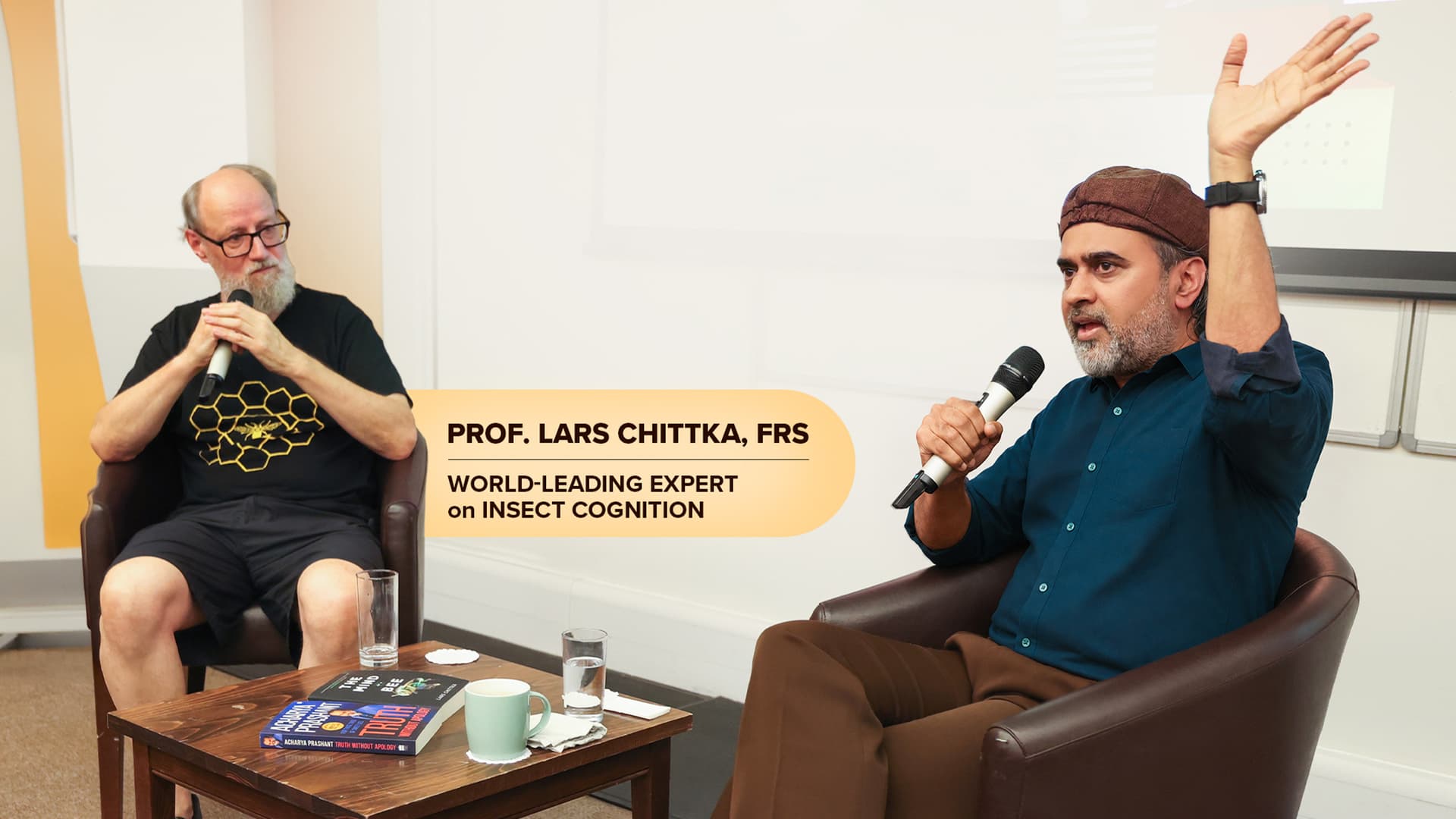
The Queen Mary University of London hosted a dialogue between philosopher and author Acharya Prashant and Professor Lars Chittka FRS, in a wide-ranging conversation that moved from the inner life of bees to the human ego and the origins of the climate crisis. The exchange drew students, researchers and members of the public, who applauded repeatedly as the two speakers built on, and at times gently questioned, each other’s positions.
Professor Chittka is Professor of Sensory and Behavioural Ecology at Queen Mary University of London and founder of its Research Centre for Psychology. His book ‘The Mind of a Bee’ argues that bees are capable of learning, counting, tool use, basic emotion and possibly a form of consciousness. Opening the conversation, he asked what Acharya Prashant had found compelling in the research on bees. Acharya Prashant replied that curiosity about other species is common, but selfless curiosity is rare. “What is rare is selfless curiosity in the other.” He argued that most discovery is eventually appropriated by the ego, which he described as “the master exploiter.”
Acharya Prashant argued that no other species pollutes, litters, or drives itself towards extinction, and that the planet has always been well without human intervention. “Give me one problem on the planet that is not man-made,” he said. He located the difference not in human biology, which he said is almost entirely shared with animals, but in what he called the psychological self, or ego, an error unique to the species.
Much of the dialogue turned on the nature of violence. Acharya Prashant maintained that animals are not violent, because violence requires a psychological choice that a predator acting on physical need does not possess. “Violence exists only when there is a psychological choice available,” he said, drawing a distinction between a lion that hunts to eat and a human being who kills for a trophy. He cautioned against anthropomorphising, arguing that the human problem is not killing itself but a psychological emptiness that no amount of killing or accumulation can fill.
That emptiness, he said, is what drives a person to pursue a fortune long past any physical need, and what he described as the 3 AM loneliness felt even by those who appear to have everything. Asked how his message differed from the charity taught by the world’s religions, he said all religion is addressed to the human being alone, because only the human being carries the suffering ego, and that the true purpose of every religion is the dissolution of that self rather than a set of rituals and commandments.
Asked whether the world might benefit from more figures like him, he said the aim was not emulation but subtraction. “You un-become who you are,” he told the questioner, describing the entire process as one of demolition rather than acquisition. “Good things happen on their own when the source of evil is challenged,” he said, “and that resides within each one of us.”
“Give me one problem on the planet that is not man-made.”Acharya Prashant, at Queen Mary University of London
View full media coverage →
For media enquiries: Dr. Anupam Chatterjee · [email protected] · +91 93165 46673