Watkins Books · London
Address·8 July 2026
Acharya Prashant Signs Books at Watkins, London's Oldest Philosophy Bookshop
Watkins Magazine recently placed Him in the Top 20 of its Most Spiritually Influential People list.
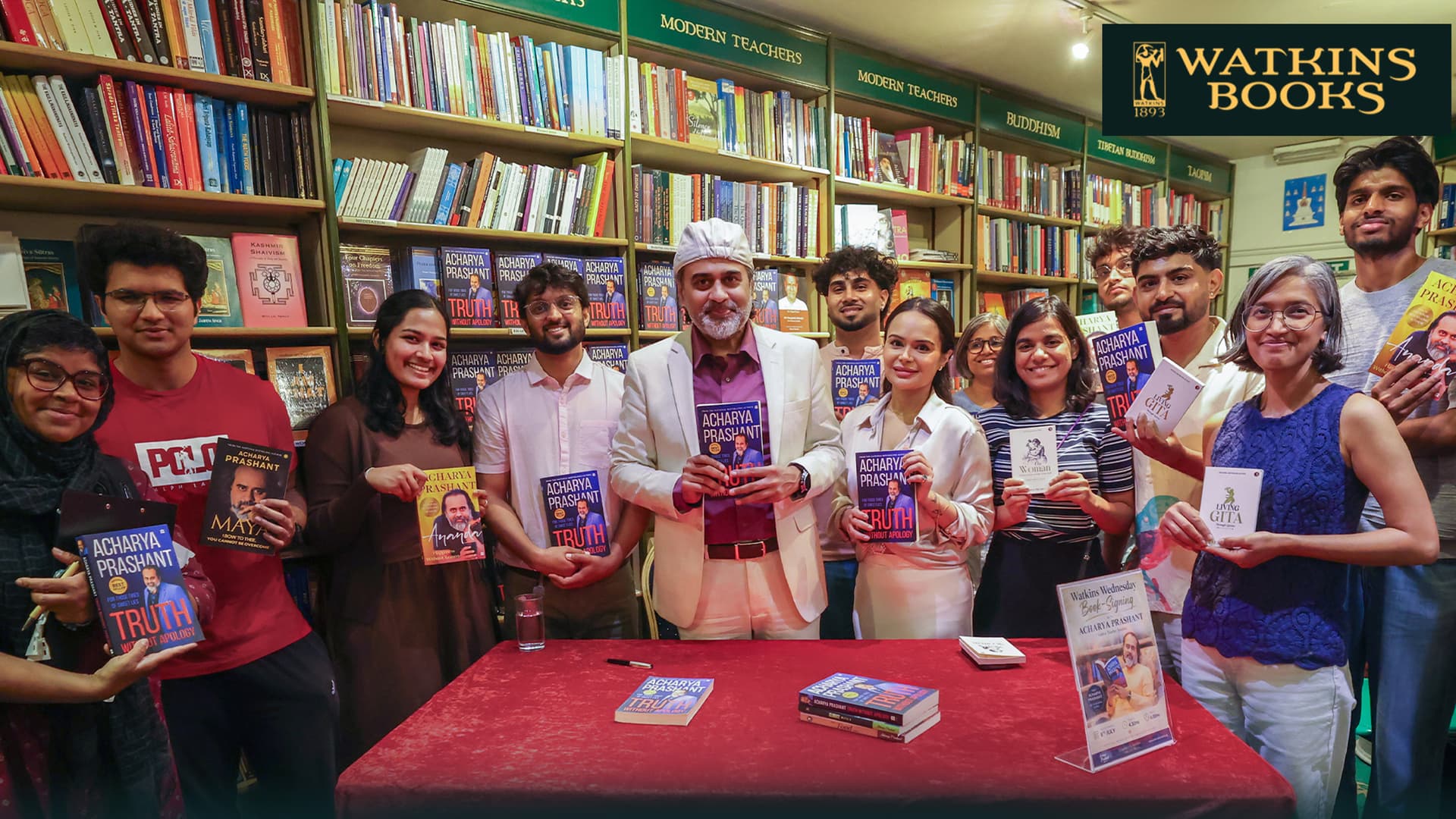
Philosopher and author Acharya Prashant spent an evening at Watkins Books in central London on Wednesday, signing copies of his books and taking questions from readers, in a session that turned from the practical difficulties of work and belonging to the older philosophical problem of whether the will is free at all.
Watkins stands on Cecil Court, a short pedestrian lane off Charing Cross Road in the West End that is lined end to end with antiquarian booksellers. Founded more than 130 years ago and long specialising in philosophy and Indian thought, the shop has been a fixture of London's intellectual life since the era when W.B. Yeats and Carl Jung were among those who frequented it. Acharya Prashant, an alumnus of IIT Delhi and IIM Ahmedabad and founder of the PrashantAdvait Foundation, was featured in the Watkins 2026 list of the world's most influential living thinkers. The magazine's managing editor presented him with a copy of the issue during the visit and invited him to return for a talk of his own choosing, an invitation Acharya Prashant said he hoped to take up as a reader first.
Readers had queued down the shop floor with books to be signed, some of them long-held copies, others bought that evening. One buyer took several at once, saying it was the best gift she could think of. Another said she had come at her mother's insistence, having missed the earlier London sessions. When the signing ended, the gathering assembled between the shelves for a photograph, books held up.
Much of the evening was given to unscripted exchange. A reader who described feeling unable to belong in her workplace, and asked where courage comes from when one stands apart, was met with a challenge to the premise itself. Acharya Prashant argued that what is commonly called belongingness is rarely physical and rarely even relational, but is the ego seeking shelter in numbers. "Right company is where you are shown the mirror," he said. "If instead of being shown the mirror, you are shown your own decent, edited, filtered portrait, then that's disservice, not companionship."
He extended the point to the language of comfort, which he characterised as a statement that ends inquiry rather than beginning it. Relationships, he said, do not require the obligation to belong, and can be both lasting and deep without it.
A second questioner, a young entrepreneur weighing a corporate offer against her own ambitions, described a fire within her that she feared losing. Acharya Prashant declined the framing. Asked to state the ambition without metaphor, the questioner arrived, under questioning, at the admission that her desires had been formed by what she had seen around her. "Even the desiring self is not your own," he said. "If my goal is not mine, then even if the goal is achieved, the success belongs to somebody else."
He drew a distinction between entrepreneurship as a word, which means arriving at something new, and entrepreneurship as it is practised, which he described as inherited ambition in fresh vocabulary. The genuinely new, he suggested, lies elsewhere. "Spirituality is the business of newness," he said. "All else is simply camouflage and a change of names, shapes, costumes."
A further exchange took up the claim that certain appetites are simply physical and therefore beyond question. Acharya Prashant's contention was that physical needs are by definition finite, since the body is finite, and that any appetite presenting itself as limitless has therefore misdescribed itself. On his account, the intellect is competent to address every genuinely material problem, food, shelter, clothing, movement, and is powerless against a psychological vacancy that no object can fill. He applied the argument to overconsumption of food and to meat eating, contending that the body neither requires flesh nor benefits from it, and that what requires it is habit and culture rather than physiology. That position on diet is one he has advanced consistently and one on which he remains at odds with substantial bodies of nutritional and cultural opinion.
The session closed on free will, a question he located within the philosophy of mind rather than outside it. Asked about the neuroscientific literature suggesting that free will is illusory, he objected that the debate proceeds without settling whose freedom is at issue. "They are simply saying there is free will or that there is no free will without caring to ask whose free will," he said. His own formulation was that free will is will free of the ego, and that the question therefore has no general answer. "If you are free, your will is free. If you are unfree, your will is unfree."
Reflecting afterwards on the visit, he returned to the shelves themselves. A great book, he said, does not fill the reader with knowledge but empties the reader of the ego, and knowledge that fortifies rather than dissolves the self has been put to the wrong use. Asked what he would take home from the shop, he said the entire bookstore.
The Watkins session was one of several public engagements during Acharya Prashant's 2026 United Kingdom visit. The programme included a dialogue at University College London with Professor Steve Fleming of the UCL Institute of Cognitive Neuroscience, an exchange with Professor Lars Chittka of Queen Mary University of London, a session at the London School of Economics with Professor Jonathan Birch, Director of the Jeremy Coller Centre for Animal Sentience, and conversations with the Cambridge-trained biologist Rupert Sheldrake, Rupert Spira, and the psychologist Dr Melanie Joy.
View full media coverage →
For media enquiries: Dr. Anupam Chatterjee · [email protected] · +91 93165 46673