St Giles in the Fields · London
Public Session·8 July 2026
The Gita Under a Church Roof: Acharya Prashant Conducts Bhagavad Gita Session at St Giles-in-the-Fields, London
A session on Chapter 3 of the Srimad Bhagavad Gita ran close to three hours at a central London church where a place of worship has stood since 1101
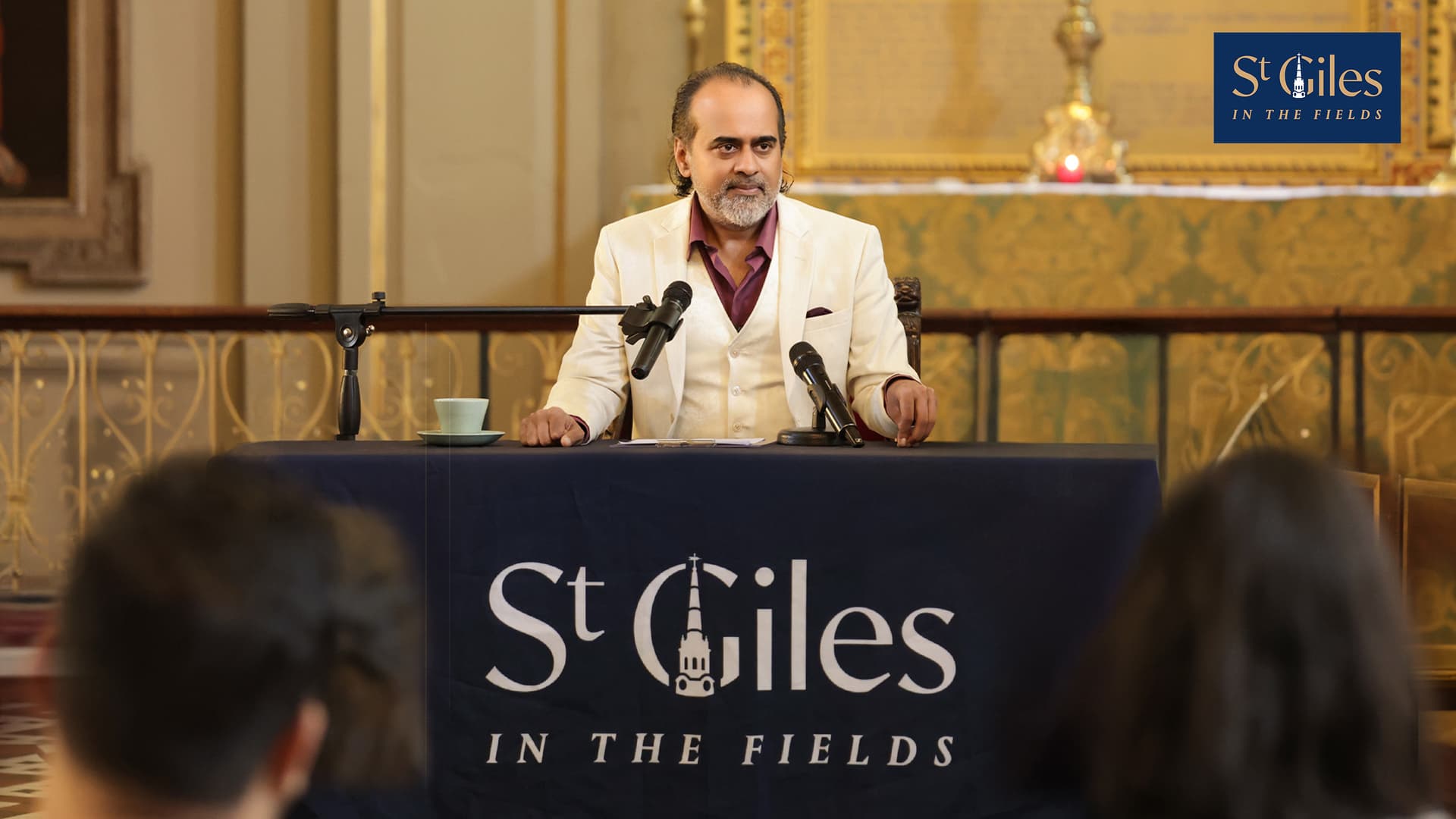
Philosopher and author Acharya Prashant conducted a session on the Srimad Bhagavad Gita at St Giles-in-the-Fields, one of central London's oldest parish churches, on the afternoon of 8 July. He took up Chapter 3, Verse 32, and the session ran close to three hours before a full hall. A place of worship has stood on the site since 1101, and the church has long been associated with the missionary enterprise that carried Christianity across the world.
Acharya Prashant said the setting called first for courtesy. "The first thing we should do is humbly thank the church management," he said, adding that a failure to do so would put a question mark on one's own decency. He said the fact that a Gita session could be held in a church of that history was no scoreboard. "This is not a matter of victory. It is a matter of truth, a matter of honesty."
Religion can certainly try to win people over and convert them, he said, and much of what has been done in the name of religion, particularly by the evangelical faiths, has taken that form. But every religious stream that reaches maturity is eventually compelled to recognise that its work is internal. It cannot be the business of religion, he said, to gather a crowd and announce that it has seven thousand followers while another has five hundred, and is therefore the greater. Symbols, flags, colours, rituals and myths all belong to the outer layer. "The very definition of religion is the dissolution of the ego. There is no other definition," he said. "Self-knowledge sits at the centre of religion, and where there is no self-knowledge, there is no religion." Distorted religion, which he calls lokdharma, may flourish and grow fat for a while, but he said it has neither future nor foundation without self-knowledge.
Inside the church, he pressed the same point using the light coming through the windows. The sun then standing overhead in London, he observed, had already set in India. "So is there a difference between the suns? No. The difference is in the watcher." Krishna, in his reading, is not a personality but an impersonal principle, and that principle is the dissolution of the ego. Any teaching that leads there is a Krishna teaching, he said, and any book that helps dissolve the ego is the Gita. He noted that the Bhagavad Gita is itself counted as an Upanishad, that several works have been called the fifth Veda, and that the same element can be found in the writings of Lao Tzu.
The verse under discussion, 3.32, describes those who are deluded about all knowledge, devoid of consciousness, invested in cavil, and who do not honour Krishna's philosophy. It is routinely read as a warning about future consequences, and Acharya Prashant told the hall that this reading is mistaken. "Sri Krishna is not delivering a sentence. He is not reading out a verdict," he said. "He is reading out the news." The punishment, he argued, arrives before the action rather than after it, and before its consequences. "Please tell me what comes first, the theft or the thief? The thief, that is the punishment." Popular religion holds that a person is punished for what he does, he said, while the Gita holds that he is being punished for what he is. No external judge is required, since the ego is self-referential and delivers the verdict upon itself.
Questions from the floor took in conditioning, self-observation and morality. Asked how right and wrong can be settled when they vary across cultures and countries, he said morality is social opinion, and that the prevailing opinion of the day becomes the morality of the time and the place. He suggested that the more useful question concerns the state of the actor, since clarity tends to leave very few options open. "From the place of light, what you would usually find is just one option."
He was careful to say that none of it comes without the listener's own effort. "Krishna is not an intruder. He won't break in. He'll wait at the door," he said, adding that whether or not the door is opened remains the listener's own choice.
Positions of this kind have not gone unchallenged. Acharya Prashant's argument that self-knowledge is the sole legitimate core of religion, and his description of ritual and symbol as peripheral, sits uneasily with devotional and congregational understandings of faith across several religions, including strands within Hinduism itself, where worship and community are held to be constitutive rather than incidental. He has said on earlier occasions that he does not intend disrespect to any form of practice, but that inwardly no form deserves a sacred place unless it works towards self-dissolution.
The session was followed by a book signing at Watkins Books, a short walk away, where readers queued for signed copies.
The engagement formed part of Acharya Prashant's UK tour, which included the Cambridge Union, Oxford, the House of Lords, Queen Mary University of London, the London School of Economics, PETA's London office, and a closing public dialogue with the cognitive neuroscientist Professor Steve Fleming at University College London on 9 July.
Acharya Prashant is an alumnus of IIT Delhi and IIM Ahmedabad and the founder of the PrashantAdvait Foundation. Drawing on wisdom literature from India and the world in an inquiry directed at the nature of the self, his work reaches more than 100 million people across social media. He was featured in the Watkins 2026 list of the world's most influential living thinkers.
View full media coverage →
For media enquiries: Dr. Anupam Chatterjee · [email protected] · +91 93165 46673