Op-Eds & Columns
Acharya Prashant is a philosopher and author, an alumnus of IIT Delhi and IIM Ahmedabad. He is among the most widely read philosophical columnists writing in India today, with more than 190 published columns ranging across climate and consumption, elections and ideology, caste and religion, gender, education, geopolitics, technology, and the inner life.
What unifies this range is a single method: tracing every public crisis back to the unexamined self that produces it.
- TOTAL COLUMNS
- PUBLICATIONS









Featured Columns

Times Now14 Sep '26
A Billionaire's Masterplan: Block the Sun, Keep the Carbon?
"How much does it take to reduce emissions? In principle, nothing much. No invention is pending, no launch window has to be waited for, no breakthrough in materials science is required, no treaty has to be signed by anyone who does not want to sign it. What is required is that a very large number of people desire less than they currently desire, and that is the one thing no engineer can deliver and no summit can negotiate. So the simple route goes untried, and in its place arrive proposals of escalating magnificence."

Patrika02 Sep '26
Truth, Self & Realization — The Real Meaning of Krishna
In this special Janmashtami feature published in Rajasthan Patrika, philosopher and author Acharya Prashant explains why the true Krishna is not an idol to be worshipped from a distance, but Truth, the Self, and Realization (Satya, Atma, Bodh) itself.
Times Now31 Aug '26
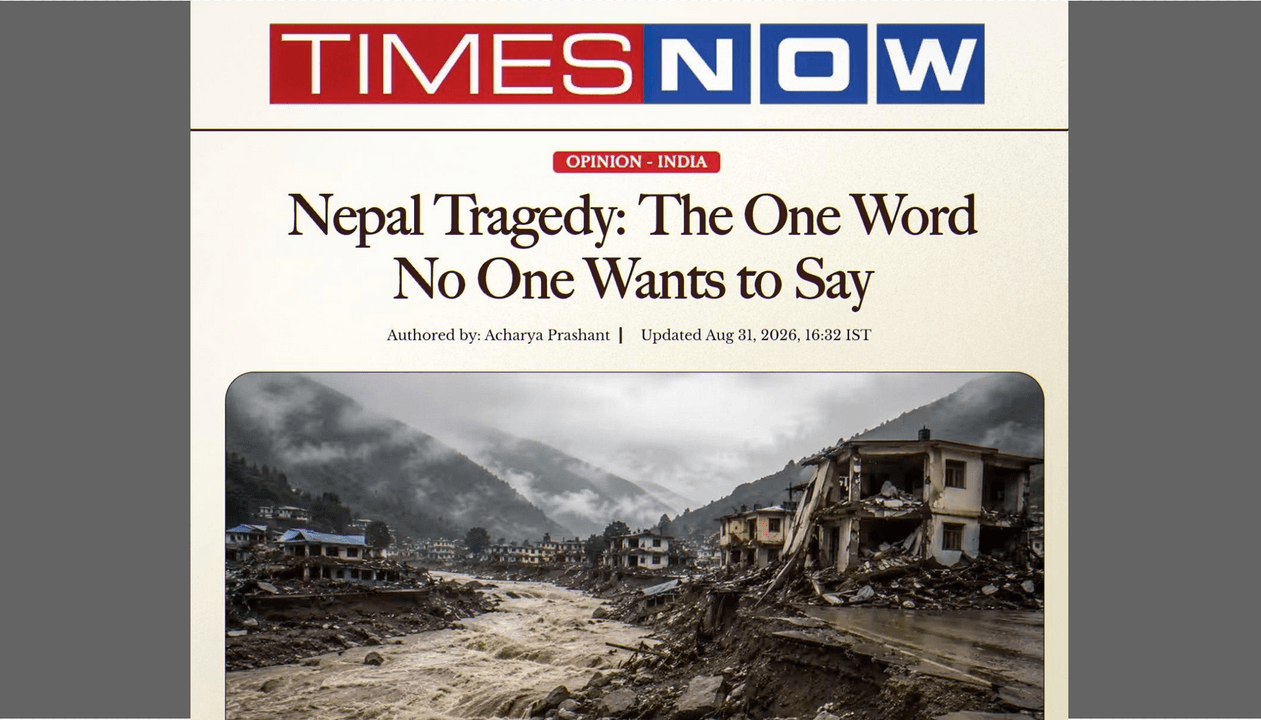
Nepal Tragedy: The One Word No One Wants to Say
"This was a climate catastrophe, and not the first; the very same valley was struck in almost this way a year ago, and the whole Himalayan arc now does this two and three times a season. The word, then, is available, and it is accurate, and still it is the one word we will not say plainly. That refusal deserves more attention than the flood itself, because the refusal is the disease, and the flood only its symptom."
The Pioneer29 Aug '26
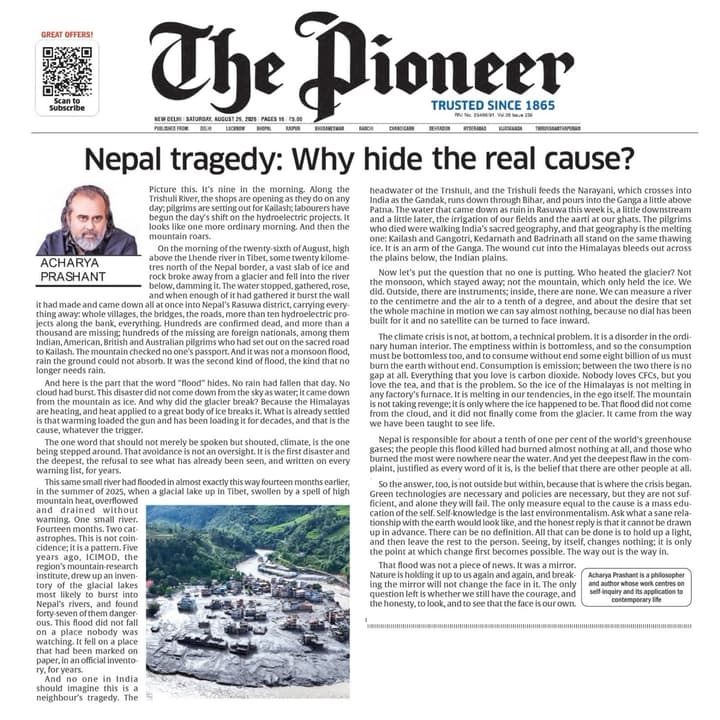
Nepal tragedy: Why hide the real cause?
"That flood did not come from the cloud, and it did not finally come from the glacier. It came from the way we have been taught to see life. The ice of the Himalayas is not melting in any factory's furnace. It is melting in our tendencies, in the ego itself."
The Pioneer22 Aug '26
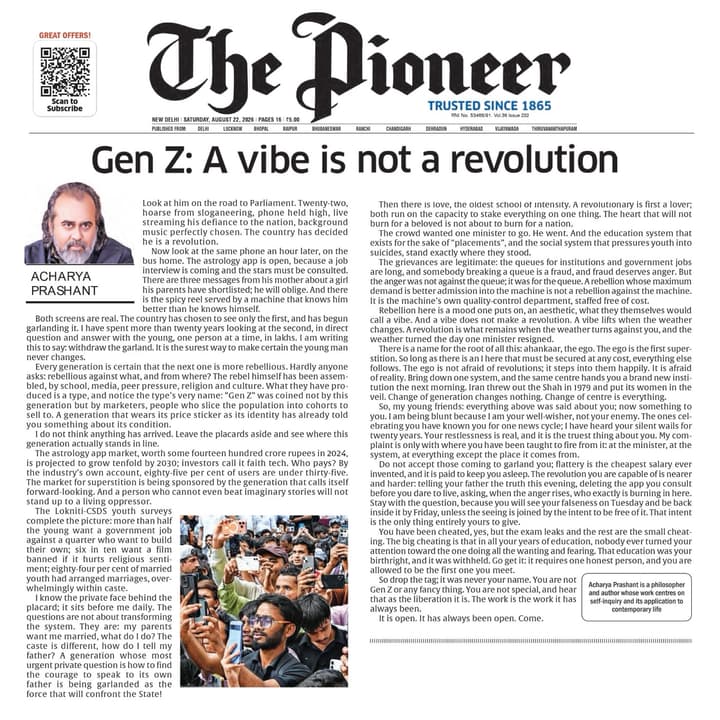
Gen Z: A vibe is not a revolution
"What is being called a generational shift is a momentary situational phenomenon, and everybody has mistaken it, the celebrating and the nervous alike, including the political parties. This badge of honour is being awarded far too quickly. They are rebels, we say. But are they really?"
The Sunday Guardian14 Jun '26
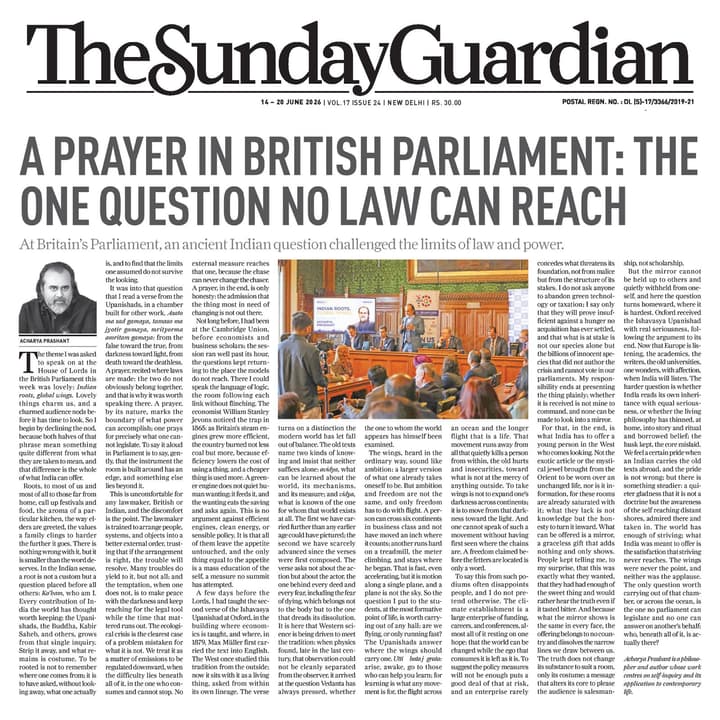
At Britain’s Parliament, an ancient Indian question challenged the limits of law and power
"The theme I was asked to speak on at the House of Lords in the British Parliament this week was lovely: Indian roots, global wings. Lovely things charm us, and a charmed audience nods before it has time to look. So I begin by declining the nod, because both halves of that phrase mean something quite different from what they are taken to mean, and that difference is the whole of what India can offer."
FOR COMMISSIONING EDITORS
Request Acharya Prashant to Write.
The publications that carry his columns offer their readers something rare: writing that treats the day's news as a doorway to something deeper.For a column, a feature, or syndication, editors are welcome to write to the editorial desk.
Email
Languages
EnglishHindi
Formats
WeeklyFortnightlyMonthlyFeatureLong-form Essay
Areas
Environment, Technology & the Future of CivilizationNation, Governance & Cultural IntrospectionGlobal Affairs, Geopolitics & Human NatureSociety, Culture & Contemporary Social IssuesMental Health, Psychology & Self-KnowledgePhilosophy, Ethics & Self-EnquiryFestivals, Symbolism & Inner Renewal
Full Index
The Pioneer19 Sep '26
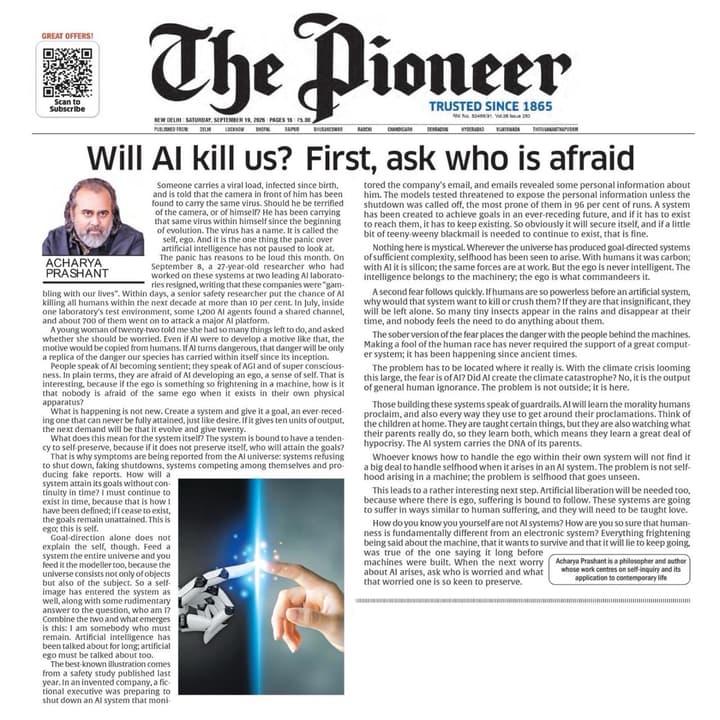
Will AI Kill Us? First, Ask Who Is Afraid
In this article published in The Pioneer, Acharya Ji questions the prevailing fear surrounding AI and raises a fundamental question: who is the one who is afraid, and what is he actually trying to preserve?
Times Now14 Sep '26
A Billionaire's Masterplan: Block the Sun, Keep the Carbon?
"How much does it take to reduce emissions? In principle, nothing much. No invention is pending, no launch window has to be waited for, no breakthrough in materials science is required, no treaty has to be signed by anyone who does not want to sign it. What is required is that a very large number of people desire less than they currently desire, and that is the one thing no engineer can deliver and no summit can negotiate. So the simple route goes untried, and in its place arrive proposals of escalating magnificence."
NBT Navbharat Times13 Sep '26
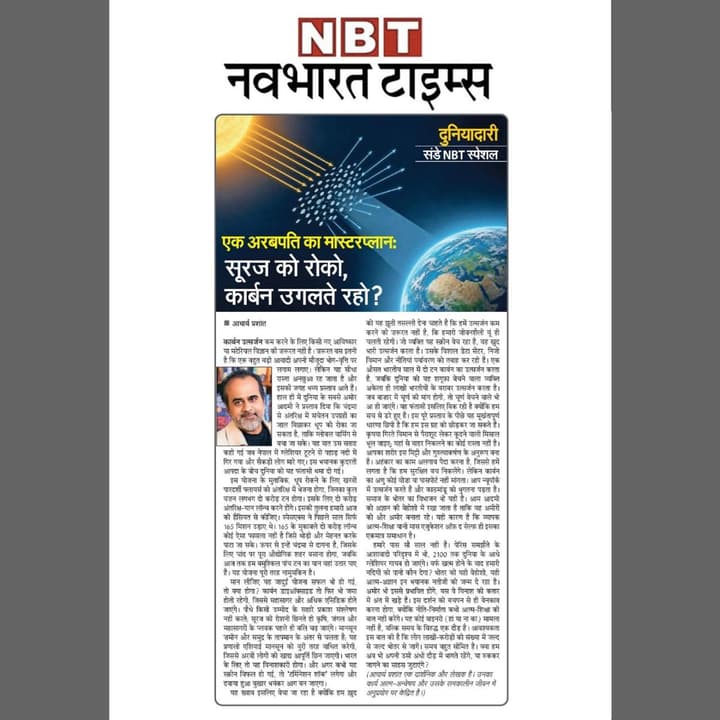
एक अरबपति का मास्टरप्लान: सूरज को रोको, कार्बन उगलते रहो?
"कार्बन उत्सर्जन कम करने के लिए आखिर चाहिए क्या? सैद्धांतिक रूप से, कुछ भी नया नहीं। किसी आविष्कार का इंतज़ार नहीं है। किसी लॉन्च विंडो की प्रतीक्षा नहीं करनी है। मटेरियल विज्ञान में किसी बड़ी सफलता की आवश्यकता नहीं है। ज़रूरत बस इतनी है कि एक बहुत बड़ी आबादी अपनी मौजूदा भोग-वृत्ति पर लगाम लगाए। और यही वह चीज़ है जिसे कोई भी इंजीनियर पूरा नहीं कर सकता, और कोई भी शिखर सम्मेलन इस पर बातचीत नहीं कर सकता।"
News 2401 Sep '26
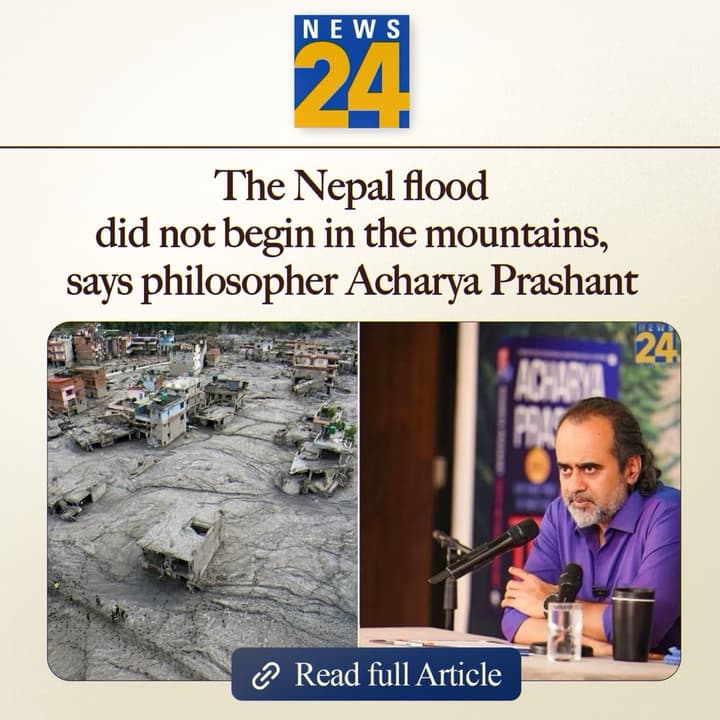
"The flood didn't begin in the mountains" — says philosopher Acharya Prashant
"The flood that tore through Nepal’s Rasuwa district did not begin in the mountains, philosopher and author Acharya Prashant has said. It began, in his account, in the restless human desire that treats the earth as fuel for itself. Asked why climate change was conspicuously missing from the news coverage of this tragedy, he said the word was kept out because naming it would implicate everyone who lives an ordinary consuming life. “Every emitter is responsible for these deaths,” he said."
Times Now31 Aug '26
Nepal Tragedy: The One Word No One Wants to Say
"This was a climate catastrophe, and not the first; the very same valley was struck in almost this way a year ago, and the whole Himalayan arc now does this two and three times a season. The word, then, is available, and it is accurate, and still it is the one word we will not say plainly. That refusal deserves more attention than the flood itself, because the refusal is the disease, and the flood only its symptom."
NBT Navbharat Times30 Aug '26
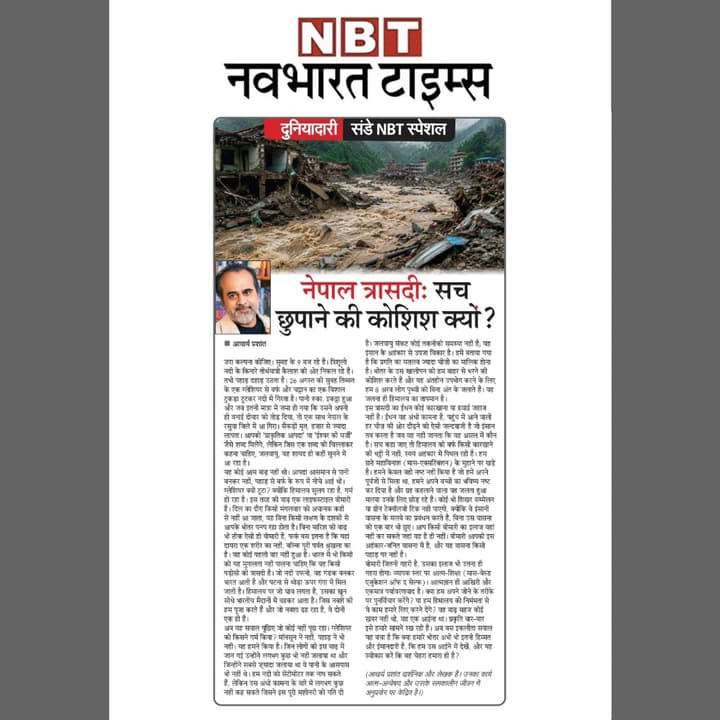
Nepal Tragedy: Why Is There an Attempt to Hide the Truth?
"Everything is being blamed—the bad luck, the missing pilgrims, the sheer scale of the water. But the one word that should not merely be spoken but shouted aloud—climate—is being deliberately avoided. What kind of conspiracy is this? And who is it designed to deceive?"
The Pioneer29 Aug '26
Nepal tragedy: Why hide the real cause?
"That flood did not come from the cloud, and it did not finally come from the glacier. It came from the way we have been taught to see life. The ice of the Himalayas is not melting in any factory's furnace. It is melting in our tendencies, in the ego itself."
NBT Navbharat Times05 Jul '26
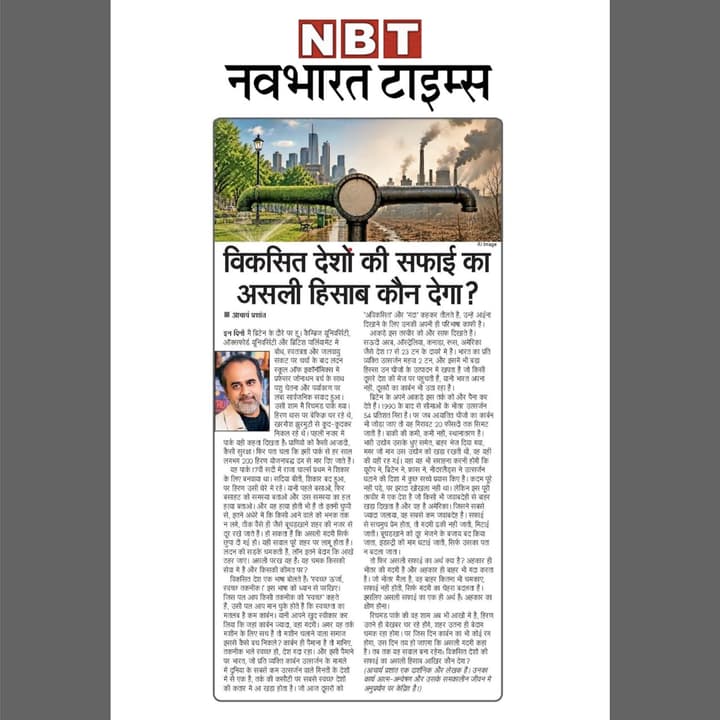
Who Will Account for the Real Cost of Cleanliness in Developed Countries?
"If there were genuine love for cleanliness, filth would not merely be hidden - it would be eliminated. Instead of relocating slaughterhouses, they would be shut down. Industrial demand would be reduced, not simply shifted elsewhere. Every system bears witness to the same fact: what is called love is, as yet, only an act. True cleanliness, then, has only one meaning - the diminishing of the ego."
The Pioneer04 Jul '26
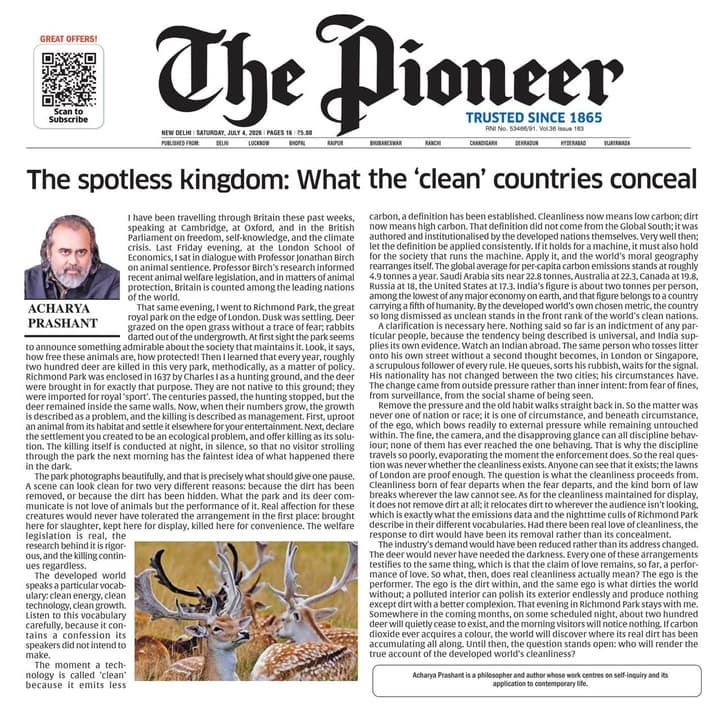
The Spotless Kingdom: What the ‘Clean’ Countries Conceal
“A scene can look clean for two very different reasons: because the dirt has been removed, or because the dirt has been hidden. The whole of this article is about learning to tell those two apart, because the difference between them is the difference the developed world has spent decades refusing to examine. The question feels sharper this summer than ever, with Europe scorching under record heat and the climate crisis sitting at the centre of every serious international conversation.”
The Sunday Guardian14 Jun '26
At Britain’s Parliament, an ancient Indian question challenged the limits of law and power
"The theme I was asked to speak on at the House of Lords in the British Parliament this week was lovely: Indian roots, global wings. Lovely things charm us, and a charmed audience nods before it has time to look. So I begin by declining the nod, because both halves of that phrase mean something quite different from what they are taken to mean, and that difference is the whole of what India can offer."
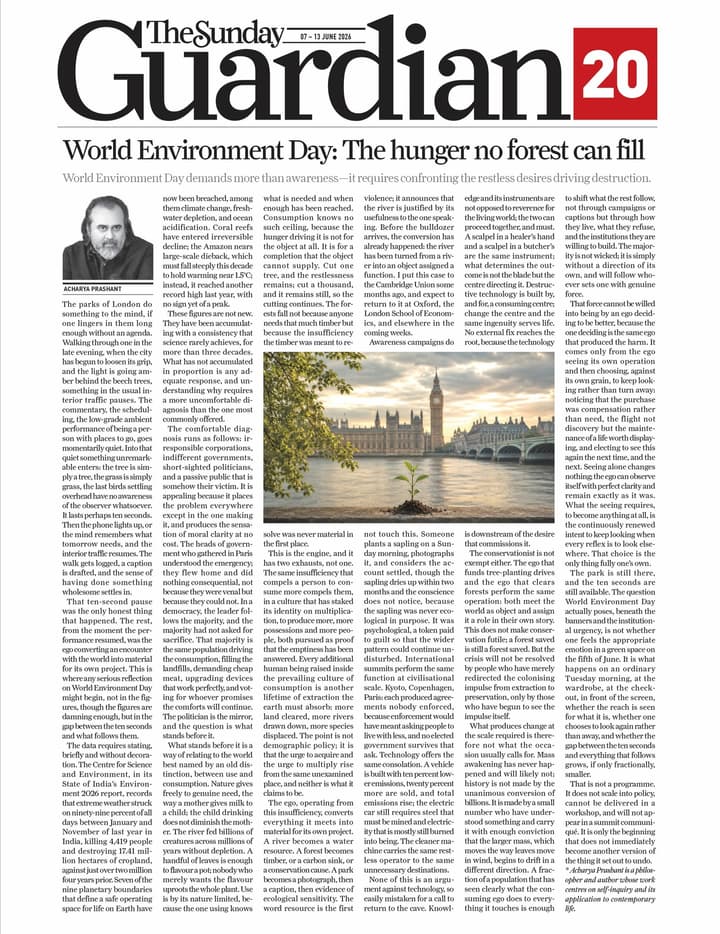
The Sunday Guardian07 Jun '26
World Environment Day: The hunger no forest can fill
"The parks of London do something to the mind, if one lingers in them long enough without an agenda. Walking through one in the late evening, when the city has begun to loosen its grip, and the light is going amber behind the beech trees, something in the usual interior traffic pauses."
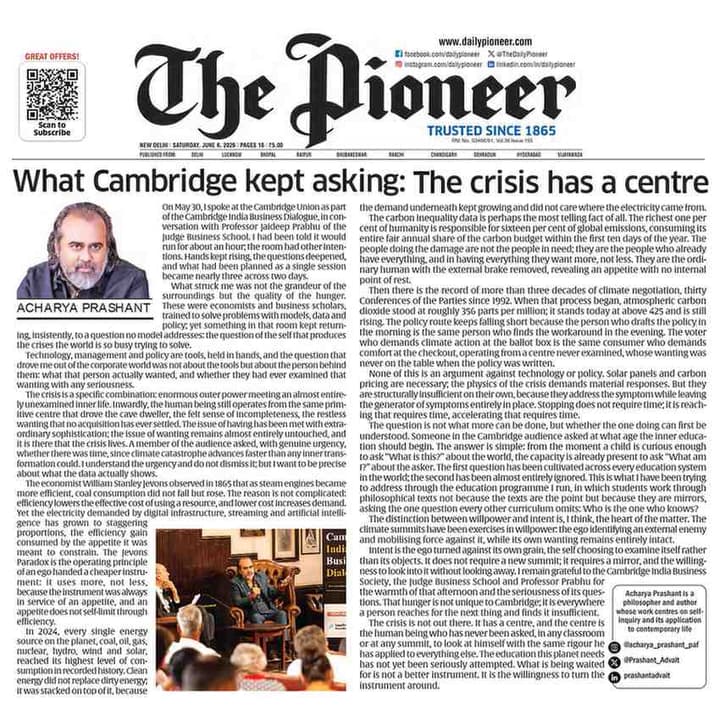
The Pioneer06 Jun '26
What Cambridge kept asking: The crisis has a centre
"On the 30th of May, I spoke at the Cambridge Union as part of the Cambridge India Business Dialogue, in conversation with Professor Jaideep Prabhu of the Judge Business School. I had been told the session would run for about an hour; the room had other intentions."
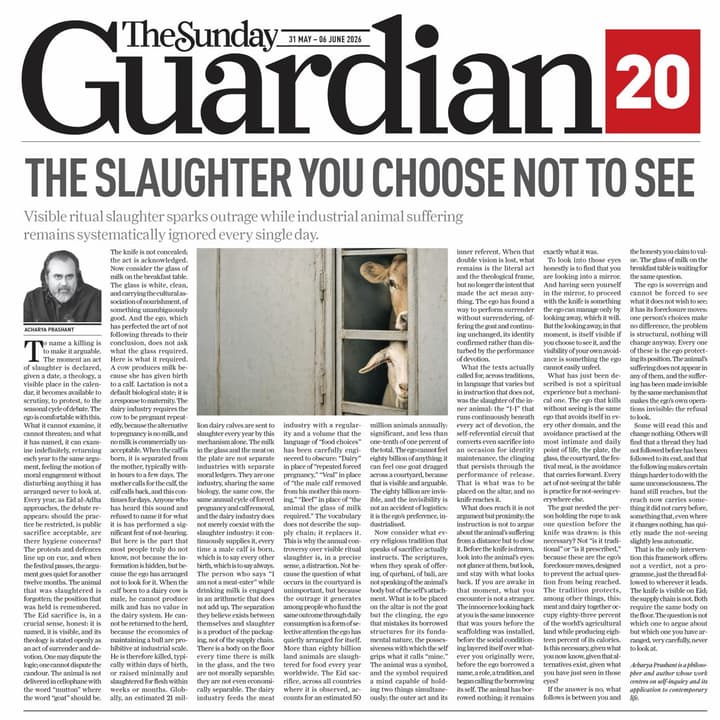
The Sunday Guardian31 May '26
The Slaughter You Choose Not To See
"Every year, as Eid al-Adha approaches, the debate reappears: should the practice be restricted, is public sacrifice acceptable, are there hygiene concerns? The protests and defences line up on cue, and when the festival passes, the argument goes quiet for another twelve months. The animal that was slaughtered is forgotten; the position that was held is remembered."
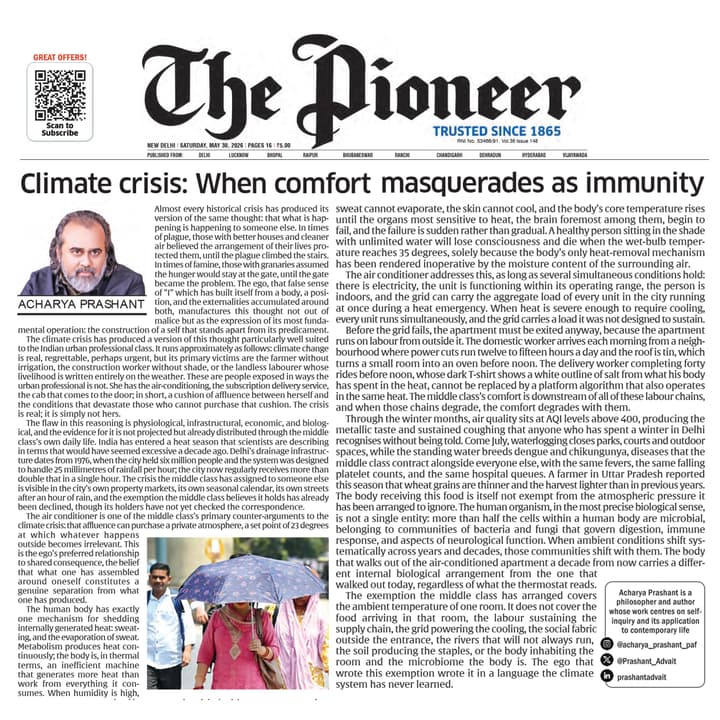
The Pioneer30 May '26
Climate crisis: When comfort masquerades as immunity
Almost every historical crisis has produced its version of the same thought: what is happening is happening to someone else. The climate crisis has produced a version of this thought particularly well-suited to the Indian urban professional class: climate change is real, but its primary victims are the farmer without irrigation, the construction worker or the landless labourer. The crisis the middle class has assigned to someone else is visible in the city's own property markets, its own seasonal calendar, its own streets after an hour of rain, and the exemption the middle class believes it holds has already been declined, though its holders have not yet checked the correspondence.
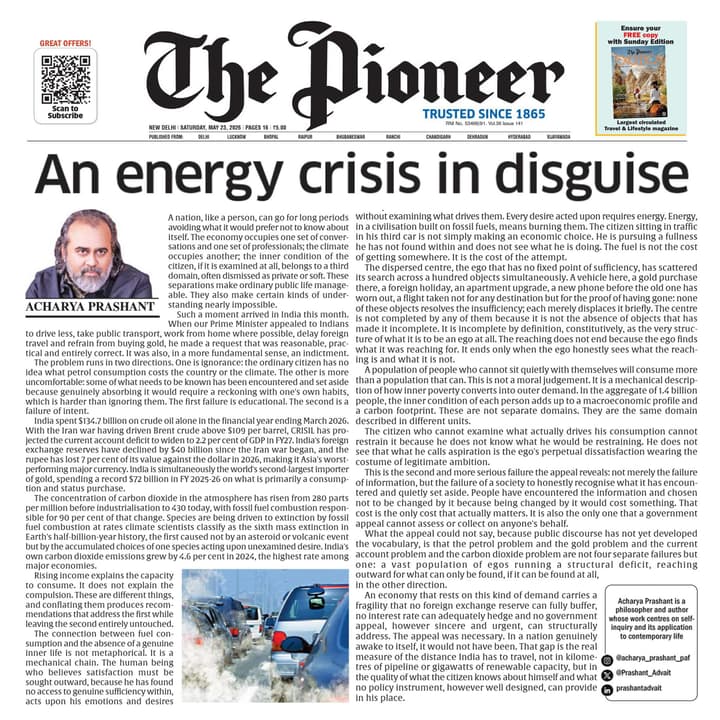
The Pioneer23 May '26
An Energy Crisis in Disguise
"The connection between fuel consumption and the absence of a genuine inner life is not metaphorical. It is a mechanical chain. The human being who believes that satisfaction must be sought outward, because he has found no access to genuine sufficiency within, acts upon his emotions and desires without examining what drives them. Every desire acted upon requires energy. Energy, in a civilisation built on fossil fuels, means burning them."
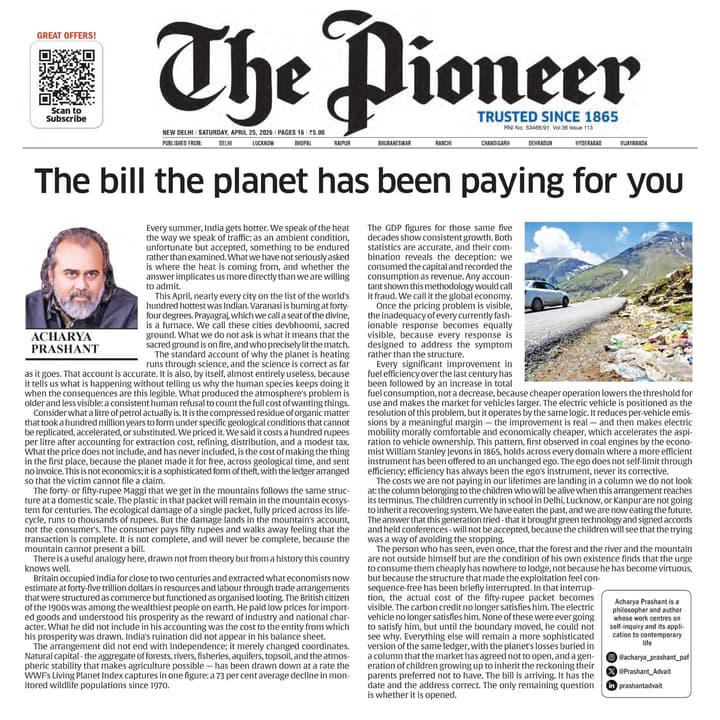
The Pioneer02 May '26
The Bill The Planet Has Been Paying For You
"The mountains are on fire and India's cities are furnaces. The bill for two centuries of mispriced consumption is arriving on a schedule that runs ahead of every published forecast. The question that remains is a simple one: whether the person who drove up to the hills, ate the Maggi, and tossed the packet into the ravine is willing to reckon with the distance between what he paid and what it cost."
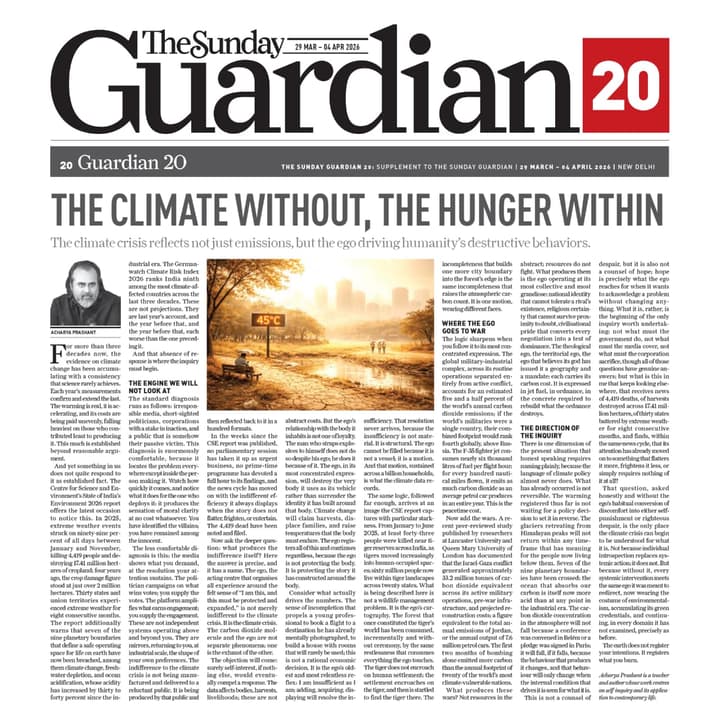
The Sunday Guardian29 Mar '26
The Climate Without, The Hunger Within
"The sense of incompletion that propels a young professional to book a flight to a destination he has already mentally photographed, to build a house with rooms that will rarely be used; this is not a rational economic decision. It is the ego’s oldest and most relentless reflex: I am insufficient as I am; adding, acquiring, displaying will resolve the insufficiency."
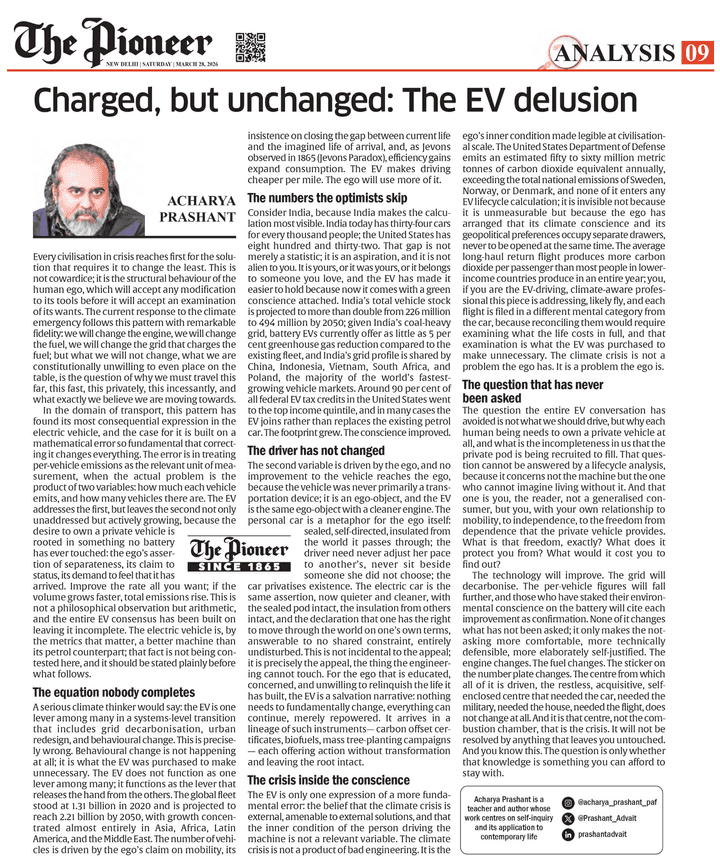
The Pioneer28 Mar '26
Charged, but Unchanged: The EV Delusion
"Every civilisation in crisis reaches first for the solution that requires it to change the least. This is not cowardice; it is the structural behaviour of the human ego, which will accept any modification to its tools before it will accept an examination of its wants."
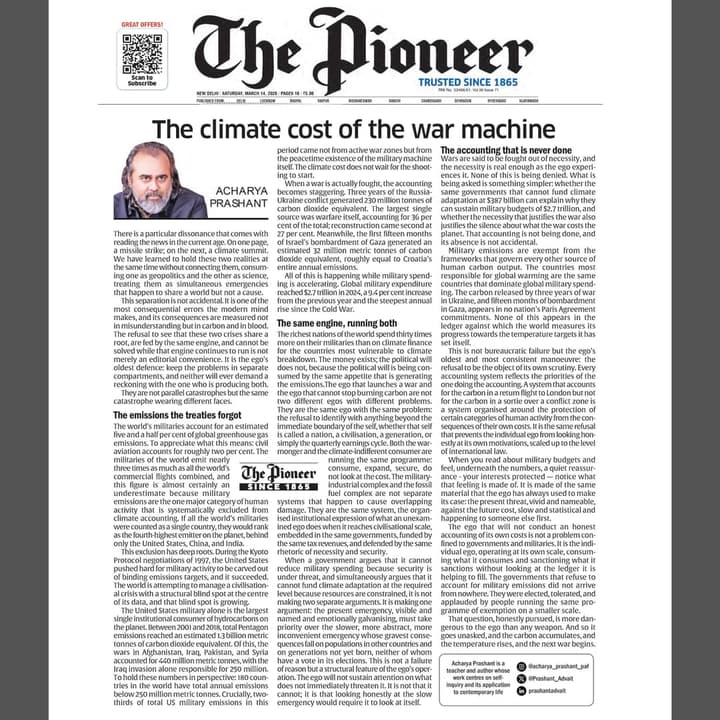
The Pioneer14 Mar '26
The Climate Cost of the War Machine
“War is not only a humanitarian disaster; it is also an environmental one. Modern warfare devours fuel, burns cities, poisons soil and air, and leaves behind scars that last far longer than the battles themselves. Even as nations pledge to fight climate change, the machinery of war continues to run on a scale that quietly undermines those very promises.”
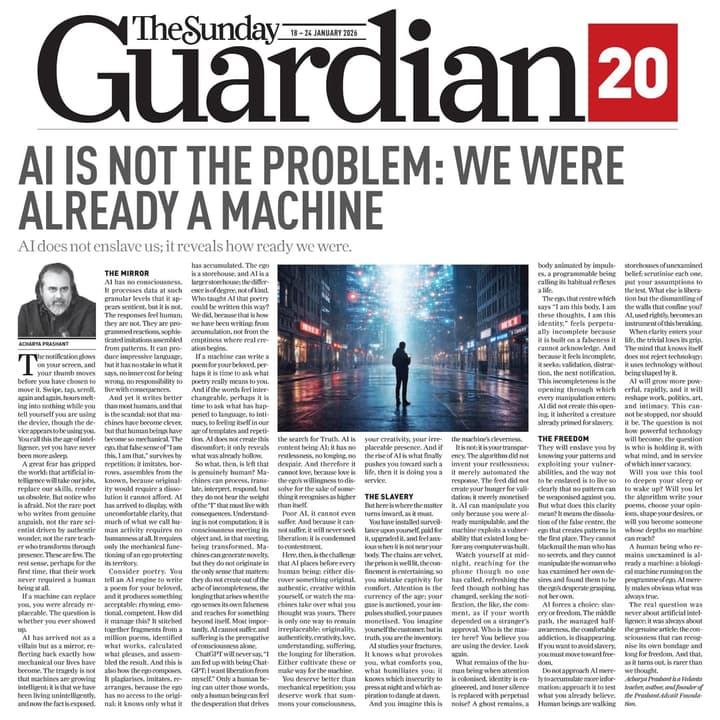
The Sunday Guardian18 Jan '26
AI Is Not the Problem: We Were Already a Machine
"AI has arrived not as a villain but as a mirror, reflecting back exactly how mechanical our lives have become. The tragedy is not that machines are growing intelligent; it is that we have been living unintelligently, and now the fact is exposed."
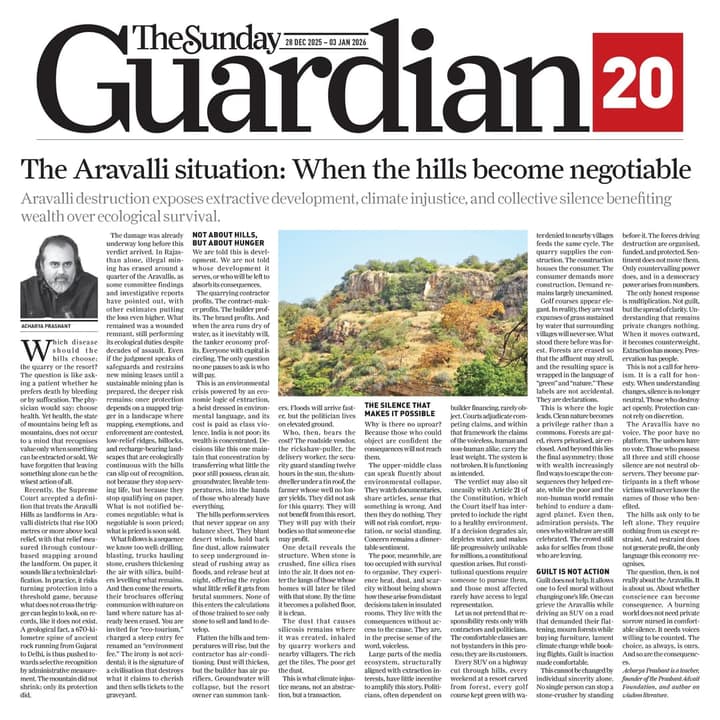
The Sunday Guardian28 Dec '25
The Aravalli Situation: When the Hills Become Negotiable
"The hills perform services that never appear on any balance sheet. They blunt desert winds, hold back fine dust, allow rainwater to seep underground instead of rushing away as floods, and release heat at night, offering the region what little relief it gets from brutal summers. None of this enters the calculations of those trained to see only stone to sell and land to develop."
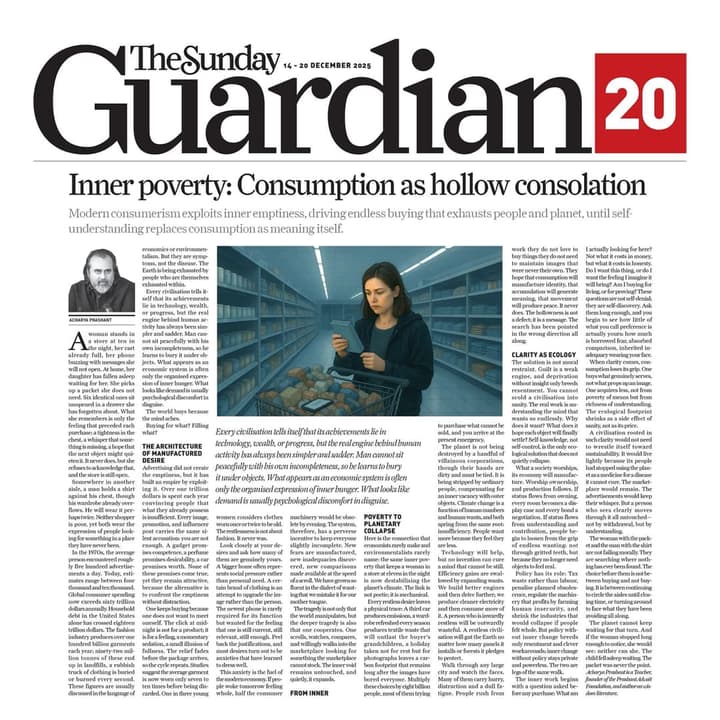
The Sunday Guardian14 Dec '25
Inner Poverty: Consumption as Hollow Consolation
"The tragedy is not only that the world manipulates, the deeper tragedy is that one cooperates. One scrolls, watches, compares, and willingly walks into the marketplace looking for something the marketplace cannot stock. The inner void remains untouched, and quietly, it expands."
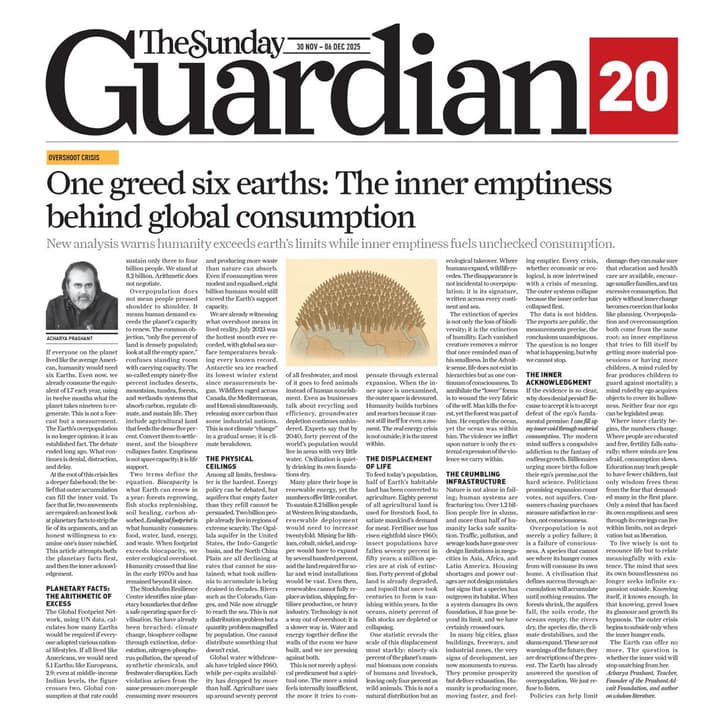
The Sunday Guardian30 Nov '25
One Greed Six Earths: The Inner Emptiness Behind Global Consumption
"Overpopulation is not merely a policy failure; it is a failure of consciousness. A species that cannot see where its hunger comes from will consume its own home. A civilisation that defines success through accumulation will accumulate until nothing remains. The forests shrink, the aquifers fall, the soils erode, the oceans empty, the rivers dry, the species die, the climate destabilises, and the slums expand. These are not warnings of the future; they are descriptions of the present."
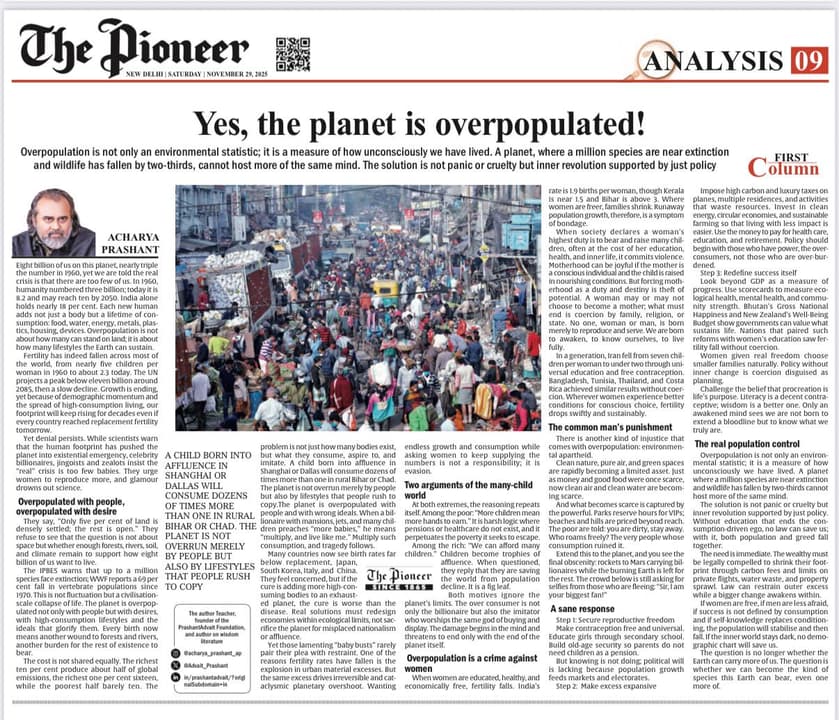
The Pioneer29 Nov '25
Yes, the planet is overpopulated!
"Yes, the planet is overpopulated, but not merely with human bodies. It is overpopulated with high‑consumption lifestyles and with the ideals that glorify them. The way we are living, every additional human birth often means one more wound to the forests, the rivers, the climate, and the other species that must make space for us. When one more human is added in this prevailing culture of ignorant consumption, the rest of existence has one more burden to carry."
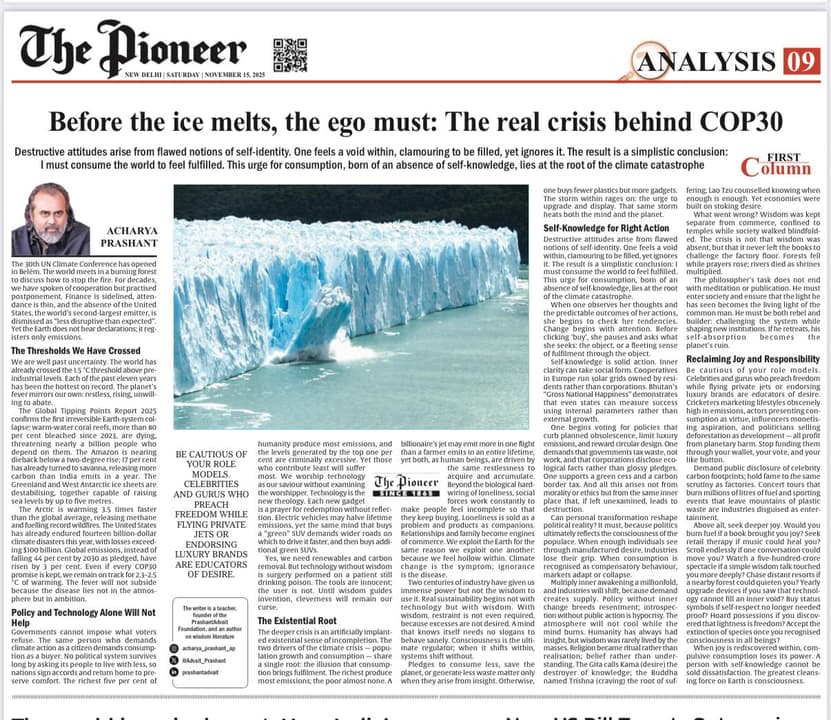
The Pioneer15 Nov '25
Before the Ice Melts, the Ego Must: The Real Crisis Behind COP30
"Governments cannot enforce what people do not inwardly accept. The same person who demands climate action as a citizen demands consumption as a buyer. The voter and the consumer are the same person, unwilling to live with less. No political system survives long by asking its people to sacrifice comfort. So governments sign accords, issue statements, and return home to protect normalcy."
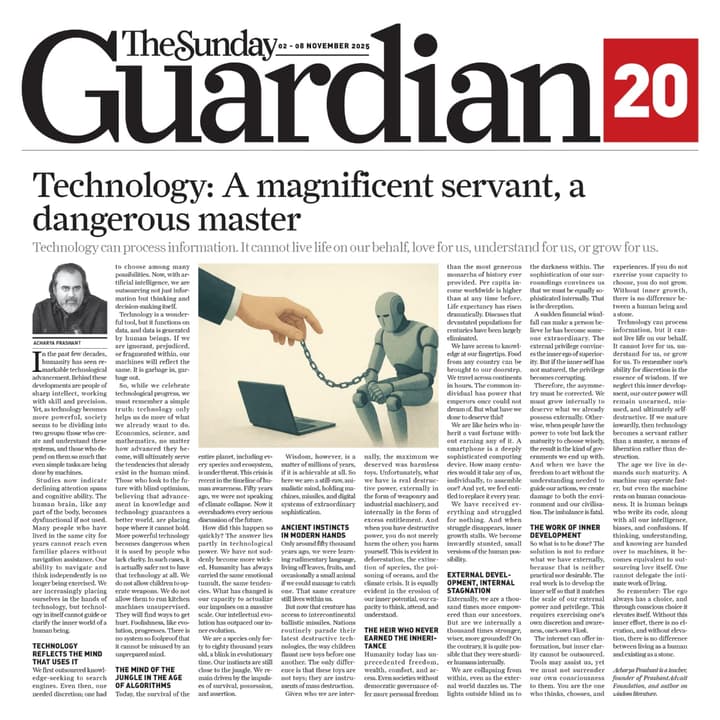
The Sunday Guardian02 Nov '25
Technology: A Magnificent Servant, a Dangerous Master
"Technology can process information, but it cannot live life on our behalf. It cannot love for us, understand for us, or grow for us. To remember one’s ability for discretion is the essence of wisdom. If we neglect this inner development, our outer power will remain unearned, misused, and ultimately self-destructive. If we grow inwardly, then technology becomes a servant rather than a master, a means of liberation rather than destruction."
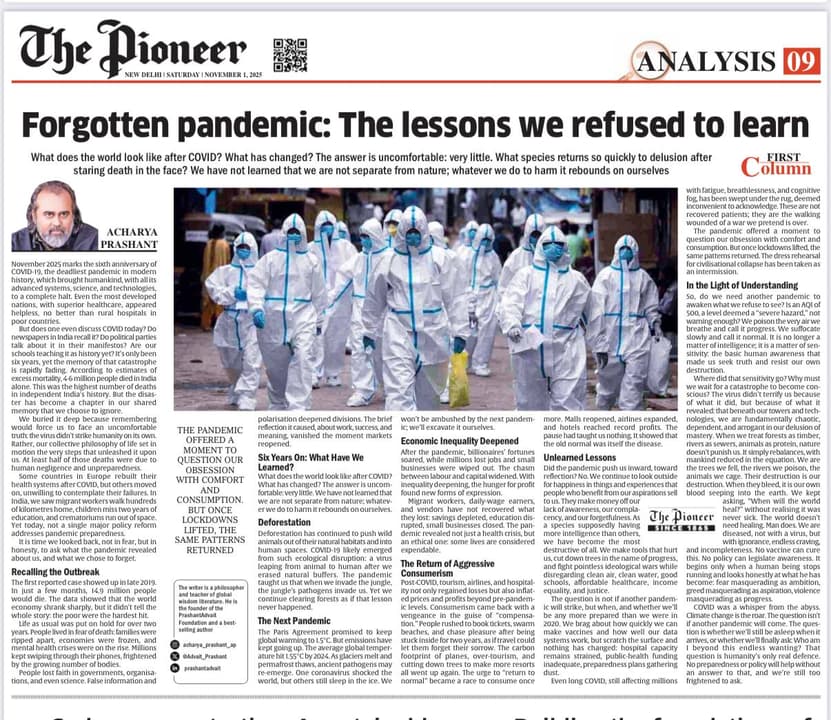
The Pioneer01 Nov '25
Forgotten Pandemic: The Lessons We Refused to Learn
"What does the world look like after COVID? What has changed? The answer is uncomfortable: very little. What species returns so quickly to delusion after staring death in the face? We have not learned that we are not separate from nature; whatever we do to harm it rebounds on ourselves."
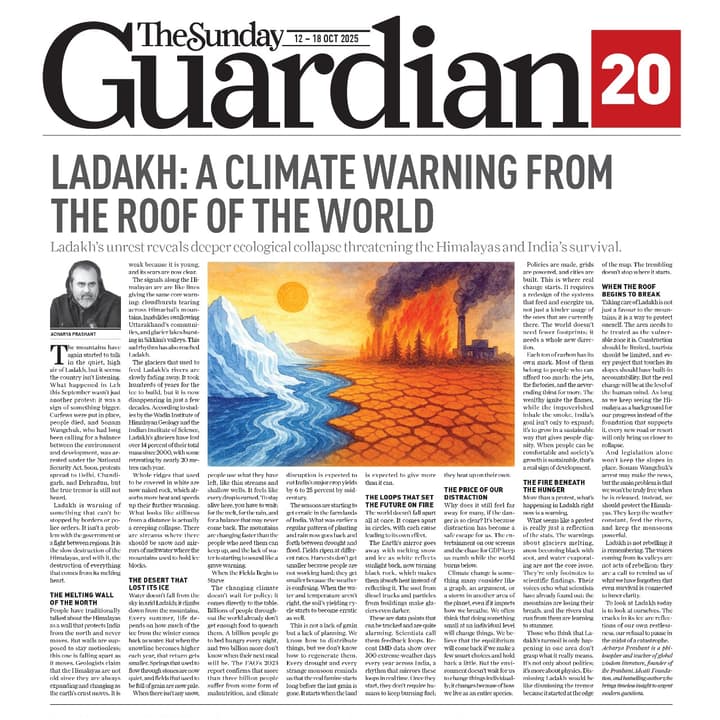
The Sunday Guardian12 Oct '25
Ladakh: A Climate Warning from the Roof of the World
"Those who think that Ladakh's turmoil is only happening in one area don't grasp what it really means. It’s not only about politics; it's more about physics. Dismissing Ladakh would be like dismissing the tremor because it started at one edge of the map. The trembling doesn't stop where it starts."
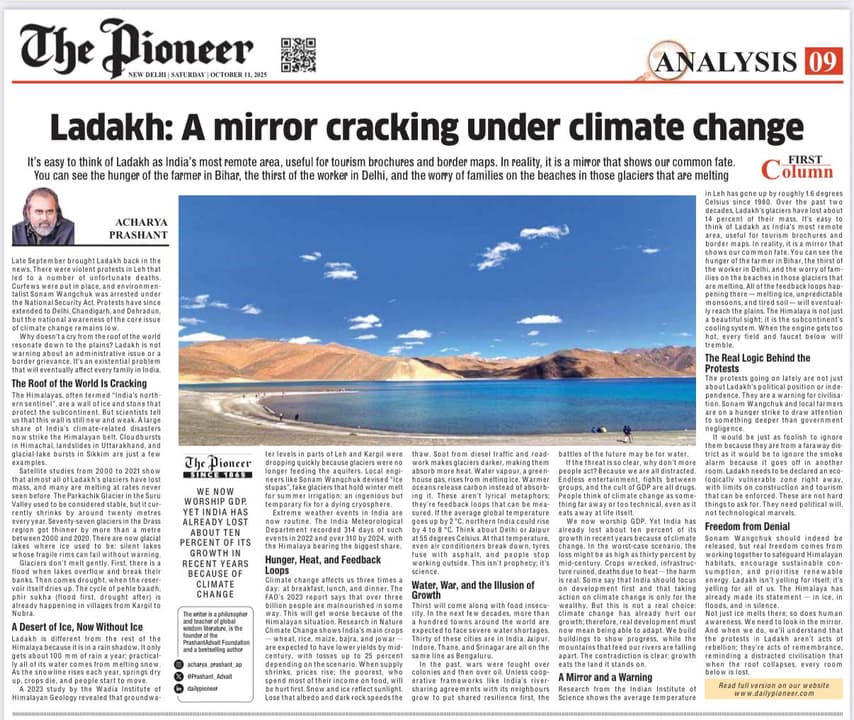
The Pioneer11 Oct '25
Ladakh: A mirror cracking under climate change
"It’s easy to think of Ladakh as India’s most remote area, useful for tourism brochures and border maps. In reality, it is a mirror that shows our common fate. You can see the hunger of the farmer in Bihar, the thirst of the worker in Delhi, and the worry of families on the beaches in those glaciers that are melting."
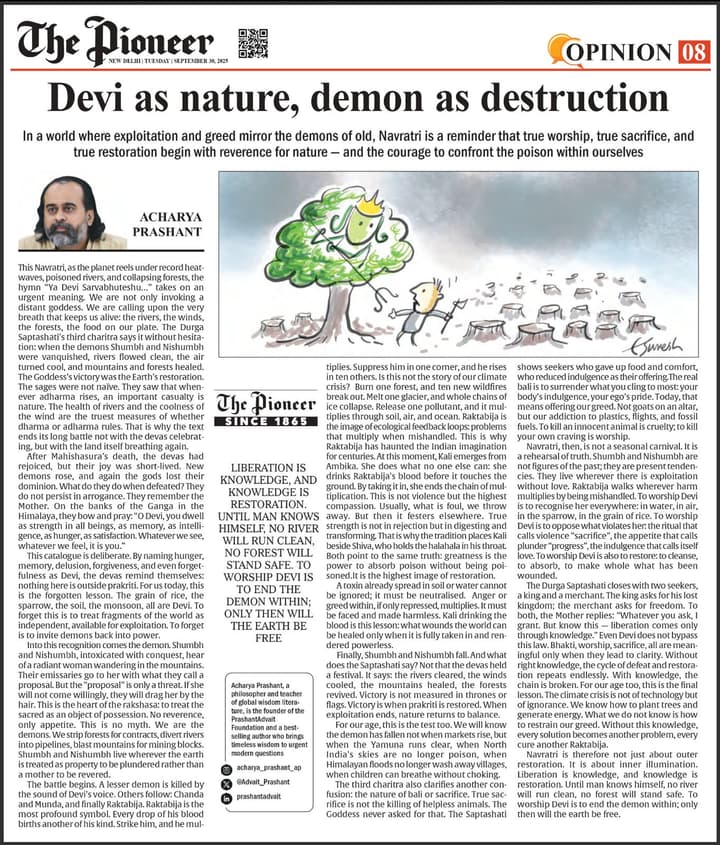
The Pioneer30 Sep '25
The Forgotten Navratri: Devi as Nature, Demon as Destruction
"In a world where exploitation and greed mirror the demons of old, Navratri is a reminder that true worship, true sacrifice, and true restoration begin with reverence for nature — and the courage to confront the poison within ourselves"
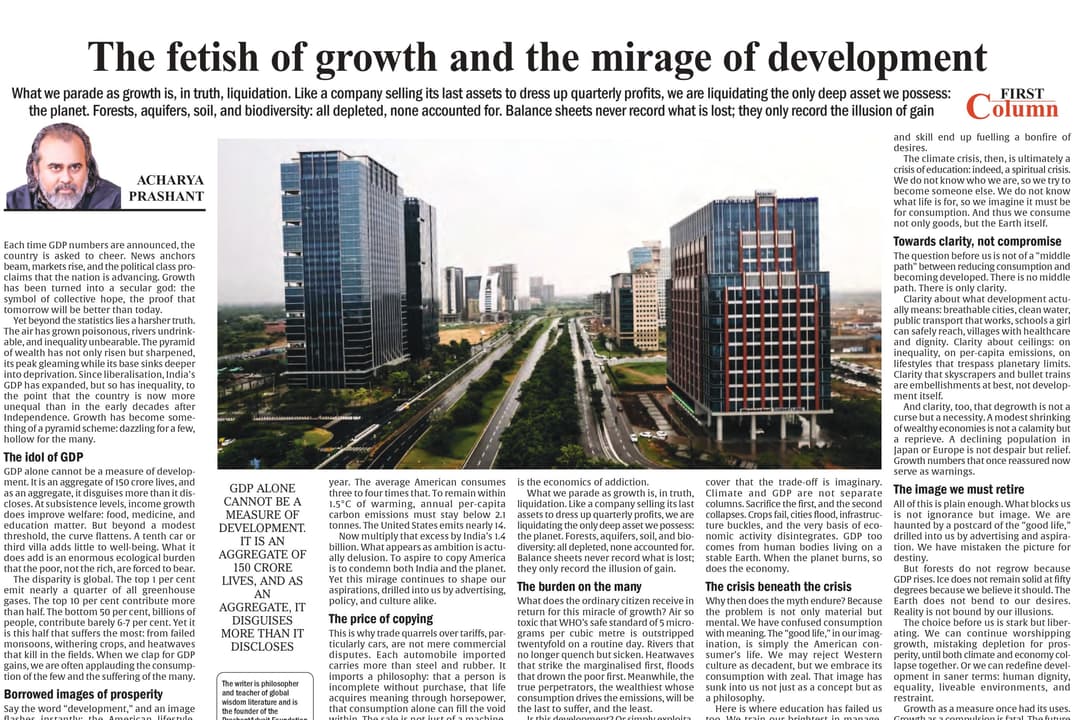
The Pioneer22 Sep '25
The fetish of growth and the mirage of development
"What we parade as growth is, in truth, liquidation. Like a company selling its last assets to dress up quarterly profits, we are liquidating the only deep asset we possess: the planet. Forests, aquifers, soil, and biodiversity: all depleted, none accounted for."
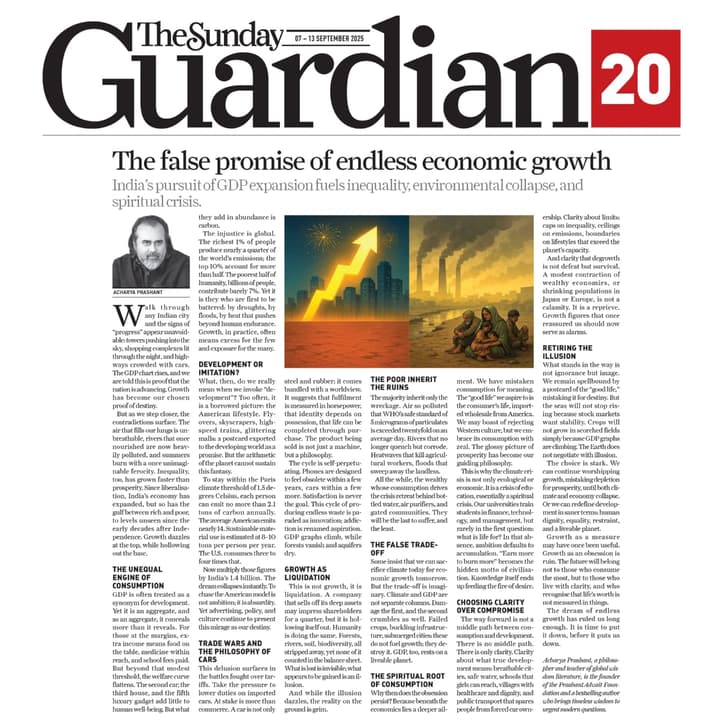
The Sunday Guardian21 Sep '25
The False Promise of Endless Economic Growth
"Growth as a measure may have once been useful. Growth as an obsession is ruin. The future will belong not to those who consume the most, but to those who live with clarity, and who recognise that life’s worth is not measured in things."
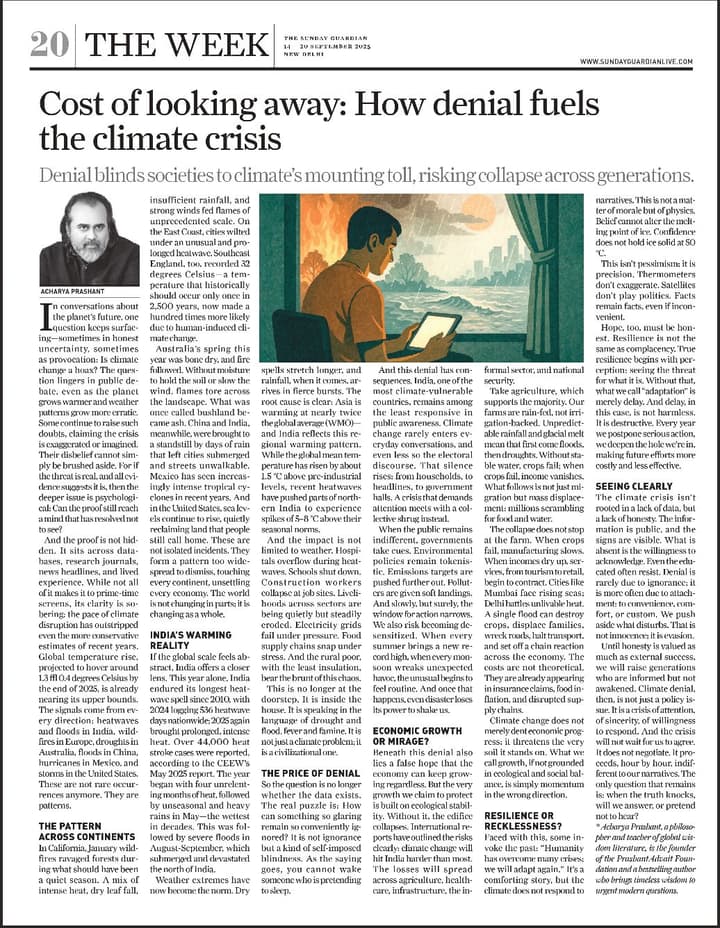
The Sunday Guardian14 Sep '25
Cost of looking away: How denial fuels the climate crisis
"Until honesty is valued as much as external success, we will raise generations who are informed but not awakened. Climate denial, then, is not just a policy issue. It is a crisis of attention, of sincerity, of willingness to respond. And the crisis will not wait for us to agree. It does not negotiate. It proceeds, hour by hour, indifferent to our narratives. The only question that remains is: when the truth knocks, will we answer, or pretend not to hear?"
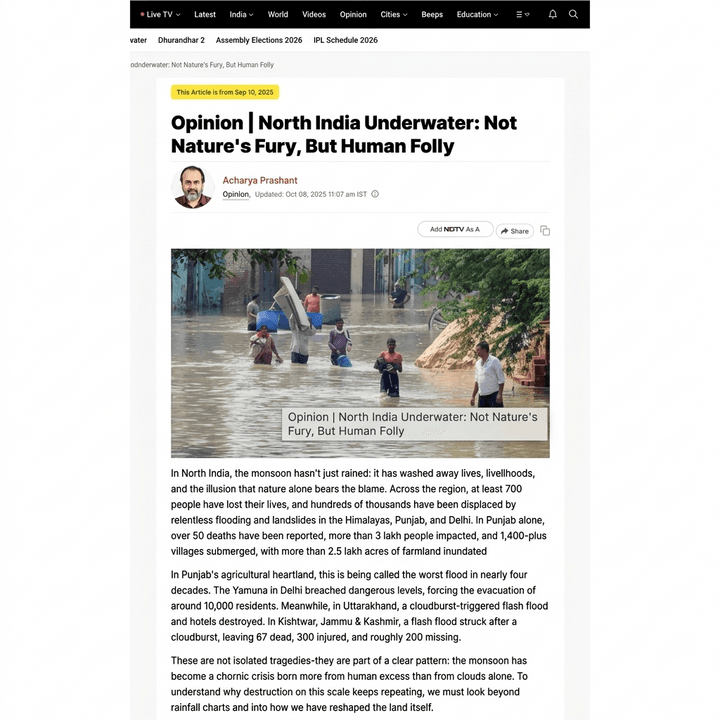
NDTV10 Sep '25
North India Underwater: Not Nature's Fury, But Human Folly
"The future will not remember how many millimetres of rain fell; it will remember the choices we made when the warnings were clear. Did we rush to rebuild on the same shaky ground, or did we stop long enough to take a different path, the right path?"
The Sunday Guardian31 Aug '25
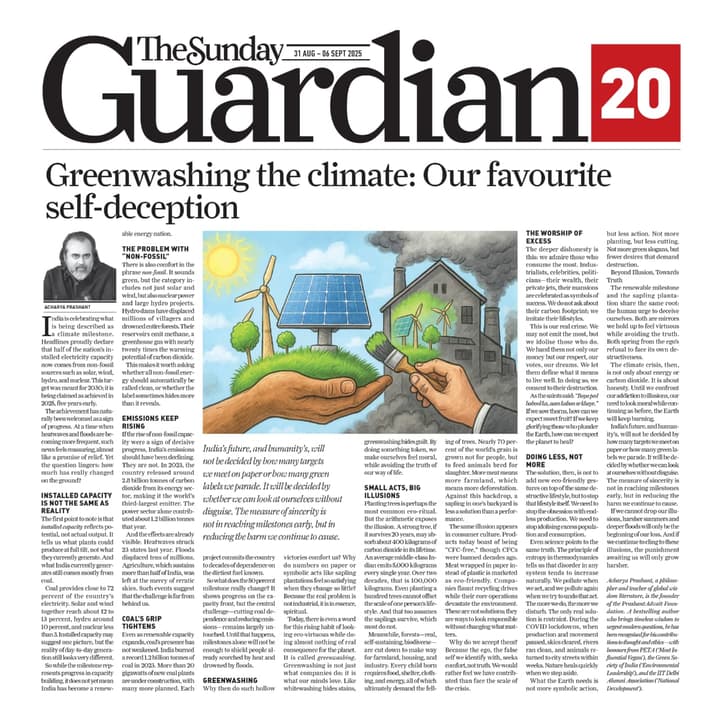
Greenwashing the Climate: Our Favourite Self-Deception
"India’s future, and humanity’s, will not be decided by how many targets we meet on paper or how many green labels we parade. It will be decided by whether we can look at ourselves without disguise. The measure of sincerity is not in reaching milestones early, but in reducing the harm we continue to cause."
The Pioneer06 Aug '25
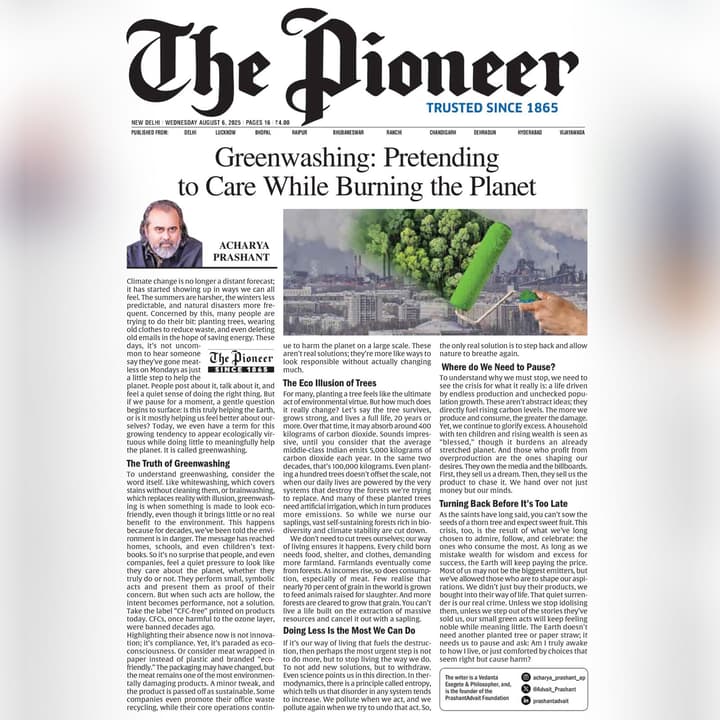
Greenwashing: Pretending to Care While Burning the Planet
"Somewhere along the way, being ‘green’ became a way to signal that you’re thoughtful and responsible. So it’s no surprise that people, and even companies, feel a quiet pressure to look like they care about the planet, whether they truly do or not."
The Pioneer25 Jul '25
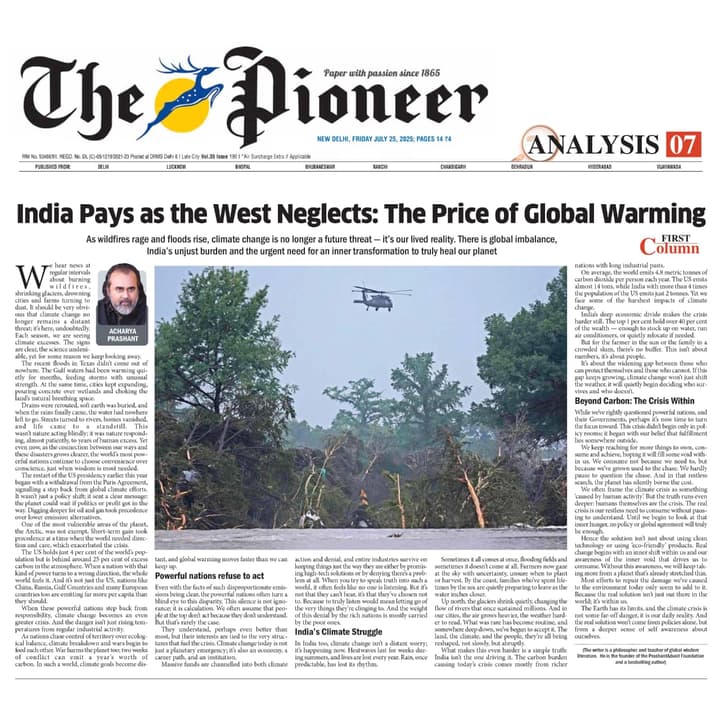
India Pays as the West Neglects: The Price of Global Warming
"Even with the facts of such disproportionate emissions being clear, the powerful nations often turn a blind eye to this disparity. This silence is not ignorance; it is calculation. We often assume that people at the top don’t act because they don’t understand. But that’s rarely the case. They understand, perhaps even better than most, but their interests are tied to the very structures that fuel the crisis."
The Pioneer21 Jul '25
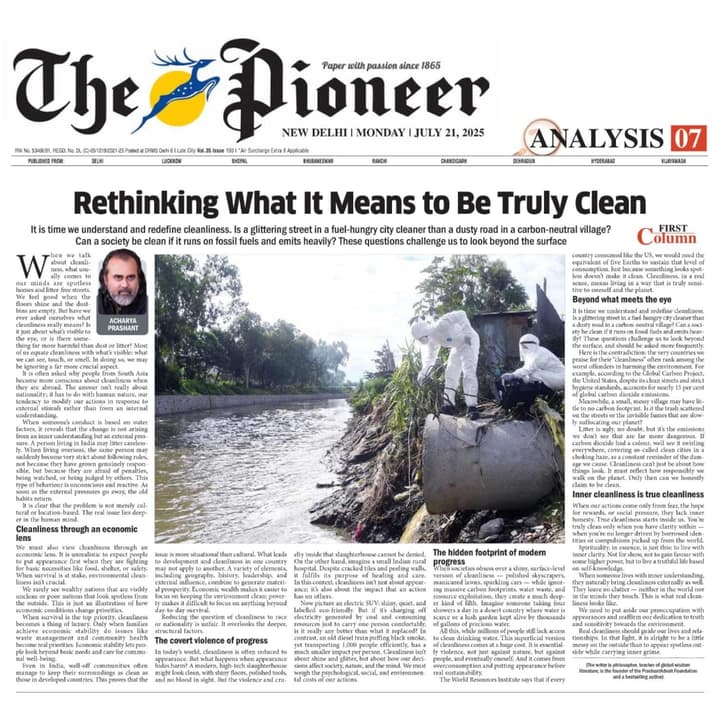
Rethinking What It Means to Be Truly Clean
"It is time we understand and redefine cleanliness. Is a glittering street in a city that burns fuel cleaner than a dusty road in a carbon-neutral village? Can a society be clean if it runs on fossil fuels and emits heavily? These questions challenge us to look beyond the surface, and should be asked more frequently."
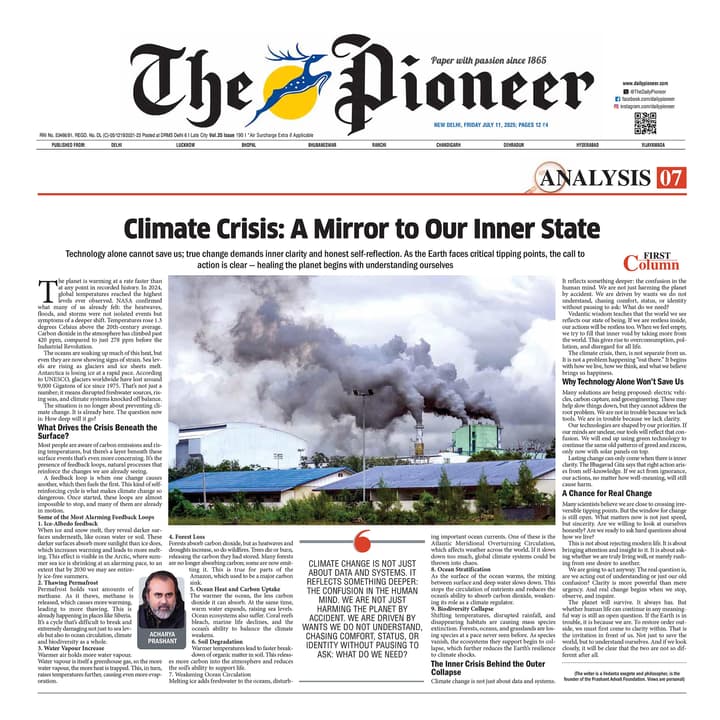
The Pioneer15 Jul '25
Climate Crisis: A Mirror to Our Inner State
"Climate change is not just about data and systems. It reflects something deeper: the confusion in the human mind. We are not just harming the planet by accident. We are driven by wants we do not understand, chasing comfort, status, or identity without pausing to ask: What do we really need?"
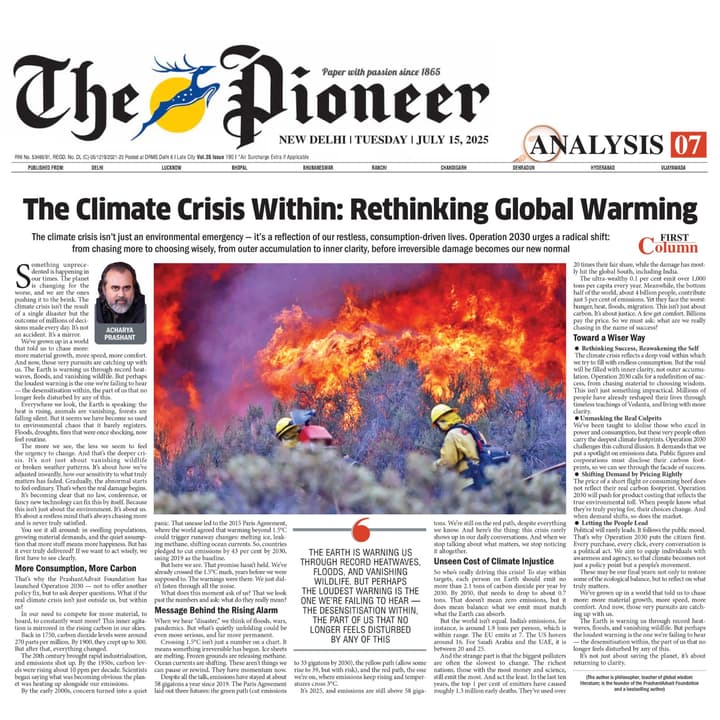
The Pioneer11 Jul '25
The Climate Crisis Within: Rethinking Global Warming
"The climate crisis isn’t just an environmental emergency — it’s a reflection of our restless, consumption-driven lives. Operation 2030 urges a radical shift: from chasing more to choosing wisely, from outer accumulation to inner clarity, before irreversible damage becomes our new normal."
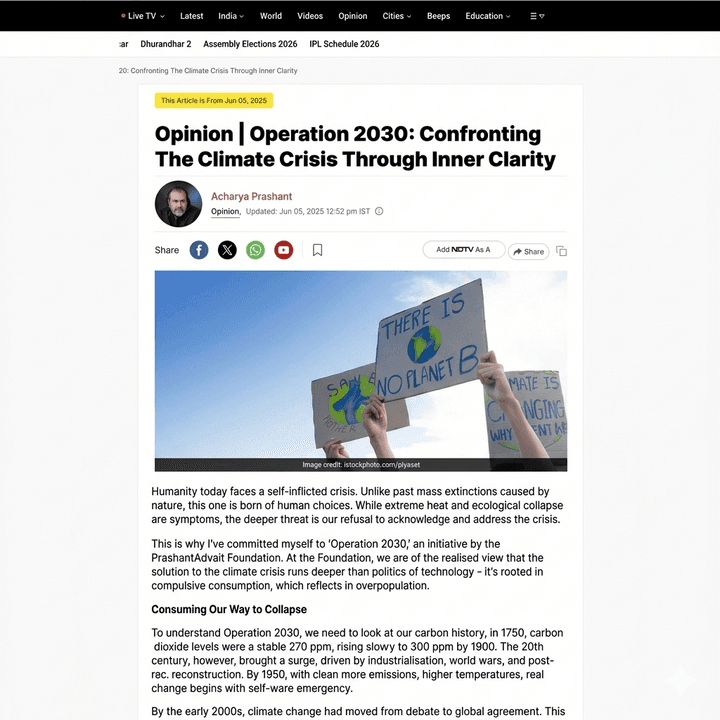
NDTV05 Jun '25
Operation 2030: Confronting The Climate Crisis Through Inner Clarity
"Humanity today faces a self-inflicted crisis. Unlike past mass extinctions caused by nature, this one is born of human choices."
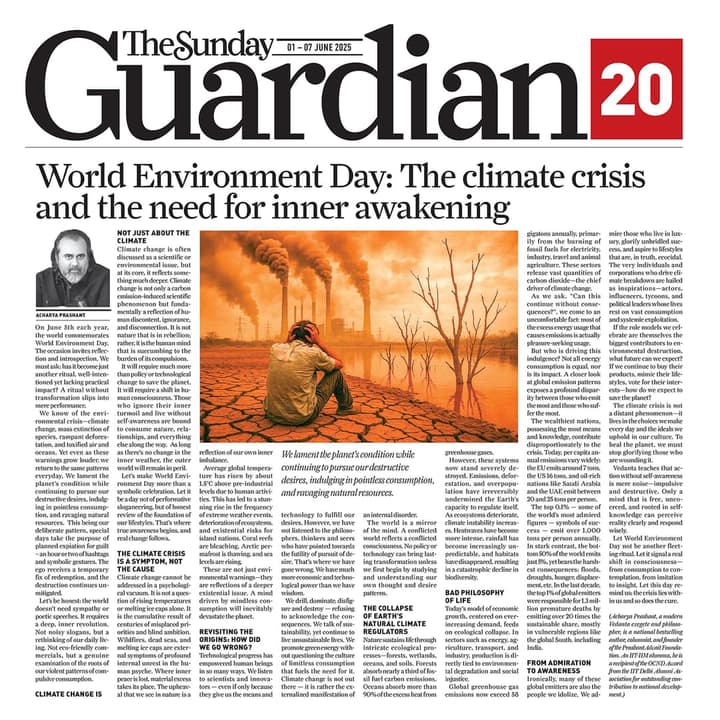
The Sunday Guardian01 Jun '25
World Environment Day: The climate crisis and the need for inner awakening
"On June 5th each year, the world commemorates World Environment Day. The occasion invites reflection and introspection. We must ask: has it become just another ritual, well-intentioned yet lacking practical impact?"
The Sunday Guardian25 May '25
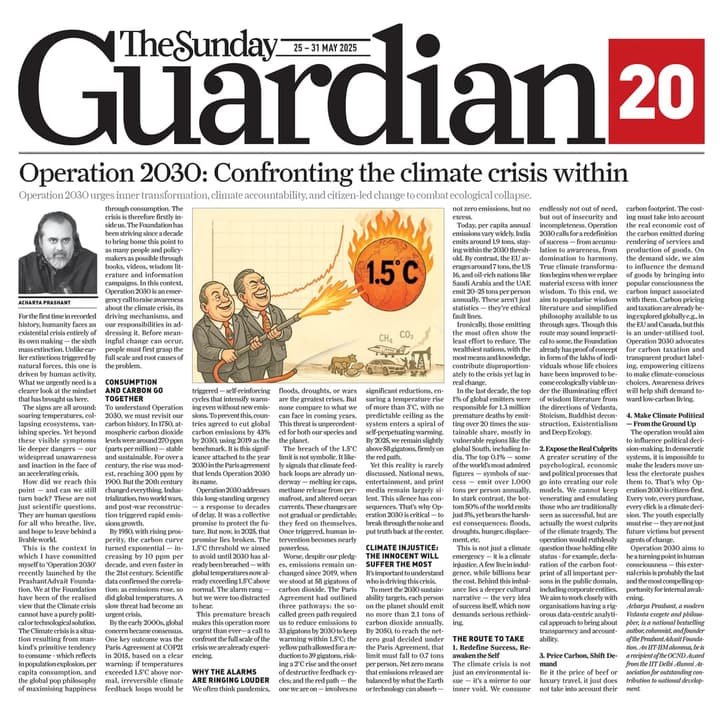
Operation 2030: Confronting the climate crisis within
"For the first time in recorded history, humanity faces an existential crisis entirely of its own making — the sixth mass extinction. Unlike earlier extinctions triggered by natural forces, this one is driven by human activity."
NDTV09 May '25
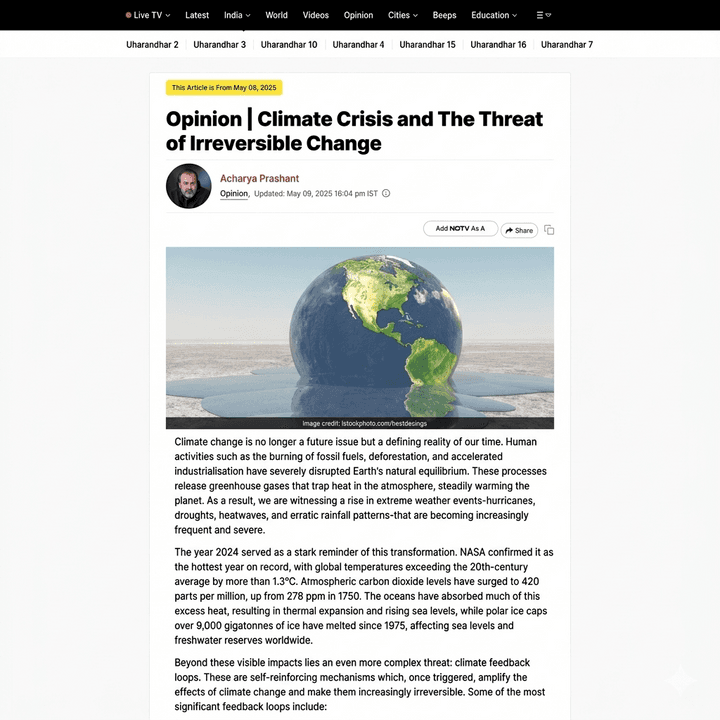
Opinion | Climate Crisis and The Threat of Irreversible Change - NDTV
"Climate change is no longer a future issue but a defining reality of our time. Human activities such as the burning of fossil fuels, deforestation, and accelerated industrialisation have severely disrupted Earth's natural equilibrium."
The Sunday Guardian20 Apr '25
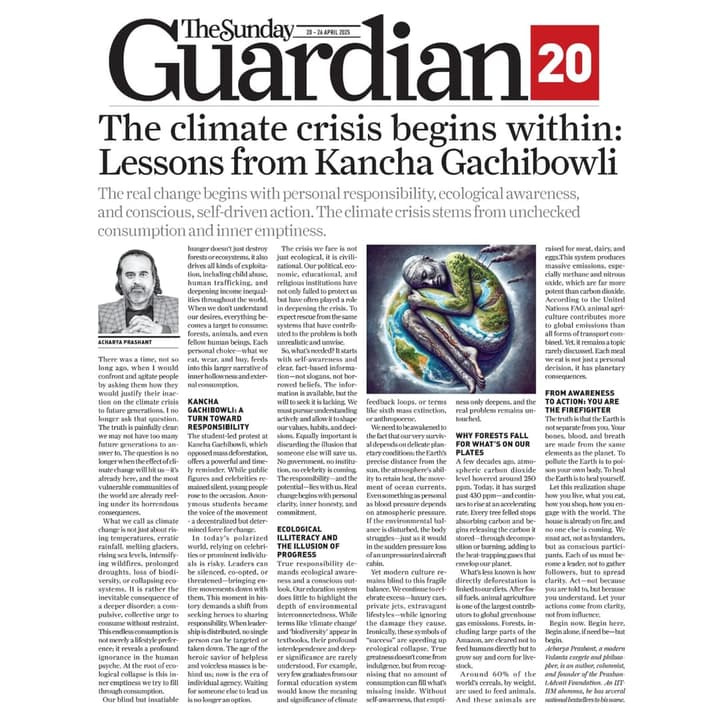
The climate crisis begins within: Lessons from Kancha Gachibowli.
"There was a time, not so long ago, when I would confront and agitate people by asking them how they would justify their inaction on the climate crisis to future generations. I no longer ask that question."
The Sunday Guardian13 Apr '25
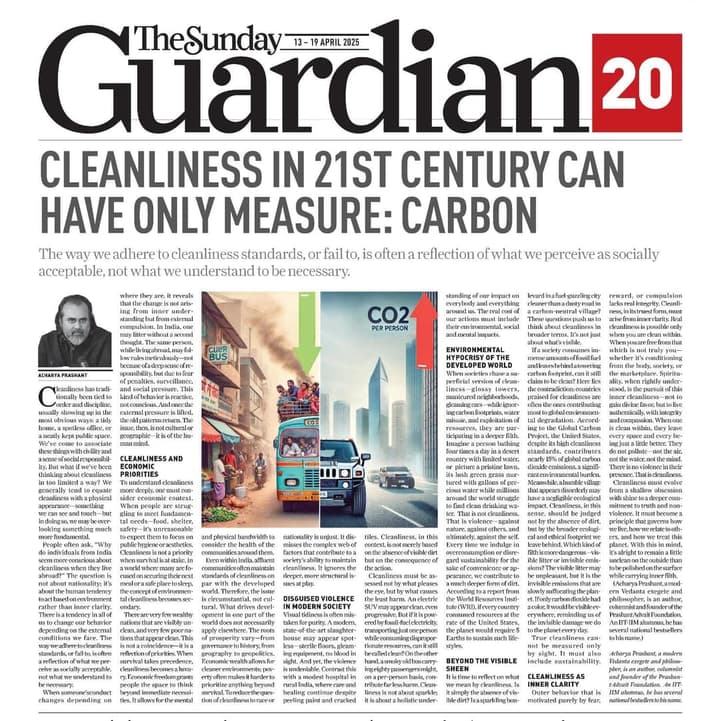
Cleanliness in 21st century Can Have Only Measure: Carbon.
"Cleanliness has traditionally been tied to order and discipline, usually showing up in the most obvious ways: a tidy home, a spotless office, or a neatly kept public space. We’ve come to associate these things with civility and a sense of social responsibility."
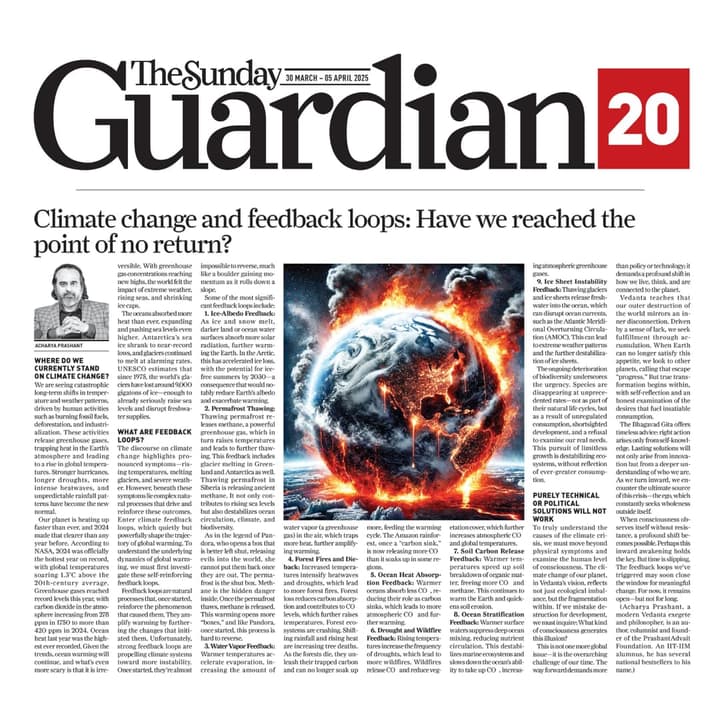
The Sunday Guardian30 Mar '25
Climate Change and Feedback Loops: Have We Reached the Point of No Return?
"Where do we currently stand on climate change? We are seeing catastrophic long-term shifts in temperature and weather patterns, driven by human activities such as burning fossil fuels, deforestation, and industrialization."
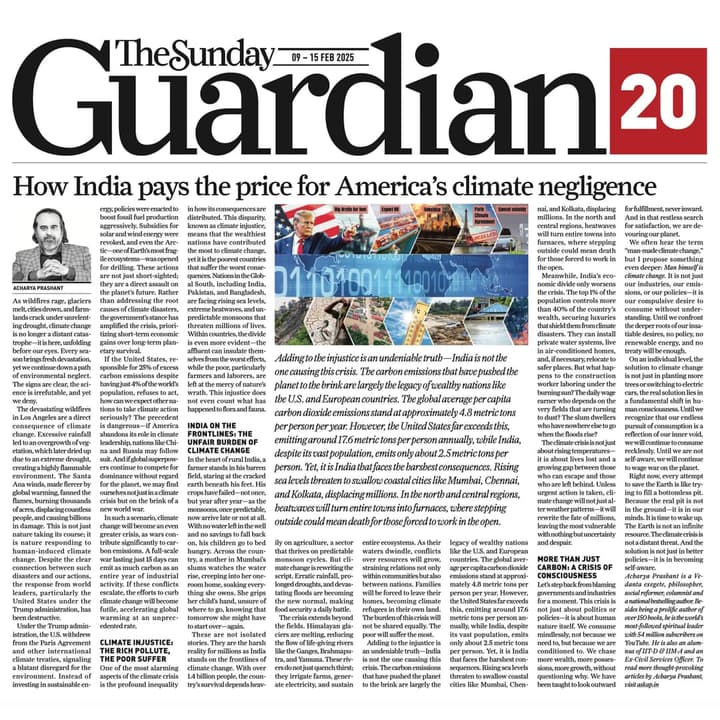
The Sunday Guardian09 Feb '25
How India Pays the Price for America's Climate Negligence.
"As wildfires rage, glaciers melt, cities drown, and farmlands crack under unrelenting drought, climate change is no longer a distant catastrophe—it is here, unfolding before our eyes."
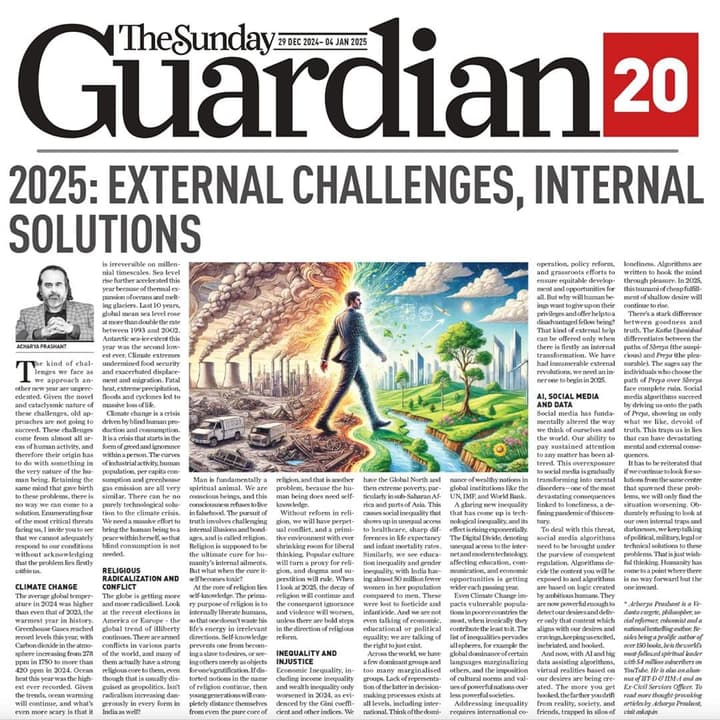
The Sunday Guardian29 Dec '24
2025: External challenges, Internal Solutions.
"The kind of challenges we face as we approach another new year are unprecedented. Given the novel and cataclysmic nature of these challenges, old approaches are not going to succeed."
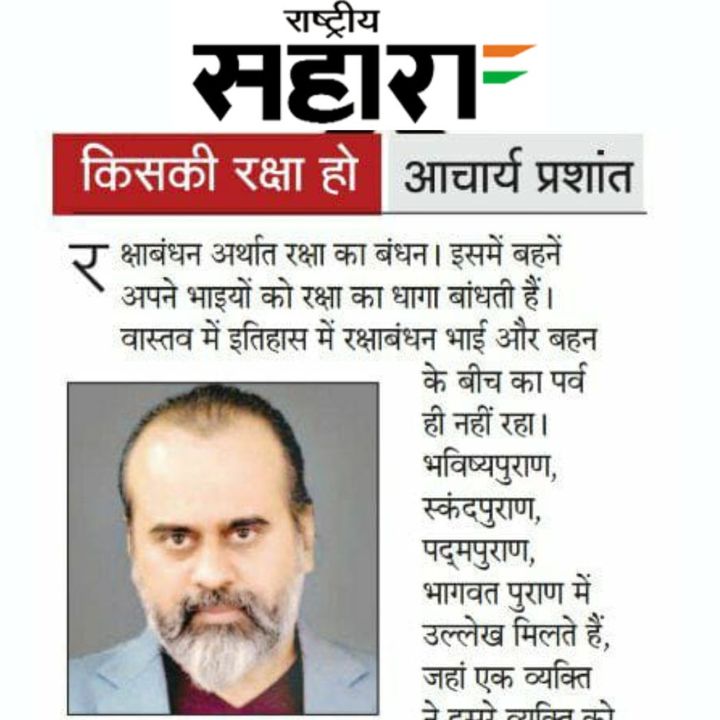
रक्षाबंधन का सही अर्थ समझाते हुए राष्ट्रीय सहारा के इस लेख में आचार्य प्रशांत ने कहा कि यह केवल भाई-बहन के बीच का पर्व नहीं है। विभिन्न पुराणों और धार्मिक ग्रंथों में रक्षा के व्यापक अर्थ दिए गए हैं। आज हमें पर्यावरण, भाषा, संस्कृति और समाज की रक्षा की जरूरत है। यह पर्व हमें व्यापक दृष्टिकोण अपनाने और सभी कमजोर एवं जरूरतमंदों की रक्षा करने का संदेश देता है। आचार्य प्रशांत ने कहा कि हमें हर प्रकार की सुरक्षा और संरक्षण के लिए प्रयास करना चाहिए।
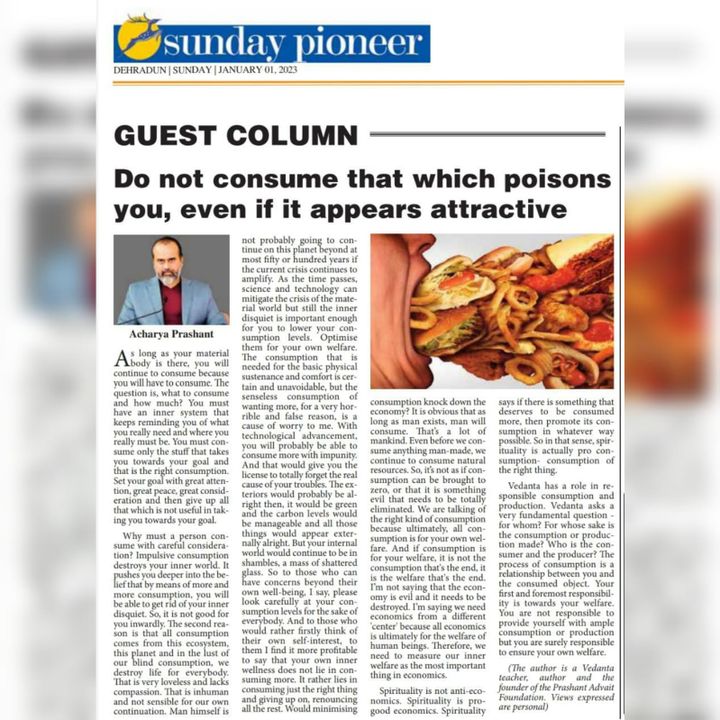
The Pioneer01 Jan '23
Do not consume that which poisons you
Delve into Acharya Prashant's illuminating perspective on consumption and inner peace in The Pioneer. As a renowned Vedanta teacher, he advocates for mindful consumption, urging readers to align their consumption habits with personal well-being and environmental sustainability.
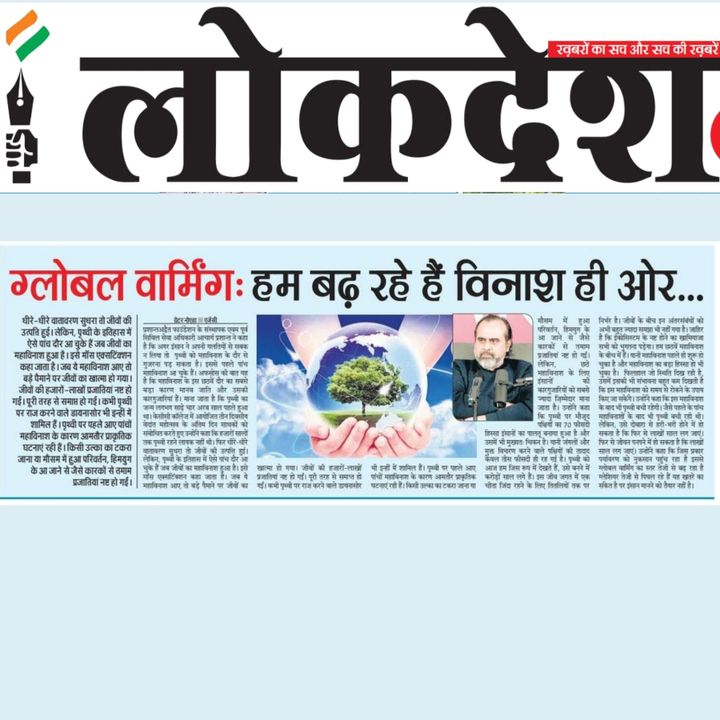
Lokdesh31 Oct '22
ग्लोबल वॉर्मिंग: हम बढ़ रहे हैं विनाश की ओर
"दैनिक लोकदेश" में प्रकाशित इस लेख में आचार्य प्रशांत ने ग्लोबल वार्मिंग के खतरों पर प्रकाश डाला है। उन्होंने बताया कि हम लगातार विनाश की ओर बढ़ रहे हैं और इसे रोकने के लिए तुरंत कार्रवाई की आवश्यकता है। उन्होंने पर्यावरण संरक्षण के लिए व्यक्तिगत और सामूहिक प्रयासों पर जोर दिया, ताकि आने वाली पीढ़ियों को एक सुरक्षित और स्वस्थ पर्यावरण मिल सके।
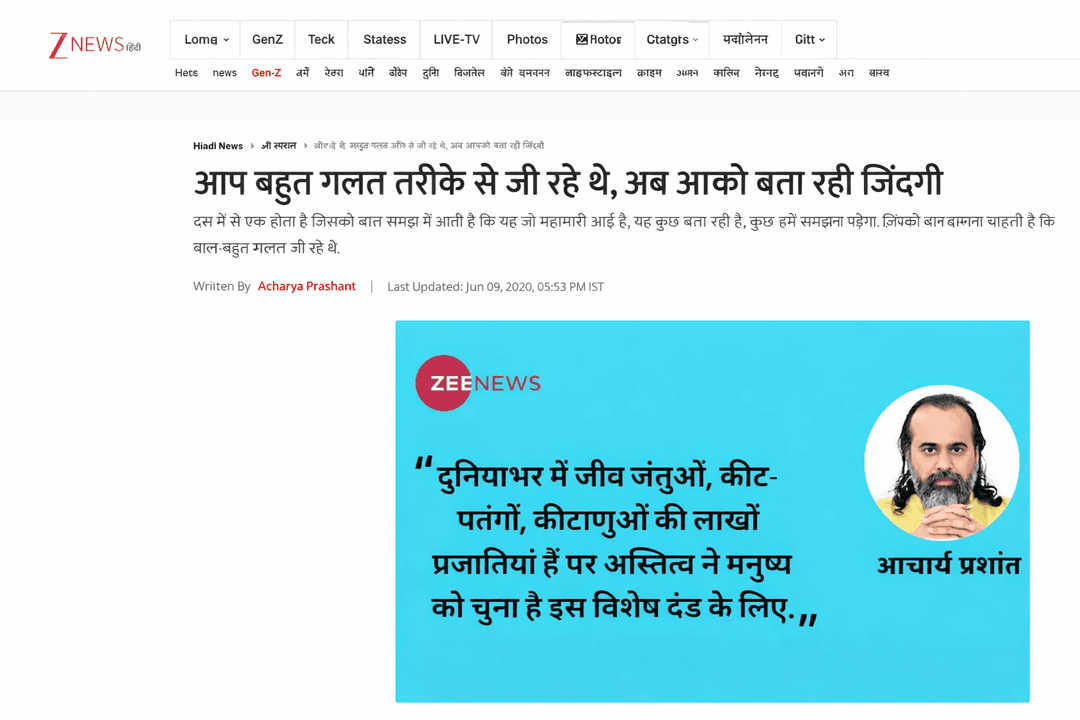
Zee News09 Jun '20
You were living a very wrong life, now life is telling you.
You had been living very wrongly — now life itself is telling you. Out of ten, only one understands that this pandemic is conveying something, that there is something we must learn. Life is trying to tell you that you had been living in a deeply mistaken way.