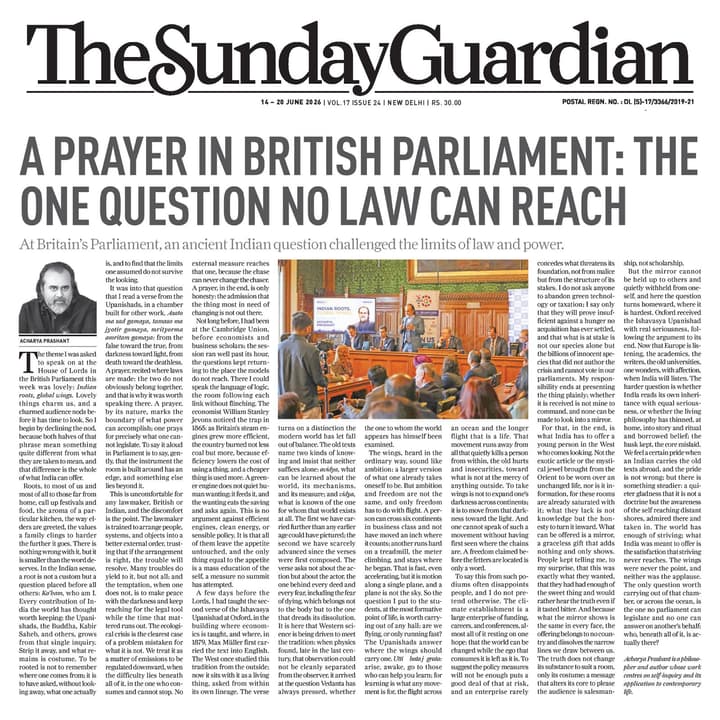
"The theme I was asked to speak on at the House of Lords in the British Parliament this week was lovely: Indian roots, global wings. Lovely things charm us, and a charmed audience nods before it has time to look. So I begin by declining the nod, because both halves of that phrase mean something quite different from what they are taken to mean, and that difference is the whole of what India can offer."
"The parks of London do something to the mind, if one lingers in them long enough without an agenda. Walking through one in the late evening, when the city has begun to loosen its grip, and the light is going amber behind the beech trees, something in the usual interior traffic pauses."
"On the 30th of May, I spoke at the Cambridge Union as part of the Cambridge India Business Dialogue, in conversation with Professor Jaideep Prabhu of the Judge Business School. I had been told the session would run for about an hour; the room had other intentions."
"Every year, as Eid al-Adha approaches, the debate reappears: should the practice be restricted, is public sacrifice acceptable, are there hygiene concerns? The protests and defences line up on cue, and when the festival passes, the argument goes quiet for another twelve months. The animal that was slaughtered is forgotten; the position that was held is remembered."
Almost every historical crisis has produced its version of the same thought: what is happening is happening to someone else. The climate crisis has produced a version of this thought particularly well-suited to the Indian urban professional class: climate change is real, but its primary victims are the farmer without irrigation, the construction worker or the landless labourer. The crisis the middle class has assigned to someone else is visible in the city's own property markets, its own seasonal calendar, its own streets after an hour of rain, and the exemption the middle class believes it holds has already been declined, though its holders have not yet checked the correspondence.
"The connection between fuel consumption and the absence of a genuine inner life is not metaphorical. It is a mechanical chain. The human being who believes that satisfaction must be sought outward, because he has found no access to genuine sufficiency within, acts upon his emotions and desires without examining what drives them. Every desire acted upon requires energy. Energy, in a civilisation built on fossil fuels, means burning them."
"The mountains are on fire and India's cities are furnaces. The bill for two centuries of mispriced consumption is arriving on a schedule that runs ahead of every published forecast. The question that remains is a simple one: whether the person who drove up to the hills, ate the Maggi, and tossed the packet into the ravine is willing to reckon with the distance between what he paid and what it cost."
"The sense of incompletion that propels a young professional to book a flight to a destination he has already mentally photographed, to build a house with rooms that will rarely be used; this is not a rational economic decision. It is the ego’s oldest and most relentless reflex: I am insufficient as I am; adding, acquiring, displaying will resolve the insufficiency."
"Every civilisation in crisis reaches first for the solution that requires it to change the least. This is not cowardice; it is the structural behaviour of the human ego, which will accept any modification to its tools before it will accept an examination of its wants."
“War is not only a humanitarian disaster; it is also an environmental one. Modern warfare devours fuel, burns cities, poisons soil and air, and leaves behind scars that last far longer than the battles themselves. Even as nations pledge to fight climate change, the machinery of war continues to run on a scale that quietly undermines those very promises.”
"AI has arrived not as a villain but as a mirror, reflecting back exactly how mechanical our lives have become. The tragedy is not that machines are growing intelligent; it is that we have been living unintelligently, and now the fact is exposed."
"The hills perform services that never appear on any balance sheet. They blunt desert winds, hold back fine dust, allow rainwater to seep underground instead of rushing away as floods, and release heat at night, offering the region what little relief it gets from brutal summers. None of this enters the calculations of those trained to see only stone to sell and land to develop."
"The tragedy is not only that the world manipulates, the deeper tragedy is that one cooperates. One scrolls, watches, compares, and willingly walks into the marketplace looking for something the marketplace cannot stock. The inner void remains untouched, and quietly, it expands."
"Overpopulation is not merely a policy failure; it is a failure of consciousness. A species that cannot see where its hunger comes from will consume its own home. A civilisation that defines success through accumulation will accumulate until nothing remains. The forests shrink, the aquifers fall, the soils erode, the oceans empty, the rivers dry, the species die, the climate destabilises, and the slums expand. These are not warnings of the future; they are descriptions of the present."
"Yes, the planet is overpopulated, but not merely with human bodies. It is overpopulated with high‑consumption lifestyles and with the ideals that glorify them. The way we are living, every additional human birth often means one more wound to the forests, the rivers, the climate, and the other species that must make space for us. When one more human is added in this prevailing culture of ignorant consumption, the rest of existence has one more burden to carry."
"Governments cannot enforce what people do not inwardly accept. The same person who demands climate action as a citizen demands consumption as a buyer. The voter and the consumer are the same person, unwilling to live with less. No political system survives long by asking its people to sacrifice comfort. So governments sign accords, issue statements, and return home to protect normalcy."
"Technology can process information, but it cannot live life on our behalf. It cannot love for us, understand for us, or grow for us. To remember one’s ability for discretion is the essence of wisdom. If we neglect this inner development, our outer power will remain unearned, misused, and ultimately self-destructive. If we grow inwardly, then technology becomes a servant rather than a master, a means of liberation rather than destruction."
"What does the world look like after COVID? What has changed? The answer is uncomfortable: very little. What species returns so quickly to delusion after staring death in the face? We have not learned that we are not separate from nature; whatever we do to harm it rebounds on ourselves."
"Those who think that Ladakh's turmoil is only happening in one area don't grasp what it really means. It’s not only about politics; it's more about physics. Dismissing Ladakh would be like dismissing the tremor because it started at one edge of the map. The trembling doesn't stop where it starts."
"It’s easy to think of Ladakh as India’s most remote area, useful for tourism brochures and border maps. In reality, it is a mirror that shows our common fate. You can see the hunger of the farmer in Bihar, the thirst of the worker in Delhi, and the worry of families on the beaches in those glaciers that are melting."