You Don't Need Work-Life Balance

Acharya Prashant

23 min
905 reads
You Don't Need Work-Life Balance
Balance is needed only when there are contradictions — when your values, people, and priorities don’t align. Why can’t your personal and professional lives be one? If I have a great purpose, even the friends and partners I choose will align with it. Find something you can give everything to, something worth loving, and share it with the people who are there in your life. When there is love, you cannot draw a finish line. You cannot say, ‘It stops here.’ What stops somewhere is a desire. This summary is AI-generated. Please read the full article for complete understanding.

Questioner: Good evening sir. Amit Kumar Tripathi from B.Tech third year Civil, NIT Bhopal, and I'm glad to welcome you here in NIT Bhopal.

Acharya Prashant: Thank you.

Questioner: My question was on balance in life. Many people say that balance can be maintained in life, where we can have emotional bonding with family and equally we can focus on our work. But many people say it's a myth. I tried both ways, but it failed for me — because, as a human being, I am an emotional being. So I need emotions and I need to work for my goals also. So what should be my approach for solving this?

Acharya Prashant: Do we get the question, all of us? This question is: how do I balance my emotions with my work?
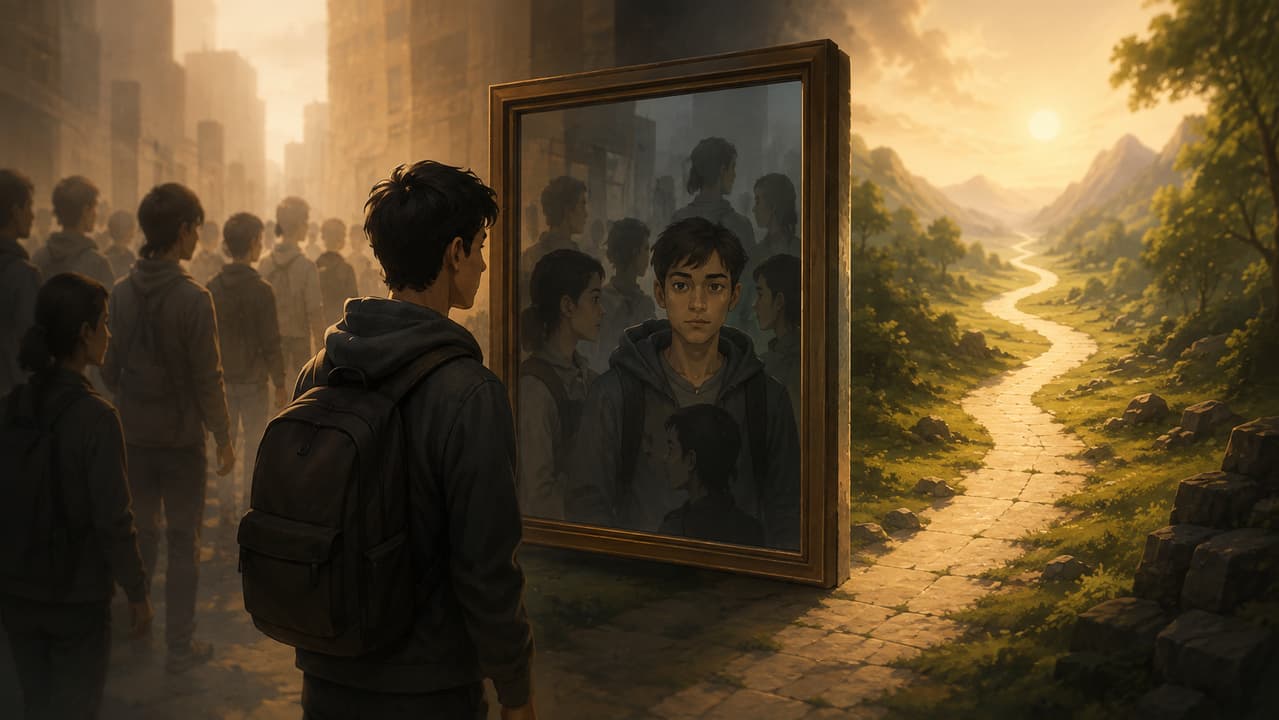
Okay, let's start with the basics. When does the issue of balance arise in the first place? Only when you have two contradictory things in your life, in your mental space or anywhere, trying to outdo each other, competing for the same spot. That's when you have to think about some kind of adjustment, how much to give to this versus how much to give to that, because this and that seem mutually incompatible. Right? This is demanding something from me and that is demanding something from me, and obviously I cannot fulfill both their demands simultaneously. So I want to strike a balance. I say, let me distribute myself or my time or my resources, whatever, in some proportion: 50/50, 60/40, 70/30, whatever. Do you get this?

So before we set out to achieve balance, it is important to see clearly that balance is needed only when you have contradictions in your life, only when you have things, people, priorities, values that do not align with each other.

For example, people talk of work-life balance, and the question from our friend is much in the same direction. When people talk of work-life balance, what they mean by "life" is their personal life, which corresponds to the emotional part of your being. Right? And when they talk of "work," they talk of livelihood, earning money, professional success, etc. And he's referring to much the same thing — how to achieve a balance?

And I'm wondering, why must there, first of all, be the need to achieve any balance? Because the very urge to have a balance reveals the presence of contradictions.

Otherwise there is no need to have a balance. And when there is balance, obviously it means you are not allotting your 100% to either side. It is some kind of compromised distribution of whatever you have. That's a balance. Right? That's a balance.

And we have been taught to be balanced personalities all our life. But there is something within us that does not want a balance. It wants to go all the way. It loves extremes. It loves totality, absoluteness, wholeness, completeness, nothing short of 100%. Is that not so?

Would you enjoy it if I told you the balanced truth? Please tell me, what do you want? 100% of it or a balance between truth and falsehood?

Listeners: 100%

Acharya Prashant: What do you want, total freedom or freedom only for six or eight or twelve hours a day? How do you want to be loved, and how do you want to love, totally or partially?

You understand what this thing "balance" implies? You can never be total in your life. But the moment I say that, a question arises, a question that resists totality. The question says: there are two opposites and they both appear important, and they both compete with each other, and if I allot 100% of myself to just one of them, what about the other? We have to take everything along. Right? We cannot survive or thrive on just one thing. So if this is important (gesturing towards the left side), that too is important (gesturing towards the right side), and you are talking of allotting the totality of yourself to one thing.

How is that possible?

Again question the assumption here. The assumption is this has to be incompatible with that. Why does that have to be? Why can't your personal life be aligned with your professional life? Why must they be necessarily separated and in opposition to each other? Why must one always come at the cost of the other? We do not experience that too often in our day-to-day life in our surroundings. So what I'm saying may appear a little utopian, a little impractical, but please stay.

What we have seen is: a fellow who goes to the office and he is one personality there. He says I'm earning money there, and then he returns to his house and he is another personality there, and he says this is where I spend the money that I have earned at the office. So these two have to go together because to spend you first need to earn. You cannot give up on either of them. At the same time, you remain kind of unfulfilled and distressed in both environments because you are never 100% anywhere.

Why is it so that one part of life has to be totally separated from the other part? Think of what our friend is saying. Why do your emotions have to be in opposition to your work? Why can't your emotions be aligned to your work?

And tell me, would you be able to give 100% to your work if your emotions are running haywire, hither-thither? You are at your workplace. You are engaged with some project, but your emotions are talking of some other thing. Now you cannot engage with your emotions, and your emotions will not allow you to engage with your work. Are you getting it? Is that a nice state to be in?

And then we say let me distribute my time wisely. I want you to explore why there must be any kind of distribution.

Distribution is needed only among those that are desperate, which means those who cannot come together or go together. And if two things cannot go together in your life, are either of them really aligned with who you really are?

Why must my personal life be separated from my professional life? Why?

I'll give you a couple of examples. The first is from India's freedom struggle itself. We have had revolutionary couples. As a young man, when you talk of emotions, a large part of that relates to the opposite gender and the fact that you would be soon starting a family and such things. So you figure it out on your own. I'm referring to the revolutionaries of Bengal, and you have had situations where the work and the choice of the person you are emotionally connected to are in perfect alignment.

Now your partner isn't going to complain, give me more time. Your partner is not going to say, you don't have work-life balance. You are giving so much to your work and nothing to me. Whatever you give to your work, you are also giving to your emotional life, to your family life, because your partner is a part of your work. Don't dismiss it as too utopian too early, because if you dismiss this then you're dismissing a very strong possibility in your life. If you're dismissing this, then you are dismissing the possibility of wholeness in life.

Just the last century. Obviously, you would have heard of Sartre, Being and Nothingness, “Existence precedes essence,” right? And Sartre is a great philosopher, and he has a relationship with another philosopher, feminist philosopher. What's her name?

Listener: Simone de Beauvoir.

Acharya Prashant: Yeah. Simone de Beauvoir. And they meet and they discuss work. Now, Sartre doesn't have to stop work to meet her. They meet and they discuss work. And it is out of these meetings that both of them could actually come up with their greatest work, books, and philosophy. The work is the date. The official meeting is the date. Now this fellow won't have to ask for a balance because he has been honest enough, authentic enough and daring enough to make work itself life.

Now work and life are totally overlapping.

So you don't have to balance one against the other. They are one already. There is no question of any balance. The question of balance arises only when we first of all compromise. And most of us agree to live compromised lives because we have not been shown too many examples to the contrary. All around ourselves we see only compromised figures. So we feel, you know, probably that's the only possible way of life.

No, that's not the only possible way.

All my life I have never had an office. And equally I could say that all my life I have never had a personal room, because my room has been the office and my office has been my room. Why do I need to strike a balance? I sleep in my office. And there was a time when my office was like an 8x10 kind of cabin, and I had a huge desk that occupied most of the room, and just by my desk at night, I would unfold a thin mattress and lie down and sleep. Where is the question of balancing work and life? Where is the question of balancing activity and leisure?

But that's another way we often talk of balance. We say, "Oh, you have worked too much. Now you need to balance it by relaxing a little." Now, think of the person who relaxes in the middle of his work. Think of the person whose work itself has become his relaxation. And why can't you aspire for such a state?

I don't have to run away from work to relax. I don't have to say, "Oh, you know, work hours and relaxation hours. There must be a 70:30 ratio." No 70:30 ratio. I work all the time. Equally, I relax all the time. It's always 100% either way. I work all the time. I relax all the time.

In fact, my nicest, most peaceful and deepest moments of relaxation are moments like these (interaction with audience). Incidentally, these are also the moments when I'm perceived as being in the middle of intense work. From where you are looking, probably I'm working intensely, right? This is work. There are these cameras that are recording, and there is an audience, and you are listening, and some of you are even taking notes, and it is these recordings then that get edited and come out as books. So this is core, hardcore work. It appears so, right?

For me these are the moments of my deepest relaxation. I don't need to balance. Yes, my legs sometimes might get tired. Yesterday there was a 3.5 hour session, and I was standing as I'm standing here, because I enjoy it more when my legs have freedom. The legs might get tired. I was not tired.

In fact, if I'm tired, I want to get into work. If I'm tired, I want to relax, then I want to work, because it is work that will offer me relaxation. Why can't you have a life like that? Why do your emotions have to be in opposition to your logic? Why can't everything be in service of something so great that there is no question of compromise? As a young person, why must you not find something to be absolutely devoted to? You understand the word absolute? 'Not relative, Absolute!'

And if you won't find anything to be absolutely devoted to, then you live a scattered life, fragmented life. Bits and pieces here and bits and pieces there, some part there, some part here, and you are wandering randomly among all these parts, giving some part of yourself to this, something to that, and then consoling yourself that you are living a well-balanced life.

You know, 10% I give to friends, 30% I give to wife, 20% I give to parents, then some part I give to random scrolling, then I also have to watch TV and entertain myself, so some part I give to that, and then the remaining 30–40% I give to work. That's the kind of balance most people have. Right? That's the kind of life we find people leading.

And not only do they lead such lives, they actively propagate such lives. They would come and preach that there is virtue in such a life. No, there is no virtue in such a life.

A divided life is a nightmare.

Get into something, and you have to stop because the next thing is now in queue. How good is that? No, that's not good at all.

You're at your workplace and you're looking constantly at your watch. Why? Because somebody at home is waiting for you. It could be your parents. It could be a friend. It could be your spouse, or your girlfriend, boyfriend, somebody. Now, why to have a person as your partner if that person doesn't align with your life work? I'm asking you.

But we usually have that because work for us is only a livelihood, a means to earn some money. So here (gesturing towards the left side) is this person, and he has chosen some random job from campus because it was offering a particular package. And here (gesturing towards the right side) is another person. This one too has chosen some random job because it was seen as respectable. And now these two get into a relationship with each other, and that's the third thing.

So, one thing is the job that this one has picked up (gesturing towards the left side). Then, there is the second thing that this one has picked up (gesturing towards the right side). And then, there is the relationship, and none of these three sit well with each other.

Why give yourself this kind of life in the first place? Why should the question of balance arise in the first place? Why can't you live a life in which you forget time?

To balance something, you need time. Because time tells you when to stop. Why can't you lead a life in which there is no question of stopping, because time has stopped? So you don't need to stop now. You're immersed totally into it. Marinated.

You don't say, "No, I'm supposed to work only till 5:00 p.m., and now I'm going back because I'm paid to work only till 5:00 p.m." No, no, no. It's not a matter of getting paid. It's a matter of love. I work because this is my love. And if this is my love, then why do I have to leave it to go somewhere else?

If I have a great, great purpose in life, then obviously the friends and the partners that I'll choose, they too will be the ones that align with that purpose. Right? If I have a great purpose in life, why will I choose someone who does not resonate with that purpose? Is that possible? No, that's not going to happen.

Because what I have chosen as my purpose is my first love. Love number 1. And then numbers 2, 3, 4, 5, 6, 7, 8 — they will be decided by number one. Number 1 will decide who will be these other people who will now enter my life. And they are entering only because they are in perfect alignment and resonance with number 1. So they are never going to ask for a balance.

Do I have friends? Yes, I have friends. I have friends within the foundation. My co-workers are my friends. And how can I really be great friends with someone who does not understand my great mission? It's impossible. Because that's what I'm eating, living, breathing, sleeping all the time.

If you are someone who doesn't understand the depth and gravity and importance of what we are trying to do, why should I spend two hours gossiping with you? Your life is totally different from a center that I've already rejected. Why will I talk to a person who's coming from a center that I left behind long back? Are you with me? So, yes, I have friends. I go and watch movies sometimes, when there is a remarkable or controversial one.

With whom? With those who work with me.

I don't say, this is my circle of colleagues and this is my circle of friends. No, my colleagues are my friends. Are you getting it? There may never be a perfect overlap practically. But why can't I try to minimize the distance at least? Why can't there be, to start with, a 60% overlap, then 70, 80, 90, 99, 99.99999, that kind of thing?

You see, pardon me for that, but we are largely loveless people. Do you understand lovelessness? We do not know what it means to give ourselves totally, to give ourselves totally to greatness. We have desires. When you talk of emotions, you're actually talking of desires. We have desires, but we have very little love. And

When there is love, then you cannot draw a finish line. You cannot say it stops here. What stops somewhere is a desire.

Do I play?

Yes.

And even when I go to play, I want people who relate to my work around me. In fact, even in the middle of playing, it so happens that there (pointing towards his own head) is a wave, an idea, a thought, and I stop and I discuss it. And I love that. And I'm sharing it with you because no one actively in person shared this with me when I was your age, sitting on chairs in an auditorium similar to the one we have here — when I was your age, 18, 20, 22. Well, wisdom is always available in great books, but I didn’t have anybody in flesh and blood coming to me and saying that a different life is possible.

It’s very easy to sell out. It’s very easy to succumb, bow down, and kneel to all kinds of nonsense. And it’s very easy to just squander away the only life you have.

And in spite of whatever I say, I know most of us will want a life of compromises, because a life of compromise is also a life of relative safety, security, conveniences, and such things. We don’t want to dare too much. We don’t want to risk too much. We don’t want to get wounded beyond a point. But as young people, you must try that out. You might enjoy it.

Do not let your life be divided. Do not be one person at one place and another person at another place.

This is not the kind of answer you're probably looking for, but this is the message I have come to deliver. So, I'll prioritize what I have to say.

Questioner: Hi sir, so my name is Aman Shukla. I'm from NLU Bhopal. So, sir, the point that you raised, that imbalance is something that we can have in our life. It is fine to have imbalances.

Acharya Prashant: I didn’t say you can have an imbalance.

Questioner: Sir, wholesomeness.

Acharya Prashant: Yes, wholesomeness.

Questioner: For example: when we walk, we need to imbalance our body so that we can move ahead. So that way, I took it as an imbalance. So my question was that everyone here is going to be in life, right? Like, after college life, people would be coming, and that is fine, you addressed that.

But what about the people who are already in my life? How to manage them? Because they won’t be having any kind of work in my life and the similar kind of common ground to talk?

Acharya Prashant: The questioner says, I find something worth loving, something worth giving my time to. It could be a field of research. It could be a particular technology you really enjoy. It could be a musical instrument. It could be some form of activism. You might want to be a writer. You might want to be a journalist. You might want to say, I want to now fly away to the US and become a great manager, something that you feel that, yeah, this is it and I can see it relates to me, it relates to the world, and it's something I can, without any regret, give everything to. So that's something you can find.

But now you are already 20 or 25, and this is something that you're discovering now. The questioner says, what about the people who are already in my life? Because I have a history of 20 years, and they're already in my life, most remarkably, family. There's family. Then there are schoolmates. Then there are also college mates. And I have a pre-existing relationship. And there is an emotional bonding, and shared memories, and such things.

And now I have begun to discover the purpose of life. Now I have begun to discover what it means to live in love. But they have stayed where they were. My parents remain the way they always were. My relatives, old friends, have remained the way they were. But I have seen something new, fresh, alive, radiant.

What to do with those people now?

Share what you have with them. Share. Share that there can be something called excellence. That life can be devoted to absolute excellence. And you can devote yourself to excellence only when you have a beating heart. Share this with them.

Hopefully, some of them will resonate with what you are telling them. Hopefully, some of them will understand that you are sharing something precious and keep trying. But very judiciously, very discreetly, you must also know when the other one has started offering unreasonable resistance.

You're trying to share something precious with the other one, and the other one is just offering unreasonable resistance and is stubbornly refusing to partake in the vision. The other one is saying, a life of mediocrity is the best for me. The other one is saying, no, there is nothing called love. There is only give and take. There are only transactions in life. What do you mean by love?

And the more you try to explain it, the more you lay out your heart, the more the other one is turning resistance. When you come to this point, then you should stop trying, because now that's a wastage of your time and effort. Are you getting it?

You are obliged to bring forth the best to the other. Yes, you can display it, you can encourage the other, but you can never force the other into loving.

Can you perforce make somebody love excellence? No.

If that fellow has already decided that mediocrity serves me best — I’m in a particular safe, secured job, let’s say a government job, and I have been a mediocre one all my life. My entire department is mediocre, and yet we have received promotions in time, and yet we have a certain status in society. So, there is nothing so much wrong with mediocrity, with a divided life. The other one is insistent. That’s the point when you should stop trying.

No point banging your head incessantly against a wall. Stop trying and concentrate on somebody else who is more receptive. You have limited time, limited energy. Obviously, you must first try to take them along. You get something wonderful, you want to share it with those around you, right? That’s basic humanness. Mama, see what I got. See what I got. Something new. Something very unlike whatever you or I have ever seen. I have discovered life itself. And you want to share it. And you really are honest about sharing it.

And if they don’t want to initially receive it, you would still want to keep trying. Keep trying. Yes, keep trying. But don’t say that I have to now limit myself to these few people when it comes to displaying excellence. If you have to display excellence, there are hundreds of others who are actively waiting, who are hungry, thirsty, and receptive. If you go to them, talk to them, demonstrate to them, they’ll be grateful — and success will be much more easily achieved. Right?

This article has been created by volunteers of the PrashantAdvait Foundation from transcriptions of sessions by Acharya Prashant
Comments
LIVE Sessions
Experience Transformation Everyday from the Convenience of your Home
Live Bhagavad Gita Sessions with Acharya Prashant
Categories