Salvation in the Middle of Samsara

Acharya Prashant

20 min
432 reads
Salvation in the Middle of Samsara
It is in this world that you locate the genesis of your suffering, and do whatever you have to do. It is here that you have to ask yourself — if I really do value love, is there love at my workplace? If I value realization, do I realize what it means to be a mother? It is in the middle of this saṃsāra that you'll have to ask these questions, that you have to seek salvation. You cannot go anywhere else. This summary has been created by volunteers of the PrashantAdvait Foundation

Questioner: Acharya Ji, you said that we are conditioned to act in a certain way. Now, in this saṃsāra, If I get this question that I want to know myself, how do I get there being within the saṃsāra? Because Gautam Buddha also went away from his family and tried to seek the answer. Now, if we are already within the society, we are already trapped in materialistic suffering. So, is it possible for a common person who is in the society to have the answer?

Acharya Prashant: No. Some people say it's a matter of common sense and they can see for themselves that they are suffering. So some people say they can do that. Our friend said he can do that. Another friend said he cannot do that. Of course, there are people of both kinds. Some say yes, it's possible. Some say, it's not possible. You say, it's not possible. The majority indeed do say that it is very difficult.

But the question is: where else would you locate the genesis of your suffering? This is the world. If you are not in one society, you would be in some other. It is here that you have your relationships. It is here that you have been brought up and educated. It is here that you will do whatever you have to do. This is your workplace. This is where you'll have a family. Maybe you'll have kids. This is the place.
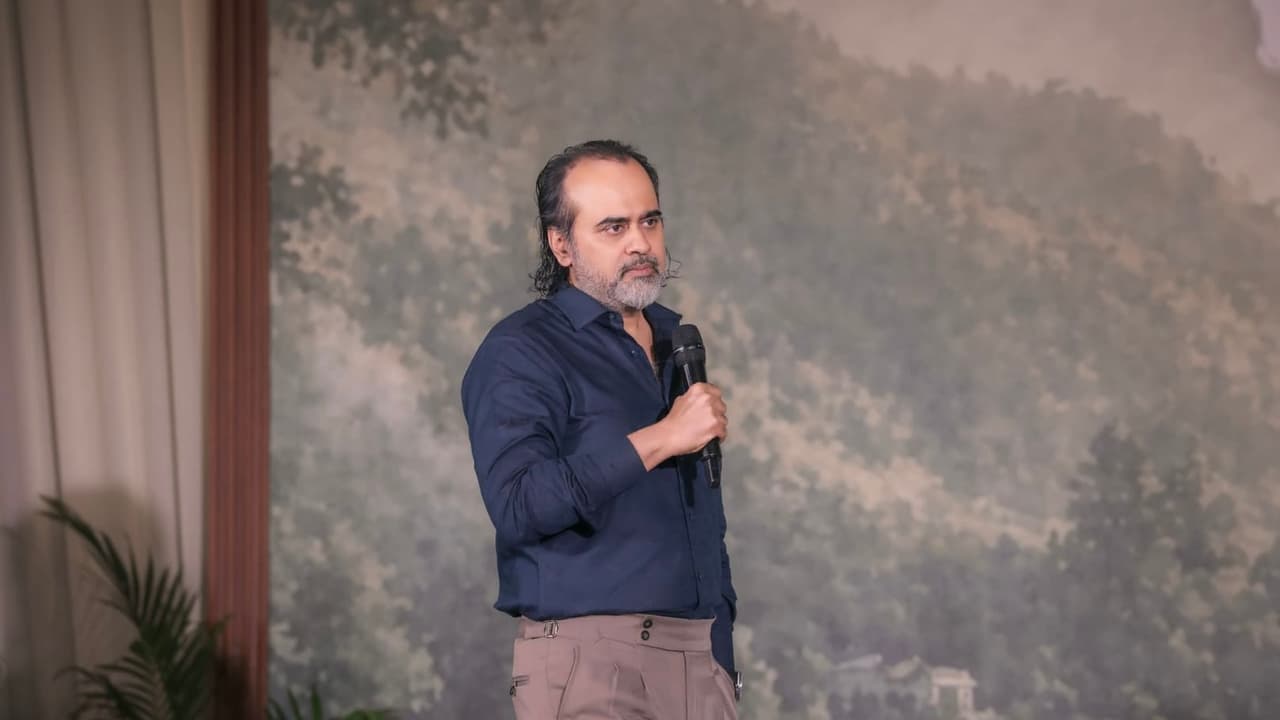
So, it is here that you have to ask yourself — if I really do value love, is there love at my workplace? If I really do value freedom, is there freedom in my occupation? If I really do value realization, do I realize what it means to be a mother? It is in the middle of this saṃsāra that you'll have to ask these questions, because it is here that you are living, eating, breathing and taking decisions.

I'm going to be employed at such a place. Do I know what that means? Do I also know what's pushing me to that place? It is here. And let's say you choose to go to some other place. Even there these questions will arise, because bondage is everywhere. And if you'll not have anybody else to put you in bondage, we are very capable on our own to create internal bondages. So that will be everywhere. And it is in the middle of saṃsāra that you have to seek salvation. You cannot go anywhere else.

Questioner: So, the major cause of suffering is within you. It’s the Arishadvarga (shadripu, the six enemies of the mind) that either control you, or you control them. So as long as they are controlling you, the Arishadvarga, you will keep suffering.

Acharya Prashant: No no, you are rushing to something premature. It's not about controlling. It's about knowing. Just as we said Vedanta has no space for the word "morality," similarly, Vedanta has no space for the word "controlling." It's a very, very liberal science. You don't need to control anything. No. You just don't want to be under somebody's occupation. You don't want to be in bondage. That does not mean that you want to control your mind or you want to control society. No. All those are perversions.

If you are free within, you like freedom outside. You don't want to control anybody. So it's not about controlling this or that. It's about knowing what is happening. And then something borderline miraculous happens.

When you know what the real thing is like, then out of that realization spontaneous action occurs.

Not with an intent to control. Not with an intent to avenge yourself. But just the right action, because it is coming from understanding. Just the right action.

Questioner: You inherently don't want to. Let's say, if I'm greedy, for example, I don't want to be greedy, or I don't decide to be greedy. But it inherently happens that you will reach a situation where you are greedy about money, or you are greedy about something. So it becomes like that. If you can get over those Arishadvarga and hold yourself in good stead, your suffering becomes less.

Acharya Prashant: No, no. It's a little different. How do we know where being greedy is a problem? In fact, where is our definition of greed coming from?

You have to go to the first principles. Vedanta doesn't stop at any level of belief. Even this is a belief, “You do not need to be greedy.” Why do I not need to be greedy? As an inquirer, I'll ask that. Because being greedy is not my fundamental problem. My fundamental problem is I am not all right with myself. That's my fundamental problem.

If being greedy can solve that problem, I'll prefer to be greedy. So I'll not stop at these moral dictums, “Do not be greedy, do not be lustful, do not covet somebody's property, do not be ambitious. This world is a place where you have come only for a few days, so take care of the next world, engage in all kinds of satkarm, nice deeds, be virtuous, take bath twice a day.” That's not Vedanta.

I understand it's commonsensical that greed is a problem. But Vedanta will not say greed is a fundamental problem. Vedanta will say the fundamental problem is the wrong center you operate from. If you can have a peculiar greed arising from the right center, that greed is sacred. May I give the example of that top greed? It's called Mumuksha — the great desire to not accept any bondages, to be absolutely liberated. Why can we not call that a kind of greed, or Mahattvākāṅkṣā (ambition)?

People have small ambitions. This is the greatest ambition — let nothing dominate me. So even greed is all right, provided it is coming from the right center and hence leads to the right outcome. I'm not asking us to be greedy, please. I'm just saying, it's not about particular actions or states of mind. It's about the place you are coming from.

Questioner: When we realized that suffering is happening to me, so after realization, I'm suffering; then you said, action happened. It is not mechanical. But when action happens, sometimes they also create misery or suffering.

Acharya Prashant: No. It can give you pain. It will most probably give you pain. Action coming from the right center will be disruptive. It will definitely be disruptive. So it will give you pain.

Now comes the word faith, which is not a fundamental word. No, not a fundamental word, but an important word. When your action proceeds from your understanding, you do not really care about the consequences. That's the Niṣkāma Karma of the Bhagavad Gita.

When your action proceeds from your understanding, you are so faithful towards the action, there is such great love towards the action, that you become unmindful of the consequences in the future. You are saying, "This action has to happen. It is inevitable, unstoppable, because I know. So this is happening. I'm not even the doer. It is just happening.” It is Akartābhāva (non-doership). I'm not even the doer. It is proceeding from my realization. And when it is proceeding from the realization, the action is all I care for, because it is coming from both my realization. Who cares for the consequences?

But we agree that the consequences are often painful. And the consequences are disruptive. But then Vedanta says we are not obliged to maintain the status quo. Vedanta is for the ones who have the heart for a rebellion. Vedanta is for the disruptive ones, because it disrupts greatly.

The reason is simple — our personal and social frameworks, structures, even the legal structures, are largely based on human ignorance. And if all the structures around us are products of human ignorance, then whatever proceeds from human enlightenment or human realization will be disruptive. As simple as that.

You have your institutions, social institutions, familial institutions, legal institutions — they are disrupted by Vedanta. That's why those in power rarely would love or patronize Vedanta. They will patronize other things. They'll patronize the kind of religion that furthers the status quo. That will be embraced. But Vedanta is a demolition. Vedanta is a bulldozer. Vedanta doesn't care for anything that you hold sacred.

Questioner: Sir, during this whole talk, we have talked about the self, currently just some agreed-upon definition of self. But I would like to ask, 'Can you just for the time being give a definition of self?' And I have a follow-up question also: how do we know that there is a self in the first place?

Acharya Prashant: There is no self, but there is somebody asking this question and saying, “Sir, I want to ask a question."

Questioner: Then I have a question, 'Sir, why does this whole talk always sound like a word salad?'

Acharya Prashant: It will, unless you have great sensitivity towards your suffering. Otherwise, it will sound like somebody else’s business. If I’m not concerned, if I have become so insensitive and cruel towards myself that I don’t mind the state of perpetual agony I’m living in, then it will sound like somebody else’s business. “Oh, somebody else is suffering, maybe.” This is fiction. This is fiction relating to somebody else.

Vedanta is meaningful only to those who have some love for themselves.

Questioner: Namaskar Acharya Ji. I have two questions. So my first question is: how does one identify if something is a bondage?

And the second question is: what is liberation? And what is the metric to quantify when you are on the track of liberation, if you are?

Acharya Prashant: If something is a bondage, if the presence of a particular object in your life — which could be an idea, a person, an institution, a career path, a material object, anything — if it’s a bondage, then it will show up as fear. There would be a clear symptom, and fear is unmistakable. It’s the loudest symptom.

If there is fear in your life, then there are bondages. And I’m pinpointing fear because bondages often disguise themselves as things like care and love also. But if you are afraid of, let’s say, exposing yourself fully to someone who professes love to you, then it’s not love. If there is the presence of fear, if you detect that, then it’s bondage.

I could talk about other things as well. Where there is blind ambition, there is bondage. Where there is greed, there are a lot of symptoms. But the loudest symptom is fear. Check for the presence of fear in your mind. Where there is fear, it points towards bondages. And the mark of the liberated one, or the one proceeding towards liberation, is that fear starts meaning less and less. Not that fear would be completely eliminated in one go, but you will find that it's receding.

“I’m no longer so hesitant, so nervous, so anxious, so frightful. I can start doing things that I was very hesitant about a while back. I can step out. I can take on challenges.” There will be telltale signs.

Questioner: Thank you sir.

Questioner: So, I had a question. So in this journey of self-realization or self-inquiry, I don't know where I am, in what stage I am, no idea. But I see that my old friends, my relations, are fading away. So I don't know how gracefully I should let go of that and accept this without any resentment and loneliness. How do you process this internally? That's my question.

Acharya Prashant: There's a bit of a logical inconsistency here. Nobody is forcing us to drop our relationships, right? It is because we have begun to see something, we have begun to understand something, that certain things, definitely for us as individuals, start appearing as valueless. And therefore, they are dropped. They get dropped. You don't even actively drop them. You just stop holding on to them.

Now this dropping process is happening only because you have seen the worthlessness of those objects. Otherwise, why would the dropping happen? And if the dropping is happening because you have seen the worthlessness of those objects, why would you resent the dropping?

I was okay gripping it (towel) very strongly, thinking that it is a bedsheet or it is a quilt that would protect me from cold. And because I kept it folded, I could never know the exact size of this, the capability of this, the very nature of this. I was holding it like this. It never offered me any protection from cold. But never did I venture into the fact, never did I confront the fact that it is not giving me what I expect from it. I maintained a certain hope. Now I see that this act is the cause of my suffering. So what do I do? I don't even do it. It happens.

Questioner: So for example, because now I'm vegan, and people don't invite me to their home because they don't know what to make for me. For example, these are practical issues. And in offices, people are not inviting to lunch because they cannot offer non-alcoholic or non-veg, all those things. So I feel like I am kind of sidelined.

Acharya Prashant: You were always sidelined, not today. You see, if the relationship was so shallow that it depended on culinary preferences, what kind of relationship would it always be in the first place? Please tell me, what kind of friendship is it if you don't eat what I eat, then I don't want you dining with me? Shouldn't you celebrate getting rid of such relationships?

Questioner: Yes. But some happen to be our own loved ones, like relations.

Acharya Prashant: The very definition of love comes into question here.

Questioner: Like, blood relation.

Acharya Prashant: Blood hi to hai kya ho gya? What blood? There is no blood relation. There would be hardly anybody here who never donated blood or who never got a blood donation, blood infusion. What blood? Sabki ragon mein sabka khoon daud raha hai. And when we go to a blood bank, do we inquire about kiska khoon hai? Think of something like — dengue, platelets chaiye to puch ke lete hain kya? Or hamare blood relation kaam aate hain? Kya karna hai?

What is blood relation? Body identification.

There is a kinship that depends on blood, and there is a kinship that depends on consciousness. The relationship of consciousness is the real one.

What is the Bhagavad Gita all about? All these blood relatives are fighting each other and shedding each other's blood. But the one relationship that shines forth is the one between Shri Krishna and Arjuna. And these two are distant relatives.

When Shri Krishna is preaching to Arjuna, Arjuna is not listening even to his own elder brother, and his elder brother was called Dharmaraj. And it’s a discussion involving the very essence of Dharma, and even Dharmaraj is not being invited. Arjuna is not saying, “I’ll listen to my blood relation. Why should I listen to Shri Krishna? He’s a distant relative. My blood relative is Dharmaraj. Dharmaraj, you come and tell me what he’s feeling.”

So, blood relatives and all, fine, we understand. There is a certain attachment — family, cousins, this, that, but as you gain maturity, you realize that relationships of a different kind are what really matter in life.

Questioner: Okay. Thank you.

Questioner: Namaskar Acharya Ji. In our everyday lives, currently, our mind is constantly bombarded with a lot of ideas about work, about everything. A lot of things affect us in our daily lives. So, my first question is: How do we discover ourselves even in this constant flux? How do we hold on to something?

Acharya Prashant: See, it is only in the flux that you can see what is happening. It is only in the flux. You are in the classroom, you are one person. You move out of the classroom. You receive a call from your mother. Don’t you see, you become another person. That’s the flux. The world is constantly changing, and the self is changing along with it. Then who am I? And why will I not suffer if the self is so dependent on time and place?

The fellow is one man at the office, so obedient to the boss, the yes-man constantly: “Yes, sir. Obviously sir. Will be done, sir. Thank you, sir.” The knock-knock is returned. And then there is the obedient wife: “Ah, get me the tea.” The tea is thrown away, and the kid is slapped. Do you see how the self changes with the situations? That is the flux.

And once you see that it’s all a flux, then there is no self — because by self, you mean something that must remain unchanging, at least slightly unchanging. This that you call as the self is so dependent on the flux that it is not stable even for a nanosecond. Then who are you?

Once you see that, it is a little upsetting, but it is also very liberating. I'm nobody. I'm just nobody. This nobodiness, it doesn't stop here. This is some kind of an invite, a trailer. It is deeper than this. It has to be all yours. Coming from me, it will sound a little foolish, a little absurd, a little meaningless. It has to be your own.

When you see this in your own life, standing here, you are one person. You sit down, your neighbor utters a foolish joke in your ears, and you're another person. See how you have changed? See how you have changed? Then who are you? Do you exist? Is there anybody called the individual? If it's all a flux, then this realization is possible only in the flux. And therefore, meditation of the kind that goes against the flux, that disrupts the flux, you say, "You know, I'm sitting and watching myself." That will have only very limited success.

Real meditation, real self-observation must happen in the middle of the flux.

Here's my friend, and the grade sheet has just been put up, and I find him having better grades than me. I coached him for the exam. He didn't know anything. On the eve of the exam, he was rolling in anxiety, prepared to die. Then I said, "Come, I'll share my notes." I tutored him, and looked at this. The fellow is at A minus. I am at B. Who are you? A great friend? A jealous one? Who are you?

And when you were coaching him, tutoring him, helping him, you see how you credited yourself with being a great helper. Do you remember? Do you see that? Do you see that? What is the nature of this so-called help then? Do you see that? And that can be seen only in the daily movement of life. You don't have to go to the Himalayas for that.

A particular beggar comes to you. You're a nice man. Religion has told you to be charitable. So you extend a 10 rupee note, "Please take," or a coin, something, "Please take these 10 rupees." And the fellow takes then (went away), “thank you bhi nahi bol sakta tha there was no gratitude on his face. He'll rot in hell!" Even 10 rupees, it is difficult to give without expecting at least gratitude. Were you giving something or bargaining then? Was it an act of charity or was it a bargain?

Charity or bargain?

And that can be seen only, only in this flux. The beggar has to come to you. You have to offer him something. It's all happening. In this happening, you see the reality. So, Adhyatma is not about impeding the happening. It is about going into the happening. It is about remaining present to the happening. And a lot gets disclosed there.

Questioner: So you always talk about the center. Like you said, when the karta is at a proper center, the appropriate work will happen. So what is the description or the definition of that center? Because whether it's my understanding about…

Acharya Prashant: Just the fact whether you have jumped in blindly into it or you have understood, have understood bhi galat hai, whether you are constantly understanding it.

There is this that the scriptures call as tamas within us. It is a lover of sleep. It says, "Whatever is happening, I'll keep sleeping." And there is a certain pleasure in sleeping, no? Even in the worst of your times, if you fall asleep, you're all right. "I'm sleeping." Nobody suffers in sleep.

There is something within us that comes up with a very nefarious response to suffering that says, "The response to suffering is, fall asleep internally." Even if you're suffering from cancer and you fall asleep, even if you are to be hanged tomorrow and you fall asleep, there is no suffering for that period. So that's the trick we play with ourselves. We decide to fall asleep internally. And that sleep extends all our life. And that's what you have to guard against.

Ask yourself — do I know or am I just flowing? Do I know or am I just being carried away? That's the center. The center of blind flow versus the center of awakening, knowing.

This article has been created by volunteers of the PrashantAdvait Foundation from transcriptions of sessions by Acharya Prashant
Comments
LIVE Sessions
Experience Transformation Everyday from the Convenience of your Home
Live Bhagavad Gita Sessions with Acharya Prashant
Categories