Continuity, Not Perfection

Acharya Prashant

15 min
764 reads
Continuity, Not Perfection
What does imperfection look like? The face in the mirror — that’s imperfect. Every imperfect person, according to his or her conditioning, dreams of perfection in his or her particular way. Perfection is a concept, an imagination. So, should I chase this imaginary ideal called perfection, or should I just look at my current state? We are not okay as we are. And in this lies the inspiration to get better, to move on. This summary has been created by volunteers of the PrashantAdvait Foundation

Questioner: Sir, when I was going through the book, Truth Without Apology, there was this one simple quote. It was not exactly a quote, but a chapter heading. It says, “Continuity, Not Perfection.” Now, this is a very simple sentence, but when I read this, it confused me a lot because it went against whatever I was forcing myself to believe in. I’ll give you a little context.

This January we had our college’s interdepartmental competition, and I came up from my department for the solo dance category. There were a lot of expectations on me to bring home the winning title. When I was preparing for the solo dance, for context, I love dancing. Dancing is something that enriches my soul and lifts me up no matter how bad my mood is. But during the preparation for the dance, the expectations and this pressure to win slowly started overpowering my love for this craft.

So there were points, even during the preparation, where I felt, ‘I’ll do this dance tomorrow,’ like you study for an examination, and that scared me because this was one thing I genuinely enjoyed, something unique to me, and suddenly it was just another thing I had to do. Now, even after I won the title, I did not feel half the happiness I thought I would feel. You know the ‘yes, I did it’ moment was not really that big of a deal.

Even after that chapter of my life ended, I took away that strive for perfection and the stress along with me in every part of my life. I started stressing myself over every small thing — be it something as simple as hobbies or studies. I kept thinking, ‘I have to be good, I have to be perfect,’ and I set unrealistic standards for myself. If I failed to meet those standards, I was dejected. I was like, ‘No, this is not how it’s supposed to go.’

So, sir, I want to know: how do you start loving this journey again, this journey called life, without making every step you take feel like a test you have to pass and win?

Acharya Prashant: So, “Continuity, not perfection.” Standing where we are, how many of us are perfect? Okay. How many of us are definitely imperfect? I am, for one. So, what is perfection then for you? If you aren’t there, where does this word come from?

Do we know something called perfection, or is it a mere concept and imagination? Please tell me. Something like perfection would correspond to infinity. You can have a sign, a symbol for it. You can have a theoretical definition. But can you know what infinity is? Just because you have a symbol for it, doesn’t mean that you know infinity, right? Or zero kelvin, theoretically we know what zero kelvin means, but it’s not attainable. You can come very close to it, but not really attain it. Getting it? So that’s perfection, which is a concept, an imagination, a thing of mind.

And then there is imperfection. Imperfection, which is our breath, our daily life, our movements, our thoughts, our emotions, our actions. All of that is steeped in imperfection. So we have a very close relationship, a very clear acquaintance with imperfection. Are we together till this point? We know what imperfection looks like, right?

What does imperfection look like? The face in the mirror, that’s imperfect. That’s how familiar, deeply familiar we are with imperfection. We see imperfection everywhere. Nothing but imperfection, right? So perfection is a concept. Imperfection is the fact of daily life. And how does this fact feel to you? You wanted to do something in a particular way and you fell short, well short. How did you feel when you were not able to live up to what you really can do during your dance rehearsals, or studies, or sports, or anything? Does it feel good to not be able to match your potential? No.

So that’s an added thing now. There is perfection of which we really know nothing. It’s like the end of the universe, the boundary of the universe, we know nothing of it. And then there is imperfection with which we are always familiar. And this imperfection, we are now adding, does not really feel good. One never feels at rest, satisfied, contented with imperfection—with flaws that could have been prevented. Right?

So what would be then your inspiration to reach an imaginary place, a place that is an imagination of the imperfect one? Or to see where you are, which is the fact, which is the reality that cannot be doubted or disputed, and just take the next step?

We said perfection is mentation. You think of it. There is perfection somewhere. “When I’ll be perfect, I’ll be like that.” How do you know you’ll be like that? How do you know that the imagination you have even corresponds to real perfection, or whether anything called real perfection actually exists?

You go to a five-year-old kid, he too will have a concept of perfection or infinity or limitlessness. But what kind of concept would that be? That would be the concept of the five-year-old. So it will be a childish concept. Right? This same kid grows up to fifteen. Now you ask him or her, “What does perfection look, feel, touch, smell like?” And this fellow, this kid, will now come up with a totally different story about perfection. Correct? Because this is now the perfection, the concept, the picture, the image of the fifteen-year-old one. Right?

So this perfection that we think of, first of all, we don’t know it. Secondly, the imagination that we have of it corresponds to our current imperfect state. So P is FIP — the perfection that we think of is a function of imperfection. Do you get this? Every imperfect person, according to his or her conditioning, thinks or dreams of perfection in his or her particular way. And the way is imperfect because it is the way of the imperfect one.

Being imperfect, can you really know anything? And if you cannot really know anything, how can you really dream of something that is actually perfect? You cannot, right? So there is this imaginary star called perfection, and this star keeps changing depending on my own state. If I’m five, this star looks one way. At fifteen, thirty-five, fifty-five.

So first of all, it’s just too far away. I know nothing of it. Secondly, it’s very ephemeral and very subjective. It depends on who I am, and I am imperfect. So should I chase this imaginary ideal called perfection, or should I just look at my current state? And it is my current state that is full of flaws. It is because of these flaws that I want to escape into dreams of an imaginary thing called perfection.

If at this moment everything is all right, why would you dream of perfection?

If at this moment you are perfectly satisfied and joyful, would you dream of a far place called perfection? Does that happen? When you are perfectly okay with things as they are, do you want to dream of some other place?

So the whole problem is we are not okay as we are. We are not okay as we are, and that’s fine. That’s fine. We are not okay as we are. And in this lies the inspiration to get better, to move on. So the reference point is your current condition, not that far-off ideal. You cannot say that far-off ideal pulls me, because you do not know that ideal. And that ideal is actually nothing but a magnified mirror image of who you are right now. Remember. ‘I’ is equal to FIP. That far-off ideal is just a big, amplified, magnified image of who you are right now.

So reaching there will not take you away from your current mess. In fact, it is quite possible that perfection as we dream of it is a bigger mess than the one we are currently in. It is possible. There are utopias, there are ideals, there are dream states, and history has shown us that men have strived for them, and when they reached there, they found out that this is a bigger mess than the one we escaped from.

The reason is simple. The reason is inner. This dream state or situation, this utopian system that you want to reach, is but a product of your own imagination from your own current imperfect state. So how can your imagination be perfect?

So let’s drop all that then. Let’s just look at how things really are right now. And as you look at them, the more clearly you look at them, the more you say, “No, I don’t want it to be like this.” It is impossible to look at how anything is and say, “Let it remain as it is.” If you can honestly look at things — life, movements, thoughts, relationships, anything. If you can honestly look at it, the first energy that rises is of transformation. You say, “This needs to change. This needs to get better.”

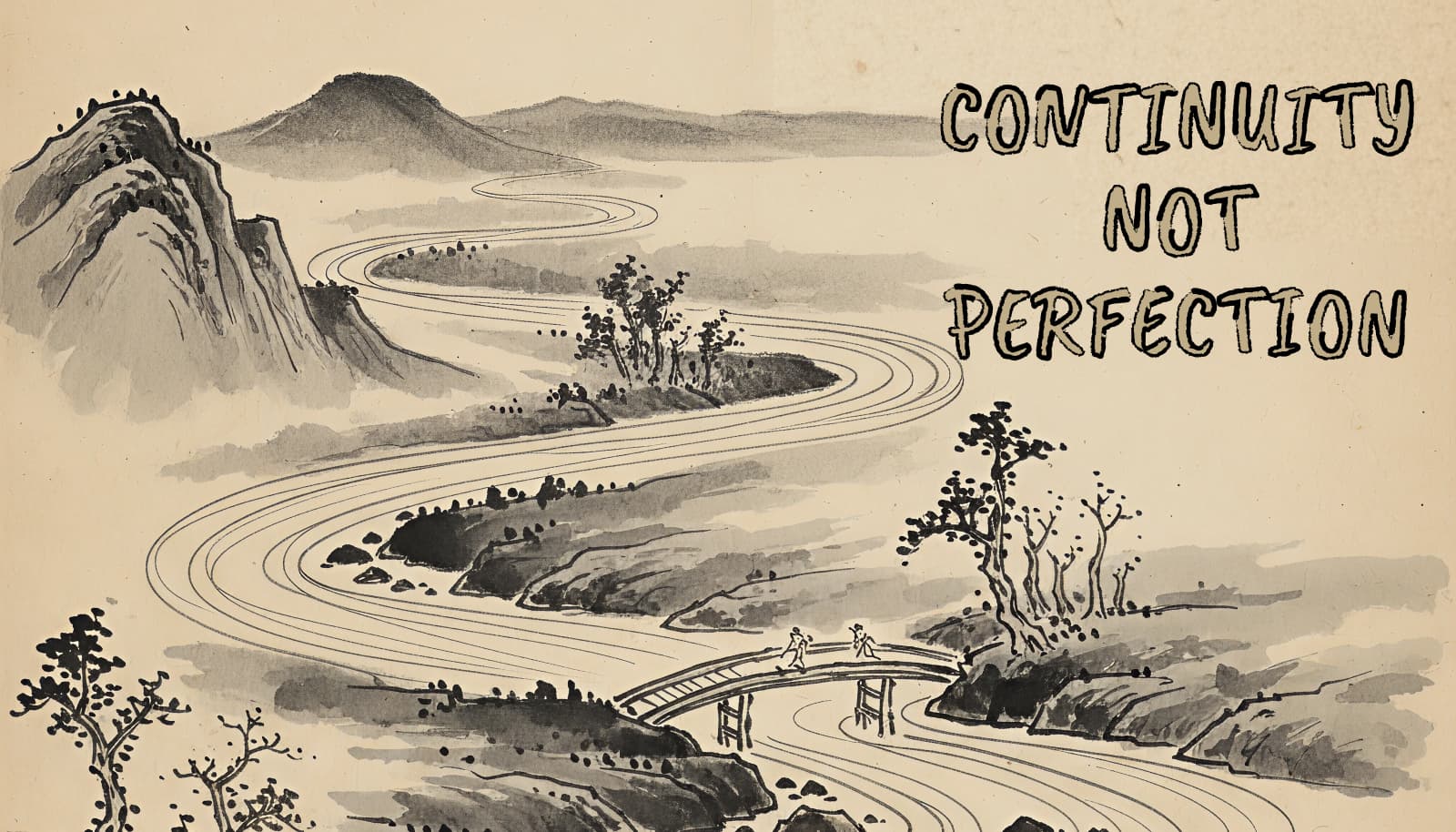
And that’s how movement can happen. That’s how continuous movement should happen. And hence the chapter of the book is titled “Continuity, Not Perfection.”

Just continuously keep bettering your current state.

Let that be the center from which your improvement comes. Instead, we think improvement will come when we have a great dream hanging in the skies and pulling us upwards.

No. You’ll have to be like a rocket that is launched from the earth using materials of the earth and then probably keeps ascending into the sky. But just dreaming of the sky and imagining that some great rope is going to fall from there so that you can be pulled up, that’s not happening.

Questioner: So when you said the next step right now should be towards something that you want to better right now, if I want to become a better dancer and I don’t think I’m a good enough dancer, I’ll think about my flaws and I’ll try to better them. But when you said you should take a step forward, most of the time there are multiple directions where we can go, right? So can we look at the ideal, as you suggested, the infinitely tended perfection? Can we move towards it, or do we move towards the most practical path right now?

Acharya Prashant: It’s about seeing things as they are, and then you don’t have to decide really which way to go. If you can see how things really are right now, your inner nature is to avoid rubbish. There is this thing within the self that does not like bondages, that does not like filth, that does not like fakeness. If you can just spot it, that is the beginning of your freedom from nonsense. So having spotted it, you won’t have to worry, “Now what is the next step to take?” The next step then emerges on its own. Mind you, emerges is not imagined. It emerges on its own — spontaneously.

But for that, you’ll have to be very honest in confronting your current situation. The problem does not lie in that we do not have perfect ideals. No, that’s not the problem. The problem lies in the fact that we are not honest enough to look at ourselves as we are, because reality is sometimes ugly, painful, and makes us uncomfortable. So we don’t look at our reality. But if you can do that, if you can master the courage, then the next action doesn’t have to be premeditated. Then the next action happens on its own.

I’ll give you an example. If I am to speak to you or to you (pointing towards the questioner and the listeners), should I have an idea of what I must tell you, or must I just listen to you carefully? Please tell me.

Questioner: Listen carefully.

Acharya Prashant: Or I could have a premeditated thing, something like a PPT (power point presentation), and we could project it here, right? And I could say, “This is what I have come to deliver.” Would you rather like that? (The listeners shake their heads in refusal.)

So that’s how ideals are. You already have something predefined: “This is what I have to do with my life, my future.” So in the morning the PPT was ready. I know this is what I need to deliver in the afternoon. And I come here and I deliver it and I think I’ve done a great job. Have I? No. Instead, I choose to come to you and dynamically, spontaneously, in a very living, breathing way, interact with you.

Now, how do I then respond? This response is also an action, is it not? From where is this action arising? This is arising just from listening to what you are saying. So you attend to the present, the fact as it is, as it is. And when you spoke, did you tell me of your perfection? You told me of your struggles. You told me of a situation that made you feel uncomfortable, not easy, a bit restless, right? Challenged. You told me of those things.

So we spoke of imperfections. And it is in dealing with these imperfections that we realize what the response would be. And the response comes on its own. Did I know this question is going to be asked? Not really. Did I know that this thing would just pop up in between? Not really. From where do I respond then? Just by seeing how things are. You look at things as they are and then something happens, and you have to have trust. Once I know how things are, then whatever I do will be better than what has been done till now. All that which has brought things to the mess that they currently are. I will be doing better than that once I know the facts, the bare naked honest facts.

Questioner: Sir, I have a doubt. Sometimes we wake up in the morning and we imagine that I could have done something better yesterday or something. So, like when we start doing that thing, we now imagine that the other person, what he is doing, is more appropriate or that it is more correct.

Acharya Prashant: You see, you obviously can look at the other person, you can look at benchmarks, but all that has to be used just as a tool to look better at yourself.

I’m asking you, when you glance at a mirror, is it the mirror that you want to see? But then everybody is found looking at mirrors. You’re so fond of mirrors, are you? Are mirrors beautiful in themselves? So all things have to be used as mirrors — not because those things really contain something valuable to be seen, but because those things can reflect you back to yourself. You can see your own real situation via those things, using those things.

So you just can’t understand where you’re going wrong. Let’s say in a dance step or you are solving a differential equation, something. So you look at the other one, that’s fine.

Comparison is fine, but comparison is not fine if you want to become like the other. Comparison is fine if comparison tells you where you stand.

That is fine then. Then comparison is acting as a mirror, which is fine.

This article has been created by volunteers of the PrashantAdvait Foundation from transcriptions of sessions by Acharya Prashant
Comments
LIVE Sessions
Experience Transformation Everyday from the Convenience of your Home
Live Bhagavad Gita Sessions with Acharya Prashant
Categories