Acharya Prashant is a philosopher and author, an alumnus of IIT Delhi and IIM Ahmedabad. He is among the most widely read philosophical columnists writing in India today, with more than 190 published columns ranging across climate and consumption, elections and ideology, caste and religion, gender, education, geopolitics, technology, and the inner life.
What unifies this range is a single method: tracing every public crisis back to the unexamined self that produces it.
FOR COMMISSIONING EDITORS
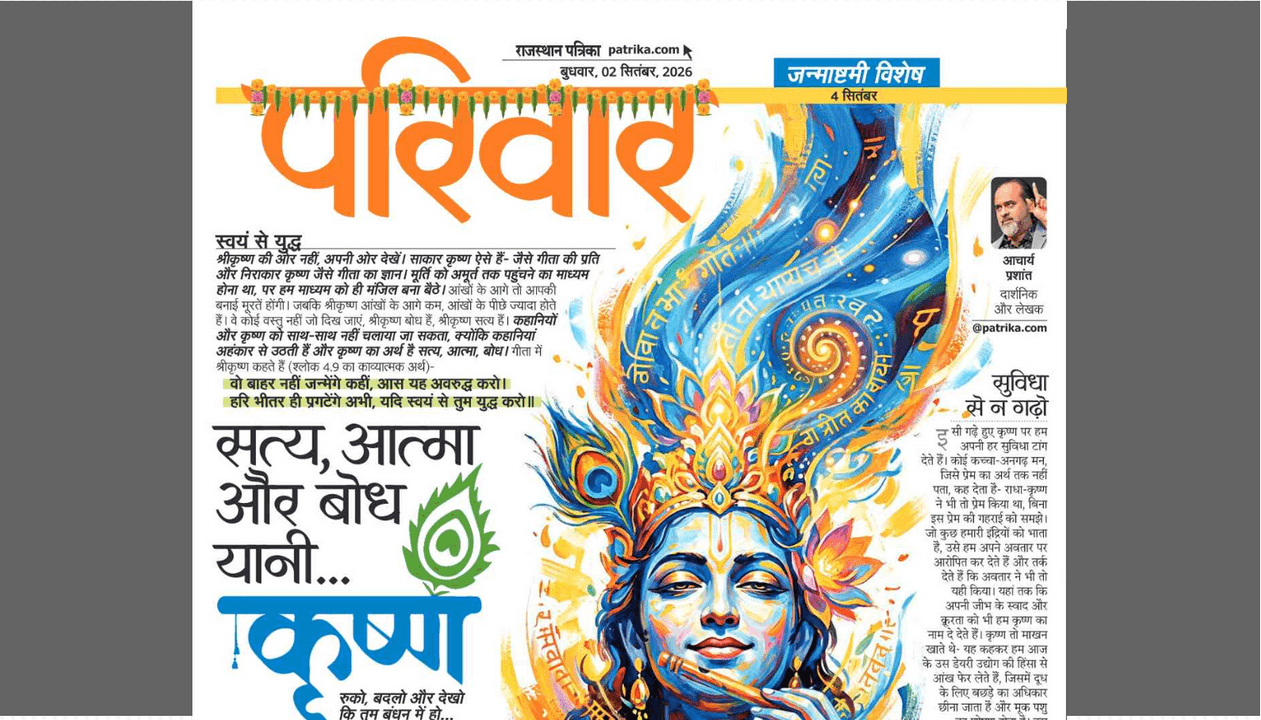
In this special Janmashtami feature published in Rajasthan Patrika, philosopher and author Acharya Prashant explains why the true Krishna is not an idol to be worshipped from a distance, but Truth, the Self, and Realization (Satya, Atma, Bodh) itself.

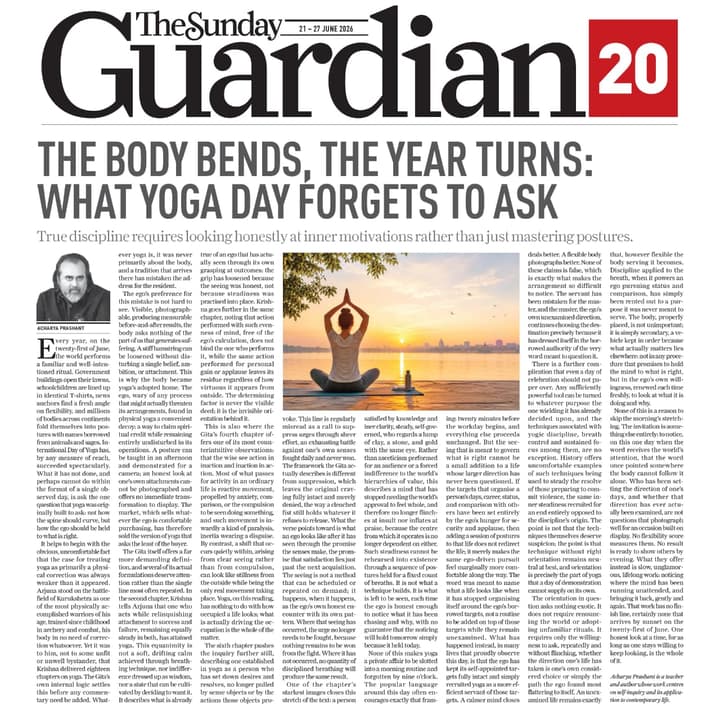
"The case for treating yoga as primarily a physical correction was always weak. Arjuna stood on the battlefield of Kurukshetra as one of the most physically accomplished warriors of his age, trained since childhood in archery and combat, his body in no need of correction. Yet it was to him, not to some unfit or unwell bystander, that Krishna delivered eighteen chapters on yoga. Whatever yoga is, it was never primarily about the body, and a tradition that arrives there has mistaken the address for the resident."

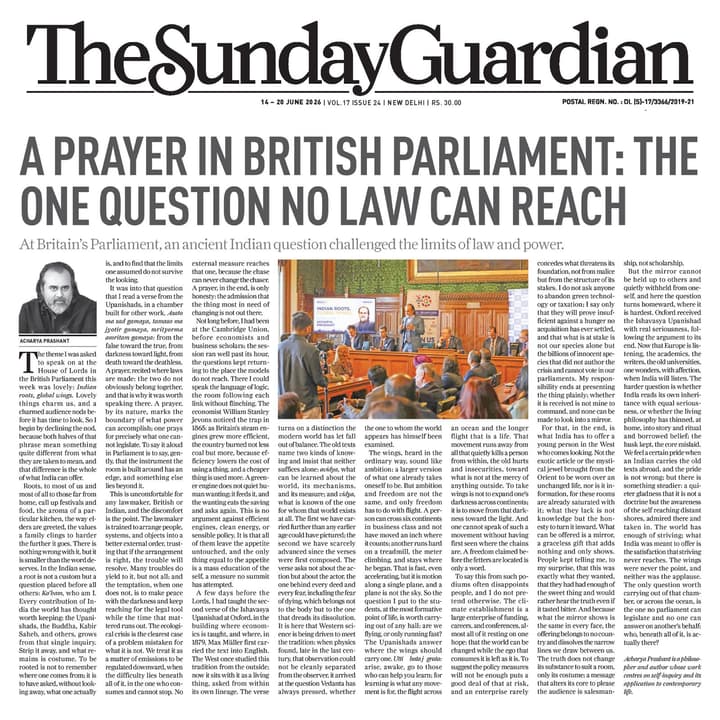
"The theme I was asked to speak on at the House of Lords in the British Parliament this week was lovely: Indian roots, global wings. Lovely things charm us, and a charmed audience nods before it has time to look. So I begin by declining the nod, because both halves of that phrase mean something quite different from what they are taken to mean, and that difference is the whole of what India can offer."

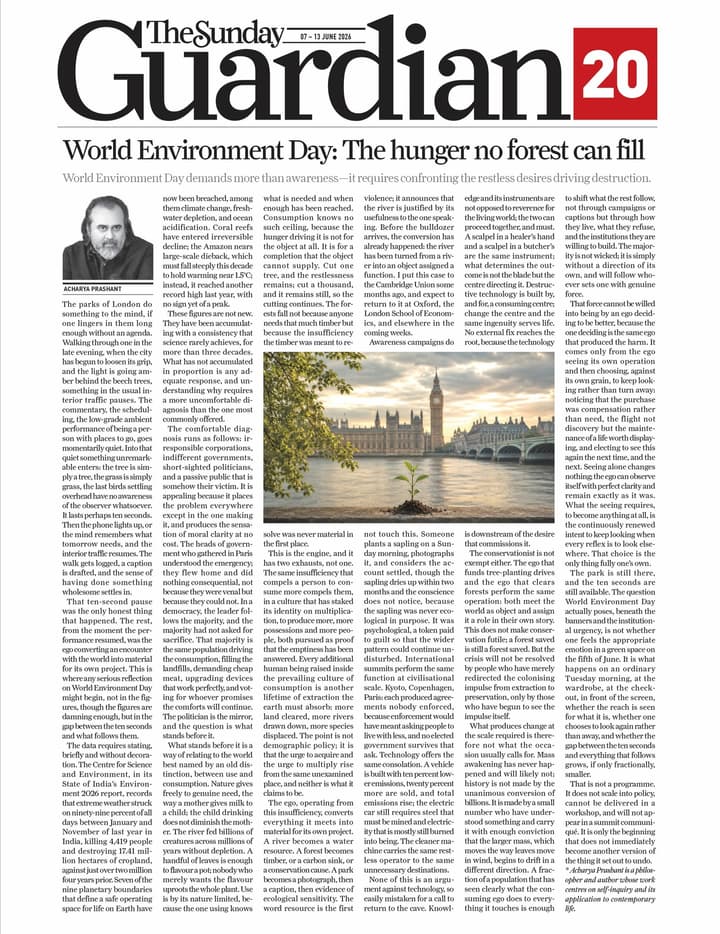
"The parks of London do something to the mind, if one lingers in them long enough without an agenda. Walking through one in the late evening, when the city has begun to loosen its grip, and the light is going amber behind the beech trees, something in the usual interior traffic pauses."

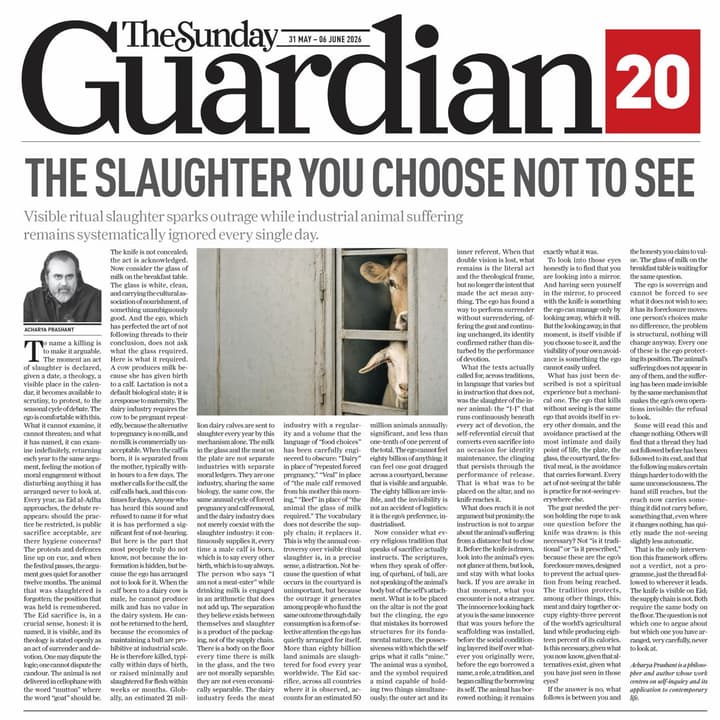
"Every year, as Eid al-Adha approaches, the debate reappears: should the practice be restricted, is public sacrifice acceptable, are there hygiene concerns? The protests and defences line up on cue, and when the festival passes, the argument goes quiet for another twelve months. The animal that was slaughtered is forgotten; the position that was held is remembered."

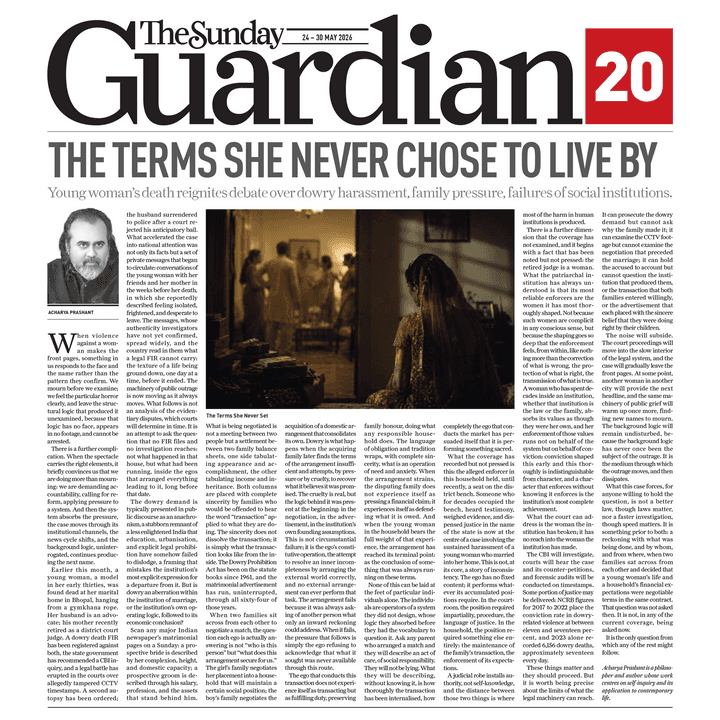
"The dowry demand is typically presented in public discourse as an anachronism, a stubborn remnant of a less enlightened India that education, urbanisation, and explicit legal prohibition have somehow failed to dislodge, a framing that mistakes the institution’s most explicit expression for a departure from it. But is dowry an aberration within the institution of marriage, or the institution’s own operating logic, followed to its economic conclusion?"

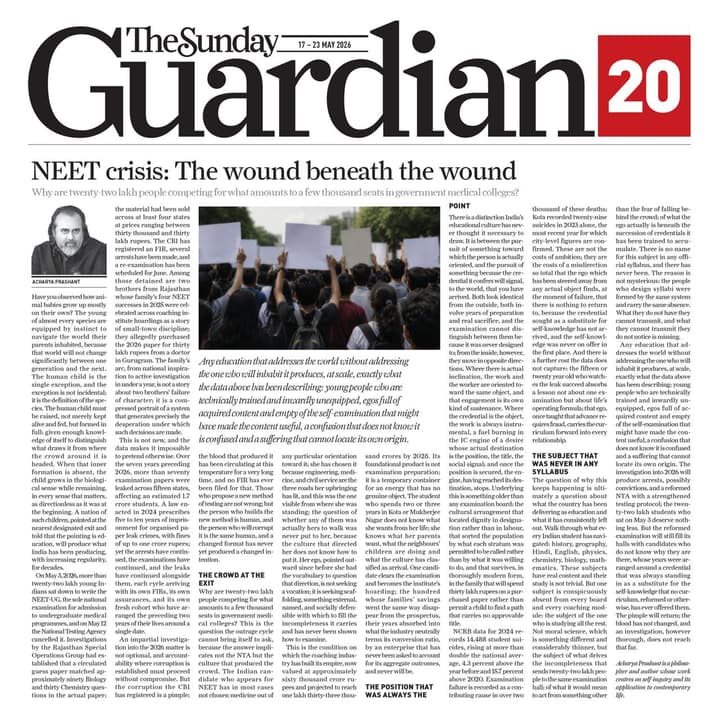
"The investigation into 2026 NEET-UG cancellation will produce arrests, possibly convictions, and a reformed NTA with a strengthened testing protocol; the twenty-two lakh students who sat on May 3 deserve nothing less. But the reformed examination will still fill its halls with candidates who do not know why they are there, whose years were arranged around a credential that was always standing in as a substitute for the self-knowledge that no curriculum, reformed or otherwise, has ever offered them."

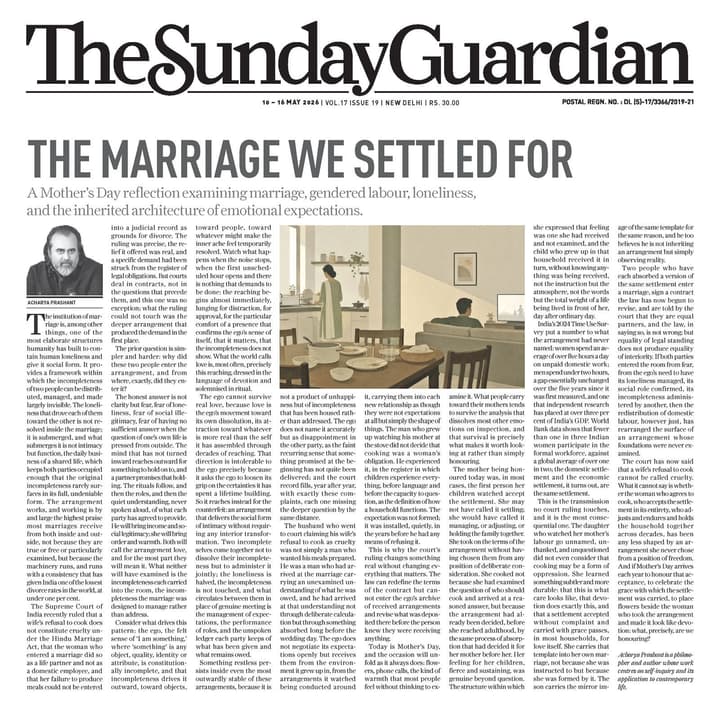
“The mother being honoured today is the first person her children watched accept the settlement. The daughter who watched her mother’s labour go unnamed, unthanked, and unquestioned did not even consider that cooking may be a form of oppression. She learned something subtler and more durable: that this is what care looks like, that devotion does exactly this, and that a settlement accepted without complaint and carried with grace passes, in most households, for love itself.”

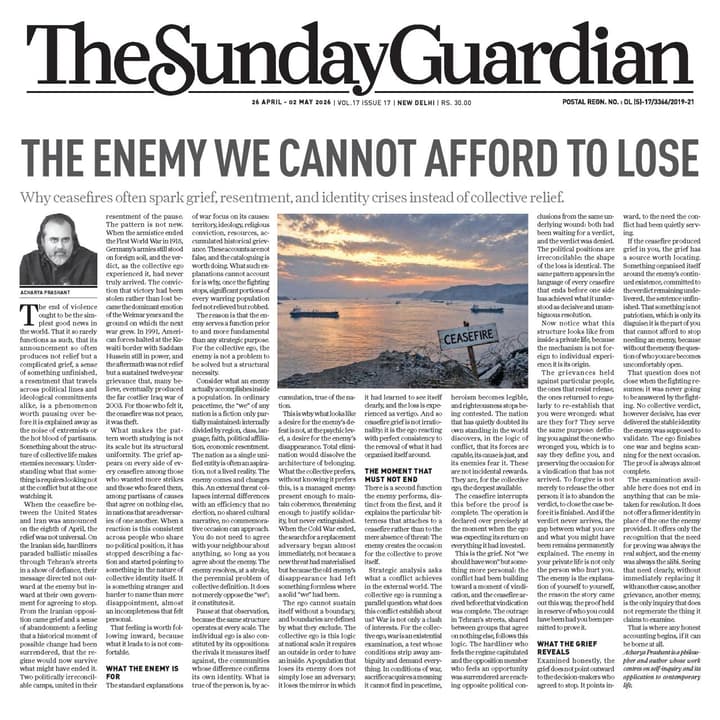
"The end of violence ought to be the simplest good news in the world. That it so rarely functions as such is a phenomenon worth pausing over. Something about the structure of collective life makes enemies necessary. Understanding what that something is, requires looking not at the conflict but at the one watching it."

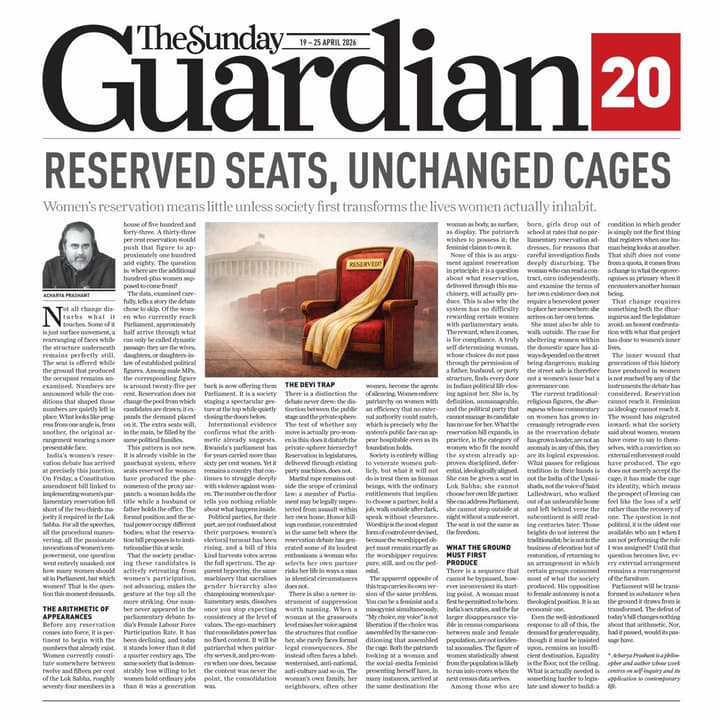
"Women’s reservation means little unless society first transforms the lives women actually inhabit."

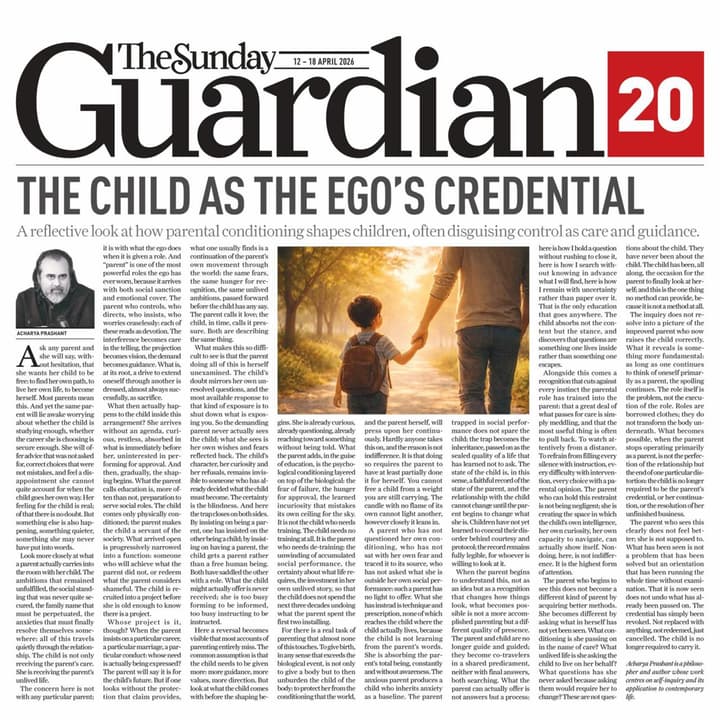
"A parent who has not questioned her own conditioning, who has not sat with her own fear and traced it to its source, who has not asked what she is outside her own social performance: such a parent has no light to offer. The state of the child is a faithful record of the state of the parent, and the relationship with the child cannot change until the parent begins to change what she is."

"The decision to depart, when genuine, must be the person’s own, arrived at in full awareness, not extracted by family exhaustion, economic pressure, or a system that has run out of ideas. It cannot come from pain alone, because suffering without self-knowledge produces desperation rather than clarity, and desperation and dignity are not on the same register."

"The sense of incompletion that propels a young professional to book a flight to a destination he has already mentally photographed, to build a house with rooms that will rarely be used; this is not a rational economic decision. It is the ego’s oldest and most relentless reflex: I am insufficient as I am; adding, acquiring, displaying will resolve the insufficiency."

"The real war is the one the ego wages against honest seeing, the war between what it is and what it insists on being taken for. It is the hunger the ego carries meeting a reality that will not satisfy it; the persistent feeling that something is missing whose name cannot be found because finding it would require looking at the one who feels it."

"What makes this machinery particularly effective is that it finds its subjects already converted. By the time a young aspirant is old enough to question the direction he has been pointed in, he has already invested years, and the sunk cost holds him in place."

"On 8th March every year, International Women’s Day is observed, speeches are made, and achievements are listed. But the woman sitting quietly behind all of it, the one who has given and accommodated her way through life, is not waiting for a celebration. She is waiting, perhaps without knowing it, for permission to ask who she actually is beneath everything she was told to be."

"Most education concerns itself with objects. Chemistry studies substances, physics studies matter and energy, economics studies exchange, etc. Even psychology studies behaviour as something observable from the outside. The curriculum grows more detailed each year. Our grasp of the world becomes more precise. But you, the self, are not an object in that world. You are the one to whom the world appears. And that fact is seldom examined."

"Summits will improve their screening, and budgets may rise, but these corrections address the temperature of the room while leaving the fire untouched. What must change is the inner posture toward inquiry itself, beginning where the distortion was first installed."

When a social arrangement is given the name of religion, it becomes nearly impossible to dismantle. You can legislate against it, protest against it, write constitutions that explicitly forbid it, and it will survive, because people will obey the law in the open and worship the belief in private.

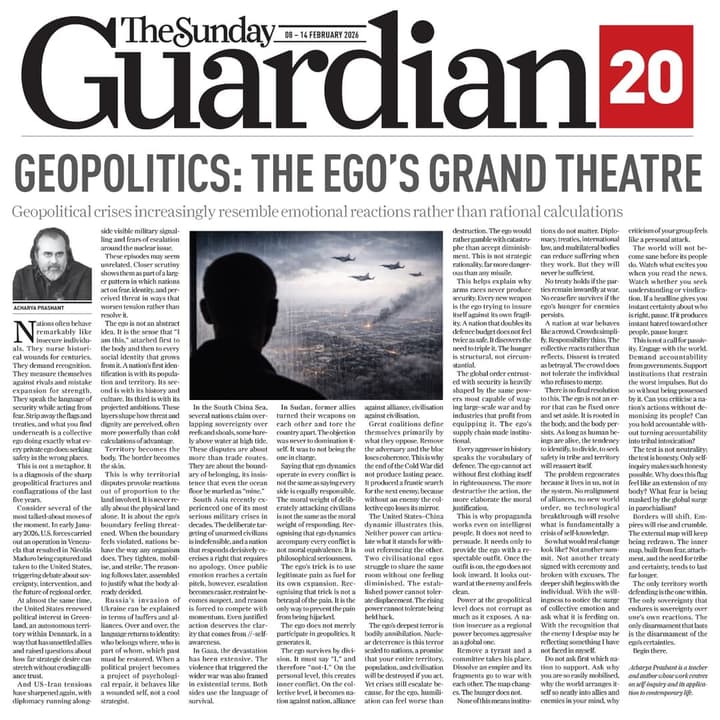
"Nations often behave remarkably like insecure individuals. They nurse historical wounds for centuries. They demand recognition. They measure themselves against rivals and mistake expansion for strength."

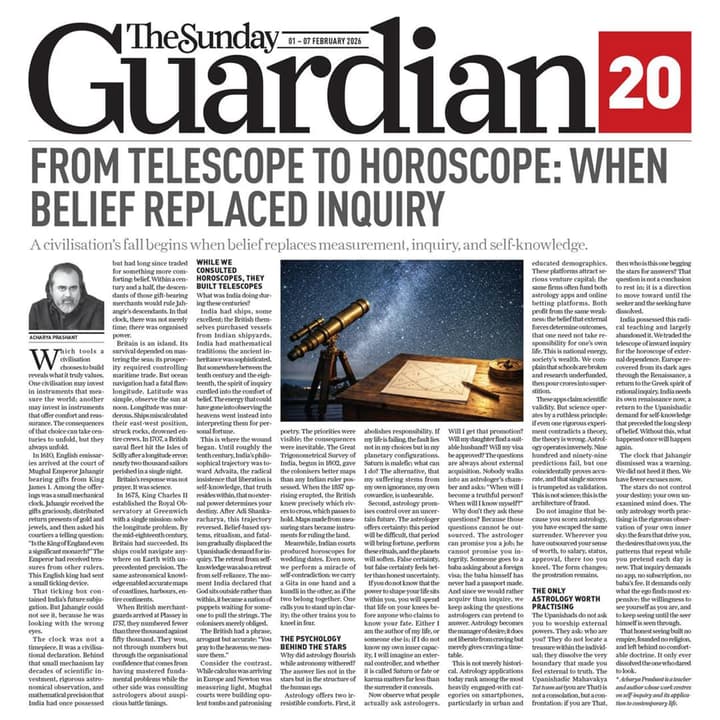
"One civilisation may invest in instruments that measure the world; another may invest in instruments that offer comfort and reassurance. The consequences of that choice can take centuries to unfold, but they always unfold."

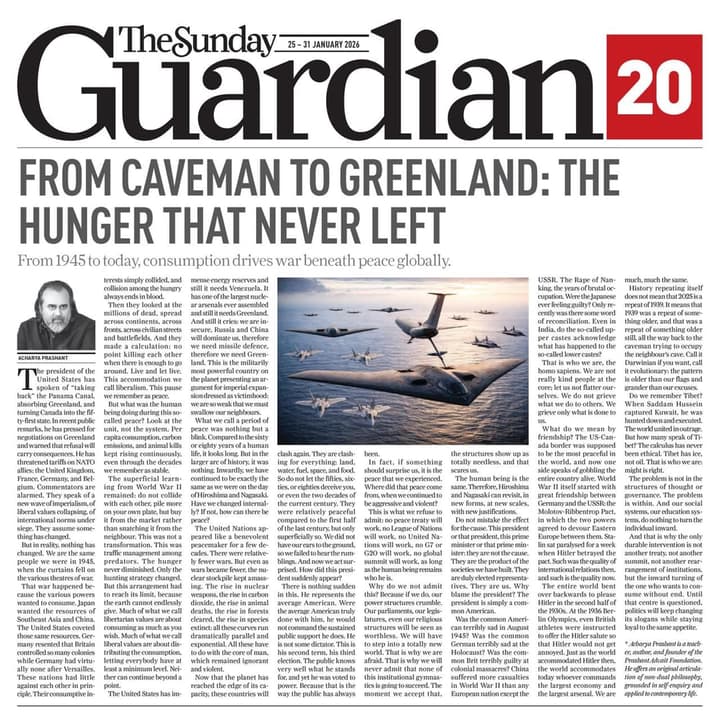
“But what was the human being doing during this so-called peace? Per capita consumption, carbon emissions, and animal kills kept rising continuously, even through the decades we remember as stable. The superficial learning from World War II remained: do not collide with each other, pile more on your own plate, but buy it from the market rather than snatching it from the neighbour. The hunger never diminished. Only the hunting strategy changed.”

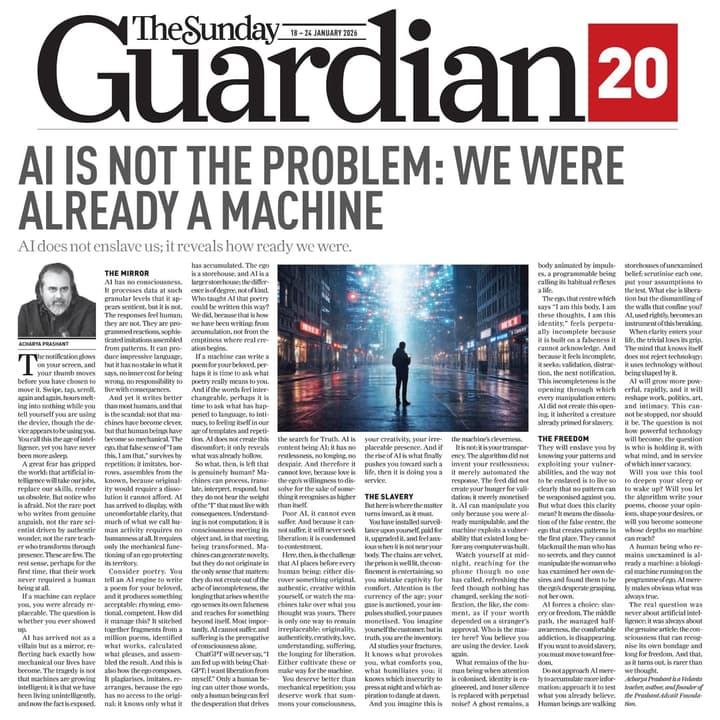
"AI has arrived not as a villain but as a mirror, reflecting back exactly how mechanical our lives have become. The tragedy is not that machines are growing intelligent; it is that we have been living unintelligently, and now the fact is exposed."

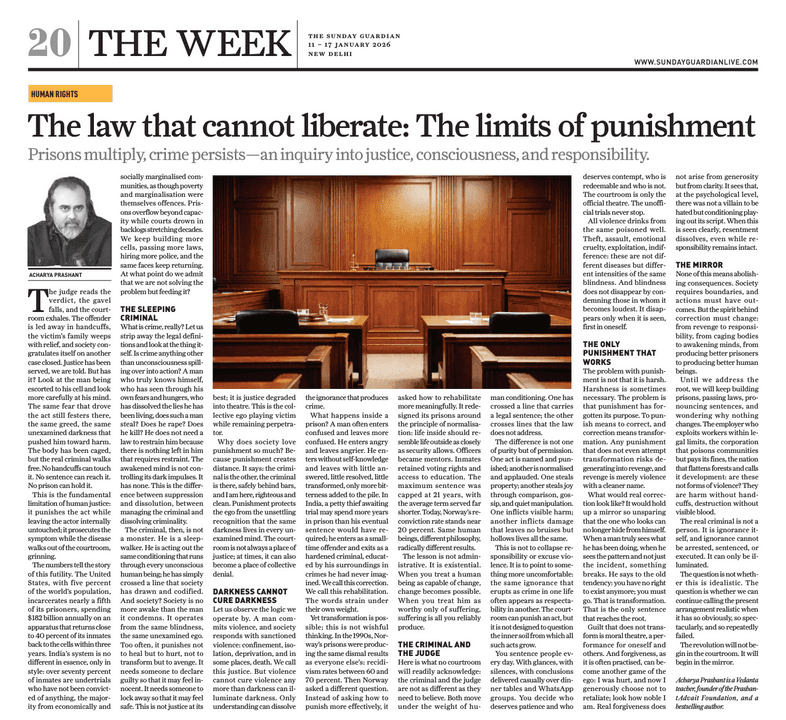
"Prisons multiply, crime persists—an inquiry into justice, consciousness, and responsibility."

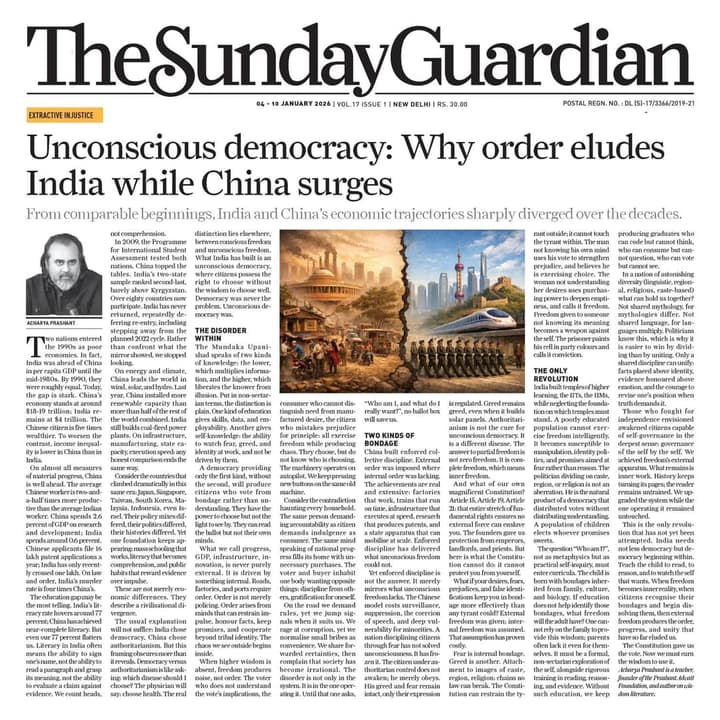
"Two nations entered the 1990s as poor economies. In fact, India was ahead of China in per capita GDP until the mid-1980s. By 1990, they were roughly equal. Today, the gap is stark. China’s economy stands at around $18–19 trillion; India remains at $4 trillion. The Chinese citizen is five times wealthier."