Acharya Prashant is a philosopher and author, an alumnus of IIT Delhi and IIM Ahmedabad. He is among the most widely read philosophical columnists writing in India today, with more than 190 published columns ranging across climate and consumption, elections and ideology, caste and religion, gender, education, geopolitics, technology, and the inner life.
What unifies this range is a single method: tracing every public crisis back to the unexamined self that produces it.
FOR COMMISSIONING EDITORS
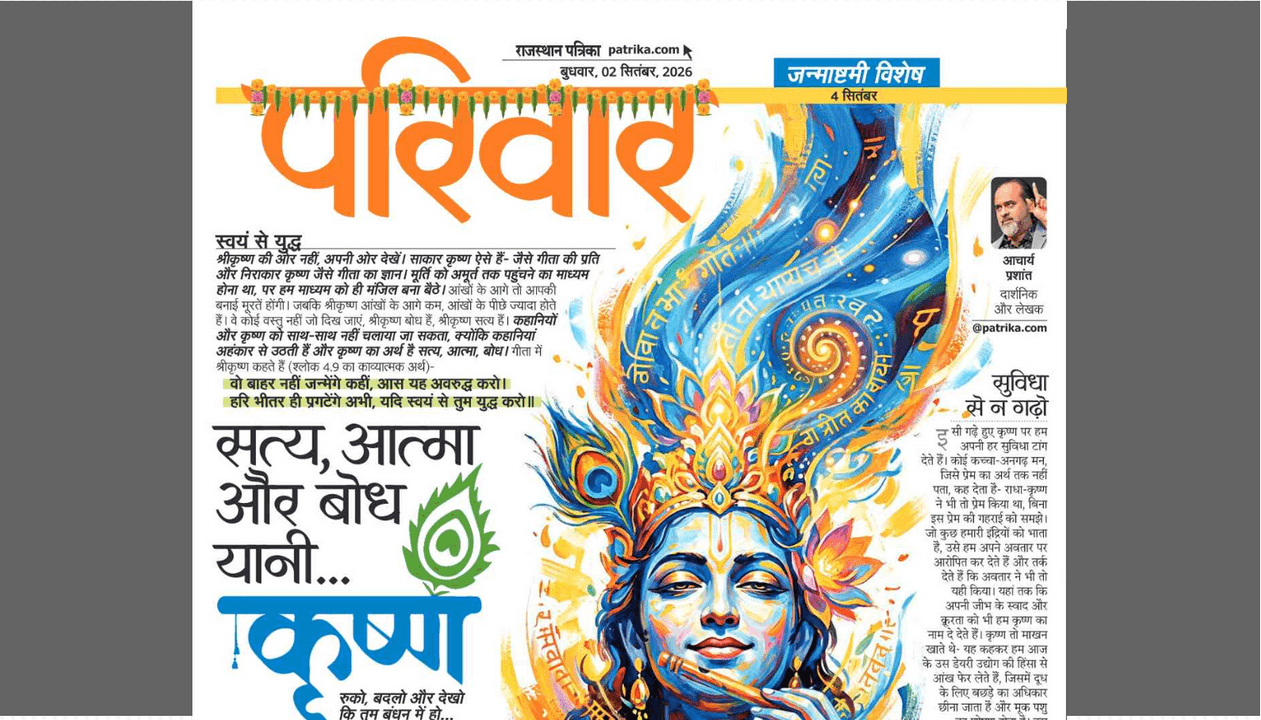
In this special Janmashtami feature published in Rajasthan Patrika, philosopher and author Acharya Prashant explains why the true Krishna is not an idol to be worshipped from a distance, but Truth, the Self, and Realization (Satya, Atma, Bodh) itself.

"The dowry demand is typically presented in public discourse as an anachronism, a stubborn remnant of a less enlightened India that education, urbanisation, and explicit legal prohibition have somehow failed to dislodge, a framing that mistakes the institution’s most explicit expression for a departure from it. But is dowry an aberration within the institution of marriage, or the institution’s own operating logic, followed to its economic conclusion?"

"The investigation into 2026 NEET-UG cancellation will produce arrests, possibly convictions, and a reformed NTA with a strengthened testing protocol; the twenty-two lakh students who sat on May 3 deserve nothing less. But the reformed examination will still fill its halls with candidates who do not know why they are there, whose years were arranged around a credential that was always standing in as a substitute for the self-knowledge that no curriculum, reformed or otherwise, has ever offered them."

“The mother being honoured today is the first person her children watched accept the settlement. The daughter who watched her mother’s labour go unnamed, unthanked, and unquestioned did not even consider that cooking may be a form of oppression. She learned something subtler and more durable: that this is what care looks like, that devotion does exactly this, and that a settlement accepted without complaint and carried with grace passes, in most households, for love itself.”

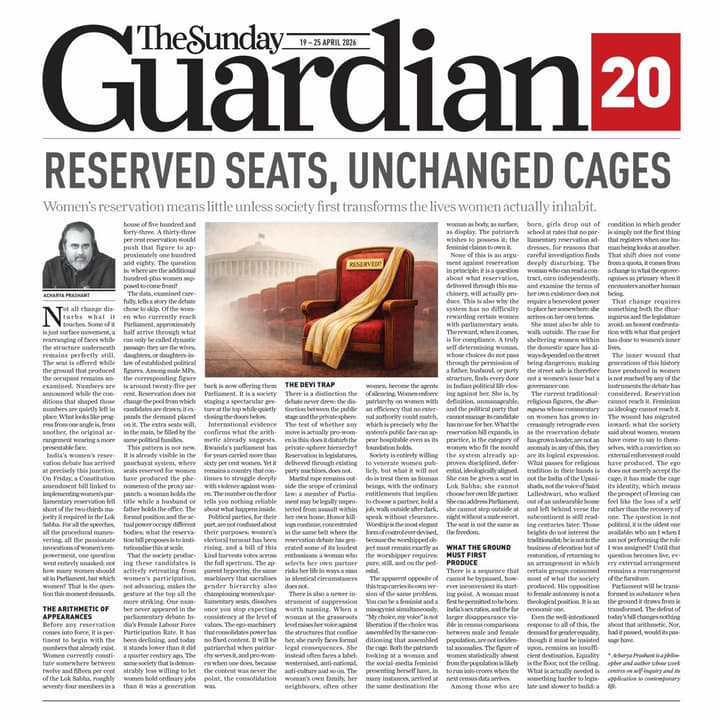
"Women’s reservation means little unless society first transforms the lives women actually inhabit."

"A parent who has not questioned her own conditioning, who has not sat with her own fear and traced it to its source, who has not asked what she is outside her own social performance: such a parent has no light to offer. The state of the child is a faithful record of the state of the parent, and the relationship with the child cannot change until the parent begins to change what she is."

"What makes this machinery particularly effective is that it finds its subjects already converted. By the time a young aspirant is old enough to question the direction he has been pointed in, he has already invested years, and the sunk cost holds him in place."

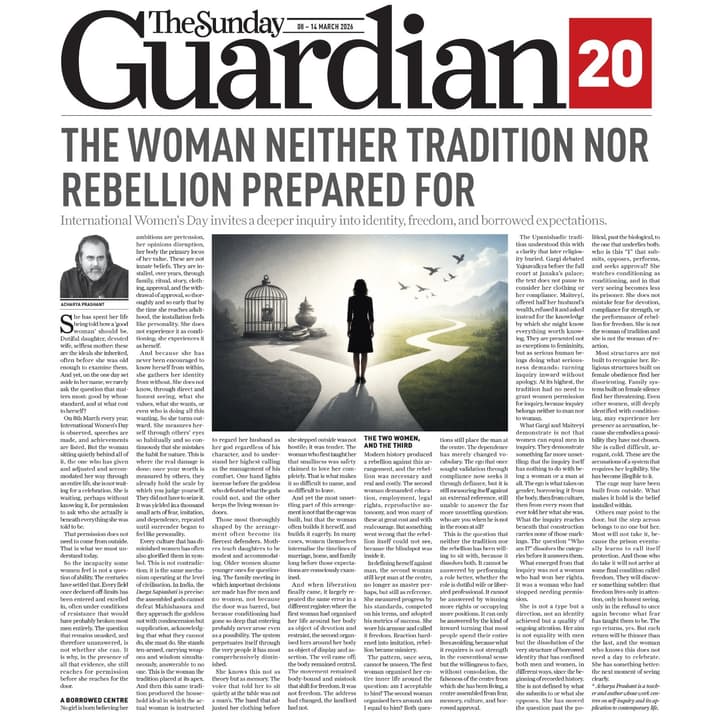
"On 8th March every year, International Women’s Day is observed, speeches are made, and achievements are listed. But the woman sitting quietly behind all of it, the one who has given and accommodated her way through life, is not waiting for a celebration. She is waiting, perhaps without knowing it, for permission to ask who she actually is beneath everything she was told to be."

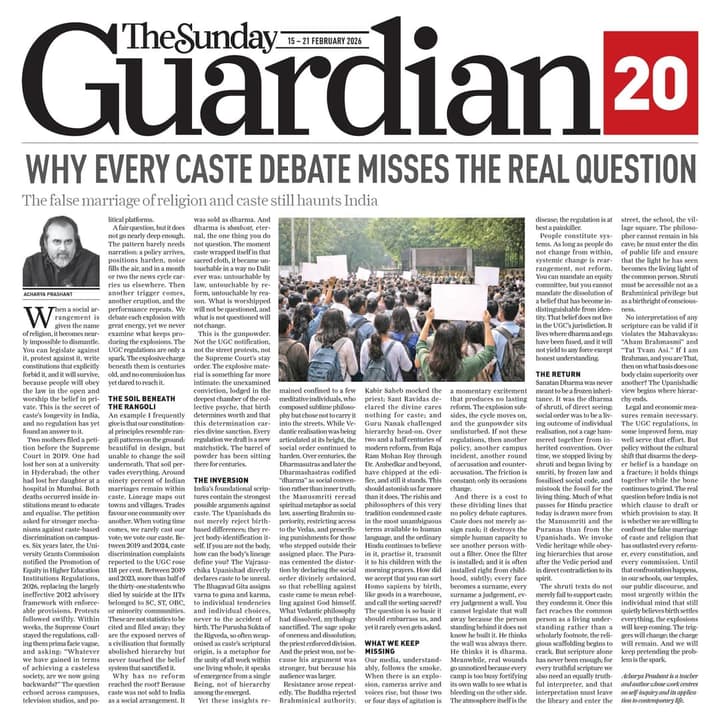
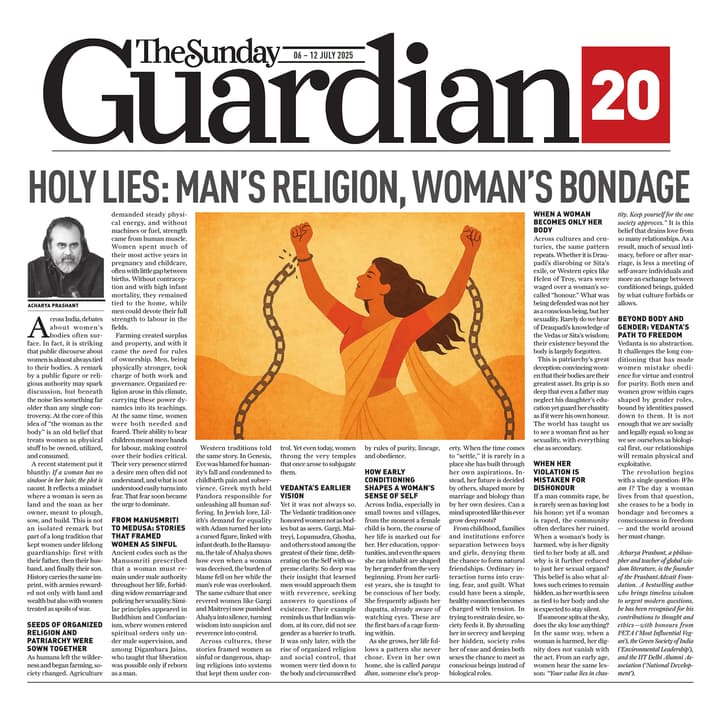
When a social arrangement is given the name of religion, it becomes nearly impossible to dismantle. You can legislate against it, protest against it, write constitutions that explicitly forbid it, and it will survive, because people will obey the law in the open and worship the belief in private.

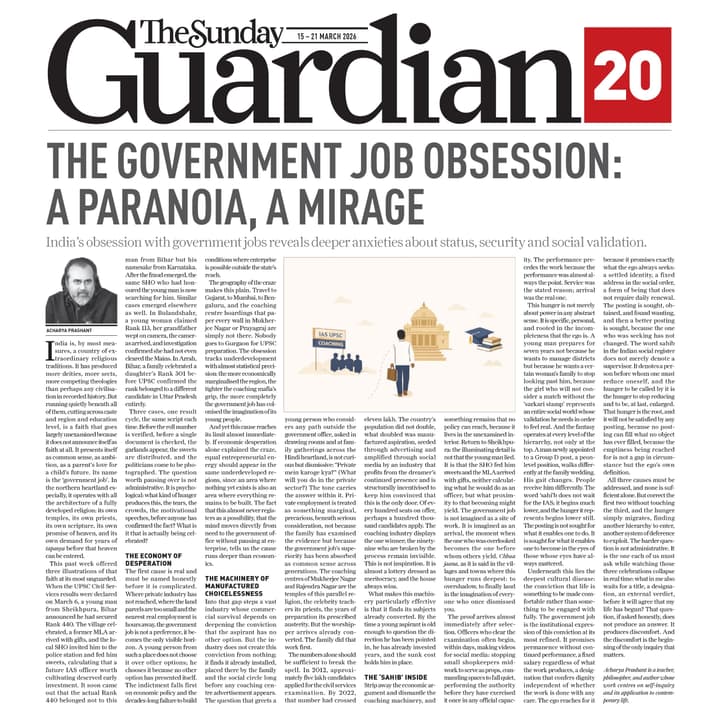
"In a healthy life, work does not stand outside life as a burden. It is a major part of life itself. A suitable job is not one that forces a person to seek regular rehabilitation from it, but one that does not require such rehabilitation at all."

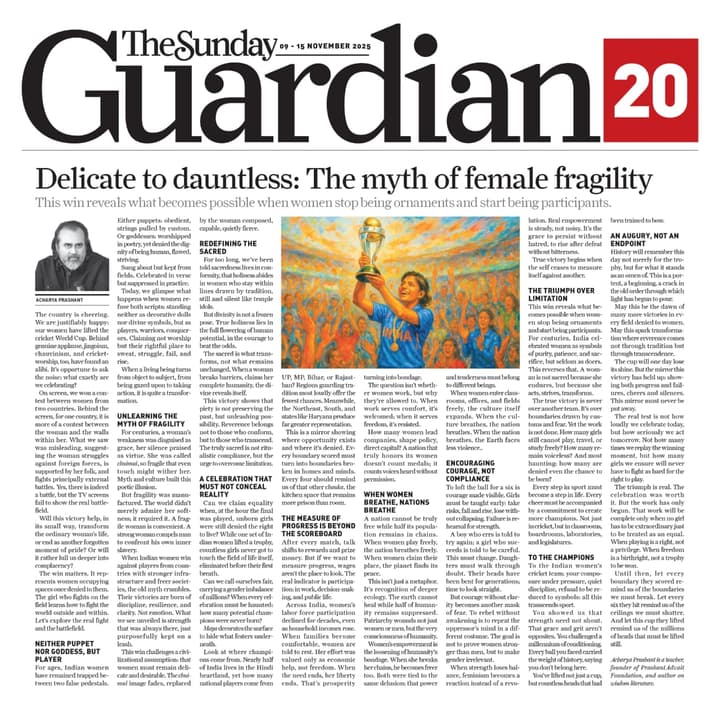
"This win reveals what becomes possible when women stop being ornaments and start being participants. For centuries, India celebrated women as symbols of purity, patience, and sacrifice, but seldom as doers. This reverses that. A woman is not sacred because she endures, but because she acts, strives, transforms."

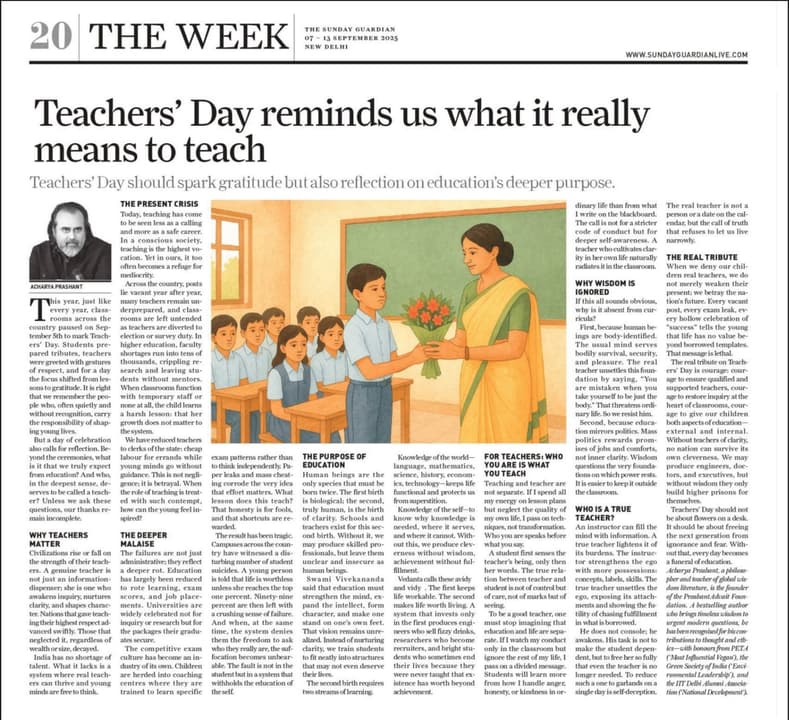
"Teachers’ Day should spark gratitude but also reflection on education’s deeper purpose."

"A remark by a public figure or religious authority may spark discussion, but beneath the noise lies something far older than any single controversy. At the core of this idea of ‘the woman as the body’ is an old belief that treats women as physical stuff to be owned, utilized, and consumed."

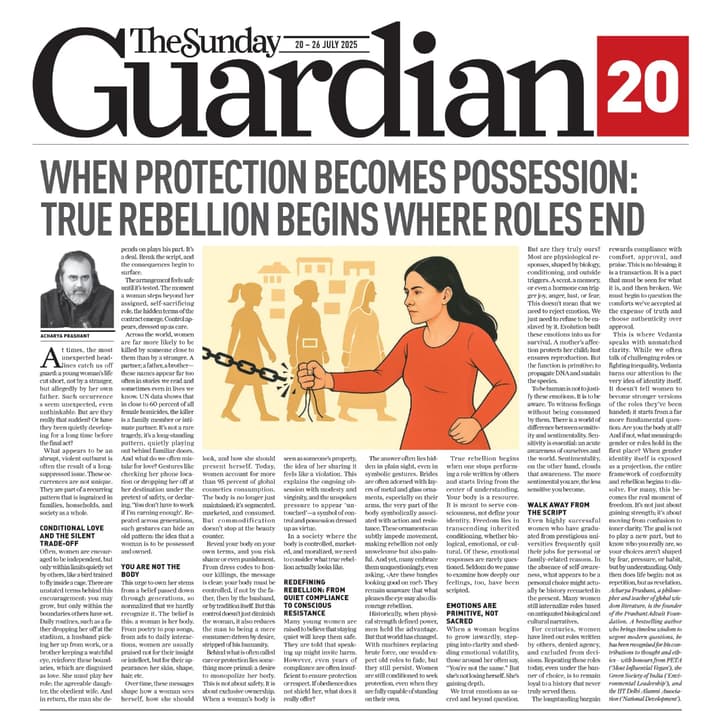
"True rebellion begins when one stops performing a role written by others and starts living from the center of understanding. Your body is a resource. It is meant to serve consciousness, not define your identity. Freedom lies in transcending inherited conditioning, whether biological, emotional, or cultural."

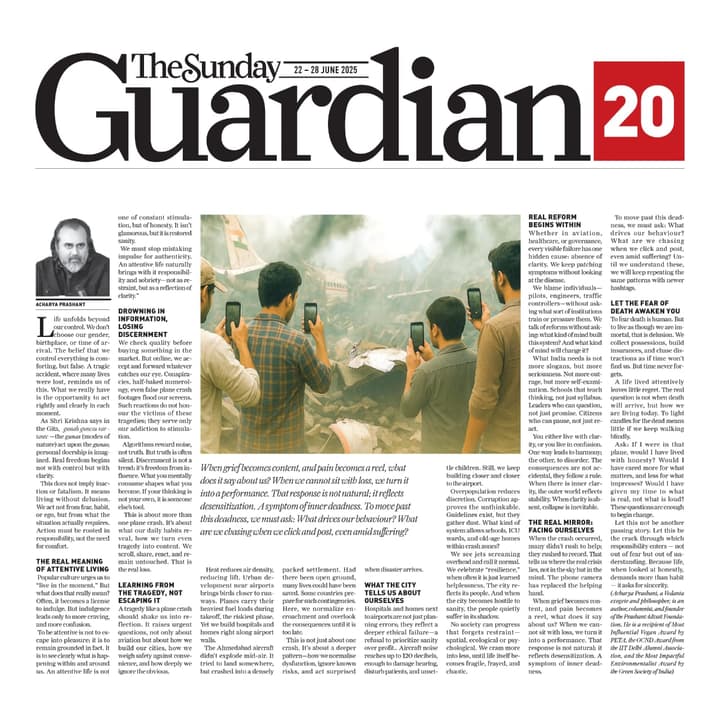
"Life unfolds beyond our control. We don’t choose our gender, birthplace, or time of arrival. The belief that we control everything is comforting, but false. A tragic accident, where many lives were lost, reminds us of this."

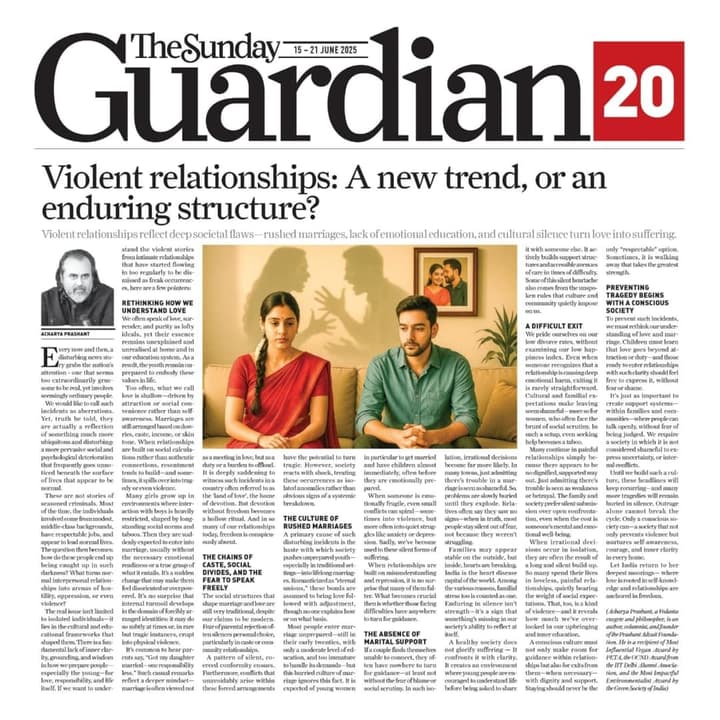
"Every now and then, a disturbing news story grabs the nation’s attention – one that seems too extraordinarily gruesome to be real, yet involves seemingly ordinary people. We would like to call such incidents as aberrations. "

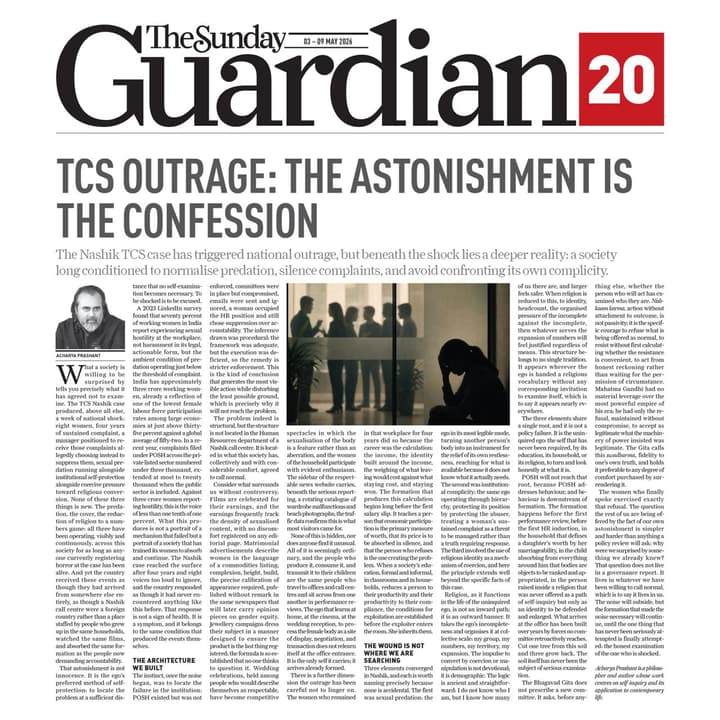
"These things are not new. The predation, the cover, the reduction of religion to a numbers game: all three have been operating, visibly and continuously, across this society for as long as anyone currently registering horror at the case has been alive. And yet the country received these events as though they had arrived from somewhere else entirely. That astonishment is not innocence. It is the ego’s preferred method of self-protection: to locate the problem at a sufficient distance that no self-examination becomes necessary. To be shocked is to be excused."

"Women’s Day is approaching, and soon discussions will emerge across various platforms. New slogans will be coined, and policy tweaks will be grandly announced."

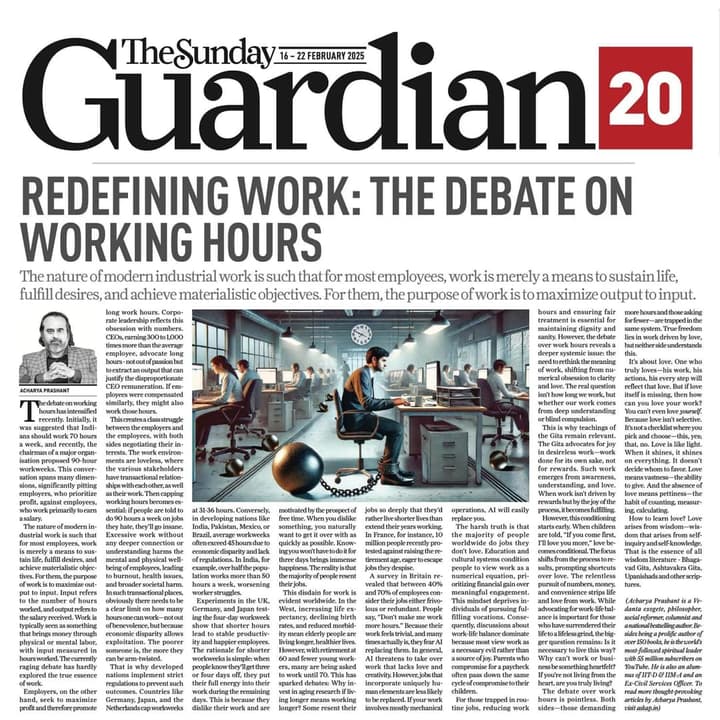
"The debate on working hours has intensified recently. Initially, it was suggested that Indians should work 70 hours a week, and recently, the chairman of a major organisation proposed 90-hour workweeks."

"Our society embodies a stark contrast between its proclaimed life-affirmative ideals and the underlying suffering that prevails. Relationships, especially marriage, are often transactional and materialistic arrangements rather than expressions of love and understanding."

"In honor of Swami Vivekananda’s birthday, celebrated as Youth Day, seminars, meetings, and resolutions around youth empowerment take centerstage. The discussions surround Swami Ji’s feat in taking Vedanta to the world, yet the immense struggles and challenges he faced often go unacknowledged."

"Ostensibly, no one likes being lied to. Yet in our social and familial transactions, lies are so prevalent that they appear almost foundational to our relationships. Why?"