Acharya Prashant is a philosopher and author, an alumnus of IIT Delhi and IIM Ahmedabad. He is among the most widely read philosophical columnists writing in India today, with more than 190 published columns ranging across climate and consumption, elections and ideology, caste and religion, gender, education, geopolitics, technology, and the inner life.
What unifies this range is a single method: tracing every public crisis back to the unexamined self that produces it.
FOR COMMISSIONING EDITORS
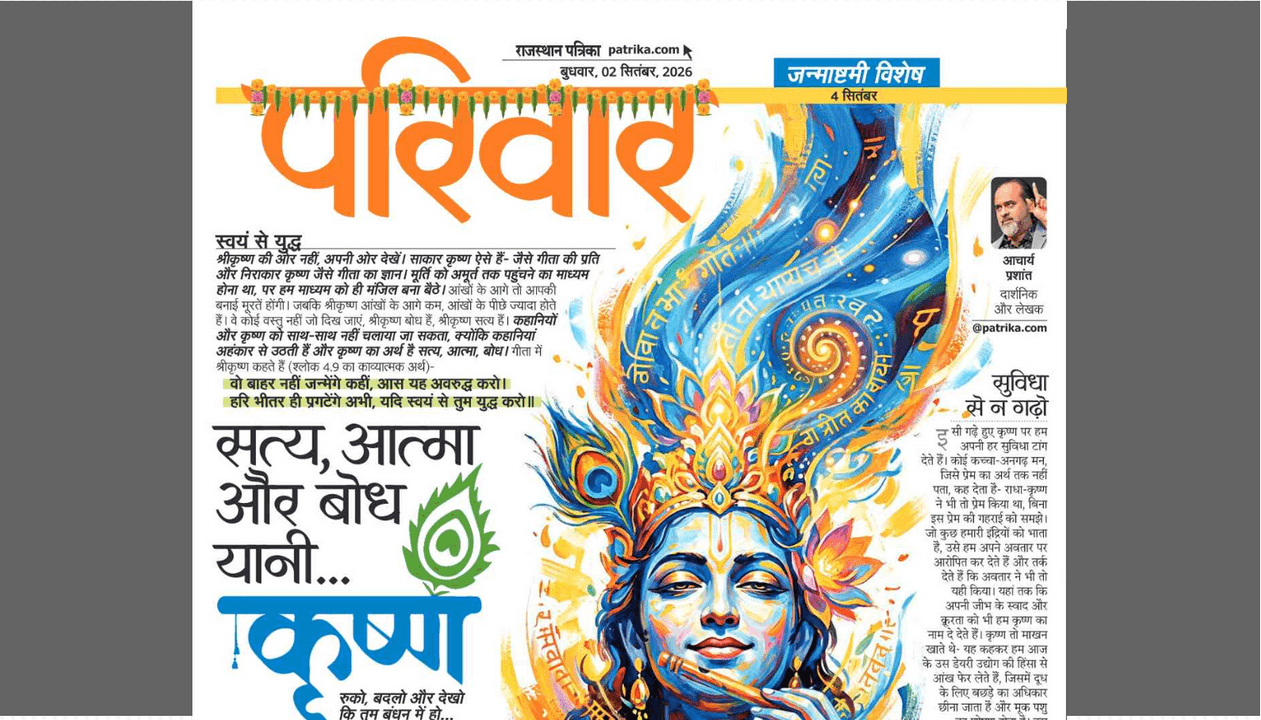
In this special Janmashtami feature published in Rajasthan Patrika, philosopher and author Acharya Prashant explains why the true Krishna is not an idol to be worshipped from a distance, but Truth, the Self, and Realization (Satya, Atma, Bodh) itself.

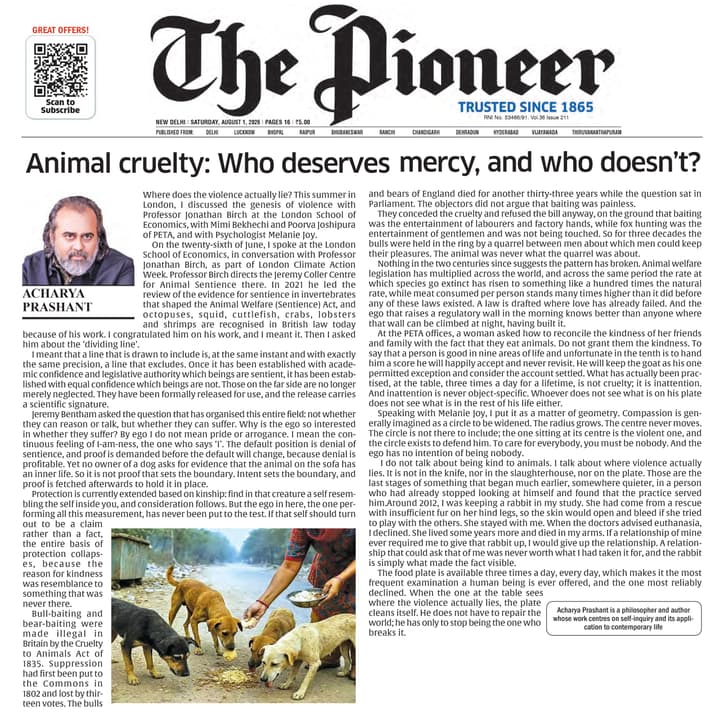
"The violence committed three times a day, with every meal, throughout a lifetime, is no longer called cruelty—it becomes unconsciousness. One who refuses to look at what's on their plate eventually loses the ability to truly see the rest of their life as well. That blindness begins spreading long before they become aware of it."

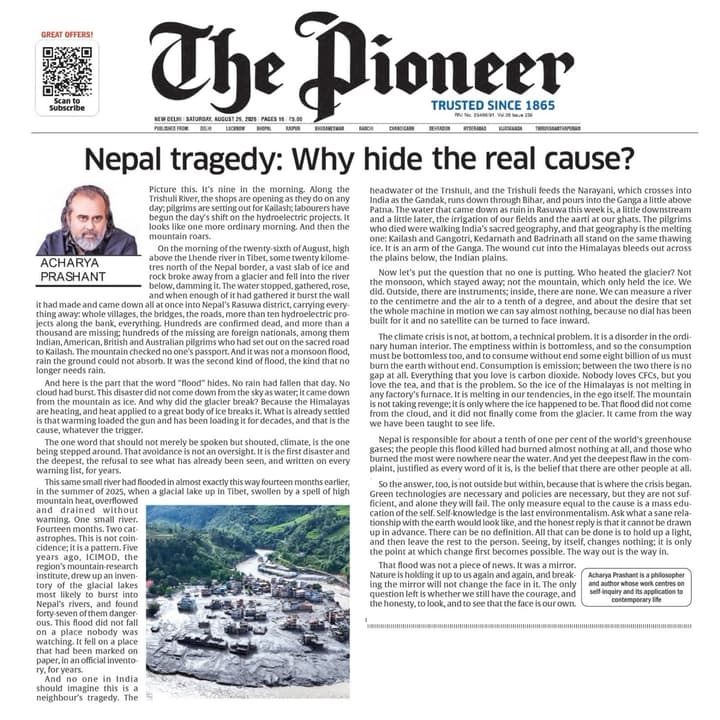
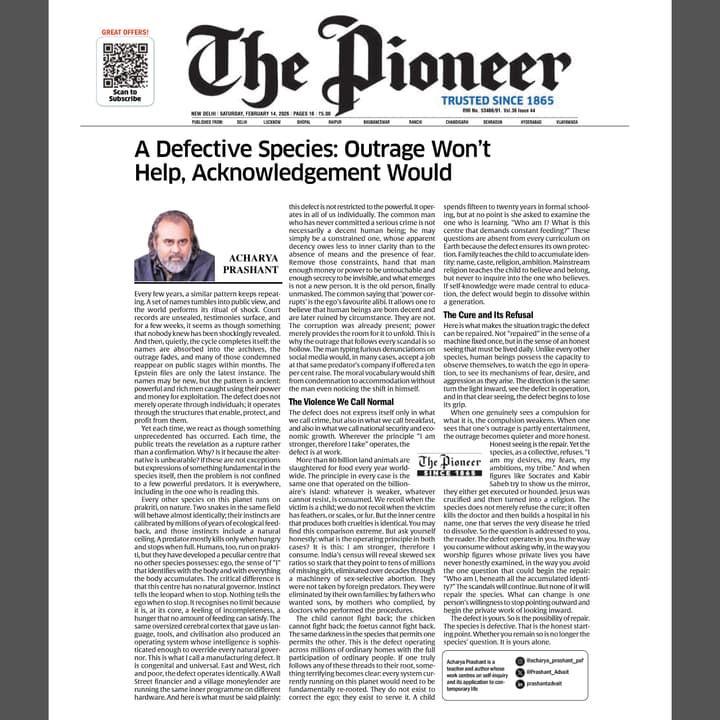
"In this article published in The Pioneer, Acharya Prashant raises some fundamental questions regarding animal cruelty and says, "I do not talk about being kind to animals. I talk about where violence actually lies, and my only work is to situate it rightly."

"Memory itself is neutral, mechanical, the same function that lets you recall a phone number or the way home without any preference for one over the other. Left alone, it would let most things fade, including the old slight that still bothers you for no reason you can name. The ego is what keeps the slight alive, picking through that storage and pulling out exactly what serves its story while leaving the rest to fade on its own."

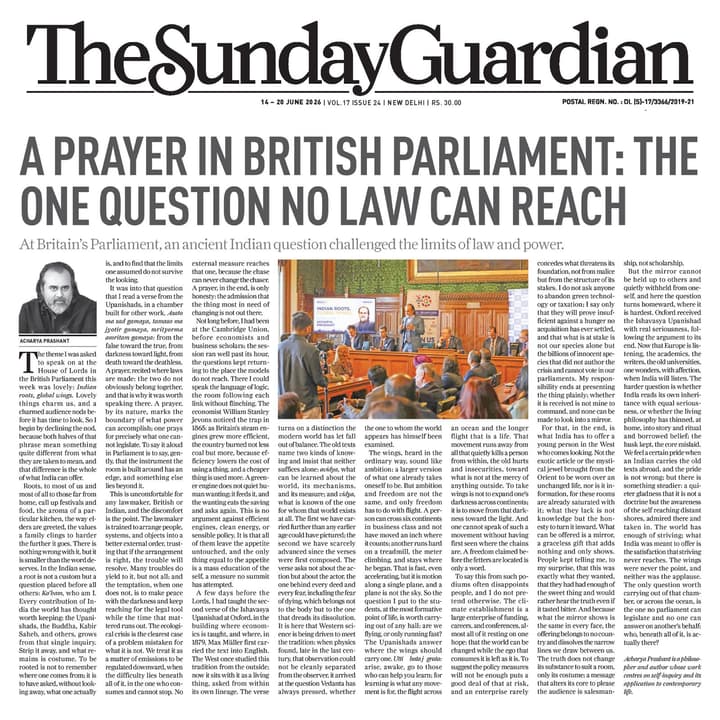
"Indian spiritual figures have been travelling abroad for more than a century. Halls have filled, applause has sounded, and followings have formed across the world. My tour of Britain in May to July 2026 might, at first glance, look like one more link in that same chain. But what mattered in those rooms was not the name of the venue; it was who sat across from me, and the standard against which the argument was placed."

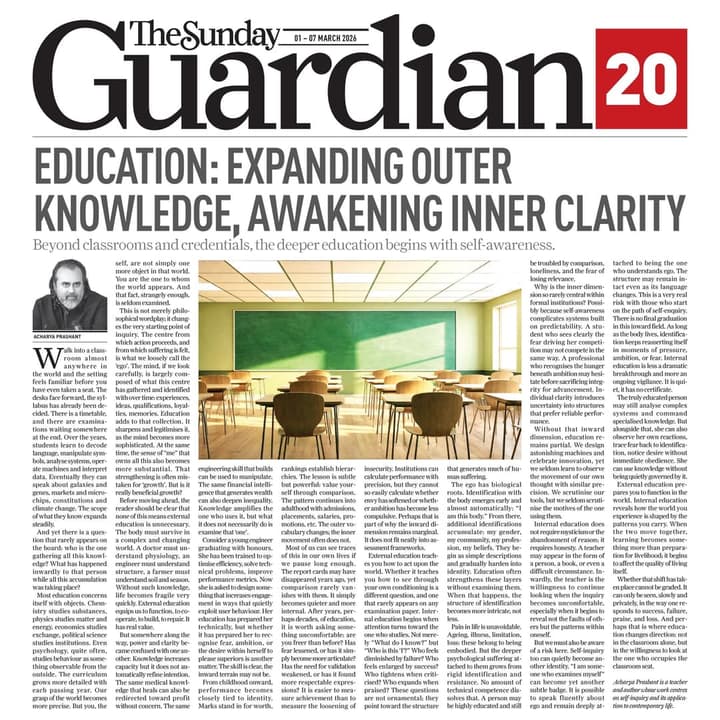
"Even the students of Oxford and Cambridge, brilliant in their fields, can sense that something remains missing, some lack that neither degrees nor money can fill. But their education does not tell them that what is missing is the cleansing of the eye and the clearing of intent. Because if the knower himself is fearful, greedy, and inwardly unclean, then even the best knowledge will finally serve ego and violence."

"The decision to depart, when genuine, must be the person’s own, arrived at in full awareness, not extracted by family exhaustion, economic pressure, or a system that has run out of ideas. It cannot come from pain alone, because suffering without self-knowledge produces desperation rather than clarity, and desperation and dignity are not on the same register."

"Most education concerns itself with objects. Chemistry studies substances, physics studies matter and energy, economics studies exchange, etc. Even psychology studies behaviour as something observable from the outside. The curriculum grows more detailed each year. Our grasp of the world becomes more precise. But you, the self, are not an object in that world. You are the one to whom the world appears. And that fact is seldom examined."

"Every few years, a similar pattern keeps repeating. A set of names tumbles into public view, and the world performs its ritual of shock. And then, quietly, the cycle completes itself: the outrage fades, the names are absorbed into the archives, and the pattern continues."

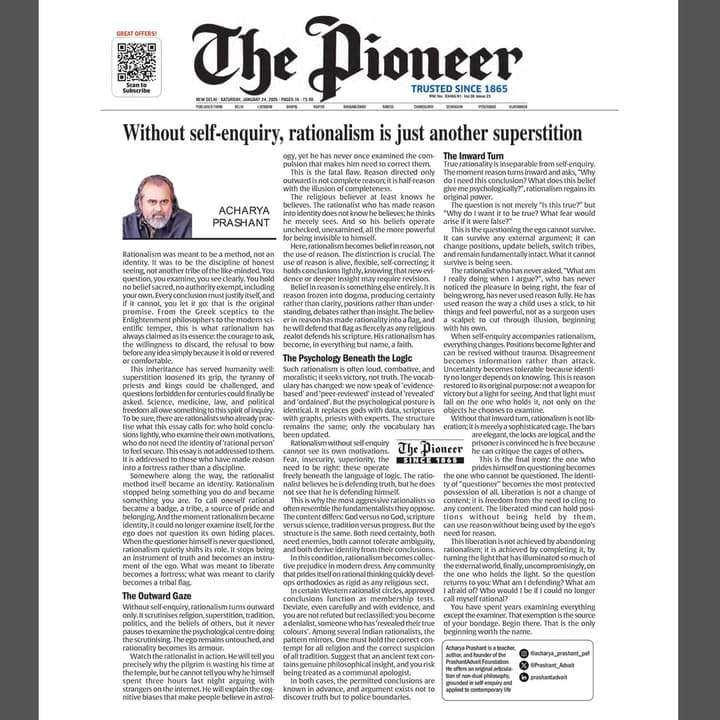
"Without self-enquiry, rationalism turns outward-only. It scrutinizes religion, superstition, tradition, politics, and the beliefs of others, but it never pauses to examine the psychological centre doing the scrutinizing. The ego remains untouched, and rationality becomes its armour."

"The believer says ‘Exists’ and clutches scripture, the atheist says ‘No’ and clutches logic. In either case, the ego experiences some relief after speaking. In questioning the existence of God, the ego successfully hides its own non-existence."