Acharya Prashant is a philosopher and author, an alumnus of IIT Delhi and IIM Ahmedabad. He is among the most widely read philosophical columnists writing in India today, with more than 190 published columns ranging across climate and consumption, elections and ideology, caste and religion, gender, education, geopolitics, technology, and the inner life.
What unifies this range is a single method: tracing every public crisis back to the unexamined self that produces it.
FOR COMMISSIONING EDITORS
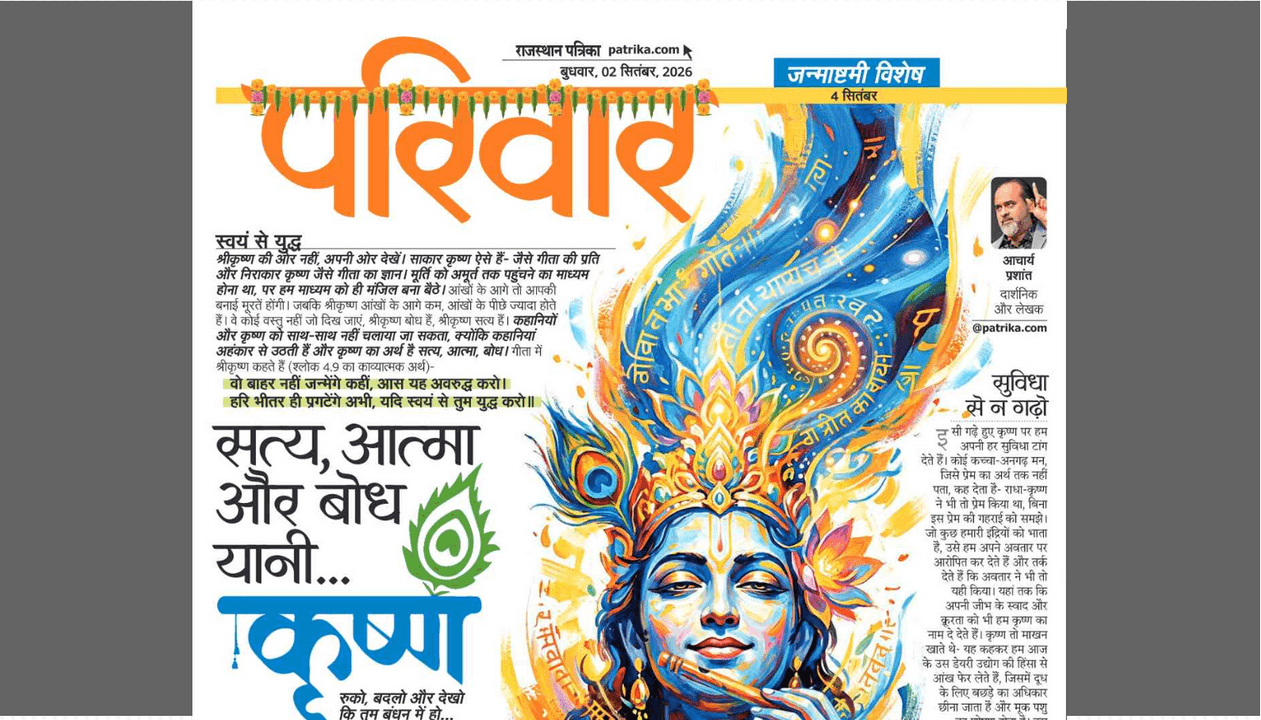
In this special Janmashtami feature published in Rajasthan Patrika, philosopher and author Acharya Prashant explains why the true Krishna is not an idol to be worshipped from a distance, but Truth, the Self, and Realization (Satya, Atma, Bodh) itself.

"In this article published in The Pioneer, Acharya Prashant raises some fundamental questions regarding animal cruelty and says, "I do not talk about being kind to animals. I talk about where violence actually lies, and my only work is to situate it rightly."

"Indian spiritual figures have been travelling abroad for more than a century. Halls have filled, applause has sounded, and followings have formed across the world. My tour of Britain in May to July 2026 might, at first glance, look like one more link in that same chain. But what mattered in those rooms was not the name of the venue; it was who sat across from me, and the standard against which the argument was placed."

"Even the students of Oxford and Cambridge, brilliant in their fields, can sense that something remains missing, some lack that neither degrees nor money can fill. But their education does not tell them that what is missing is the cleansing of the eye and the clearing of intent. Because if the knower himself is fearful, greedy, and inwardly unclean, then even the best knowledge will finally serve ego and violence."

"Every few years, a similar pattern keeps repeating. A set of names tumbles into public view, and the world performs its ritual of shock. And then, quietly, the cycle completes itself: the outrage fades, the names are absorbed into the archives, and the pattern continues."

"Without self-enquiry, rationalism turns outward-only. It scrutinizes religion, superstition, tradition, politics, and the beliefs of others, but it never pauses to examine the psychological centre doing the scrutinizing. The ego remains untouched, and rationality becomes its armour."

"The believer says ‘Exists’ and clutches scripture, the atheist says ‘No’ and clutches logic. In either case, the ego experiences some relief after speaking. In questioning the existence of God, the ego successfully hides its own non-existence."

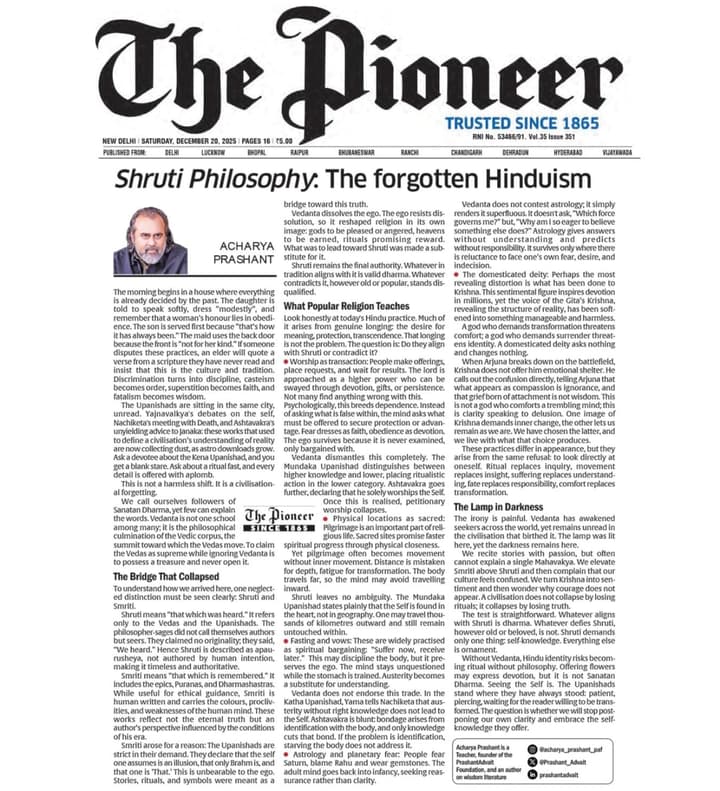
"The test is straightforward. Whatever aligns with Shruti is dharma. Whatever defies Shruti, however old or beloved, is not. Shruti demands only one thing: self-knowledge. Everything else is ornamental."

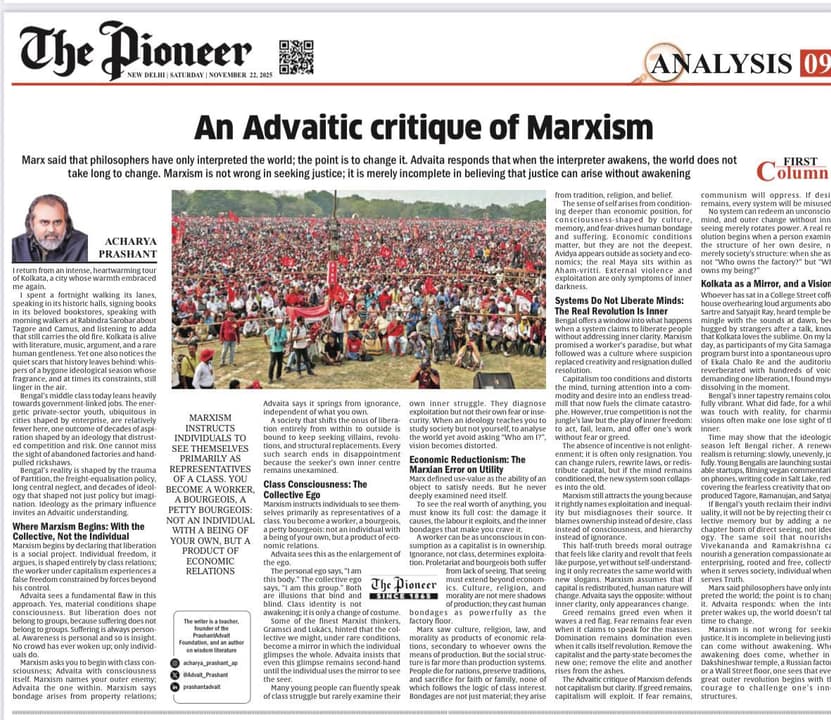
"Marxism is not wrong for seeking justice. It is incomplete in believing justice can come without awakening. When awakening does come, whether in a Kolkata adda, a Dakshineshwar temple, a Russian factory, a Wall Street floor, or a village panchayat, one sees that every great outer revolution begins when one has the courage to challenge one’s inner structures."

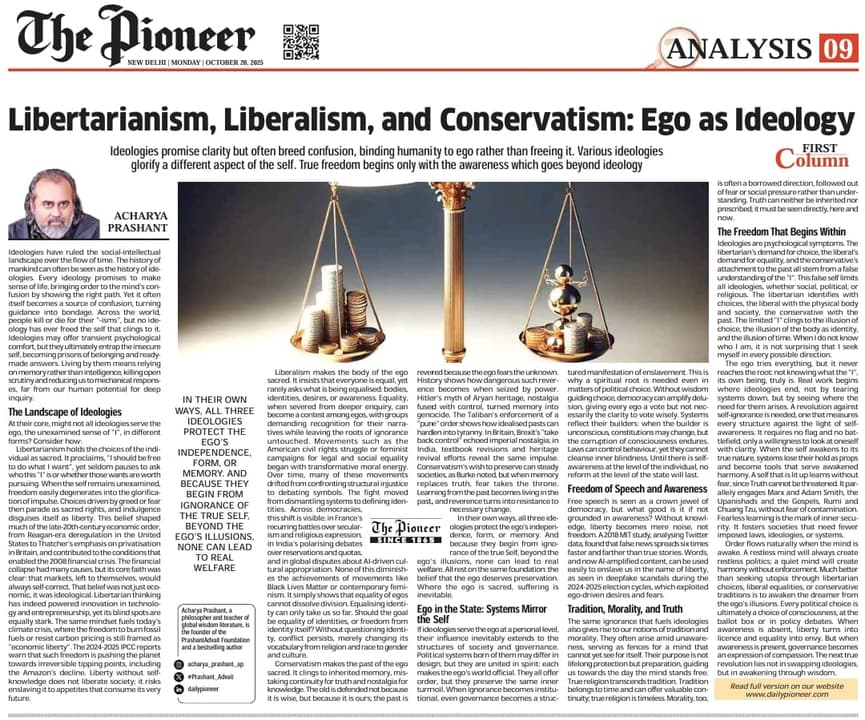
"In their own ways, all three ideologies protect the ego’s independence, form, or memory. And because they begin from ignorance of the true Self, none can lead to real welfare. All rest on the same foundation: the belief that the ego deserves preservation. Where the ego is sacred, suffering is inevitable."