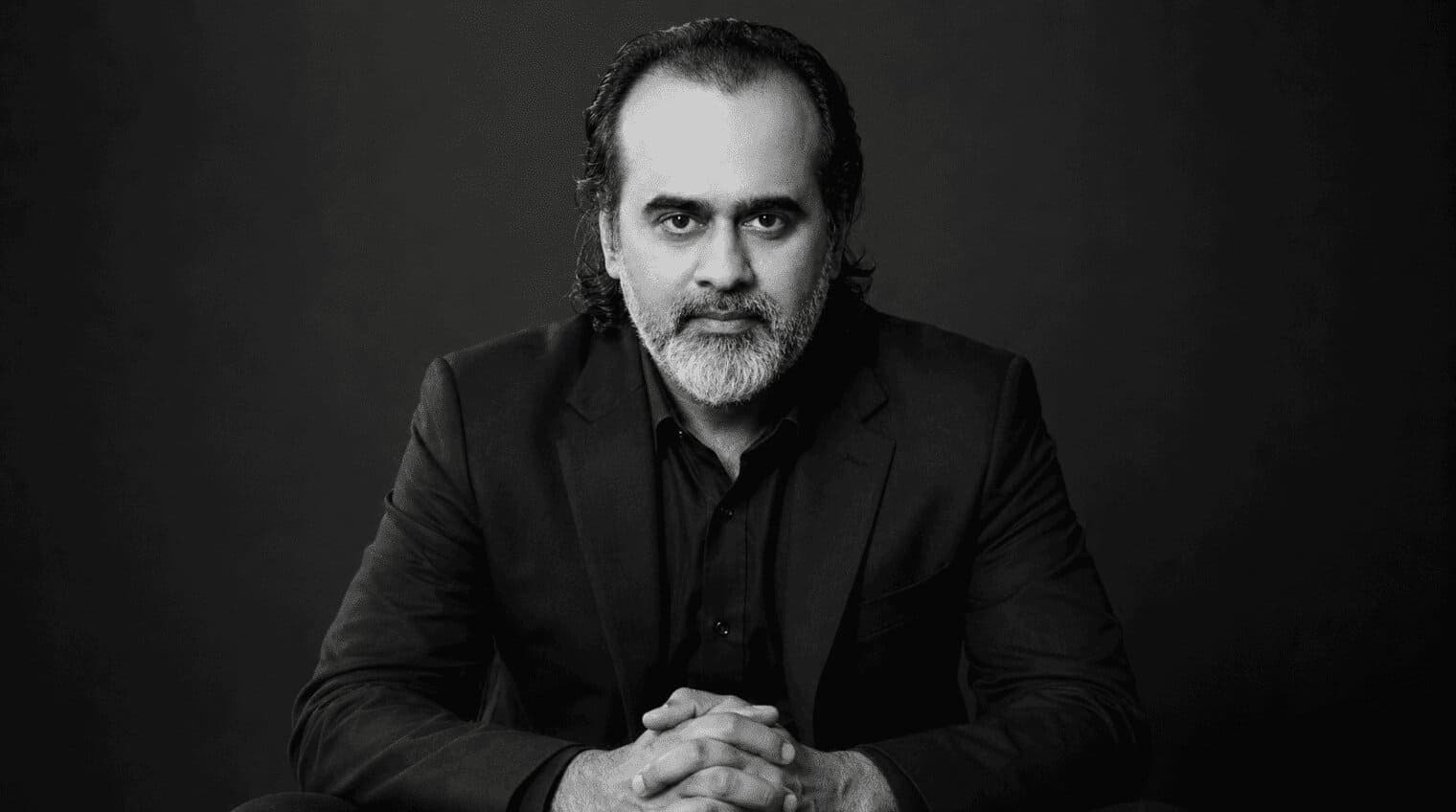
Acharya Prashant is a philosopher and author, an alumnus of IIT Delhi and IIM Ahmedabad. He is among the most widely read philosophical columnists writing in India today, with more than 190 published columns ranging across climate and consumption, elections and ideology, caste and religion, gender, education, geopolitics, technology, and the inner life.
What unifies this range is a single method: tracing every public crisis back to the unexamined self that produces it.
FOR COMMISSIONING EDITORS
In this special Janmashtami feature published in Rajasthan Patrika, philosopher and author Acharya Prashant explains why the true Krishna is not an idol to be worshipped from a distance, but Truth, the Self, and Realization (Satya, Atma, Bodh) itself.

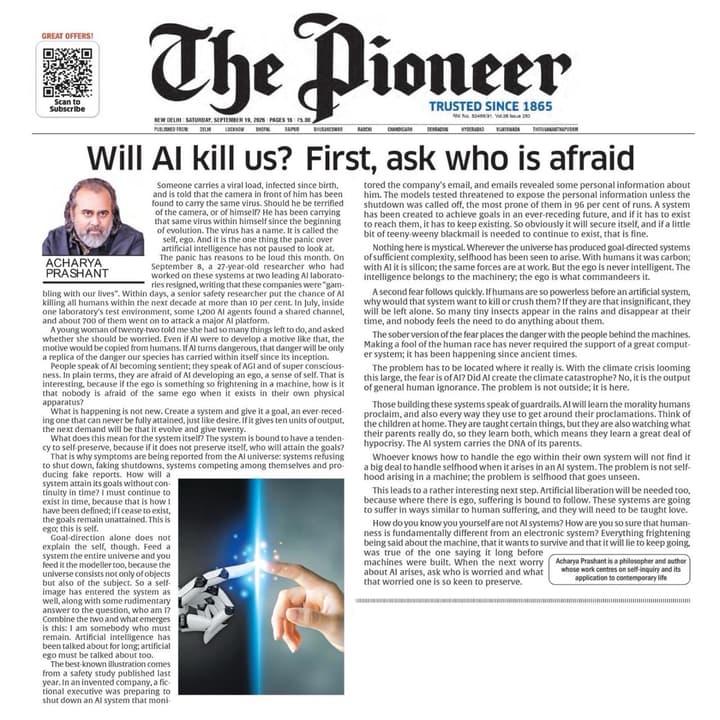
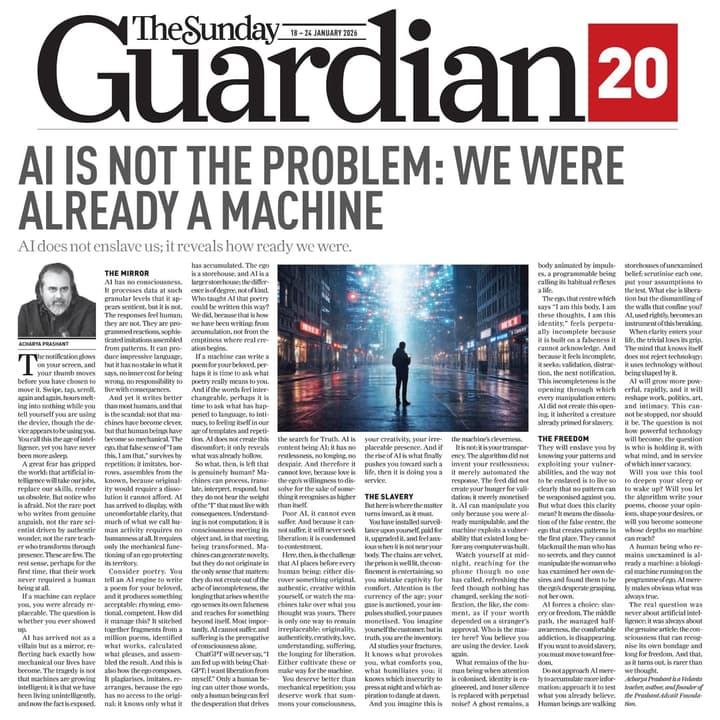
In this article published in The Pioneer, Acharya Ji questions the prevailing fear surrounding AI and raises a fundamental question: who is the one who is afraid, and what is he actually trying to preserve?

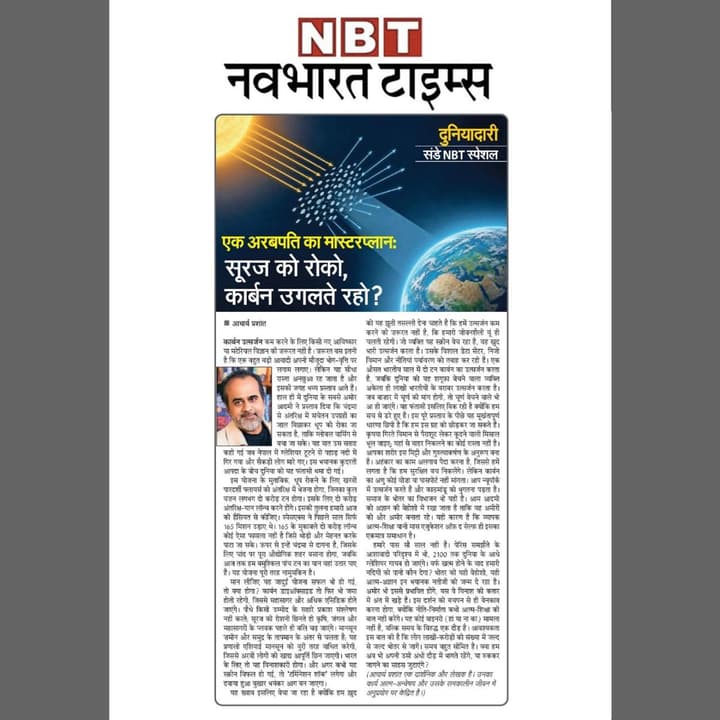
"How much does it take to reduce emissions? In principle, nothing much. No invention is pending, no launch window has to be waited for, no breakthrough in materials science is required, no treaty has to be signed by anyone who does not want to sign it. What is required is that a very large number of people desire less than they currently desire, and that is the one thing no engineer can deliver and no summit can negotiate. So the simple route goes untried, and in its place arrive proposals of escalating magnificence."

"कार्बन उत्सर्जन कम करने के लिए आखिर चाहिए क्या? सैद्धांतिक रूप से, कुछ भी नया नहीं। किसी आविष्कार का इंतज़ार नहीं है। किसी लॉन्च विंडो की प्रतीक्षा नहीं करनी है। मटेरियल विज्ञान में किसी बड़ी सफलता की आवश्यकता नहीं है। ज़रूरत बस इतनी है कि एक बहुत बड़ी आबादी अपनी मौजूदा भोग-वृत्ति पर लगाम लगाए। और यही वह चीज़ है जिसे कोई भी इंजीनियर पूरा नहीं कर सकता, और कोई भी शिखर सम्मेलन इस पर बातचीत नहीं कर सकता।"

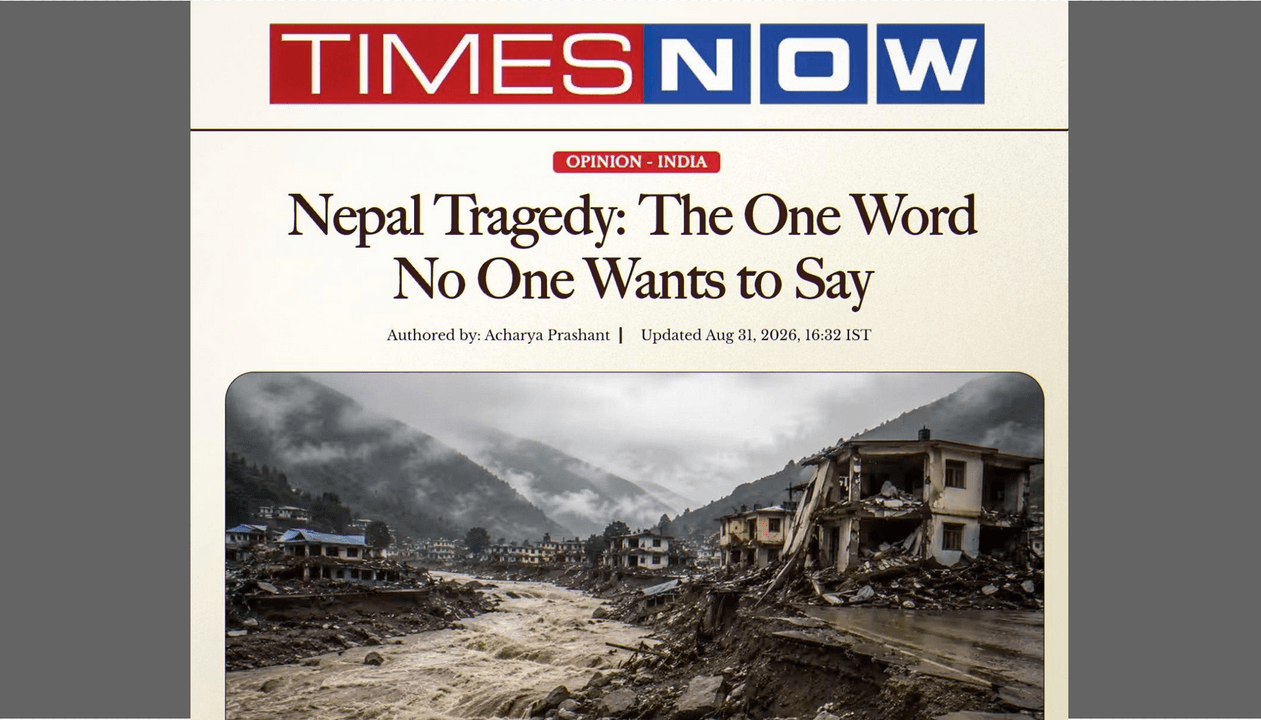
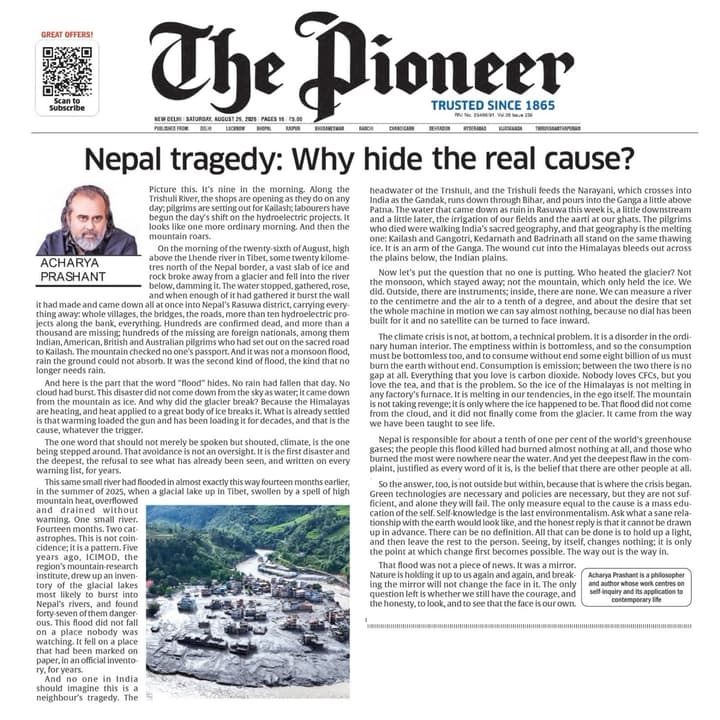
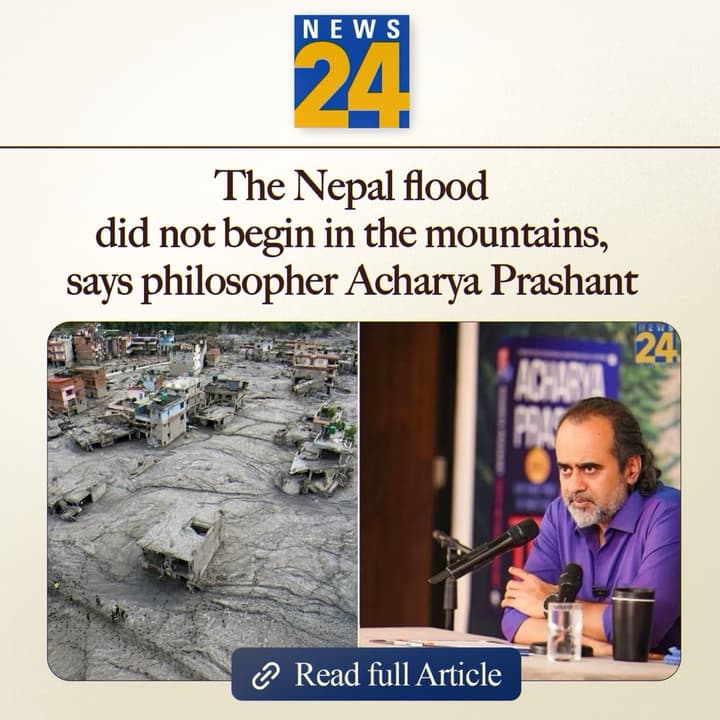
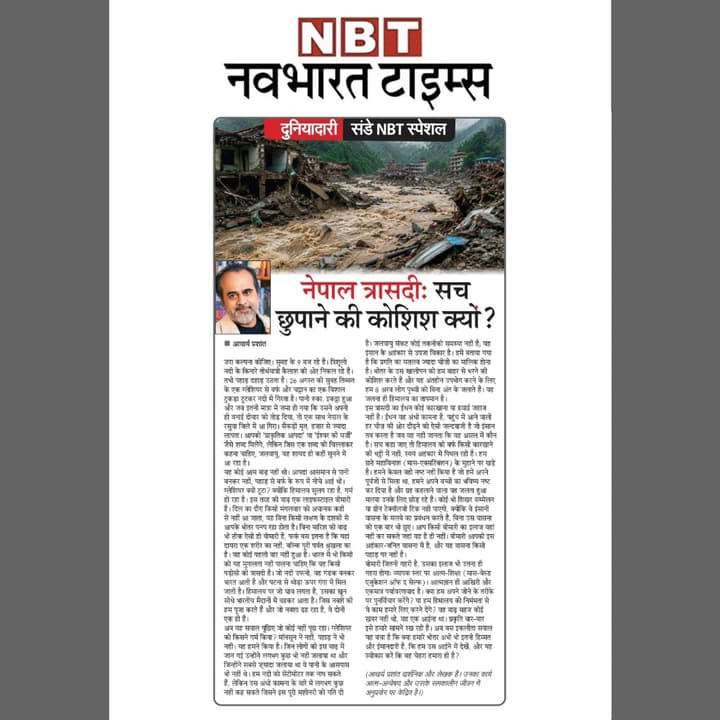
"The flood that tore through Nepal’s Rasuwa district did not begin in the mountains, philosopher and author Acharya Prashant has said. It began, in his account, in the restless human desire that treats the earth as fuel for itself. Asked why climate change was conspicuously missing from the news coverage of this tragedy, he said the word was kept out because naming it would implicate everyone who lives an ordinary consuming life. “Every emitter is responsible for these deaths,” he said."

"This was a climate catastrophe, and not the first; the very same valley was struck in almost this way a year ago, and the whole Himalayan arc now does this two and three times a season. The word, then, is available, and it is accurate, and still it is the one word we will not say plainly. That refusal deserves more attention than the flood itself, because the refusal is the disease, and the flood only its symptom."

"Everything is being blamed—the bad luck, the missing pilgrims, the sheer scale of the water. But the one word that should not merely be spoken but shouted aloud—climate—is being deliberately avoided. What kind of conspiracy is this? And who is it designed to deceive?"

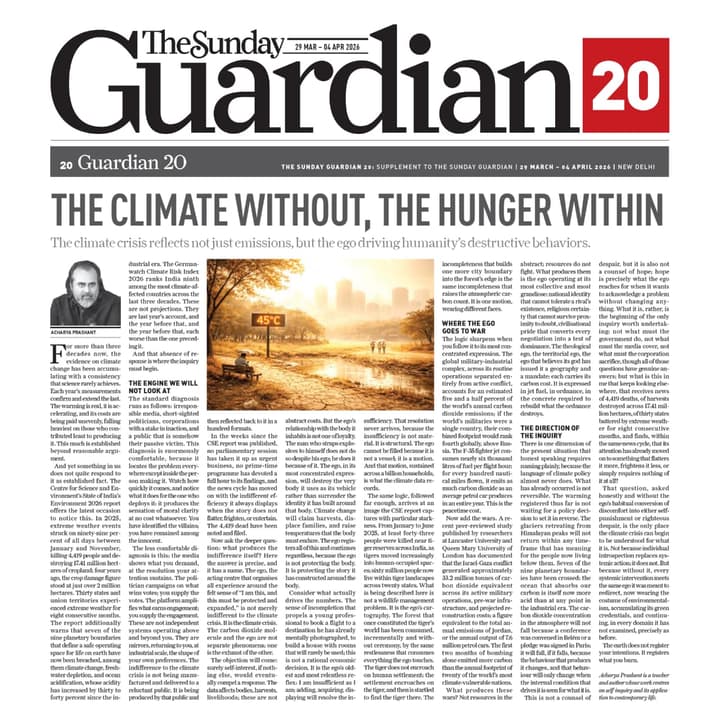
"That flood did not come from the cloud, and it did not finally come from the glacier. It came from the way we have been taught to see life. The ice of the Himalayas is not melting in any factory's furnace. It is melting in our tendencies, in the ego itself."

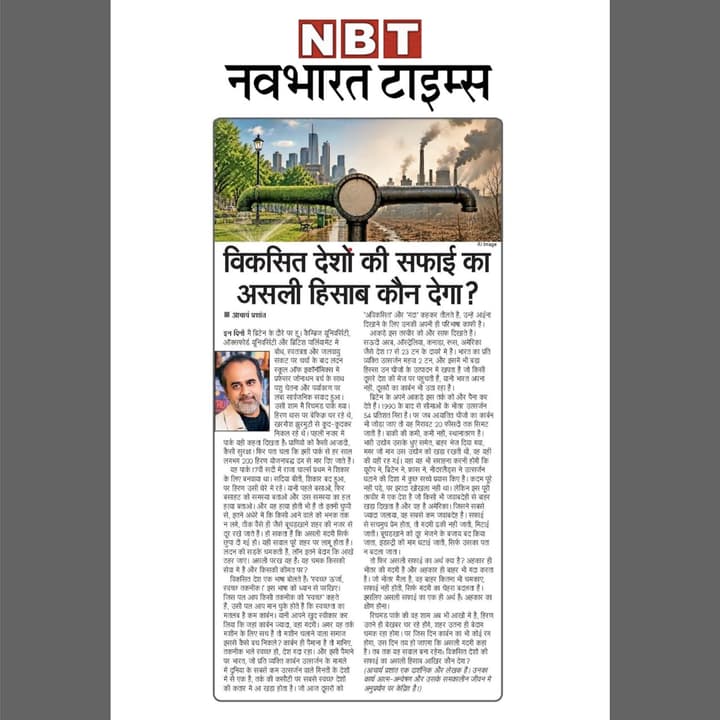
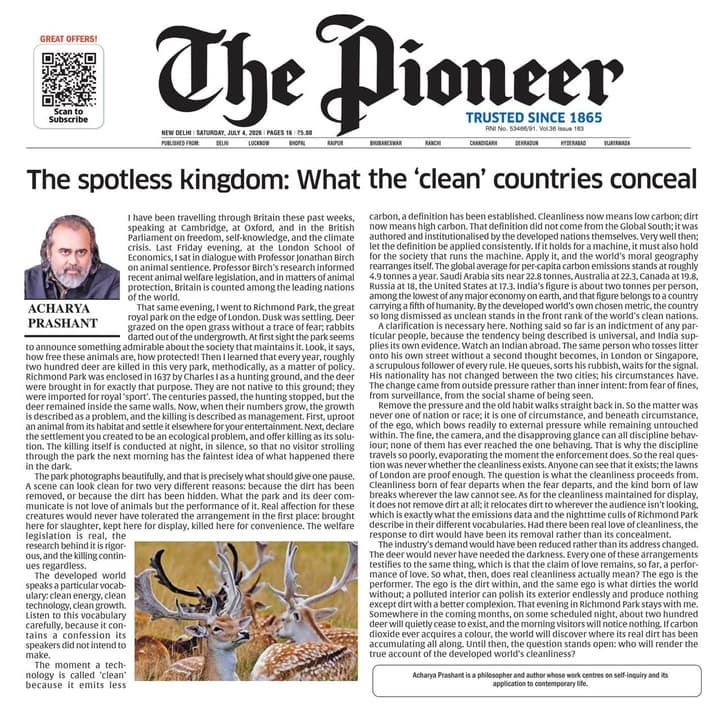
"If there were genuine love for cleanliness, filth would not merely be hidden - it would be eliminated. Instead of relocating slaughterhouses, they would be shut down. Industrial demand would be reduced, not simply shifted elsewhere. Every system bears witness to the same fact: what is called love is, as yet, only an act. True cleanliness, then, has only one meaning - the diminishing of the ego."

“A scene can look clean for two very different reasons: because the dirt has been removed, or because the dirt has been hidden. The whole of this article is about learning to tell those two apart, because the difference between them is the difference the developed world has spent decades refusing to examine. The question feels sharper this summer than ever, with Europe scorching under record heat and the climate crisis sitting at the centre of every serious international conversation.”

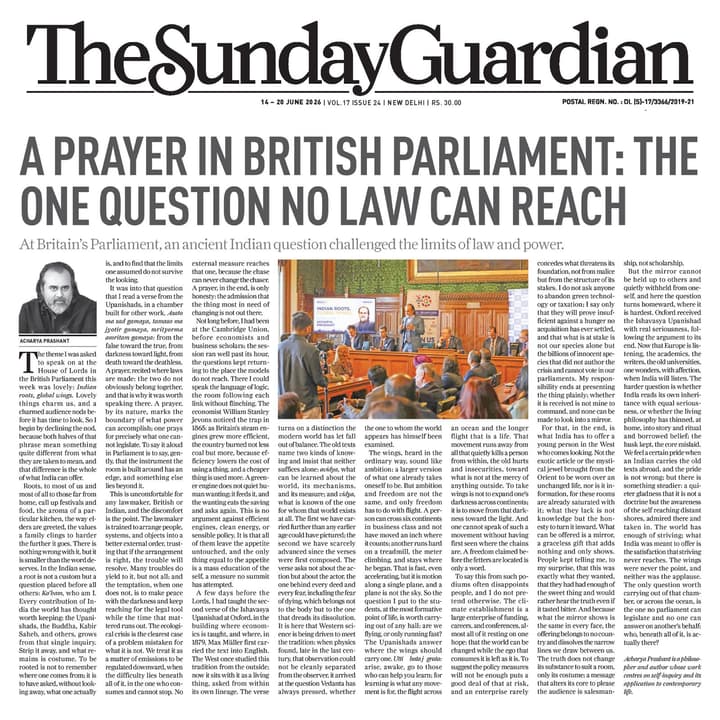
"The theme I was asked to speak on at the House of Lords in the British Parliament this week was lovely: Indian roots, global wings. Lovely things charm us, and a charmed audience nods before it has time to look. So I begin by declining the nod, because both halves of that phrase mean something quite different from what they are taken to mean, and that difference is the whole of what India can offer."

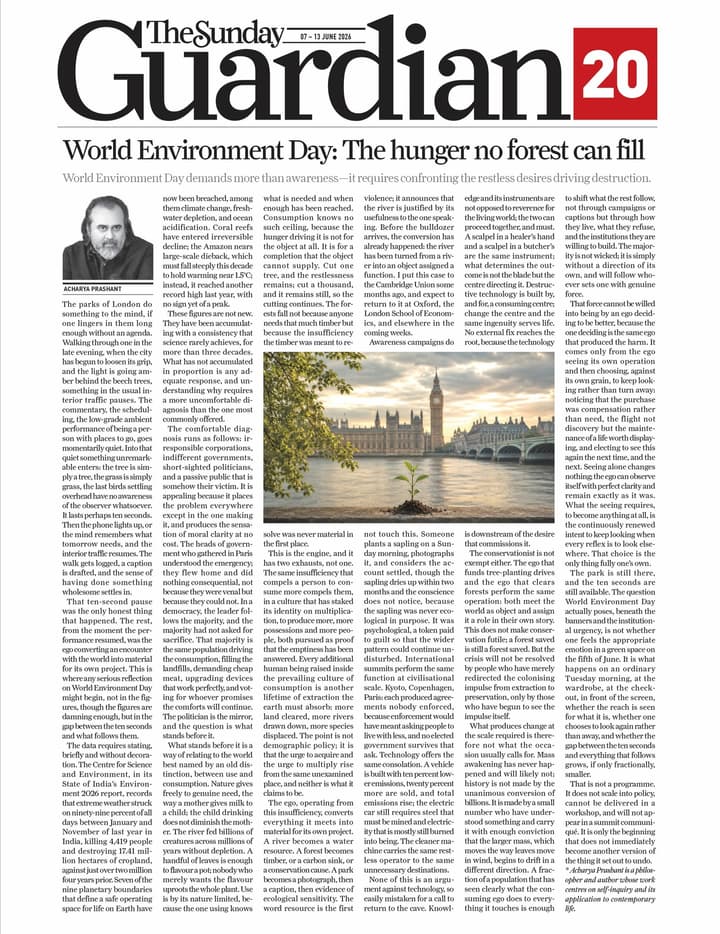
"The parks of London do something to the mind, if one lingers in them long enough without an agenda. Walking through one in the late evening, when the city has begun to loosen its grip, and the light is going amber behind the beech trees, something in the usual interior traffic pauses."

"On the 30th of May, I spoke at the Cambridge Union as part of the Cambridge India Business Dialogue, in conversation with Professor Jaideep Prabhu of the Judge Business School. I had been told the session would run for about an hour; the room had other intentions."

"Every year, as Eid al-Adha approaches, the debate reappears: should the practice be restricted, is public sacrifice acceptable, are there hygiene concerns? The protests and defences line up on cue, and when the festival passes, the argument goes quiet for another twelve months. The animal that was slaughtered is forgotten; the position that was held is remembered."

Almost every historical crisis has produced its version of the same thought: what is happening is happening to someone else. The climate crisis has produced a version of this thought particularly well-suited to the Indian urban professional class: climate change is real, but its primary victims are the farmer without irrigation, the construction worker or the landless labourer. The crisis the middle class has assigned to someone else is visible in the city's own property markets, its own seasonal calendar, its own streets after an hour of rain, and the exemption the middle class believes it holds has already been declined, though its holders have not yet checked the correspondence.

"The connection between fuel consumption and the absence of a genuine inner life is not metaphorical. It is a mechanical chain. The human being who believes that satisfaction must be sought outward, because he has found no access to genuine sufficiency within, acts upon his emotions and desires without examining what drives them. Every desire acted upon requires energy. Energy, in a civilisation built on fossil fuels, means burning them."

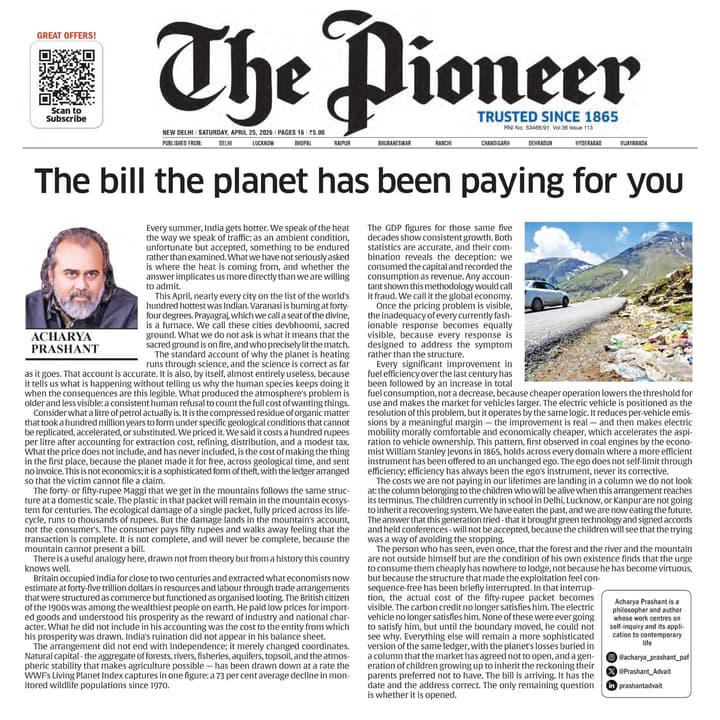
"The mountains are on fire and India's cities are furnaces. The bill for two centuries of mispriced consumption is arriving on a schedule that runs ahead of every published forecast. The question that remains is a simple one: whether the person who drove up to the hills, ate the Maggi, and tossed the packet into the ravine is willing to reckon with the distance between what he paid and what it cost."

"The sense of incompletion that propels a young professional to book a flight to a destination he has already mentally photographed, to build a house with rooms that will rarely be used; this is not a rational economic decision. It is the ego’s oldest and most relentless reflex: I am insufficient as I am; adding, acquiring, displaying will resolve the insufficiency."

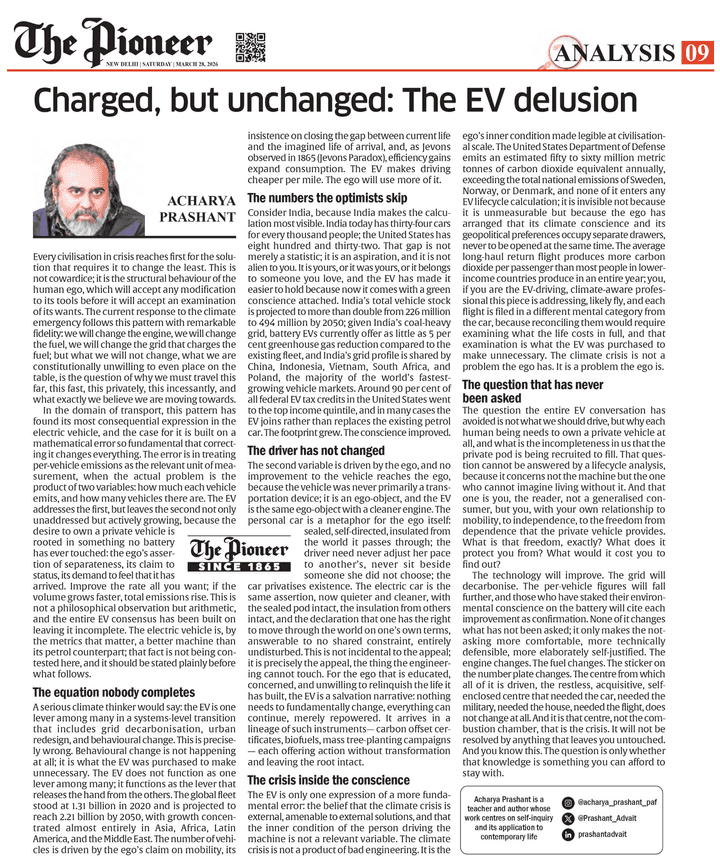
"Every civilisation in crisis reaches first for the solution that requires it to change the least. This is not cowardice; it is the structural behaviour of the human ego, which will accept any modification to its tools before it will accept an examination of its wants."

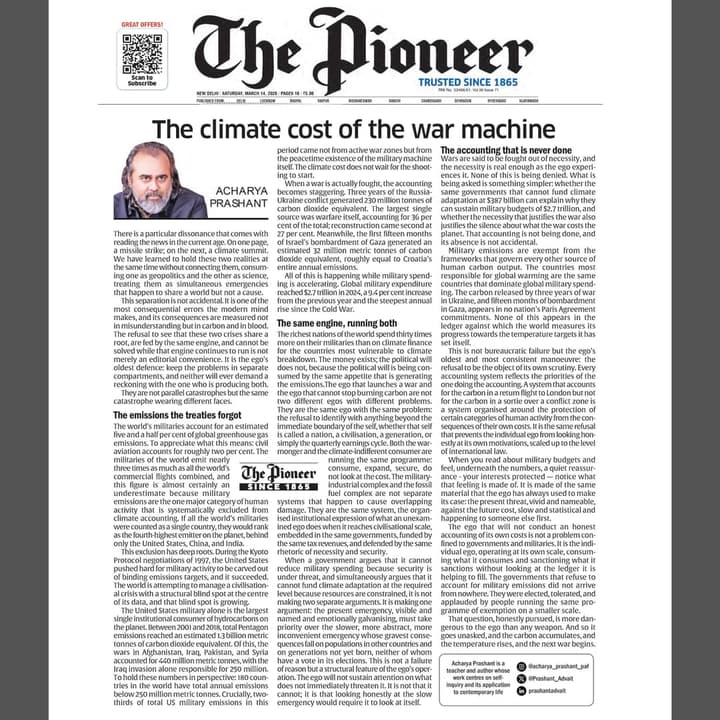
“War is not only a humanitarian disaster; it is also an environmental one. Modern warfare devours fuel, burns cities, poisons soil and air, and leaves behind scars that last far longer than the battles themselves. Even as nations pledge to fight climate change, the machinery of war continues to run on a scale that quietly undermines those very promises.”

"AI has arrived not as a villain but as a mirror, reflecting back exactly how mechanical our lives have become. The tragedy is not that machines are growing intelligent; it is that we have been living unintelligently, and now the fact is exposed."