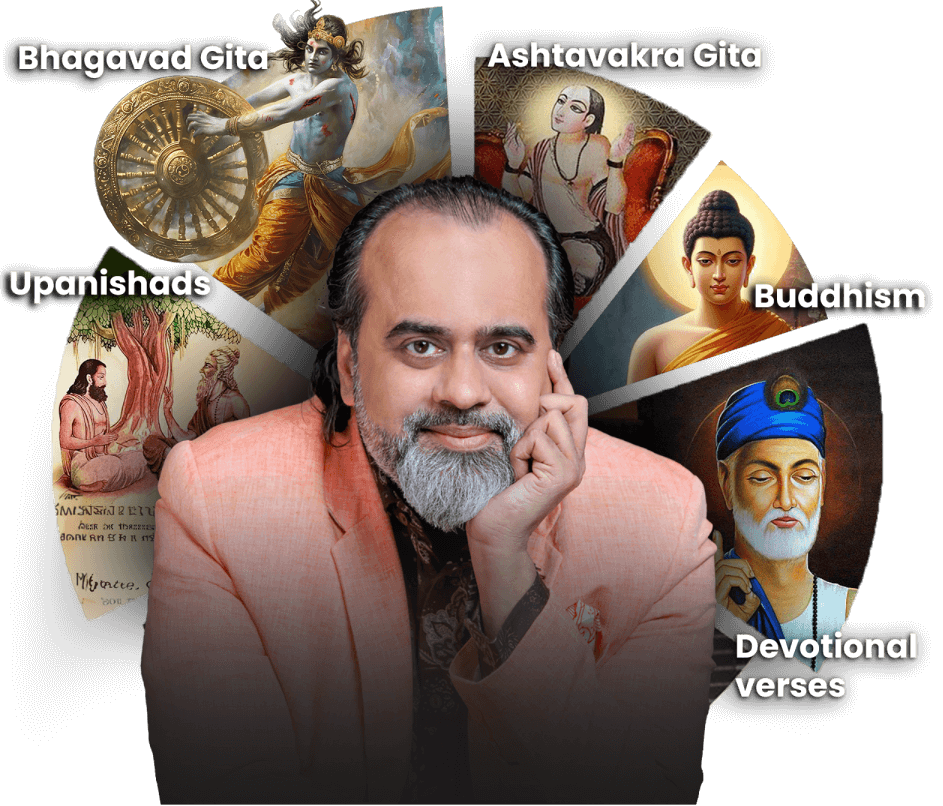
Acharya Prashant at London School of Economics

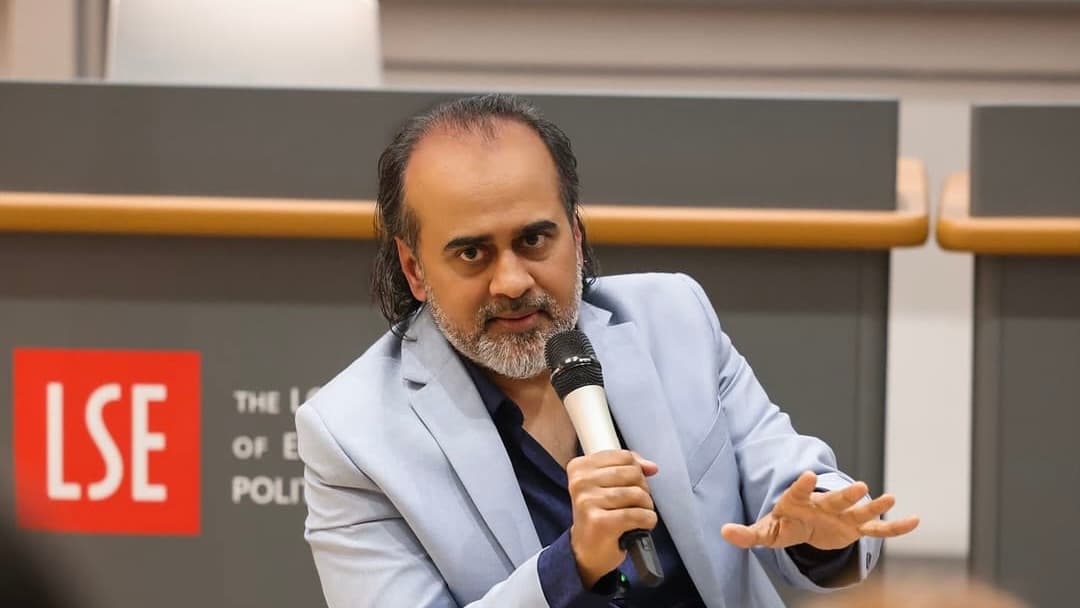
Acharya Prashant: Glad to be here, and I see that I have come right at the end of the session. I'm sure that you have already discussed and deliberated a lot on the topic or something similar to it. I'll see how the whole thing can be brought together as a closure.
So we know that, the last 3 years, the global average temperature is already 1.5° more than 1.5° above normal. We also know that the last 11 years are the 11 hottest ones on record. We also know that over the last century, the oceans have already risen by 20 cm, and they are rising by four mm per year.
All this is very well known to us. We know that if we are to stick to the Paris Agreement goal of 1.5°, all that we are left with is some 170 billion tons of emissions, whereas we produce more than a quarter of that every year.
These facts are known, not that we lack in facts. We probably lack an understanding of where the emissions are coming from. It is somehow convenient to assume that the emissions are coming from an engine, an industry, that they are coming from deforestation or meat. But we fail to look at what is behind the engine. We fail to look at what is behind the axe. We want to believe that it is just human activity that is responsible for the temperature increase and other kinds of climate upheavals, which is not limited, obviously, to temperature and sea levels.
But what kind of human activity?
For long, we did not want to even believe that it is anthropomorphic. Now we have just come to admit that, yes, it is human activity that is causing all things. But again, what kind of human activity? That is not being specified, that is not being looked into.
That human activity is not of need, not of genuine physical or civilizational need. That human activity is the one that arises from inner emptiness. A psychological hollow, and that psychological hollow just cannot be met through outer measures.
That psychological hollow is a misplaced inner belief that thinks that through outer consumption, the inner void can somehow be addressed.
And equally facetious is the attempt to address that inner hollow through external solutions. That inner hollow is what I am calling the ego. Ego not in the Freudian sense. Ego not in the sense of pride or arrogance. Ego in the sense of the unseen feeling of I-amness. The unseen feeling of the self. And that is the real emitter. That is the real pollutant.
Let me simply say, the climate crisis is the ego made atmospheric. We do not realize what is it within that is continuously burning, and for that inner thing to burn, what is needed is combustion outside of us. We look at that combustion, which is in front of the eyes, which is available to the senses, and we feel that external solutions, again in front of the eyes, available to the senses, would work. Whereas the real culprit or the real patient is within, and that's the one we are refusing to look at.
Instead, what we are coming up with is solutions that are fabricated by the patient itself. Call them egoic solutions. They exist so that the ego can remain as it is and can still have a very sophisticated kind of guilt management.
For example, luxury consumption, for example, all kinds of emphasis only on policy measures and green technologies.
So the ego will not look at itself. It is a network of a set of beliefs, and it does not want to challenge that. And that is what I'm going to call ignorance. Ignorance not in the sense of lack of knowledge. Ignorance in the sense of a vast inner network of false self-knowledge. False self-knowledge. I am the doer. I am the emitter. The climate crisis is a result of what I take myself to be.
If I do not know who I am and yet I keep experiencing an inner incompleteness, obviously I will have to strive to somehow address it. I do not know where that incompleteness is coming from. I have never bothered to go into its inner nature. But I experience it nevertheless. Just as one experiences a headache or a stomach ache, the experience is real. The diagnosis is missing.
So one tries all kinds of things, and that's what humanity has been trying, not just today, not just the postindustrial age, not just as we have moved from 280 ppm to 430 ppm. That is what we had always been doing. It's just that we never had the technology and the economics to implement our destruction on scale. We now have it.
Nothing new has happened. Man has always been an internal darkness, which is a needless darkness because one can go into it, and it is not a darkness that light has not reached. It is a darkness in the form of a dark painting that we have painted on our own canvas.
So, it remains fashionable and very acceptable, with the very norm across cultures, across nations, across civilizations, across religions, to just assume that we are human beings, that we are human beings and we are born to be happy. We are born to be happy. And how does one become happy? Through consumption. That's the popular philosophy underlying every bit of human action, every corner of the planet.
So I'm supposed to be happy, you know. Are you happy? Yeah, you're supposed to be happy. You're supposed to be confident. And how does one get there? By consuming more. By consuming more. So the ego consumes everything. The ego consumes the planet. The ego consumes other people. The ego consumes animals. The ego even consumes its own body, the primary host. The ego consumes everything.
And the ego is sophisticated enough to consume even institutions. Look at, because I stand here. Look at what our institutions produce. And it's important that we address it very squarely. Are we producing wise people, or are we just producing more sophisticated consumers, more efficient egos? People who know how best to go about the very, very primitive business of making the best of life through all kinds of consumption.
As long as that remains the ideal of life, as long as we proceed towards gathering external knowledge, external power, without bothering to look at who we are within, without bothering to be rigorous and honest and analytical in the inner domain, remaining, remaining believers, very superstitious kind of believers in the concept of humanness.
Who am I? I'm just a human being. What does that really mean? And we don't want to address that. And our education systems, our media, the way we are brought up, our families, none of them are culturally equipped to address that question. So the kid is brought up in an environment of great inner superstition.
And I'm using that word with caution, standing here in an educational setup.
Yes, one might be greatly educated, one might have great external knowledge, but one might still be inwardly believing in something that has never been tested, and that's what we need to do. Education is the answer.
On my tour to the UK, I have been repeatedly emphasizing it is mass education of the self alone that will deliver the goods for us because the climate crisis is not an external crisis.
Yes, obviously we require good technologies. We require green technologies. Yes, we require illuminated voters, the electorate and great policymakers. But technology and policy are necessary but not at all sufficient. That is not going to suffice because the crisis is primarily internal, and if we are not addressing that, then we are fooling ourselves. It's obvious. We are just not on track in any imaginable way possible in meeting the targets that we have set for ourselves, and there is obviously no hope on the horizon either. Please remember, whatever is to be done is to be done by the human being, who is this sense of I-amness.
If this I-amness is not set right, if there is no inward glance, then whatever we do would simply be an offering to the incompleteness inside. You can have great intellect. You can have great institutions. You can have great academic models. You can have great research. You can have great technologies. But all of them will become food and fodder to the ego. And that's what is happening.
The way we are approaching the climate crisis is just not going to succeed because we are thinking that it is primarily something to do with the planet, with carbon dioxide, with the oceans, with the glaciers. We think the crisis lies out there somewhere. We fail to see that the ego is the central pollutant.
We want to say, oh, you know, the pollution is somewhere out there. No, no. The ego is the pollution in the body, and the ego is the pollutant of the atmosphere.
The ego is the thing, and when I say ego, I mean a misplaced, false, unexamined, unseen sense of the self. And that's why I'm calling it the inner pollution because it does not need to exist, and that's what defines a pollutant, right? It does not need to exist, still is there. So that's what the ego is, and because it exists needlessly within, it does all kinds of needless things on the outside.
Please do not forget, and that's the last thing I want to emphasize: 60% of the emissions that we have, they come from extraction and processing. The ego wants to extract. The ego wants to process. The ego wants to package so that it can consume.
What's pathetic is that this consumption yields the ego nothing at all. Man remains inwardly as desperate as he ever was. In fact, the instances of mental illness have only risen with all kinds of progress. So, we have destroyed the planet. The hope is that destruction will somehow plug that inner hollow, and that inner hollow has not been plugged. We are riding on hope, and hope won't deliver the goods.
We'll have to change direction, and that has to be a historical U-turn because we have never done that before. But then this crisis, too, is of a magnitude that we have never seen before.
So, if we are not prepared to look within, if we think that education is all about knowing about this and that rather than the one inside, as long as that kind of model of education will be there, we can have very knowledgeable students. We can have very efficient professionals who are still very, very ignorant within. And that's the curse of the planet, and that's what is pushing us to our probable eventual doom and demise.
Thank you.