London School of Economics · Hong Kong Theatre, LSE
Dialogue·26 June 2026
At the LSE, Acharya Prashant and Prof. Jonathan Birch Discuss the Frontiers of Sentience
A packed theatre for a dialogue on animal consciousness and the environment — insights from science and Vedanta.
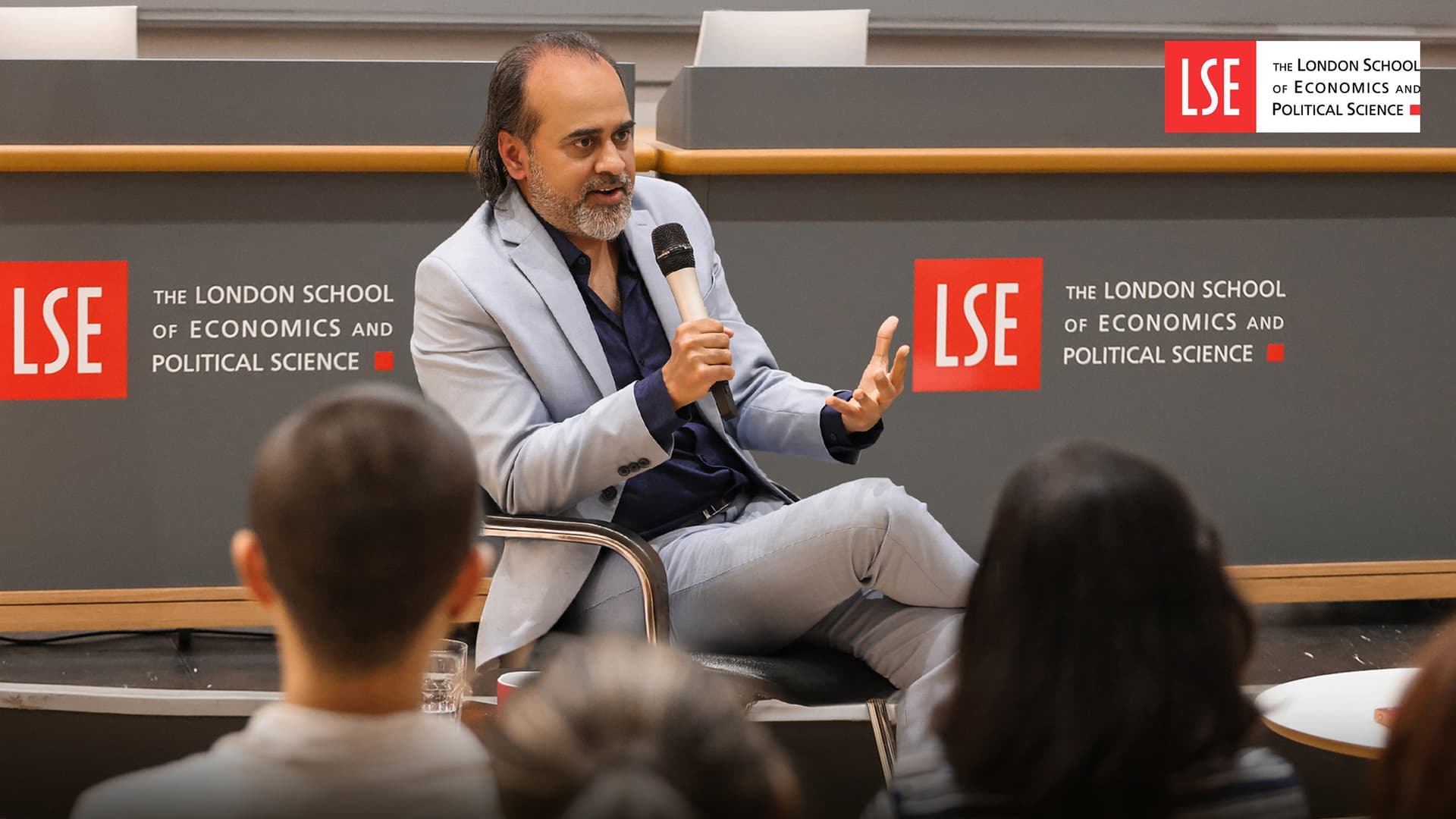
Philosopher Acharya Prashant and Professor Jonathan Birch held a public dialogue on animal consciousness and the environment at the London School of Economics on Friday evening. A packed Hong Kong Theatre broke into sustained applause as the session got underway. Titled “Animal Consciousness and the Environment: Insights from Science and Vedanta,” the dialogue drew students, researchers, faculty and members of the public. Professor Birch is Director of LSE’s Jeremy Coller Centre for Animal Sentience.
The event was held as part of London Climate Action Week and introduced by Dr Eva Read, a faculty of animal welfare science at LSE, who described the evening as a rare cross-cultural meeting point between Western philosophy of mind and Indian philosophy. She introduced Acharya Prashant as ranked in the top twenty of the Watkins 2026 list of the world’s most influential living thinkers, noting that he has built one of India’s largest platforms for the mass education of the self, with his teaching-based app crossing five million downloads.
Professor Birch opened by describing a convergence between recent scientific findings on animal consciousness and positions long held in Indian philosophical traditions, noting that the 2024 New York Declaration on Animal Consciousness, which he helped frame, found realistic scientific support for sentience extending well beyond vertebrates. Acharya Prashant responded that the difficulty has never been a lack of scientific proof but a lack of intent. “The man who talked of the speaking tree and feeling oceans was not doing something special,” he said. “This man was just free of exploitative intent, and then it was obvious.”
The sharpest exchange of the evening, and the one that drew the most thunderous applause, centred on an analogy Acharya Prashant returned to repeatedly: that of a drunk driver. He argued that contemporary approaches to crises, from animal cruelty to climate change, resemble a society that responds to a driver who is drunk at the wheel not by addressing the drunkenness, but by engineering better roads, softer dividers, more advanced safety technology and a faster ambulance response, while leaving the state of the driver untouched. “We are prepared to do everything except look at the state of the driver,” he said, to a wave of applause. “Human beings are that driver, and that is the one thing and the only thing that we need to change.”
An audience member pressed him on whether this implied the problem could only be solved slowly, one person at a time. Acharya Prashant clarified that he was not arguing against regulation or technology, comparing them instead to the bamboo fences used to protect young saplings in London’s Richmond Park. “The crutches are needed precisely because the legs are not yet strong enough,” he said, adding that laws and technology remain necessary so long as the ego persists, but that their necessity should be measured by how quickly they become redundant, not treated as a permanent solution in themselves.
Both speakers described themselves as vegan, but Acharya Prashant drew a distinction between veganism as a deliberate ideological stance and veganism as something that arises naturally once a person sees clearly. “I never embraced veganism as an ideology or as a set of actions, do’s and don’ts,” he said. “My veganism is a natural offshoot of what I see, what I understand, and what I continue to observe on a daily basis.”
Speaking to IANS after the event, Acharya Prashant said the discussion had gone beyond data and policy into the nature of the self that seeks to solve problems in the first place. “Far from being the problem solver, what if the self is a problem creator,” he said. He described the fraction that separates humans from animals, which includes the human capacity for egoic identity, as “a design feature that should be better called a design bug, a manufacturing defect.”
“The pollution is visible on the outside, but the pollutant is inside,” he said. “The pollution is tangible, the pollutant is not.” Asked whether science’s openness to uncertainty has a parallel in Vedantic thought, he said the more fundamental claim was not about the limits of knowing but about the absence of a separate knower. “Knowing will happen,” he said. “But the knower obstructs knowing.”
“We are prepared to do everything except look at the state of the driver. Human beings are that driver, and that is the one thing and the only thing that we need to change.”Acharya Prashant, at the LSE
View full media coverage →
For media enquiries: Dr. Anupam Chatterjee · [email protected] · +91 93165 46673