Cambridge Union · University of Cambridge
Institutional Talks·30 May 2026
“Inwardly, We Are Still Cavemen”: Acharya Prashant Brings India’s Contemplative Tradition to Cambridge
The sole philosopher on the programme at the Cambridge India Business Dialogue argued that the disorder of modern civilisation is a symptom of an inner life never seriously examined.
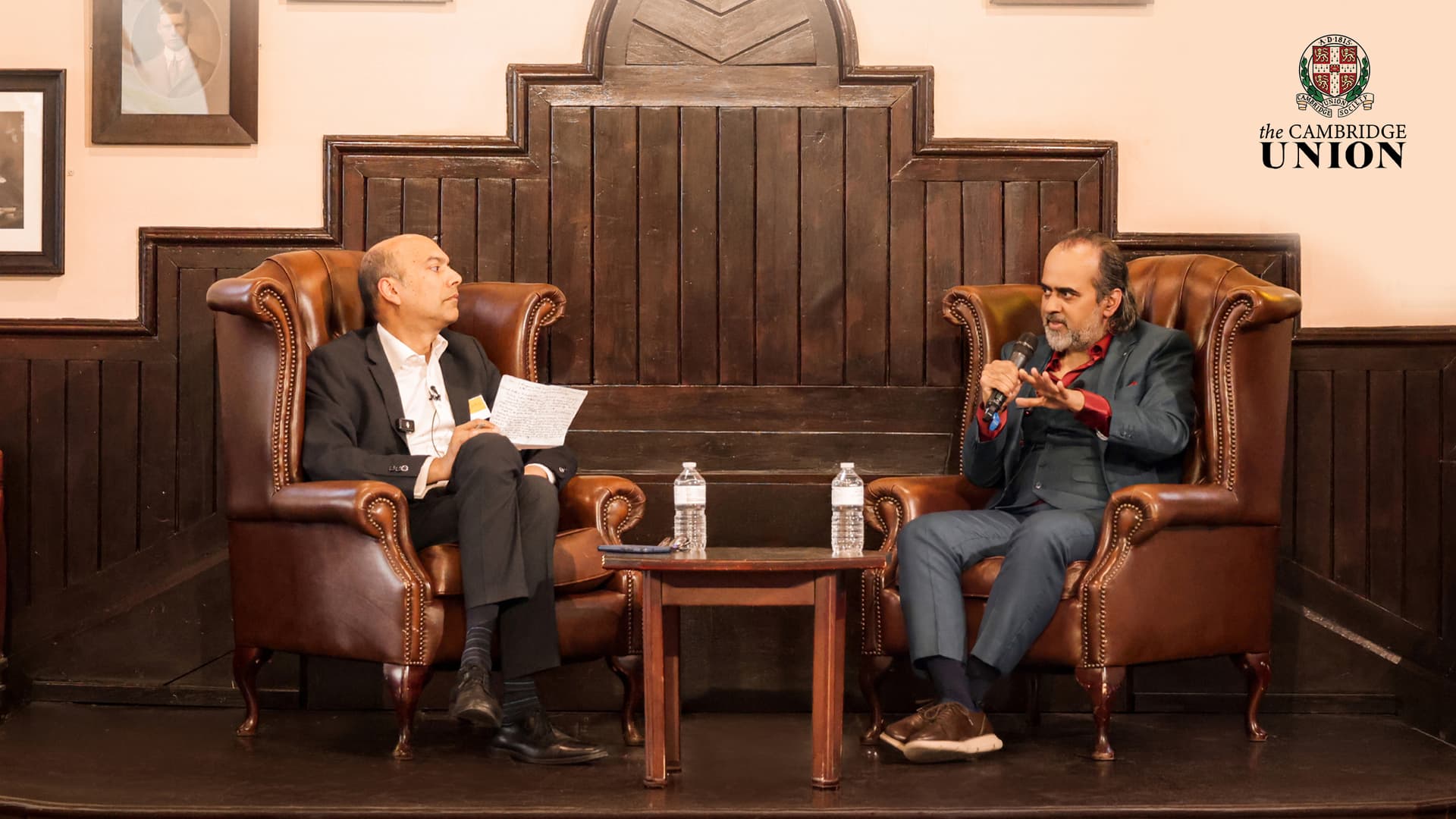
Philosopher and author Acharya Prashant addressed a packed audience at the University of Cambridge on Friday in a fireside chat at the iconic Cambridge Union, asking a question that is rarely on the agenda at Britain’s most prestigious institutions: what if the climate crisis, and the broader disorder of modern civilisation, is not a failure of science or governance, but a symptom of an inner life that has never been seriously examined? The audience response was overwhelming; tickets had sold out before the day arrived.
The Cambridge Union, which has hosted figures including Winston Churchill, Franklin D. Roosevelt, and Stephen Hawking, served as the venue for what organisers described as the summit’s marquee session. Among an exceptional roster of distinguished speakers drawn from politics, diplomacy, and industry, Acharya Prashant was the sole philosopher on the programme and was accorded the longest speaking slot of the day, a distinction that reflected the organisers’ intent to place questions of inner life at the centre of a gathering otherwise defined by external power.
The event was hosted by the Cambridge India Business Dialogue and conducted by Professor Jaideep Prabhu, Director of the Centre for India and Global Business at Cambridge Judge Business School, one of the world’s leading institutions for business and global affairs research, who led the fireside conversation and posed questions to Acharya Prashant throughout. The theme of the conversation was “Indian Contemplative Traditions as Applied to Climate Change, Inequality, and Global Responsibility.” The gathering brought together Kanishka Narayan, Minister for AI and Online Safety and Member of Parliament for Vale of Glamorgan; Lord Karan Bilimoria; India’s High Commissioner H.E. Periasamy Kumaran; and Nyrika Holkar of the Godrej Enterprises Group. Notably, Acharya Prashant was the only speaker at the summit whose session was moderated by a University of Cambridge professor.
Acharya Prashant, an alumnus of IIT Delhi and IIM Ahmedabad and founder of the PrashantAdvait Foundation, argued that for all its scientific and material progress, humanity has not advanced correspondingly within. The tools change, he said, but the self wielding them does not. “Outwardly, we are more prosperous and powerful than at any point in history,” he told the gathering. “Inwardly, we are still cavemen.”
The argument he built from there was, for a room accustomed to policy solutions, deliberately uncomfortable. Human desire, he said, is not a technical problem and cannot be resolved by technical means. He was careful to make clear that he deeply respects science and that technology is necessary and valuable. The failure lies elsewhere: formal education, across schools, universities, and institutions the world over, trains people in skills and external knowledge but does not address the education of the self. The questions that most determine how that knowledge will be used are almost never asked: what is desire, where do our wants come from, why do we want what we want, and does the self exist as we imagine it? Every tool humanity has ever built, he said, has been turned toward feeding a psychological emptiness that remains unexamined and therefore insatiable.
The climate argument followed directly. In Britain, steam engines improved, and electricity consumption multiplied many times over. Artificial intelligence has advanced at speed. Electric vehicles are held up as the answer to the automobile’s damage, yet they still require cobalt and lithium to be mined, forests to be cleared, and ecosystems to be disturbed. Efficiency, he said, has never reduced desire. It has only made desire cheaper to satisfy. Leaders are shaped not only by voters but by consumers, and the consumer is the same self that no climate conference has yet addressed.
When Professor Prabhu raised the question of whether there was time left for the kind of inner transformation being described, Acharya Prashant was characteristically direct. Time, he said, is needed only when there is a distance to cover or an additional task to accomplish. The crisis does not ask humanity to do more. It asks humanity to stop. “Acceleration takes time,” he said. “How much time does it take to stop where you are?”
He pointed to the Upanishadic distinction between Vidya and Avidya, outward knowledge and inward wisdom, as the oldest and still most accurate diagnosis of where modern civilisation has gone wrong. Humanity has progressed immensely in Vidya, he said. Avidya remains almost entirely unaddressed.
It is a recognition that has taken institutional form. Through the PrashantAdvait Foundation, Acharya Prashant runs an online night school every single day of the month, drawing students through the Upanishads, the Bhagavad Gita, Buddhist teachings, the writings of Lao Tzu, and existential literature and plays. Students sit for examinations, and the programme reaches more than 100 countries. “We are students of the self,” he said. “These works are not the destination. They bring us back to ourselves.”
Acharya Prashant is a philosopher and bestselling author who was recently featured in the top 20 of the Watkins’ 100 Most Spiritually Influential Living People list. Drawing on the Upanishads, the Bhagavad Gita, Madhyamika Buddhism, and global wisdom literature, his work reaches over 100 million online followers across more than 100 countries.
“Outwardly, we are more prosperous and powerful than at any point in history. Inwardly, we are still cavemen.”Acharya Prashant, at the Cambridge Union
View full media coverage →
For media enquiries: Dr. Anupam Chatterjee · [email protected] · +91 93165 46673