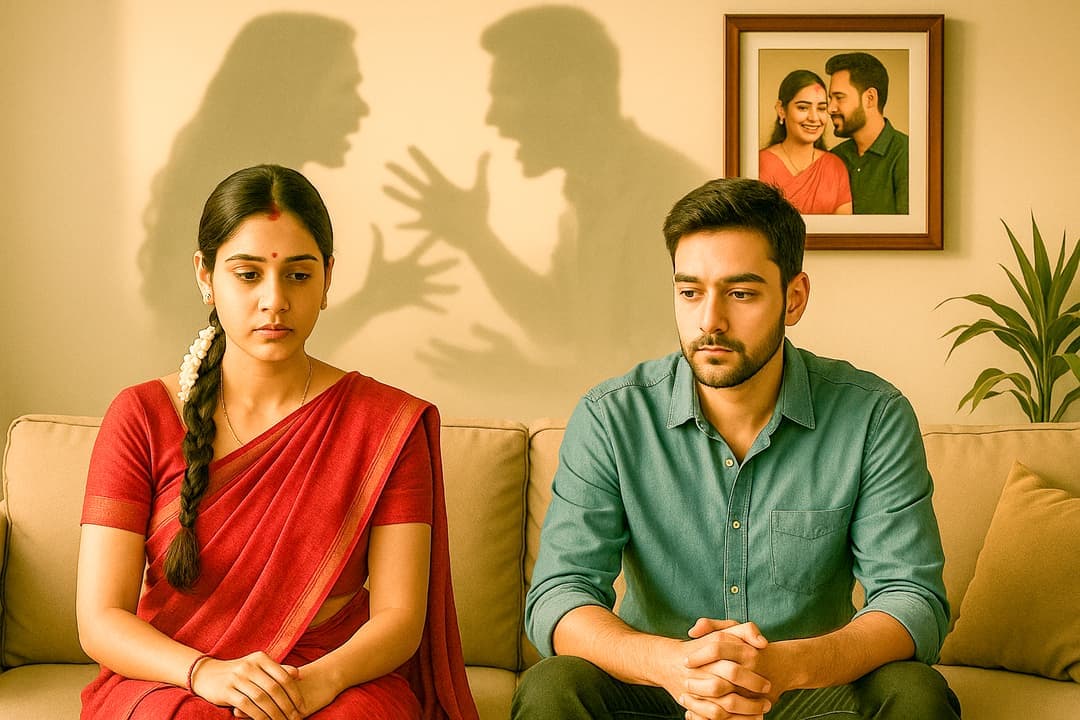
Women Sacrifice More in Relationships?

Acharya Prashant

11 min
2.8k reads
Women Sacrifice More in Relationships?
Women, the way they are brought up in our country, anyway do not have much to lose. If I do not have much in life, and then there arrives a person who is attractive, earns well, is strong, then why, as a woman, will I not go for him? Your body is impelling you to take a particular decision, and you don't even know that it's coming from the body. The only solution is understanding, real, deep, honest observation of life. And this you could also call spirituality. This summary has been created by volunteers of the PrashantAdvait Foundation

Questioner: Namaste Acharya Ji. Mera naam Ankita hai. I'm a government servant and an alumni of this college. Mera sawal yeh hai ki, when it comes to choosing love over everything else. I think women are more forthcoming in making that sacrifice. But men, on the other hand, tend to think more about society, what people will think. They are more hesitant in taking that leap of faith. So why is that?

Acharya Prashant: First thing is, I do not know to what extent this generalization is factually valid, but it might just be. To know whether or not it is valid, we'll need some data, maybe a survey conducted over men and women with a particular sample size to ascertain their priorities.

Questioner: Correct.

Acharya Prashant: And if the survey reveals that women indeed do value their relationships so much that they are prepared to forsake everything else for the sake of the relationship, then we might infer this. I don't think we have surveys of this nature, but let me take you at face value. Let me assume what you are saying is born out of facts.

Do you get the question, all of us? Let's first get to the factual basis of this.

So your observation is coming over a sample of Indian women.

Questioner: Yes.

Acharya Prashant: Indian women. Indian middle-class women mostly. Middle class including the lower middle class. So there might be a particular segment of women for which this observation holds validity. First, we have to admit that. And there might be women who do not fall in the scope of this observation. So now we get rid of the generalization.

Now we are saying, let's take up this question only for the segment of women who behave in this way. And what is the behavior we are talking of? There are women who, for the sake of love or relationship, are prepared to give up on other things in life. And you're saying this kind of behavior is not observed so much in men.

Questioner: I feel that men may want to take that step, but they would rather think about everything else first. They would prioritize society. They would prioritize family, whatever, rather than prioritizing what they want out of life. Here, what I'm trying to stress upon is women would want to make that choice: that I want to spend my life with this person. Everything else we can work out.

Acharya Prashant: This observation that you're saying, once we understand that it's valid mostly for a particular segment of women, that will open up the answer for us.

Please understand, if I do not have much in life and then there arrives a person who is attractive not only in the physical sense but also in the sense that he earns well, is strong and capable of body and mind, then why as a woman will I not go for him, considering that I do not have any way much to lose because upbringing, society, and patriarchy anyway never gave me anything much to lose.

Men may not be so easily prepared to give up on what they have because, in the first place, they have something.

Women, the way they are brought up, and we are talking about a particular segment of women, not all women. Women, the way they are brought up in our country around us in the middle classes, they anyway do not have much to lose. Do they get their fair share in the father's property? If a man says, "I'm quitting my family and my father for the sake of my love," then he is quitting on his inheritance as well. The woman, anyway, had no inheritance to get. So it's easier for her to say tata. You're getting it. The stakes for her are lower. The stakes for the man are higher, and that's a sad commentary on the way our society is and the way it brings up and treats its daughters. Are you getting it?

And obviously, then there is the emotional factor, genetics, evolution. The woman is programmed to be a little more emotional because that's needed when you are doing the business of procreation, keeping the baby in the womb, and then taking care of it for several long years. That cannot happen if you are not very emotional.

Because the kind of things that you are doing in the process, and the kind of things you are forsaking in the process, cannot be easily justified using logic alone. So you need a fair dose of hormonal emotionality to justify the expenditure of time, energy, and life on pregnancy, childbearing, and child raising.

If you're not emotional, then you will ask a few questions, and the questions may lead to inconvenient answers, and those inconvenient answers may forbid you from conceiving the baby or bringing up the baby.

So by design, Prakriti, We very well know the hormones in the woman's body and the man's body are different. We also know that the brain structures are slightly different. We also know that the perceptions are different, and all that has been scientifically and experimentally proven. So there is that factor also. I'm emotional, and here is a person, and I decide in a more emotional way and I choose this person. More often than not, that decision doesn't yield any auspicious results or anything of goodness to anybody, especially the woman, but still that decision gets made.

So there are these two things, and whenever a decision is happening, there are only these two things: social and physical. There are only these two bases to decision-making. Either,

Your body is impelling you to take a particular decision, and you don't even know that it's coming from the body, not from your understanding.

It is coming from a hormonal upsurge. So it's the body. When you are 10 or 12, certain things do not yet appeal so much to you. By the time you are 15 or 16, certain things start becoming attractive. You think you made a decision to find that thing attractive. No.

It's just that now Mother Nature has arranged to secrete certain chemicals inside your body, and those chemicals are directing your thought and emotion. And so you said, "No, I find that thing attractive," or "that person attractive, I need to go to him." It's not your decision; it's the play of chemicals happening within. That's one factor that brings us to our so-called decisions.

The other factor is society. We talked of both — the way we raise our daughters, they don't have much to lose. So, they are looking for saviors. Sometimes girls are even looking for father figures because their biological fathers could never become real fathers. There was discrimination. There was secondhanded behavior. There never was real love in the relationship with the daughter. So the daughter has an emotional void, and when she meets a man in her youth, some part of her subconscious is looking to fill up that void. So she says, "Here, he will give me what my parents could not."

That's not the way you actively think or decide. You don't consciously say, "Oh, you'll be my papa now, not my boyfriend." No, not consciously. But if you observe the patterns of behavior, it will become visible. The way a lot of girls lean on their boyfriends, the way they demand security, it's as if you are with your father.

Whereas the two of you are of similar age, probably similar educational background. Why should one person act as some kind of caretaker, warden, or guardian? But often that's a relationship, and men too take up that role very comfortably. They'll say, "You keep informing me when you leave your room. Oh my god, it's 10:30 in the night. You have still not returned." And it's a very instructive kind of role-switching that happens.

When she is at the house with her parents, she keeps reporting to her parents, right? If she has gone out, she'll keep reporting, "Yes, I have reached the place I set out for. Now I'm doing these things." And she's constantly sending these messages to mama aur papa or to the big brother. And now she's a little more grown up and is with the boyfriend, and you find that she's reporting in a similar way to the boyfriend. Have you not seen that?

And there are so many boyfriends who actually actively demand that. "No, you know, it's because I'm very possessive about you. It's because I love you so much that I want to know every minute of your life. Let me know exactly when you enter the washroom. Let me know exactly when you leave the commode. And if there's a deviation of 34 seconds, my heart starts racing.” Somebody's kidding you. Literally kidding you.

You are being treated as a kid, and you are being treated as a kid, and you accept that because you are still looking for papa. "Can I get papa somewhere? Somewhere. Papa. Papa. Papa. Nice papa."

We are talking about women. So we can say this: if we were to talk of men, a lot of them are still looking for their mothers. So a lot of their behavior resembles the behavior of a little kid with the mother. She looks more for external worldly physical support that papa provides, and he looks more for the emotional warmth and care that mama provides. Both are outputs of bad parenting. Both never had really fulfilling experiences as kids. So they are still looking out in the world for their parents.

So that's the social dimension.

The inner dimension is hormonal. The social dimension is the kind of experiences you went through, and these dictate our behavior. Nothing else.

The third thing is the real thing that I'm referring to as nothing else because it is real but rare. So I said nothing. Real but rare. The third thing is when you can see that your decisions are coming either from the body or from the society, and you say, "None of this, nothing doing. I'll be my own man or my own woman. I am consciousness personified. I understand what these two rascals are trying to do to me. The inner one and the outer one. I'll yield to neither of them. I understand the traps you are laying for me. I'm not going to be ensnared." And I can see the fate of those who do get trapped all around me. I can see that game happening. And the woman suffers, and the man also suffers. Both suffer.

Think of the statement: "Now that I left everything for you, shouldn't you two give your 100% to me?" And why would such a demand not rise? You're saying the woman is prepared to leave everything for the sake of love. That is the man.

And if you come with this feeling that you have left everything behind for a man, you will want reciprocation. You will say, "See, I left behind everything: my house, my family, my career, my future, my job. I left everything for you. Now you two should leave everything for me." Which means I should become the center of your life. And this is such a violent demand. I should be the most important thing in your life. Isn't this violent?

So all kinds of neurosis proceed from here.

The only solution is understanding, real deep, honest observation of life. And this you could also call spirituality. Real spirituality.

This article has been created by volunteers of the PrashantAdvait Foundation from transcriptions of sessions by Acharya Prashant
Comments
LIVE Sessions
Experience Transformation Everyday from the Convenience of your Home
Live Bhagavad Gita Sessions with Acharya Prashant
Categories