Why It Hurts So Much After Someone Is Gone

Acharya Prashant

17 min
46 reads
Why It Hurts So Much After Someone Is Gone
We don’t remember death. We think of death as something ugly. But facts cannot be ugly. Facts are just facts. But in the moment of love, in the moment of ownership, attachment, possessiveness, we hate to remember death. This summary has been created by volunteers of the PrashantAdvait Foundation

Questioner: My name is Saniya, and I'm a final-year PhD student. So there is always an extent; I’ll talk about grief here. All of us have dealt with grief in some way or the other. We have lost our loved ones, right?

So, as an observer, who should not be participating in it, but then you always have an extent of feeling towards people whom you are losing. For example, if you lose a parent, the grief or the feeling of losing that person, even if you try to observe, “Okay, this is the hormones, this is what is happening, and eventually it will dilute, maybe or maybe not.” But to detach yourself from that situation and just be the observer, I think, it is the most difficult thing to do. And how do you start that? What is the beginning?

Acharya Prashant: You see, after the person is dead, you remember that person, right? But when the person is alive, do you remember death?

Questioner: It also depends on the context. Like, if you know the person has a chronic illness, you will imagine.
Acharya Prashant: Even if the person has chronic illness, you will remember death only three or four times a day, that too reluctantly.

I repeat my question: when the person is dead, you remember that person; but when the person is alive, do you remember death?

Listener: Not exactly.

Acharya Prashant: You don’t. And that’s where suffering lies, because when you do not remember death, then you waste the time you have with that person while alive. And that’s why there is so much grief: because time had been wasted, so much was possible when the person was alive, you squandered the opportunity. And that’s what entire grief is for.

We don’t remember death. We think of death as something ugly. But facts cannot be ugly. Facts are just facts. But in the moment of love, in the moment of ownership, attachment, possessiveness, we hate to remember death. The mother holding the baby in her arms would just not want to imagine death. Right? Embracing your beloved, you won’t want to think of the skull, the bones, the ashes, would you? And then you waste the opportunity.

Death has to be seen as a fact, a fact not at the end of a string, but as a present reality. Everything is changing all the time. That is death. Why do you want to avoid it? Even if this person is set to stay alive for another three decades, she won’t be the same one she is this evening. And I waste away this evening because I forget there would be change, that there would be death. So the evening is gone, and tomorrow she’ll be another person, and then I’ll regret. And one day, when this body will be ashes, I’ll regret even more.

It is not death that scares us. Unlived life is what we grieve for.

Questioner: So I think I can translate it like this: when we grieve for others, we are grieving for ourselves.

Acharya Prashant: Who is not dying every moment? Please tell me. Who is not dying every moment?

Questioner: Sanyasi.

Acharya Prashant:** Then why do you want to believe that the person as you see him right now would be carried over to the future? No one gets carried over to the future. No one. Which means this is all that you have. This person would be dead in an hour. An hour is too much. He would be dead in a minute. A minute is too much. He would be gone in a nanosecond. Why don’t you make the most out of this, then?

And that’s where grief lies. You don’t make the most out of this because you choose to forget death, especially when you are young, especially when all seems green and verdant and vibrant.

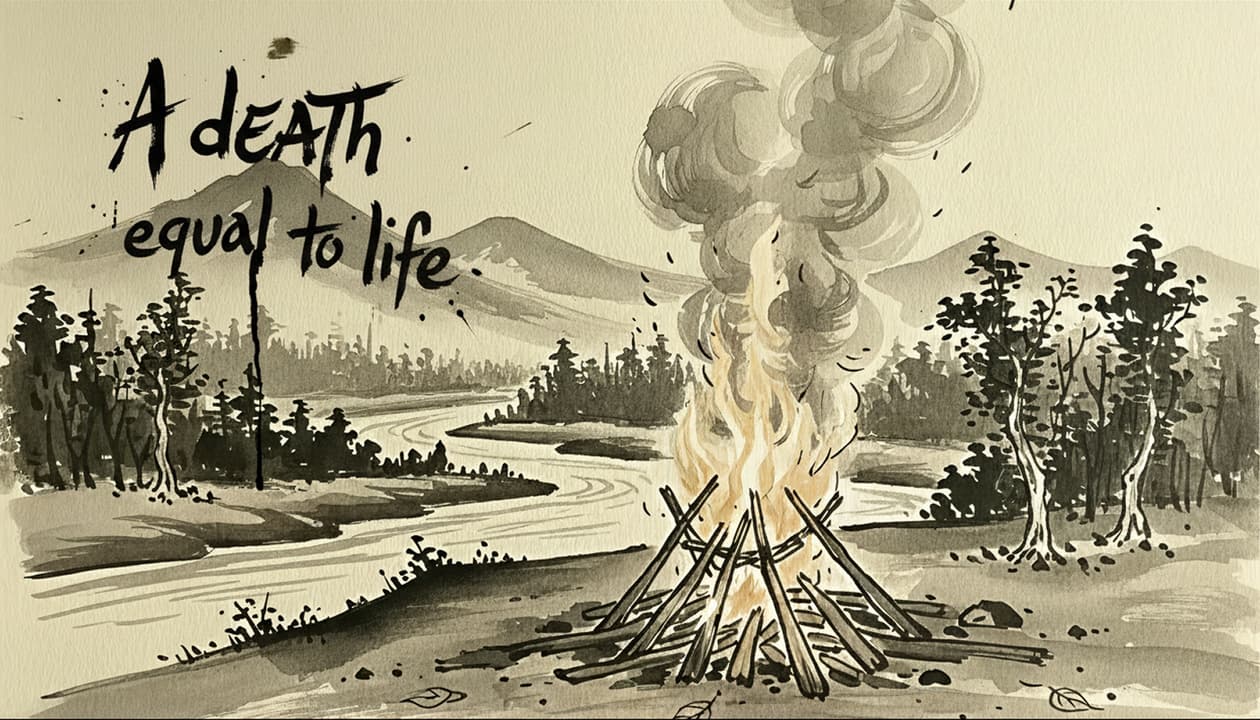
Death is a scare. The god of death is shown with such a hideous face and such a crazy appearance in all cultures. But death is life. When I'm teaching my students, I tell them only death is born. Only death is born, how can you avoid death? This that you are seeing is not a human being. It's death. Why do you want to suppress the fact? Yes, you want to suppress the fact, and when you suppress it, it explodes. When it explodes, then we weep.

Questioner: I am Amit Kumar. I am a master's first-year student in the Entrepreneurship and Management Department. And I happened to pen down my question that I have.

So, Acharya ji, I wish to ask about bringing depth into life. Having faced situations where the fragility of life became very evident, such as near-death experiences and also losing loved ones, I have realized how impermanent everything is. At the same time, life often appears repetitive, almost mechanical. This creates an existential crisis where many deep questions arise, but very few answers seem satisfying. To truly face and transcend this, I feel one needs a certain depth and expansiveness of consciousness. My question is: how does one bring out that depth in one's life and living?

Acharya Prashant: Mostly, what is shallow has already been labeled as deep. Now, is depth even needed?

Questioner: It's relative. Whatever is deep for one person might just be…

Acharya Prashant: We are limiting ourselves to one person. If that one person has already labeled shallow as deep, is depth even needed? That's the answer. Start seeing that all that you call as deep is very shallow, and then some depth will reveal itself. Otherwise, there is no need for depth. You have already taken something very superficial as deep.

Questioner: Yeah. Depth would be dependent on your context of your problem or your purpose. So one shallow situation might just be…

Acharya Prashant: Yes. When you say, “Oh, I love you deeply,” please see how shallow that is. When you say, “You know, my religion has great depth,” please see how shallow what you call your religion is. We're not talking of religion itself.

The ego, the participating self, this one, the ego, hates to admit that it is stupid, whereas it is obviously. Otherwise, it wouldn't participate, right? So it keeps labeling in the most mischievous way. See that happening all around.

“Oh, he's my life partner.” Like really? What kind of label are you assigning?

“This is the house of my dreams.” Really? I'm not saying that dreams are false. I'm saying this is not even a house.

“I'm educated.” Really? And if you think you are educated, education stops.

“I won't settle for less.” “I won't fear anybody.” Like really?

When you start labeling cowardice as courage, courage is killed. But the ego won't accept that it is a coward. It will label cowardice itself as some brand of courage.

Who wants to admit life is dry and loveless? So we say, “No, I have so many loving friends and family members,” and “Meet my new girlfriend,” and she is already looking over her shoulder. That one is nice.

Questioner: But so many things, “I am educated,” and if they all are meaningless. So I think 99.99% people are tired of finding these things only.

Acharya Prashant: If all of that is meaningless, will we say that, or will we first figure out whether that is meaningless? Please tell me.

Questioner: But everyone expects something in their life. Some expect power, some expect money, some expect beautiful relation.

Acharya Prashant: Yes. Right. But if in the garb of power what you have gathered is dependency, how wise are you? Please tell me. Again, if in the name of love you have accumulated dependency or exploitation, how wise are you?

What did you order from the menu, and what do you have on your table? How wise are you to consume it now and then pay the bill? You didn't want this for sure, but then you didn't know the dish. You went to a Mexican restaurant and ordered some fancy thing, first time heard the name, and then he brings you something. You have no way of determining whether this is that. So you eat it and also pay for it. That's love.

Without knowing what love is, why do you place an order?

Questioner: Even not that materialistic kind of love. If a person wants, be a kind person so that everyone cannot get hurt. If everyone will want this, then only the people…

Acharya Prashant: All right. I'll be a kind person who doesn't want to hurt anybody. Sir, please say you do want this. (Pointing towards the listener).

Listener: I want this.

Acharya Prashant: Please say you too want this. (Pointing towards the other listener).

Listener: I want this.

Acharya Prashant: And I'm a kind person. I don't want to hurt anybody. What do I do? What kind of notions are these? What is this?

Questioner: So you are saying that that is also some kind of, like, we are having some purpose?

Acharya Prasant: Bad labeling, bad labeling. You are labeling desire as kindness. You are labeling desire as love. Deceptive labeling, that's all, nothing else. The mother loves the child unconditionally. Yes, only her child. And is that not a condition? The very first condition: “I have unconditional love for my own child.” Don't you see through all this?

The idea here was, sir, you are talking of the materialistic kind of love, but real love is also there, sir. Why are you discounting it? Please show me where it is.

Questioner: No, sir, then real love doesn't exist?

Acharya Prashant; It can. If it doesn't exist, then you won't suffer. You won't be restless. Do you know why you can't sleep properly? Nobody can. Do you know why we are always discontented? That is love. But instead of getting into it, we settle for something very small and say, “No, sweetheart.”

Questioner: So we all pursue something in life, career, goal, or personal aspirations. Often these pursuits take us to a certain place, position, or state. We are also told that one must have a purpose in life. But I have seen that having a purpose does not always translate into true meaning or some fulfillment. So my question is: what should be the wise or smart approach so that our pursuit of purpose also leads to genuine meaning and fulfillment in life?

Acharya Prashant: First of all, you have to drive the crowd away from your interiors. The moment you say ‘purpose,’ what you get is a very limited list to choose from. And that limited list has been supplied to you by the crowd, by tradition, by history, by surroundings, by peers, by all these. So you have a list, and that list contains maybe some ten, fifteen items, and you pick one of them. You are ticking that box, you think you have exercised choice. No, that is not a choice. That is not a choice. Right? That's like choosing, like, which wall of this hall do I choose to break my head on? That kind of choice.

My purpose has to be something totally innate, totally innate. It has to be irrespective of your education.

Questioner: The reptilian brain?

Acharya Prashant: yes, the reptilian brain, the evolutionary brain, it's all coming from there. Yes. But why must we be so captivated by it, all that is this (pointing towards the water bottle) and this (pointing towards the another water bottle) is who you are? Why must you allow the limitations of this to become your limitations? Remember.

So the matter of purpose, now what can determine your purpose? Only your own situation. And you are situated in this world, right? We are not hanging somewhere in a vacuum. So there is this (pointing towards the outside), there is this (pointing towards oneself). And if I know both of them, a purpose will spontaneously arise. But instead, we allow the crowd to dictate our purpose without knowing this (pointing towards the outside), without knowing this (pointing towards the outside). You see how loveless the crowd is. And do you see how deep an act of love it is to know?

Do we know what's going on in the world? Do we understand? Do we know our own situation? And if we know that, then we'll know what to do next. Spontaneous, effortless action arises, and you are unstoppable, because you know nobody can convince you against your own discretion, because you know.

Otherwise, think of the choices we made, the purposes that we hold. This one, the wise one, would come and convince me against what I have decided. Does that not happen? For forty days, you said, “I have finally found the ultimate purpose of life.”

Questioner: One step away from a contradiction.

Acharya Prashant: It's beautifully put, one step away from being contradicted. And then you are again waiting for somebody to lean on, and this person will now come in and hand over another purpose, only to be contradicted by this one (pointing towards the listener) this time. Last time it was this one (pointing towards the other listener). And these are not persons; these are situations. These are phenomena, right?

Something can happen, it could be an event, and now you again are left feeling like a fool. “I was carrying this thing close to the heart for so long, and now it doesn't appear meaningful. What do I go for next?”

Please understand this *(pointing towards the outside)*and this (pointing towards oneself), and then you will get something that may have nothing to do with what the crowd does, and yet may be just the right thing for you. And that requires courage, right? But that's what you must have, because you are young and you're educated.

Questioner: So courage to finding the purpose, isn't that also appending the list, to add one more thing in that list?

Acharya Prashant: No. That dissolves the list. You tear away the list. No list anymore. Even I do not know my purpose, in some sense. It is happening. It is arising spontaneously. Knowing has become doing. Knowing has not become deciding. It is not a decision. It is not a decision, because decisions can be reversed. It is not a decision. It is unstoppable.

Listener: Coma person.

Acharya Prashant: Yes. Yes. Very intricately seen. In the coma person and in this one, there is such great similarity. Both appear to be flowing. Both appear to lack agency. Both appear to lack an inner controlling agency.

You know, you were talking of Advaita Vedanta, and I said many, many of the wisdom traditions of the world talk of awakening as the great inner beautiful death, death of the one who never existed at all. So you are worse than now being in a coma. You are actually?

Questioner: Dead.

Acharya Prashant: The comatose one can never afford death, but you have embraced death. You have embraced death, and now you are flowing. But the quality of this flow is fundamentally different from the quality of the flow of the comatose person.

Apparently, they’ll be the same. The comatose person doesn’t decide. The awakened person also doesn’t decide. That one looks like flowing; this one also looks like flowing. That one looks mad; this one also looks mad. Yet there is a great difference.

Questioner: Isn’t that one a series of impulses?

Acharya Prashant: Yes, that one has a series of impulses. This one has become an observer of all impulses, all such series.

Questioner: But being an observer, I have to delve into that impulse also.

Acharya Prashant: No, that would be the purpose. All observation is purposeless. If you have a purpose, then you will distort the observation. Whenever you go to look at something with an aim, with a goal, with a purpose or desire, you will end up distorting what you are seeing.

Questioner: It all starts with understanding that there is no absolute Truth for any belief that you have. It’s only a relative one, constrained.

Acharya Prashant: You can start from there. You can start from there, and having seen the futility of all relatives, all relatives. You could say, with nobody left to say anything. This is the absolute.

Questioner: It is just different frames of reference.

Acharya Prashant: As long as there is somebody relative to what is relative, you are only talking of relatives.

Questioner: But isn’t that observer also being a frame of reference from which it is observing?

Acharya Prashant: No. Because it has nothing to do with anything.

Questioner: It is not impacting. But you said it has an effect on this.

Acharya Prashant: If it is purposeful or desirous, if it wants to be the consumer, then it will destroy this. If it is an observer, obviously it doesn’t interfere. It has nothing to do with this. That's an observation.

Questioner: So it is just different, not any form of matter or any form of… It does not occupy.

Acharya Prashant: Yes. Because if it is matter, matter will interact with matter. Matter cannot help interacting with matter. Is there anything called an inert material? Even that which you call inert is actually non-reactive. You just need to give it the right conditions. So if this is material, this cannot be an observer. It will become a participant.

Questioner: So it is just something inert which is beyond the form of consciousness.

Acharya Prashant: Yes, it is nothing.

This article has been created by volunteers of the PrashantAdvait Foundation from transcriptions of sessions by Acharya Prashant
Comments
LIVE Sessions
Experience Transformation Everyday from the Convenience of your Home
Live Bhagavad Gita Sessions with Acharya Prashant
Categories