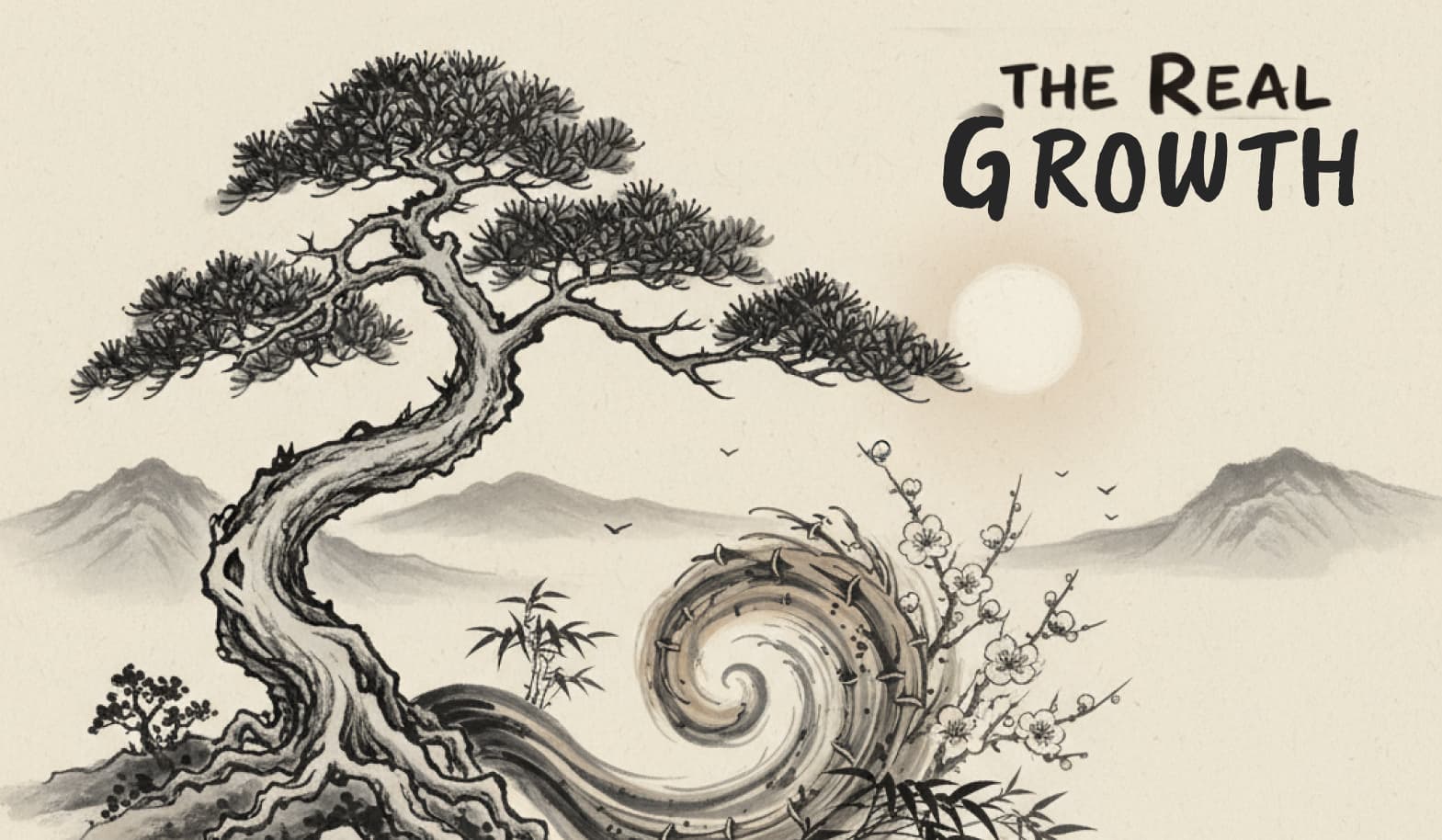
True Growth Requires a Second Birth

Acharya Prashant

10 min
465 reads
True Growth Requires a Second Birth
Growth is a reduction, growth is a dissolution. True growth is rather a contraction, bidding goodbye, letting go, dropping, unburdening, unloading, unbecoming. Those are the real words. This birth that we are carrying as our identity is just suffering for the one who is carrying it. Why should you carry something that simply burdens you? That’s what is intended to be read. This summary has been created by volunteers of the PrashantAdvait Foundation

Questioner: Namaskar Acharya Ji, here you have quoted that “True growth requires a second birth; through self-knowledge, education, and freedom from the instincts we inherit.” Now, saying that true growth requires a second birth, definitely it’s not a biological one, it will come from knowledge or that is also self-knowledge.

Now, how will I get to know that my second birth has started?

Acharya Prashant: They wanted to keep it a little sweet. This needed to be a bestseller. Bluntly put. Other days I would have written, true growth requires a real death. Instead, I’ve written, true growth requires a second birth.

It’s not really a second birth; it’s, first of all, a demise of the one that you are. That’s what is needed, the one that you have become, right? So, growth is then not accumulative, not additive.

Growth is a reduction, growth is a dissolution. Growth sounds like an enhancement of something, right? An accumulation, an expansion. True growth is rather a contraction, bidding goodbye, letting go, dropping, unburdening, unloading, unbecoming. Those are the real words.

Instead of that, I have said, true growth is the second birth. What’s implied is that this birth that you are currently carrying or believing in this that you have come to become, this is something you should bid farewell to, let it go, because this is of no use to you.

This, that we are carrying as our identity or our life is just a suffering for the one who is carrying it. Why should I carry something that simply burdens me? That’s what is intended to be read.

Questioner: So this witnessing second birth, Abhi jaise growth ki baat kar rahe hain ham, to abhi jo hamara star hai, definitely ham ye keh sakte hain jahan par aaj ham hain, to wahan se hokar hamara star upar uth gaya hai. That we can say growth. Ki jahan par abhi fanse hue hain, kaafi saari maanyataon mein fanse hue hain, abhi khud ko nahi jaante, actual mein hamari reality kya hai.

So that growth is called self-knowledge?

Acharya Prashant: Dekhiye, upar uthne mein na ek samasya raheti hai. When you say that “I want to get better from where I am,” then the mental model is — I have a house called personality, a four-storey dwelI, and rising or getting better or getting bigger means letting the foundation remain as it is, letting the four storeys remain as they are, and on top of those four storeys, building another three.

This is what we often think of as ascension, as elevation of one’s level. Right? So what one thinks is that I have this, and getting better means adding something on top of this, like adding three floors on top of the four that you already have. It’s not that way. So, it’s a bit of a misnomer, a misleading one, when you say that I want to improve my level, because immediately you will think of the four storeys and then the three more on top of those four. That’s a flawed model.

It’s actually about bringing down the four you have erroneously constructed on a weak foundation. It’s not that you can add three more to the four that are already unsustainable. Think of this, the foundation is weak, even those four floors are shaky on that weak foundation, and in the name of growth or development you are adding three more on top of the four shaking ones. Is that wise?

But that’s what we often think of as growth, not just material growth, even spiritual growth. We don’t want to give up what we already have; we want to add to it. So I have certain, for example, beliefs or superstitions, right? And that I want to carry. But in the name of spiritual growth, I want to add something to what I am already carrying. And then it becomes very difficult for the process and for the teacher because it’s principally about unburdening yourself, right? And then there is also a major dissonance at your core. You remain who you already are.

Listener: This is a conflict.

Acharya Prashant: And the teacher is giving something, and you want to wrap that around that pre-existing core, and these two will be inconsistent. And then there will be an inner conflict, and you’ll be divided.

The core is something you don’t want to give up. So you will give up the wrapping, which means you’ll drop the teacher. The process will become unsustainable. You can’t carry it. So it’s not an accumulative process. It’s not something that you can wear like your garments. It’s not like money that you can add to your existing account. It’s about emptying yourself. It’s about looking at yourself and asking, “Do I need to carry this? I have been carrying this since long. And if I can’t look at myself, can I look at others? Can I look at history?”

There have been so many like me, just like me. We all are one in many ways. You look at the entire flow of history, and in some ways you see your own face, and you say, “All of them were doing much the same things that I do. What did they get? And I have this short life, and maybe a few years or decades left. I want to spend them doing this?” That’s the question you need to ask. It’s a matter of just releasing something you have been clutching. Go, Gate Gate Pārāgate Svāhā. Go.

Questioner: Acharya Ji, the same thing. Can you please elaborate the things that we are accumulating in the saṁsāra? Can you please elaborate this with a real-life example, how we can practically implement this? Like for example, a normal man, he’s earning, he’s having a job, whatever he’s having. So if he implements this structure, then naturally he is tending to become someone like Diogenes ultimately, ideally. Then how can this be implemented?

Acharya Prashant: You don’t have to become like somebody. It’s not about any other person at all. Your cup is already full. Your hands are already full. Pull off yourself. You are carrying so much of yourself. Why do you want to look at a Diogenes, or a Socrates, or a Nachiketa? You already have a huge and complex case study available. Whose? Your own.

So look at yourself and ask — this that I am, that I call my life, my being, my belief, whatever this that I am — where is it coming from? And whatever I have become, what is it doing to me? Am I contented being this that I call myself? There is no Diogenes in this. There is no teacher, no scripture in this. There are no commandments in this. It’s between you and you. It’s between you and the mirror. You’re getting it?

It’s not about imitation. It’s about realization. And it’s about the sense that if I call myself alive, and right now I think most of us do call ourselves alive, then death is staring at me all the time. Life is always in the shadow of death, is it not?

So things have to be time-bound, right? Do I have time to spend? I have a limited amount of time, right? And I’m not really free or liberated. I have something to take care of. I have work to do, a task to accomplish, chains to melt. Correct? And there is limited time. And what I’m doing doesn’t take me in the direction of my destination. So, why am I playing it in an absurd way?

That's the question to ask. It's entirely between you and you. Did I mention Diogenes once? Did I mention anybody even once? No teacher really has a role in it beyond a point. You, your life, your responsibility. Am I answering? Am I reaching?

Questioner: Yes. I'm getting 10%, I think. It's very difficult. I'm trying to.

Acharya Prashant: I'll try harder.

Questioner: I'll try harder, Acharya ji.

Questioner: One more thing, that you have mentioned, “Freedom from the instincts we inherit.” What do you mean by “we inherit?”

Acharya Prashant: Inherit from the body and the society.

Questioner: But we’ll not get freedom, right? From society, body?

Acharya Prashant: What does freedom mean? I'm around you all, that doesn’t mean that I have to burden myself with the instincts all of us or anybody is carrying. Do I have to? Is there an obligation? Living in society, does it have to necessarily imply being a social slave?

Listener: No.

Acharya Prashant: One can merely live in society in a liberated way. That’s fine. And that would be a beautiful society of free individuals — free to relate, free to love, free to give, and free to take as well.

Questioner: But when we bind to the people or things, suppose that person is not there, or those things, those material things are not there, then we feel some...

Acharya Prashant: All things are material. Everything is materialistic. There is nothing but the material. This is material (pointing towards the book). This is also material (pointing towards the mouth). This voice box is material. The brain that is processing these sound waves is also material. There’s nothing but the material. What’s the problem with being materialistic?

The problem is when you think of the material as something that would fulfill you, then it’s a problem. But the fact is that all this is material.

Questioner: That thought itself is stopping my freedom.

Acharya Prashant: How?

Questioner: Suppose you are saying, if I’m materialistic in my world, I’m engaged with any person or any kind of thing, and if I lose that person or thing, then I feel very sad. So it’s because of this binding, right? So there’s no freedom.

Acharya Prashant: What the material is, then it will be difficult to grieve the loss of a related one, because if it’s all material, then material is immortal really. Material cannot die.

Questioner: Yes, correct.

Acharya Prashant: Where can a body go?

Questioner: Pañca Tattva.

Acharya Prashant: It doesn’t go anywhere. And that will bring some sobriety to your grief. Nobody goes anywhere. We arise from the soil and we go back to the soil.

The only problem is when you start thinking that by accumulating material you can be liberated from the material. When there is a lack of love or realization within, and you think that by getting a bigger TV set, or a little more furniture, or a third car, you’ll achieve fulfillment, that’s when materialism becomes a curse.

Questioner: Correct. Thank you so much, Acharya ji.

This article has been created by volunteers of the PrashantAdvait Foundation from transcriptions of sessions by Acharya Prashant
Comments
LIVE Sessions
Experience Transformation Everyday from the Convenience of your Home
Live Bhagavad Gita Sessions with Acharya Prashant
Categories