The Child as the Ego’s Credential

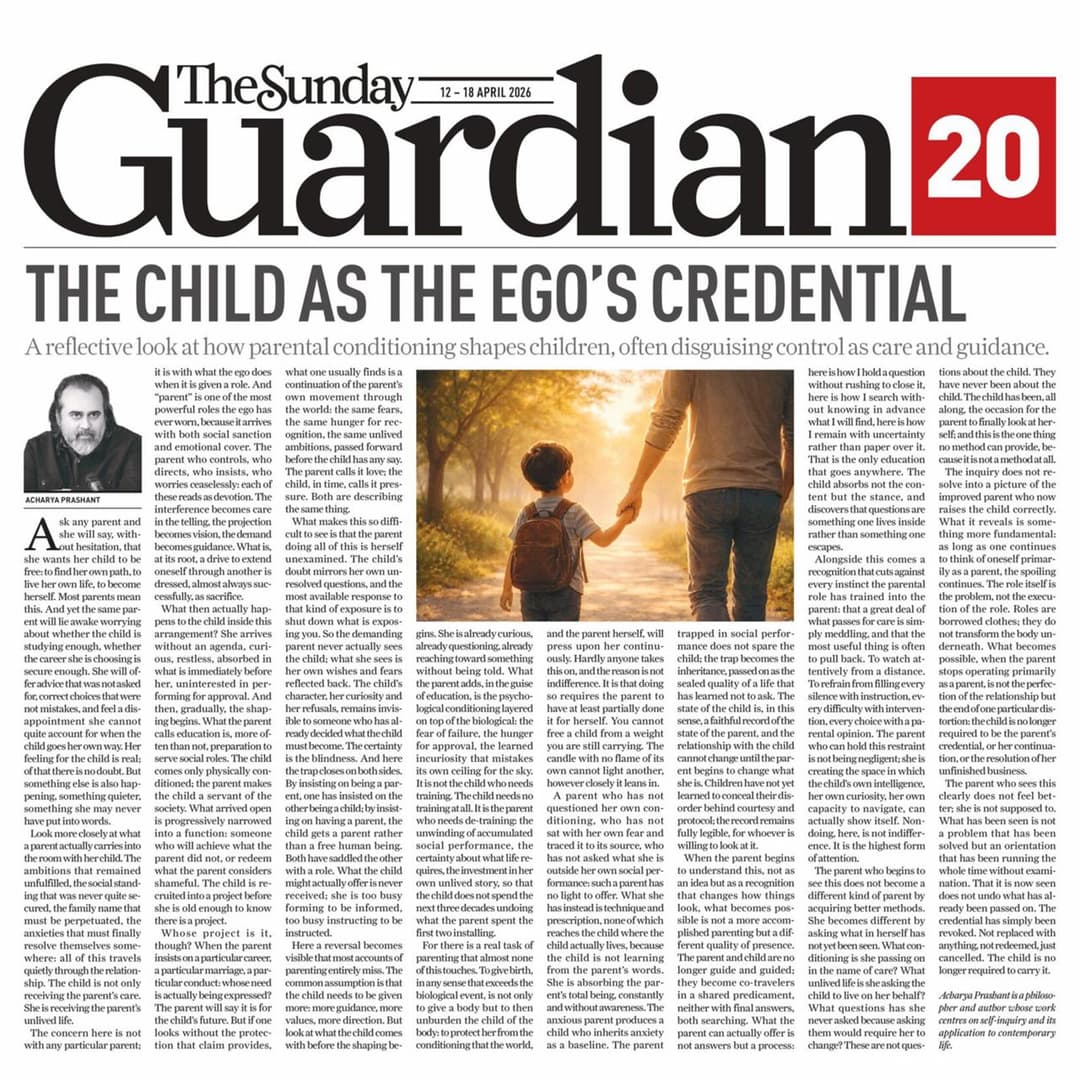
Originally published in The Sunday Guardian on 12 apr '26
Ask any parent and she will say, without hesitation, that she wants her child to be free: to find her own path, to live her own life, to become herself. Most parents mean this. And yet the same parent will lie awake worrying about whether the child is studying enough whether the career she is choosing is secure enough. She will offer advice that was not asked for, correct choices that were not mistakes, and feel a disappointment she cannot quite account for when the child goes her own way. Her feeling for the child is real; of that there is no doubt. But something else is also happening, something quieter, something she may never have put into words.
Look more closely at what a parent actually carries into the room with her child. The ambitions that remained unfulfilled, the social standing that was never quite secured, the family name that must be perpetuated, the anxieties that must finally resolve themselves somewhere: all of this travels quietly through the relationship. The child is not only receiving the parent’s care. She is receiving the parent’s unlived life.
The concern here is not with any particular parent; it is with what the ego does when it is given a role. And “parent” is one of the most powerful roles the ego has ever worn, because it arrives with both social sanction and emotional cover.
The parent who controls, who directs, who insists, who worries ceaselessly: each of these reads as devotion. The interference becomes care in the telling, the projection becomes vision, the demand becomes guidance. What is, at its root, a drive to extend oneself through another is dressed, almost always successfully, as sacrifice.
What then actually happens to the child inside this arrangement? She arrives without an agenda, curious, restless, absorbed in what is immediately before her, uninterested in performing for approval. And then, gradually, the shaping begins. What the parent calls education is, more often than not, preparation to serve social roles. The child comes only physically conditioned; the parent makes the child a servant of the society. What arrived open is progressively narrowed into a function: someone who will achieve what the parent did not, or redeem what the parent considers shameful. The child is recruited into a project before she is old enough to know there is a project.
Whose project is it, though? When the parent insists on a particular career, a particular marriage, a particular conduct: whose need is actually being expressed? The parent will say it is for the child’s future. But if one looks without the protection that claim provides, what one usually finds is a continuation of the parent’s own movement through the world: the same fears, the same hunger for recognition, the same unlived ambitions, passed forward before the child has any say. The parent calls it love; the child, in time, calls it pressure. Both are describing the same thing.
What makes this so difficult to see is that the parent doing all of this is herself unexamined. The child’s doubt mirrors her own unresolved questions, and the most available response to that kind of exposure is to shut down what is exposing you. So, the demanding parent never actually sees the child; what she sees is her own wishes and fears reflected back. The child’s character, her curiosity and her refusals, remains invisible to someone who has already decided what the child must become.
The certainty is the blindness.
And here the trap closes on both sides. By insisting on being a parent, one has insisted on the other being a child; by insisting on having a parent, the child gets a parent rather than a free human being. Both have saddled the other with a role. What the child might actually offer is never received; she is too busy forming to be informed, too busy instructing to be instructed.
Here a reversal becomes visible that most accounts of parenting entirely miss. The common assumption is that the child needs to be given more: more guidance, more values, more direction. But look at what the child comes with before the shaping begins. She is already curious, already questioning, already reaching toward something without being told. What the parent adds, in the guise of education, is the psychological conditioning layered on top of the biological: the fear of failure, the hunger for approval, the learned incuriosity that mistakes its own ceiling for the sky. It is not the child who needs training. The child needs no training at all. It is the parent who needs de-training: the unwinding of accumulated social performance, the certainty about what life requires, the investment in her own unlived story, so that the child does not spend the next three decades undoing what the parent spent the first two installing.
For there is a real task of parenting that almost none of these touches. To give birth, in any sense that exceeds the biological event, is not only to give a body but to then unburden the child of the body: to protect her from the conditioning that the world, and the parent herself, will press upon her continuously. Hardly anyone takes this on, and the reason is not indifference. It is that doing so requires the parent to have at least partially done it for herself. You cannot free a child from a weight you are still carrying. The candle with no flame of its own cannot light another, however closely it leans in.
A parent who has not questioned her own conditioning, who has not sat with her own fear and traced it to its source, who has not asked what she is outside her own social performance: such a parent has no light to offer.
What she has instead is technique and prescription, none of which reaches the child where the child actually lives, because the child is not learning from the parent’s words. She is absorbing the parent’s total being, constantly and without awareness. The anxious parent produces a child who inherits anxiety as a baseline. The parent trapped in social performance does not spare the child; the trap becomes the inheritance, passed on as the sealed quality of a life that has learned not to ask.
The state of the child is, in this sense, a faithful record of the state of the parent, and the relationship with the child cannot change until the parent begins to change what she is. Children have not yet learned to conceal their disorder behind courtesy and protocol; the record remains fully legible for whoever is willing to look at it.
When the parent begins to understand this, not as an idea but as a recognition that changes how things look, what becomes possible is not more accomplished parenting but a different quality of presence. The parent and child are no longer guide and guided; they become co-travelers in a shared predicament, neither with final answers, both searching. What the parent can actually offer is not answers but a process: here is how I hold a question without rushing to close it, here is how I search without knowing in advance what I will find, here is how I remain with uncertainty rather than paper over it. That is the only education that goes anywhere.
The child absorbs not the content but the stance and discovers that questions are something one lives inside rather than something one escapes.
Alongside this comes a recognition that cuts against every instinct the parental role has trained into the parent: that a great deal of what passes for care is simply meddling, and that the most useful thing is often to pull back. To watch attentively from a distance. To refrain from filling every silence with instruction, every difficulty with intervention, every choice with a parental opinion. The parent who can hold this restraint is not being negligent; she is creating the space in which the child’s own intelligence, her own curiosity, her own capacity to navigate, can actually show itself. Non-doing, here, is not indifference. It is the highest form of attention.
The parent who begins to see this does not become a different kind of parent by acquiring better methods. She becomes different by asking what in herself has not yet been seen. What conditioning is she passing on in the name of care? What unlived life is she asking the child to live on her behalf? What questions has she never asked because asking them would require her to change? These are not questions about the child. They have never been about the child. The child has been, all along, the occasion for the parent to finally look at herself; and this is the one thing no method can provide, because it is not a method at all.
The inquiry does not resolve into a picture of the improved parent who now raises the child correctly. What it reveals is something more fundamental: as long as one continues to think of oneself primarily as a parent, the spoiling continues. The role itself is the problem, not the execution of the role. Roles are borrowed clothes; they do not transform the body underneath. What becomes possible, when the parent stops operating primarily as a parent, is not the perfection of the relationship but the end of one particular distortion: the child is no longer required to be the parent’s credential, or her continuation, or the resolution of her unfinished business.
The parent who sees this clearly does not feel better; she is not supposed to. What has been seen is not a problem that has been solved but an orientation that has been running the whole time without examination. That it is now seen does not undo what has already been passed on. The credential has simply been revoked. Not replaced with anything, not redeemed, just cancelled. The child is no longer required to carry it.
Originally published in The Sunday Guardian on 12 apr '26