Seeking External Validation: You Are a Bubble Blown by Society

Acharya Prashant

11 min
519 reads
Seeking External Validation: You Are a Bubble Blown by Society
Had you not been told what to do, would you have done even one of the things that you currently do? Think of it. If nobody tells you to take a particular kind of education or a particular career, would you still go in that stream? Very unlikely. Most of that which we want is something we have been ‘made to want.’ You are not even a puppet. You are a bubble — a bubble blown by society. Once you start looking directly at yourself, the need for external validation then reduces. This summary has been created by volunteers of the PrashantAdvait Foundation

Questioner: I feel most of us strive for perfection, and in that road we often seek external validation. Even if we say we don’t want external validation, we are doing it for ourselves, but there’s this part of us that would love it if somebody compliments us, tells us we did great. Now you said imperfection is a very humane thing to have. Is this seeking external validation also a humane thing to have, or is this something negative that we should remove?

Acharya Prashant: See, when you say humane, you could either mean the socially conditioned human being or you could mean the natural, free, beautiful human being. Seeking validation from others is not really your natural state. Right? It comes from social conditioning.

If I want to control you all, right? I would say, “You know, you are my assessment of who you are,” which means I’ll dictate who you are. And I’ll call you all by certain, let’s say, numbers. On a scale of 100, you’re 78, you’re 64, you are 81, you are 92, just 54. And you, I don’t like you at all, 31. So that’s how you’ll be addressed.

Those numbers will now become your identities, right? You’ll carry them as your descriptions of who you are. “I’m 31. I’m 91.” You say you are 31. But who assigned this number 31 to you? I did. Somebody outside of you, right? That’s how society handles the kid. The kid, the schoolgoer, the student, the college student, the university student. We will decide who you are. If we say you are 31, then you better accept you are 31. Not only should you accept that you are 31, you identify with 31, you introduce yourself as 31.

If I say you are valuable, then you are valuable. You can imbibe that. If I say you are valuable, then you are valuable. Let four people say, “Oh, you are pretty,” and you say, “I’m pretty.” Otherwise, is there any objective standard for prettiness? Please tell me. It’s just so social. “Oh, he’s a wonderful person.” How do you know somebody is wonderful? Because four others have been calling him wonderful, and he has been trained that you are what others describe you as.

So that is the point from where this need for validation arises. It is an implanted need, an artificial need. If you look at very small kids, their need for validation is very small, just as small as they are. A part of the need for validation is biological as well, but that is a very small part. Very, very small. Extremely small. The overwhelming need comes from your social upbringing.

“I must be respected.” By?

Listener: Others.

Acharya Prashant: Others. And “If they respect me then my name is Mr. Respectable. Nothing changes within me, but if they withdraw their respect then I am no more Mr. Respectable.” So society then has the power to change who you are. You are not even a puppet. At least a puppet, if it is dropped, maintains some degree of individual existence. You are a figment. You are a bubble, a bubble blown by society. And they tell you who you are, they tell you who you are not.

I will ask you a simple question. Had you not been told what to do, and this is a question for everybody here — had you not been told what to do, would you have done even one of the things that you currently do? Think of it. And by “currently” I do not mean just this moment. I mean this life. Right from childhood till today whatever you have done, has that not come from an external point? Imagine there was nobody to tell you to lead life like this. Would you have still led life the way you currently do? No.

So all these things, things we put so much effort and time into, things that are so intimate to us, even they are socially dictated. Think of it. No one tells you to wear clothes like this. Would you still wear the same clothes or would you, rather than that, try to be creative, try to be more of yourself? Nobody tells you to take a particular kind of education or a particular course or a particular career. Would you still go in that stream? Unlikely. Very unlikely. Nobody came and told you that the institution of marriage exists. Would you still marry? Very unlikely.

So all these things that we do are all socially dictated. Right? And they cannot dictate you unless they have an inner hook. There has to be something within you that corresponds to their directions. Are you getting it?

Just having a remote control does not suffice. There has to be something within the machine that follows the control. So the society handles the control remotely, but to make it work, it implants a chip inside you without your consent. So they control you from outside and they do not even tell you that they are controlling you. You feel you are doing it on your own. You feel, “This is my wish. This is what I want.” No, no, no.

Most of that which we want is something we have been made to want. We do not want it. We have been told to want it.

And if you go against that, then you might be outcasted, ostracized, invalidated, condemned, and that will work on you because you have been told that if you are condemned then you stand condemned. Otherwise somebody can come and condemn you and you can say, “To hoots with you. How does your condemnation matter? I know who I am.” And that is the worst kind of injustice we can inflict upon the young one, the kid and then the student to deprive him or her of an internal locus of control, to make a young person look at herself through others’ eyes.

I do not have eyes that can directly look at myself. So how do I look at myself? In a secondhanded way. I look at your eyes and the impression I see there is what I make of myself. Why cannot I look directly at myself? Once you start doing that, the need for validation which is actually a great kind of slavery that needs then reduces.

Questioner: Sir, I do not think I understood the question properly. Because I am very fragile to society telling me how to exactly feel and it is very natural for a human to exactly do what the society wants. That is what you said, right? Should you oppose this? Should you consciously oppose the need for society to control me in order to feel the need to come?

Acharya Prashant: Kathan says, “It is very natural for a human to do exactly as the society tells him to do.” Kathan, then you have a very unnatural being sitting in front of you. If we do something, we start calling it natural. It might be normal. It is not natural. Now the norm is something that the society can dictate. Norm basically is a statistical thing just like mean, median, etc. If most people are doing something, that becomes the norm there at that point, at that place, in that moment. That is the norm there.

In a hospital sickness is the norm. It is normal to find sick people in hospitals. In a mental asylum insanity is the norm. Being normal is one thing, natural is another thing. You cannot say people are naturally sick. No. Yes, you can have a situation, a bad situation, in which a lot of people behave in outrageous ways and then that becomes the normal there, statistically the normal there. Normal is statistical. Natural is internal. These two are very different things.

So if you have come to a point where you are greatly affected by how people think of you, then you need to ask yourself, what do I really get by following others’ wishes, commands, opinions? What do I really get? Also ask yourself, what is it that they can really take away from me if I do not live as they do or as they command? That is the question you need to ask, because your nature is freedom and the objective of the whole field of wisdom is liberation, which is nothing but internal freedom.

And if you have been made to believe that a lot in your life depends on external situations, that is a lie and you must call it out. As long as you do not investigate that lie you will keep believing in it. Don’t we all have a great inner fear? I will come to you now, that if I do not do what others do, great harm will come to me. Right? That great fear is there. I am saying that fear is a lie. It stands there just as a blabbering threat, a very hollow threat. If there is something that others can actually take away, it was anyway not worth it. Let it go.

And anyway, what others have given will always remain something alien, something foreign, something borrowed with you. You will never have complete ownership or complete oneness with it because it has come from somewhere else. Whatever comes from outside can always slip back to where it came from. It can never become totally yours. The good news is you do not need to make any of those external things totally yours. You are all right as you are. You are all right. Yes, in practical life we do require things supplied by others, which is fine in a practical sense, not in an inner sense.

Not in an inner sense. For purposes of day-to-day movement, transaction, social life, yes, you will depend on things that come from others, like public transport, or even if you have your own car, that has to travel on a public road. So you are dependent in many senses on things given by others, which is fine. Let all that remain at the periphery of your being. Internally you must never identify with anything that others have given you. Otherwise you will be very, very afraid and you will be controlled and you will be enslaved.

As young people, do you like to be enslaved? How many of you? You see, that is what we call nature. I did not tell you that freedom is beautiful. But the moment I ask you, “Do you love to be controlled or enslaved?” not one person raises a hand. That is nature. Nature is freedom.

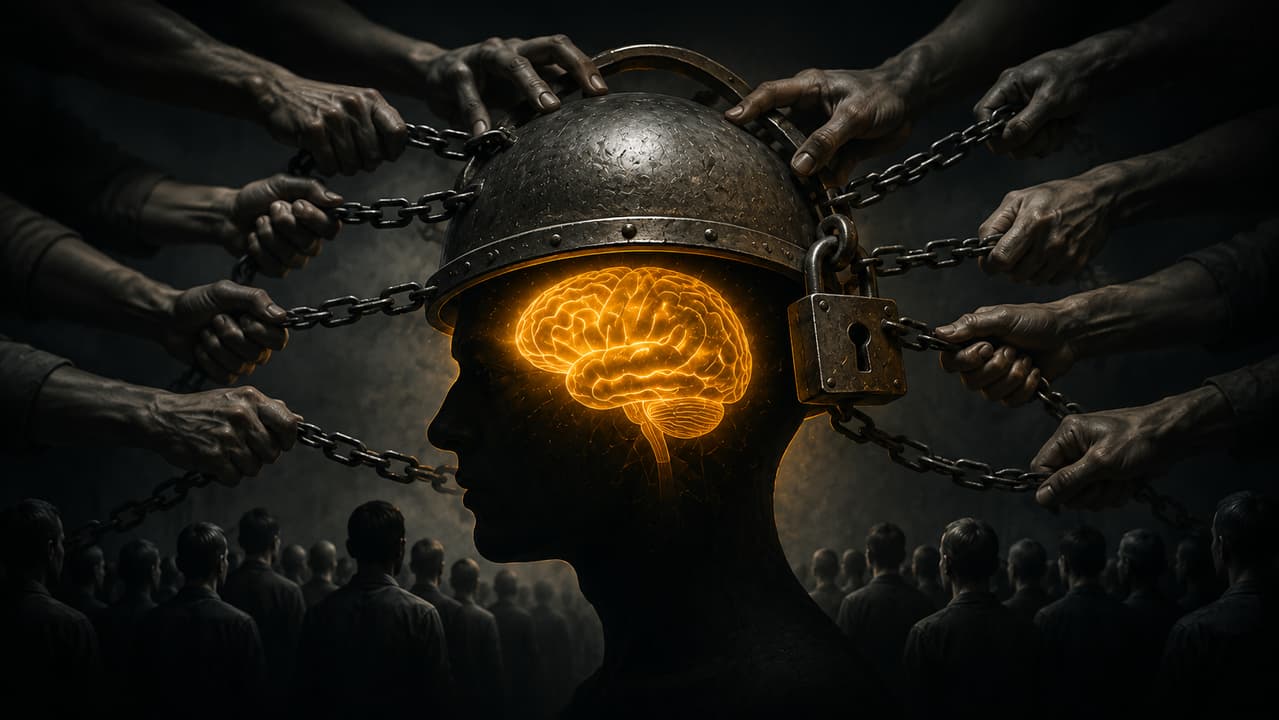
Even animals do not like to be caged. That is your nature. And that is the reason when you have to be punished, you are put in a small cell. But that is a smaller punishment because that is confining you only at the level of the body. What if the jail is inner? Here (pointing towards the brain). What if at the bodily level you are free to go anywhere but inwardly you are not free to move? What if your very identity and all your thoughts have been encaged? Isn’t that a more unfortunate prison? So that has to be avoided.

All prisons come with incentives. You do not need those incentives. Refuse them and be free.

This article has been created by volunteers of the PrashantAdvait Foundation from transcriptions of sessions by Acharya Prashant
Comments
LIVE Sessions
Experience Transformation Everyday from the Convenience of your Home
Live Bhagavad Gita Sessions with Acharya Prashant
Categories