Messi’s GOAT Tour: Cheers for Gloss, Tears for India

Acharya Prashant

19 min
493 reads
Messi’s GOAT Tour: Cheers for Gloss, Tears for India
If somebody is a great cricketer, I am all right admiring him irrespective of his nationality; that’s fine. But the question is: why is such adulation and such expenditure reserved only for people outside your own country? Indian soccer is totally starved of funds, but the same fans will not spend this money, not even a fraction of this money. Are we really poor, or are we just poorly directed? We don’t know the right direction to move in because we don’t know the right center to have. This summary has been created by volunteers of the PrashantAdvait Foundation

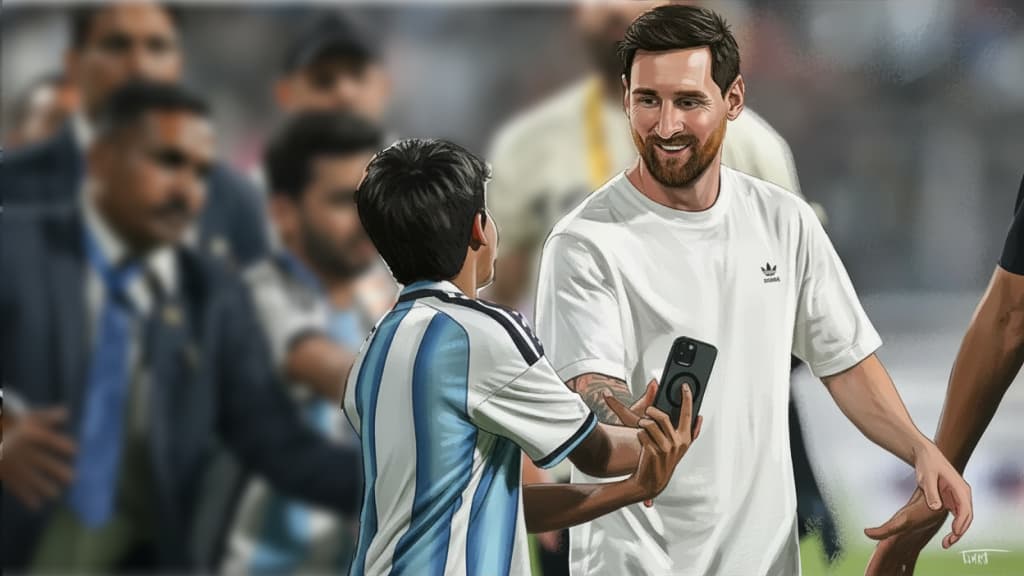
Questioner: Namaste Acharya Ji. I am Aditya from Kolkata. So my question is regarding the Lionel Messi GOAT tour that’s been going on in our country in four cities, and you must have known what had happened in Kolkata with respect to the event.

As soon as we knew that Messi was going to come, we were expecting that he would play some match or something. But as soon as we got to know about the schedule, some of us immediately boycotted it, and we could kind of sense what was going on.

My question is regarding fan psychology. After things went south, there were some protests, and we have seen that a ruckus has been going on in the stadium. So why don’t we see the same thing when our country is not qualifying for the 2027 Asian Cup, or for that matter when our top league, the ISL, has been in a halt for some time and we don’t know what the future holds? What kind of a fan psychology is this, that we worship celebrities and we don’t actually protest when things matter?
Acharya Prashant: You went there, you didn’t?

Questioner: No, no, I didn’t. I support Argentina. I chucked the plan as soon as I sensed some kind of fraud was going on. And I am thankful to you in some way with respect to that decision.

Acharya Prashant: How much were the tickets for?

Questioner: I think the tickets were ranging from 3,000 to 15,000, or even 20,000. And if you wanted to get a selfie with Lionel Messi, you had to pay, I think, 8 to 10 lakh for a single photo.

Acharya Prashant: What do I say? What do you want me to say?

Questioner: Sir, I understand that there are some fans who have wanted to see Messi since their childhood. But then again, he’s not playing, right? And they don’t have any option as well, if they want to see him; we don’t have that culture, he is not going to play in India anytime soon. So there’s one way, they are going to pay a few thousand bucks and they’re going to watch Messi. But when things went wrong, they’re the same fans who vandalized the stadiums and all. This is a loss to our stadiums; the biggest stadium in our country, the Yuvraj Krirangan.

Acharya Prashant: Okay, okay, I get it. See, I understand Indian football is deflated and down in the dumps and everything. I understand. You are right. The domestic football league does not seem to be resuming. Our international rank; when was the last time we managed to get into the top 100?

Questioner: I think it was sometime around 2018. I think we displayed valor in front of Qatar, and that was the last well-played, good match we played against them.

Acharya Prashant: And we got into the top 100?

Questioner: That time, the rank was 97.

Acharya Prashant: 97; otherwise, we usually are between 130 and 150 something, right?

Questioner: So we are around 120, 130, 140.

Acharya Prashant: 120 is good.

Questioner: And even we lost to Bangladesh.

Acharya Prashant: We lost to Bangladesh also.

And the fans are not bothered about Indian soccer, our rankings, our performance. Every four years, the World Cup arrives and we go nuts. In fact, was it the last one or the last-to-last one? We even had riots somewhere in Kolkata itself, right? Somebody got injured or somebody got killed, something happened. Brazilian and Argentinian fans clashed. Something happened, and that was in Kolkata.

Questioner: Yeah. So, I think something happened with Pelé as well, when he arrived in Kolkata, but that’s long back. I don’t know about the exact event.

Acharya Prashant: The ego cannot know of any higher purpose, right? It can parrot words that sound high and noble. But beneath all those big words, the ego is a very petty thing, very, very petty. All it knows is its own random likes and dislikes, tastes and distastes, preferences, accidental attachments. That’s what the ego is about.

It can keep talking, for example, of the nation, but does it really care? Does it really care? True nationalism is about living the great ideals that constitute our nation, right? And the ego will never really accept that. Though people will keep calling themselves nationalists and patriots and whatnot, they will never show even 1% of that kind of mad fervor for their national football team. They would not flock to domestic soccer matches. If some kind of fundraising happens for domestic football, I don’t know how many people would want to contribute even a fraction of the size of that ticket.

Approximately how many would have purchased tickets?

Questioner: Sir, in our stadium there are around 75 to 80 thousand.

Acharya Prashant: And it’s a four-city tour, right?

Questioner: Yeah, it’s a four-city tour: Kolkata, then Hyderabad, Mumbai, and then Delhi.

Acharya Prashant: How much does that add up to?

Questioner: Sir, I calculated it, before the tour it was around 50 crore, I think.

Acharya Prashant: 50 crores. Now, 50 crores from one city or four or five cities?

Questioner: Sir, I calculated by taking an average. I took 5,000 to 10,000 for the ticket price and multiplied it by the stadium audience. So it was around 50 crore, for four cities.

Acharya Prashant: For four cities. Now, this 50 crore is coming from the pockets of the so-called football fans, right?

Questioner: Right.

Acharya Prashant: But they will never give this 50 crore for the sake of Indian football. They gave it just to get a glimpse of a foreign star, which is all right. We understand certain things must not obey national boundaries. I understand. If somebody is a great cricketer, I am all right admiring him irrespective of his nationality, that’s fine.

But the question is: why is such adulation and such expenditure reserved only for people outside your own country? 50 crores, in the context of Indian football, is not insignificant at all. Indian soccer is totally starved of funds, but the same fans will not spend this money, not even a fraction of this money. What does that mean? Do we really love the nation? Are we really nationalistic people? Are we?

That brings me to this movie recently released, Dhurandhar. People are actually celebrating the portrayal of those who caused 26/11. You look at Instagram and other places, people are actively celebrating.

Questioner: The famous song which got viral.

Acharya Prashant: Yeah. Not just that song, everything about the movie, except for one or two characters. The ones being celebrated are the ones who tried to terrorize India, who caused mayhem in Mumbai, and people are very happy with them. And then we call ourselves Indians and lovers of the nation.

A certain amount must have been spent in purchasing the movie tickets as well, right? You said 50 crores for Messi. The movie would have done like 200 crores by now and will go on to do some 500 crores, maybe. Did even a fraction of this amount go to the victims in Mumbai and elsewhere?

Terrorism has been a festering wound for 20 years, 30 years, and we have had the most recent incident this year itself. Are Indians prepared to contribute even a fraction of the amount they paid for the movie to the victims of terror, or towards a fund that is exclusively dedicated to countering and wiping out terror? And then we say we are great patriots.

The ego cannot be anything. It cannot be nationalistic. It cannot be patriotic. The ego is just a lover of its own indulgences.

So that’s what we see here.

Shiva just gave me this little story, and a particular gentleman is saying that instead of spending around ₹150 crore on a short Messi visit; it’s not 50 crore, it’s 150 crore, the same money could be invested in grassroots development to create 10 Messis in India. And that’s right. He says that with the right coaching infrastructure and long-term planning, India could build world-class football talent and even dream of winning the World Cup someday.

And the comment seems to have sparked debate. We are 150 crore people, please think of it, right? The argument that is often advanced is that we lack the stamina, the build, to match the Europeans, the Africans, and the Brazilians. That’s the argument often given. But is that possible?

We are 150 crore people, right? And you require only 11 to make a soccer team. We won’t even have 11 capable players? That’s not possible. So, the physique argument is misplaced, very misplaced.

Do you see this? When you have a distribution that is very wide because it is very populous, then even the extremes are relatively densely populated. So if you look at, for example, the tallest 50 lakh people in India, they will be as tall as the tallest 50 lakh people in, let’s say, the UK or the US. Can somebody Google or look this up? Just as the richest 50 lakh Indians are almost as rich as the richest 50 lakh Britons.

We appear poor because we have a very long tail of poverty. So that greatly brings down the average figure. But when it comes to the extremes, we are as rich or as tall as any other nation purely by the virtue of our tremendous population.

So if you look at the strongest 50 lakh Indians, they’ll probably be as strong as the strongest 50 lakh Germans. Just that Germany does not have even 10% of India’s population, right?

But that’s the thing with sports on the ground. You do not field a team with members in proportion to your population. You just field the best 11. So Germany has to field 11. India too has to field 11. But Germany has to figure out 11 from, let’s say, 10 crore, and India has the privilege of picking up those 11 from 150 crore. And that privilege is real and practical.

Any particular parameter, top 50 lakh Indians match any other nationality in the world. Any parameter. We think of ourselves as this: we lack in this, we lack in that. In whatever you lack in, you’ll be astonished that when it comes to the top 1 percentile, you are as good as any other nationality.

Have you tried looking up the data? (pointing towards the listener).

In fact, the tallest Indian in recent times is taller than the tallest Briton (source: wikipedia articles). So you can rule the world not just in soccer but also in basketball. Just as we don’t stand anywhere in soccer, we also don’t stand anywhere in basketball. And what’s often quoted is the average Indian height. But that’s not true, because the top 10 lakh or 50 lakh Indians will be as tall as the top 10 lakh or 50 lakh anywhere else.

Questioner: Right.

Acharya Prashant: What we then lack in is purpose and commitment, including financial commitment. When it comes to resources, we start beating our chest and displaying the begging bowl. We say, “Oh, we don’t have money. We don’t have money.” If you don’t have money, where did this ₹150 crore for Messi come from? If you don’t have money to, for example, fence the international boundary, how did the movie make ₹500 crore? If we don’t have money to properly patrol our borders, how come movies made on these themes are laughing all the way from the box office to the bank?

The money is there. Indians are not short of money. When it comes to Kolkata, the per capita income is one-third or one-fourth of that of Bengaluru or Hyderabad. Again, look up the data. I hope I’m not mistaken. The per capita income in Kolkata is way lower than that in Hyderabad, Bengaluru, or Gurgaon. But look at the kind of money Kolkatans came up with. So are we really short of money?

For Messi Kolkata had all the money. But when you look at those pulling the rickshaw on their back, you observe it’s a unique Kolkatan sight: hand-pulled rickshaws and the pullers, I was in Kolkata for two weeks, and some of them were barefoot. Having no shoes at all.

Yeah, I’m not mistaken. Kolkata is ₹1.5 lakh per person per year per capita, and NCR, Mumbai, Hyderabad are all above ₹4 lakh (Source: Jagran Josh), and Bengaluru will, in fact, be ₹6 or ₹8 lakh (source: Govt. of Karnataka district PCI 2023-24). So looking at the stats, you will say, “Well, Kolkata has no money.” But for Messi, Kolkata had everything.

Are we really poor, or are we just poorly directed? We don’t know the right direction to move in because we don’t know the right center to have.

So between Bengaluru and Kolkata, the per capita difference is almost four times; between the other cities, almost three times. But still, ₹150 crore came up from nowhere. That is not just a social phenomenon; it is actually coming from the individual.

As individuals, do we know where to put our money, where to spend our resources? We don’t. And that shows up in a collective way in our social priorities. Just as fathers, as persons, as husbands, as mothers, we just don’t know what to do with our money, so we keep spending it or saving it in fruitless, even silly ways. So does society, because society is not much beyond an aggregation of individuals. If the individuals are misdirected, that will show up in the social phenomena.

Questioner: Sir, one surprising fact is that the person who was actually talking about the expense of bringing Messi, his team went to Norway and won a trophy, and that’s equivalent to an Under-15 World Cup. So our boys do well when they are playing for younger teams, but as soon as they turn 18, something goes wrong.

Acharya Prashant: No, it’s not something that goes wrong. Now the parents tell them to go out and earn their bread. Till you are 15 or 16, right? Soccer etc. are tolerated as childish indulgences. Fine, the kid loves to play soccer. Yeah. He keeps kicking that ball around. Let him go. That’s fine. But now you are 17 or 18, and it’s time for college, and you have to be a collegiate; otherwise, who will employ you? That’s what kicks in.

Just as we happily tolerate the academic achievements of our daughters till the time they turn 24 or 25. And once they hit that threshold, everything else gets kicked to the background. Now it’s your time to get married. Drop all else. What is this thesis? What is this research? What is this career thing? Forget all this. Now, will she go out and conduct research or be a great volleyball player? No. She’s supposed to now quickly get pregnant, right?

Indians do well in most sports in the junior stages, even in tennis. It’s not only about football. Tennis, even basketball, I suppose. Indians manage to do well under 13, under 15, sometimes even under 17. We do well. But after that, society jumps in. The social factor kicks in because the players are not operating in a vacuum, right? They arise from the social soil, and our social soil is not very conducive for experimentation and exploration. It does not really have the ingredients to breed talent and genesis.

Culturally, we have become just too insecure. We worship a secure future. And to some extent, the worries of the parents are understandable. They want to see their son or daughter doing well, at least not starving. If you could put money in soccer, if young players were guaranteed at least a basic livelihood, the parents wouldn’t be so dismissive of a sporting career, right?

So, I mean, priorities. It’s not that we are poor; it’s just that we don’t have the right priorities, and we are too shackled by the past. The 200 years of British rule have left us deeply scarred and deeply insecure. The first thing that matters to us is: will I have a job, some food? And that has continued to matter even when the tide seems to be turning and economic survival is no more such a difficult matter. But still, the cultural insecurity has continued.

The moment we spot an outlier, we grow too eager to discipline him, restrain him, sober him down, and domesticate him, an outlier in any field: science, technology, arts, humanities, sports, any field. As a society, as a culture, we do not respect outliers. In fact, we are envious of them and suspicious of them.

Questioner: Sir, on the other side of the story, whenever an event like this happens, there is this inherent entitlement from the politicians, the VIPs, the celebrities, that we are entitled to bring our family, everyone on the field, and they can take photos with Messi and with all the other players who came. But from the news, I got to know that the Santosh Trophy winner team, West Bengal, actually won the last Santosh Trophy against Kerala.

They were not invited to the stadium to meet Messi. The organizers told the IFA, the West Bengal Football Association, that only a few selected players would be allowed to meet him. They rejected this, because a team is a team. One or two players cannot meet Messi on behalf of the entire team that won the trophy.

So, in Kolkata, things went wrong. But in the other cities, the events were the same. People were clicking photos. It’s just that they organized it better, they packaged it better, and things didn’t go wrong in those places. So, we now appreciate the organization and the management there. But the reality remains the same: people who did not deserve to be on the field were on the field, meeting Messi.

Acharya Prashant: What do you think? Will those politicians lose the next election?

Questioner: I don’t think so, sir.

Acharya Prashant: So that’s the answer. We elected them, and we will keep electing them. I do not know their names, but irrespective of the name, the politician is the same. The faces keep changing, and the voter is the same. The faces keep changing.

It’s one particular tendency, electing a particular object. Every election, the tendency remains the same. The name of the voter and the name of the party keep changing. And what’s the name of the tendency? Deep, dark ignorance. I do not know who I am, and I do not know what’s good for me. So I operate in total darkness, doing something random. It doesn’t matter the place, the polling booth, the shopping mall, the football stadium, the classroom, the boardroom. It doesn’t matter the place, I will keep operating from darkness. I will never ask myself: what exactly am I doing? What’s making me cast this vote? Where are my actions coming from?

As long as we don’t change, our politicians won’t. That’s obvious. No? Our politicians, in fact, are just a reflection of who we are. Change the population first. There’s no point complaining against the politicos. Change is always inside-out. Outside-in doesn’t work, because the actor is within. Though he does get influenced by what happens outside, still the actor is within. Real change will always originate from within.

Questioner: Thank you.

This article has been created by volunteers of the PrashantAdvait Foundation from transcriptions of sessions by Acharya Prashant
Comments
LIVE Sessions
Experience Transformation Everyday from the Convenience of your Home
Live Bhagavad Gita Sessions with Acharya Prashant
Categories