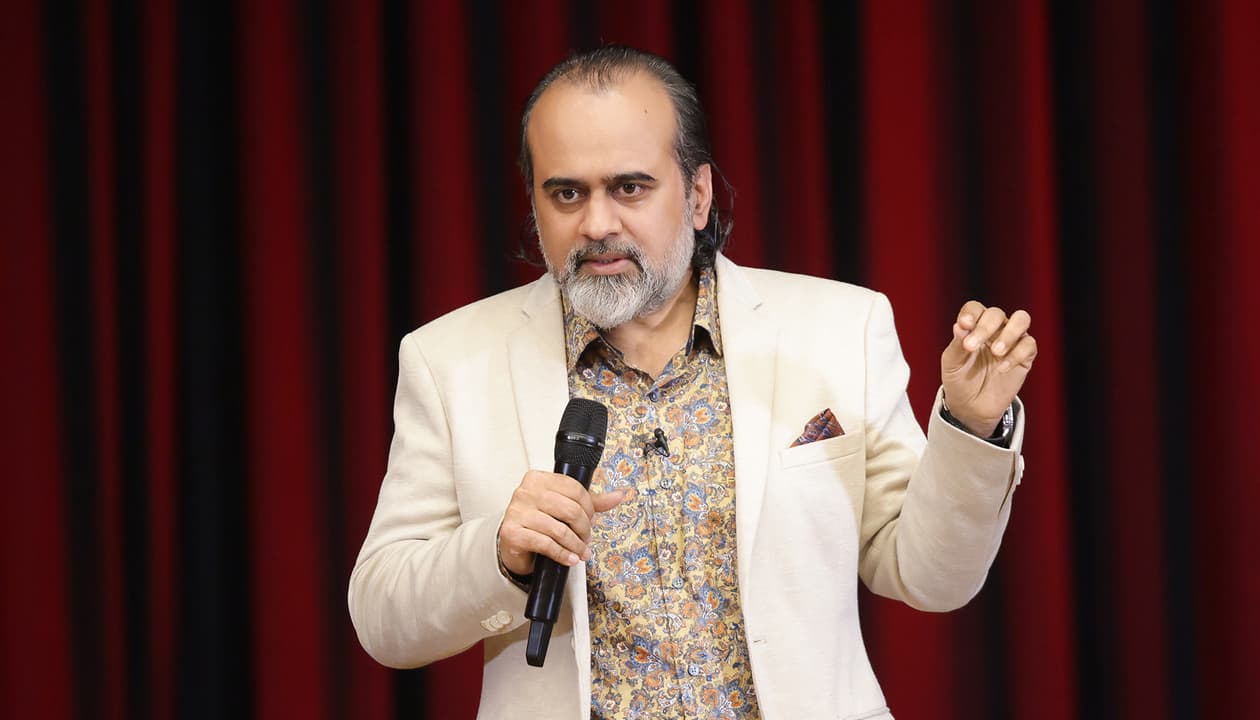
Questioner: Good afternoon, sir. I'm Rashmik from the Mechanical Department. I have been seeing your videos for the last two years. The first thing I would like to say is: you changed my view on Gandhi. I had a friend group who would be telling different things about Gandhi, and I stumbled upon your video once. I have gone through your videos, and I had a very different view of Gandhi before that point, it completely changed since then.
So my question today is: we, as youth, the number of patents or the number of research papers which our country publishes; because research is a very crucial important thing for the future. So, I feel the number of patents being published are quite less in our country. What is something that is missing in the student community, which is very much important to keep our national interest first? That’s my question, sir.
Acharya Prashant: Publishing is an act, somebody has to do it, right? And something gets done only when the doer has an interest in doing it. There has to be an intent, and then one finds a way. Now look at the way a kid is brought up in our society; are we risk-taking people? Are we willing to dare uncertainty and challenges across all strata of society? What we want is certainty. We are very all right with settling in some lower orbit of life, provided we feel safe there, safe, secured; life must be comfortable and, more importantly, predictable. And then it’s fine with us.
The numbers you’re talking of, compared to the developed world, and now compared to China, the research output, the patents, they are less reflective of the infrastructure and more reflective of our social mindset. You see, how does the inner thing work? When you are brought up on a diet of fear, because I’m afraid, I’ll be continuously looking for security, right? I’m afraid, and that’s what a fearful person can do.
Now, I don’t know what security is, or whether security exists at all. But because I am afraid, I’ll project a picture of security, some image of security. And where will that image come from? It cannot be my own, it cannot be originally mine, because I have never known security. So I’ll borrow it from others, I’ll hear it from others. In fact, I don’t even need to actively initiate the borrowing or hearing from my side; there are just so many eager to lend it to me, or rather implant it within me.
They’ll say, “That image, if you reach there, then you are secured.” So even when you are in class 6th or class 8th, you already have been given an image or a set of images: “That’s one place you should reach, and then you’ll be okay,” or “That place, or that place, or that place.” Become a good doctor; that’s the image. Get settled; that’s the image. An IT job in Bangalore; that’s the image. A US visa; that’s the image. Right? One of these you have to crack.
And then, from there, from that image, you start tracing a connecting line to where you currently stand. So the line does not start from here, it starts from there. It does not start from here. You don’t say, “Here I am, and I have a heart, it beats, I’m conscious, so I want to know.” That’s where all research effort comes from, right? “I want to get into the unknown, I want to explore it.” It starts from here. We don’t start from here; we start from there, and then backtrack the route from there to here. So, if you have to reach there, then you have to be there, and n is the place that you have to reach. So then you see, to reach n, what is the n-1 place you must be at? For n-1, you backtrack, okay; n-2, then, then, then, then, you connect the line all the way back up to yourself. Right?
So there is no heart in all this, there is only fear. And when you are afraid, you can’t be creative. There is no question of getting into research or getting even into life’s glorious uncertainties. All that we’ll want is a safe groove, “Give me safety of some kind.” Why? Because the very concept we are brought up with is: you see, your life is not in your hands. The moment you are told this, you’ll be afraid.
There are masters in the family. There are masters in the education system. There are masters in society. There are masters in the political system. And then there are masters in the skies and in the heavens. So there are just so many masters all around and over you, and they are calling the shots and pulling the strings, and they can do anything that you cannot control. So you’ll be very, very afraid because these masters; they are whimsical. You don’t know how they operate, right? And they can get upset for no reason at all. You don’t know their own internal system. Getting it?
Think of the kind of fear plants into your mind. Think of that. And it’s not something merely of childhood; it’s there in the environment. It remains with you constantly. It’s the air you breathe. It is too much to expect that a society whose values are founded on fear and external authority will be a creative society: a society of researchers, explorers, adventurers. That’s not going to happen. You’ll be preoccupied with just somehow saving yourself, escaping the harshness of the masters in some way or the other.
In fact, instead of a researcher, you will prefer becoming a sycophant, because that’s the easier route to please the lords and the authorities. You see that the one who tries to make a fresh path for himself and break new ground is rarely appreciated. But those who bow down and sell themselves off and surrender meekly, they rise to high positions in society and in the institutions. Have you seen that? Now why would you then want to get into research?
Even the Indians going abroad don’t really prefer research. When we go abroad, we prove to be good employees doing the conventional type of jobs. And often it is not that our talent is irreplaceable; it is about being more dutiful, more obedient, being called the model minority, or in case of offshore services, proving to be advantageous by way of cost. Getting it?
And it’s not limited just to science or engineering or biotechnology or some other field of scientific research. Are we creative even in the arts, music, movies, anything? We stick to the old because the old is known, and in the known we feel secure. We stick to that which is tried, tested, proven, verified, because that does not terrify us. We say, “This is what has been done since ten generations, so this must be the right thing.” If I try out something new, something different, who knows what might be the consequences?
As a result, we have not even bothered to build safety nets for those who venture to fly, because we don’t quite like them. If you don’t like someone, why would you want to build a safety net for that person? If the boy or the girl in the family says, “I wish to go out and explore life,” and the father or the mother have been saying, “No, no, no, you get into that kind of government job and I’ll ensure you get it, through bribery or whatever. Why don’t you just settle down? Take that job and settle down.” And you’re saying, “No, I want to try something else. I want to venture out.”
One of the threats handed out would be, “All right, go out. But if you fail, don’t come back to us.” So not only are you not being given an environment to go out, an environment that actively promotes inquiry, investigation, adventure, you are actually being threatened: “If you try this out, then you are on your own. Don’t count on us.”
You can try to institutionalize research. Yes, that’s how it has happened in the West. But still, the very nature of research is that there would be uncertainty. It’s a dive into the unknown. And
If we fear the unknown so much that we want to stick to known lanes throughout, then that’s what explains the lack of research culture.
Questioner: Yes, sir. What should I do, sir? Like you’re saying, the whole environment is built up already in such a way, so at the end..
Acharya Prashant: Defy the environment. What else? Don’t listen to them. What else? Why mince words? Why use sweeteners? It’s your life. You are young. And if you lose out on what is possible to you, if you don’t actualize your potential, you’ll have only yourself to blame.
And all those who stop you from flying high; they are being irresponsible, because they in no way can compensate for the opportunity you lose. Please understand, if you say you want to go there, because there is something for you there, probably you sense that, and I stop you, then I must at the same time say that a thing of equal worth is available here. “Follow my advice, come to me, and take this.” Right? Then I’m being at least partially responsible. I’m saying, if I am influencing you or persuading you to give up that thing over there, then come over, I’m promising you this thing here, and this thing holds equal value to that. Now, this is what you’ll call responsibility. Right?
Questioner: Sure, sir.
Acharya Prashant: But the fact of the matter is: those who are preventing you from attempting that which is infinitely precious, they are the ones who, in return, are offering you something that has no value, or a very petty value. They’re robbing you, actually. Forget about being responsible, they are actually robbing you. You are attempting something that is the elixir of life. You are attempting that which you are born for. And instead, they are saying, “You come over to me, I’ll give you this two-rupee thing.” This is not just being irresponsible, this is violence. So defy them. That’s all.
Questioner: If I deep dive into something, like if I started some work and then deep dive into that, then so many other things get like here and there. Bichhad jaata hai. To main jab kaam nahin karta hoon to sab kuch theek chalta hai, jab koi kaam mein doobta hoon to baaki sab idhar-udhar ho jaata hai.
Acharya Prashant: The question is: I have seventy things that I think of as important, and then when I get down to working, then those seventy things cry for attention and get deprived of attention.
So, do you see the contradiction in the question itself? Then those seventy things are your work. Why are you attempting the seventy-first thing? Keep yourself busy with those seventy things. If they are so important, why are you trying out something else?
The question in itself contains a contradiction. Please see, one has to have a system of priority, that is what is called a value system. You must know how to evaluate a value system, and upon evaluation, you discover what is more important than the other. There is a hierarchy of values, no? And then you can prioritize, this is more important, so I’ll allot my time to this.
If you fill yourself with clutter, then obviously the real thing will be crowded out. There will be no space for that. Obviously, time is limited, life is limited, energy is limited; so you have to be selective. And in being selective, first of all, you must know the value of the different objects and tasks that speak to you.
This one says, “I’m important.” That one calls from behind. And just as you are about to commit to this one, you receive a phone call saying something else is important, the fifth thing. The entire universe, in that way, is a big temptation; temptation or an obligation, whichever way.
If you do not know what to attend to, everything becomes important. And when everything becomes important, actually nothing remains important, which means life becomes centerless and directionless.
The mark of the clear mind is that it is one-pointed. Not that it works only on one thing, but at one place, at one time, it knows what is important here and right now. This is what is important.
So there can be no second thing that appeals to me. I’ll resist, I’ll reject all the temptations, or obligations, or responsibilities, or calls, or whatever.
As I sit with you, I speak to you. I was talking to this gentleman here. Then you ask this question, this becomes the all-important thing for me. Does that mean this will remain the same way three hours later? No, not at all. Was it the same way half an hour before? No, not at all. I was extremely busy with something else, something else of great importance. But now that I’m with you, how can seventy other things beckon me? They cannot. But that can be done only when you know what is important to you. That’s what is self-knowledge: I know myself, therefore I know what I must relate to, what I must attend to.
By the way, this was not related to research or inquiry.