Questioner: Hello, sir. My name is Sudeep. I'm a technologist from Bangalore, so I came here for this session.
My question is related to technology. If we look at the last 200 years, let's say, we have made a lot of progress. Our life expectancy has doubled or tripled in some places. Infant mortality is gone. The conveniences that we have are incredible food, shelter, all of this. But despite all of this, when we look at what's happening in the world, we have multiple wars raging. We have wars between countries, religions, castes, I don't know, all kinds of identities. But we've made so much progress as well at the same time.
So my question is: How do we deal with, or how do we understand, this dichotomy that is there? And also, personally, as a technologist, what should I be doing to ensure that we're not just progressing in some way, but we're making progress in all of these other very important aspects of our society, our life?
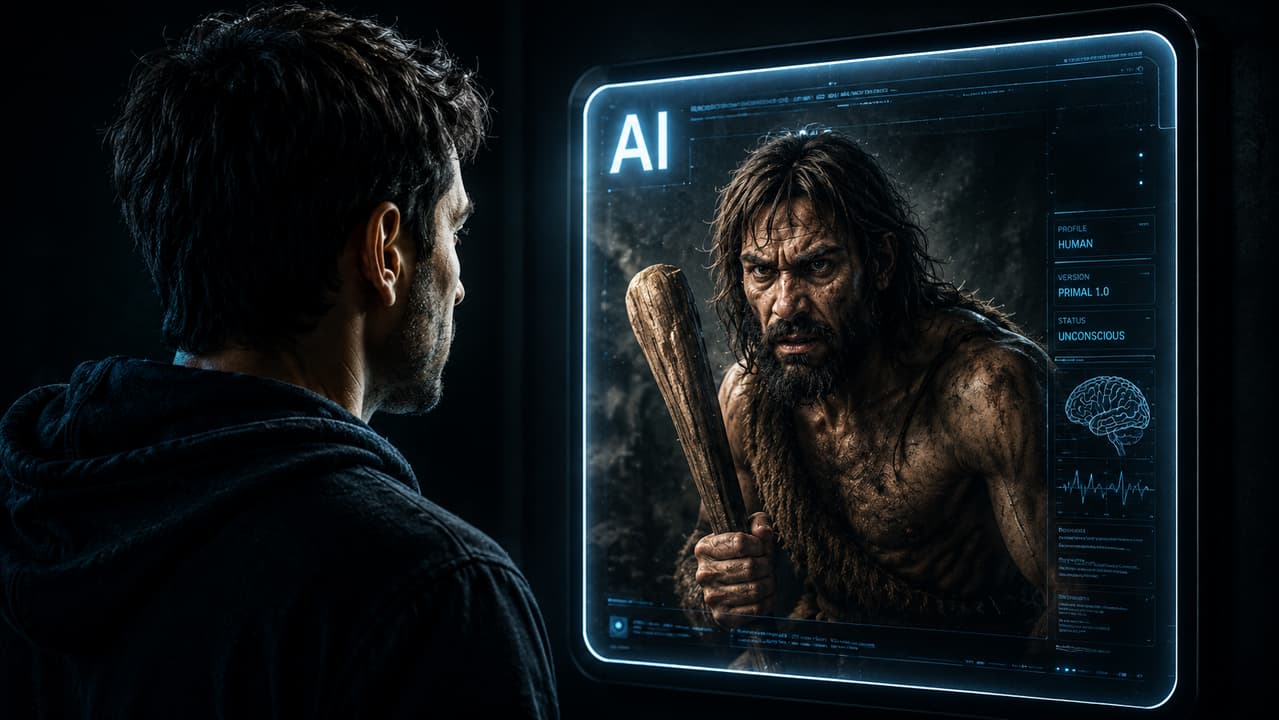
Acharya Prashant: Think of a destructive beast caged in its ancient cave. The beast is there. The beast is as beasts are, but it's trapped in its cave. It is frustrated. It is sad. It is angry. But one thing is certain: it cannot cause much damage to anybody because the beast has been limited by its ancient old cave. Right?
So the forest remains happy. So the forest remains protected from the beast. Now the beast progresses, and all that kept it inside the cave is defeated. The darkness inside the cave is defeated. The huge rock at the mouth of the cave is blasted away. There is some technology to show the way out and then all the possible routes in the jungle, and the beast is still exactly as it was since the beginning. Right?
So this is freedom for the beast. This is freedom for the beast brought about by tech progress. But freedom for the beast spells destruction for the jungle. The beast no more has to bother about, care about, its ancient concerns that kept it confined, that kept it occupied, busy, limited, caged. The beast is out. The beast is out without the burden of all that historically bogged it down. We know what that means for the jungle, right? How do we spell beast? M-A-N.
So often, we hear this romanticized version of the so-called ancient times, whatever that means, because that's never specified. “You know, in the good old days, people were simpler, and they were not hacking nature down, and they lived in peace and harmony with everything around them." Right? “Places were quieter, the air was cleaner.” And it appears as if we were better beings in the past.
No, we were not better beings in the past. The beast was always the beast. Just that the beast didn't have the opportunity to wreak havoc on the jungle because the beast was kept tamed by disease, by ignorance, lack of scientific know-how, mortality, lack of media of communication, all kinds of information barriers, travel constraints.
The beast couldn't do much. Not that the beast was any better, let alone divine, in the past. It was still the same. And within the cave, it still did whatever it could within the scope of its powers. It was still equally destructive, just that it didn't have the tech power to be destructive beyond a point.
So how was it surviving within the cave, using rocks and boulders and such primitive things? It was killing little insects or bats, maybe, and consuming them for food. It was still equally violent, just that the violence didn't have great means of amplification.
But knowledge, as we know, is accumulative, provided entire civilizations are not wiped out. If there is continuity in human existence, then knowledge increases. It is additive, which means, as a rule, as a default condition, it is certain that each generation will know a little more than the previous one. And that knowledge also includes ways to obtain knowledge from other peoples in far-off lands. So knowledge grows even more steeply, and beyond a point, the growth of knowledge is going to be exponential. It is no more additive. From additive, firstly it becomes multiplicative, and then exponential.
And that's what has happened. That's what has happened. There's nothing miraculous in it. It's the very law of evolution that technological know-how had to come to a point of eruption, inflection, and that happened. So the beast emerged from the cave.
The cave was a boundary. You could call the village that boundary. A lot of people never would come out of their village or the area around their village. Now the doors of the cave are flung open. You can travel from any place to any place, right?
Because there was no knowledge, so there was fear, fear of the unknown. You didn't know what lay ahead, so you were afraid of venturing out. That fear is no more there because technology enables you to peep deep into the jungle. So you emerge, and you emerge all equipped with means of destruction because destruction is what you were anyway always doing, even inside the cave. Even within that primitive village, even within the household, even when we were much more like orangutans and apes sitting on treetops, we were still equally destructive. Do you get this? But that destruction was tolerable because the ape can't destruct beyond a point.
Now, remaining the beast within, what the curve of evolution has given us is tech power. So we see what is happening. So we see what is happening.
And just as the curve of evolution says knowledge will go this way, you very well know that nothing in nature can be infinite. Right? Everything has an upper limit. So consumption and destruction, too, are bound to have an upper limit. The curve that remained almost flat for tens of thousands of years started growing, and grew for a few hundred years, and then suddenly took off. Yeah, it has taken off. But the law itself, if you think of it, dictates that it's going to crash now. It remained flat, right?
Our species, as a thinking species, is between 50,000 and one lakh years old, right? And we remained flat when it came to knowledge. And the same knowledge becomes technology. When it came to knowledge, the curve remained flat. If, let's say, we can be called sentient beings for one lakh years, the curve remained flat for 90 to 95,000 years. The last 5,000 years, the worm started raising its head after remaining flat, flat, flat, flat, flat, flat, flat, flat, flat for 95% of the time.
For 5,000 years, the worm starts looking up. And as you said, in the last 200 years, up. There's nothing special about this worm. It's a law being followed. And the same law dictates that if the beast remains the beast, it's going to crash. And that would hurt very badly. Not that we'll have to return to the cave. There would be no cave left to return to. Even that little cave would have been destroyed by this monster.
So, not that the whole thing will be reset to zero. No. It will be reset to something deeply negative. Not that we'll be back to square one. The board itself would have been destroyed. So you can't even begin from square one. The crash is going to be so devastating.
Can something be done about it? If, as people who can think and who care, we come to see this, is there something we can do? Now, remaining the beast? No. No way.
The problem that you are experiencing today is a problem that began almost one lakh years back. And the problem was that mental activity started happening in a more organized and sophisticated way without the center of mind elevating itself. So, from the center of the beast, mental activity started getting more organized, more refined, whereas the center remained the same. The ape remained the ape. That brings us, obviously, to the only possible solution. And what's that? The ape will have to evolve.
What we call evolution is just the evolution of the body, and the body includes the brain, and the brain can think. So the body has evolved, the brain has evolved, and thought has evolved, but not the center of thought. Yes, we are thinking much more finely, but we are thinking from the same place. Twenty thousand years back, we were thinking of how to dominate the other, and then maybe we had nothing but some crude weapon made of some metal. Even today, we think of the same thing, just that now we have finer means of domination. Right?
We were greedy then. We are greedy today. We were deceptive then. We are self-deceptive today. So, instead of evolving, we have kind of involved. Instead of going outwards, what we are experiencing is involution. We are going backwards.
We were in a beast-like state then, and beasts are not capable of deceiving themselves. Yes, they deceive others because that's their natural biological conditioning. For example, a chameleon. For example, the humble lizard we have. All these beasts deceive their prey and their predators. But now we have become someone who is as adept at deceiving himself. So evolution has worked very badly for this species. For other species, it might have meant physical survival. They have kept getting better at that. But for this particular species, evolution has spelled doom. Do we see that?
The beast is still the beast, and the beast has become more sophisticated. He has all kinds of means to fulfill his desires, to carry out his tendencies, and the tendencies are not even primitive. The tendencies are worse than primitive.
Are animals ever as cunning, at their center, as humans can be? Please tell me. Not possible. Would an animal even think of wiping out an entire ethnicity? Please tell me. So, at our center, we are not just beastly; we are worse than animals. At our center. And at the periphery, we have accumulated great knowledge. Great knowledge. So we are not just animalistic. We are demonic at the center. And outwardly, what do we have? All kinds of means, methods, weapons.
So I used to say, for long, for many years, that the gorilla now has a laptop and a nuclear button and an ICBM. That was an understatement. It's not the gorilla that has all these things. No gorilla would ever push a nuclear button. No gorilla is interested in burning down the jungle he himself lives in. Does any animal do that? But we are a special animal. This is our home, this planet, and we are burning it down. Right? So, to be fair to the humble gorilla, now I spare him. It's the demon with the nuclear button, not the gorilla with the nuclear button. That's the human condition. Please understand.
One wishes that the beast remained in the cave forever. Maybe that is what is implied by the biblical story containing the instruction to avoid the apple of knowledge. Don't get knowledgeable. Stay in the cave. Do we see that? We don't deserve knowledge. We don't deserve it. We don't deserve all this progress. This progress is a delusion. It makes us think we are somebodies. It makes us all puff up and be proud of ourselves. So proud that we use the word jungle as a pejorative, as if our cities are better than jungles. Do we see this?
We don't really deserve that apple. And if you want to have a concrete visualization, think of all the people in the world who carry tremendous power. Think of that special one sitting across the globe with his old finger on the nuclear button, and he's threatening to resume nuclear tests. Not a gorilla, but a monster.
Gorillas are cool people. They don't demand the Nobel Peace Prize, do they? They are content being gorillas.
Think of all the people who carry the billions, and now the trillions, of dollars. Think of all the people. Do they deserve that? Do we deserve the power, the money, the knowledge, the know-how that we have?
Please, when you have a kid, do you entrust him with a revolver? Why? You're still not up there, right? You won't know what to do with it. Humanity is not just a kid. Kids, again, are innocent people, much like gorillas. Yeah, monsters. And it's not revolvers we have obtained. You know what we have. Enough stuff to blow the Earth eight times over. One time is not sufficient. You know what is happening in the climate summit by the amazon? You know the kind of sharde we are playing on ourselves. Kids and gorillas won't do that.
What to do about it? If you really care, then you'll have to look at the user rather than the used thing. You'll have to ask yourself, "This is something beautiful, wonderful that I have. Am I up to it?"
I didn't invent the phone. I didn't make any of those discoveries. In fact, nobody in particular did because knowledge is accumulative, right? Every generation is sitting on the shoulders of the previous one. You know how far the books have already brought you, the books of science, the books of mathematics. And then, from there, you take one step ahead. Right?
You have this (pointing towards the mic). Do you know what to do with it? Do you deserve it? That's the question to be asked. Not the used thing, but the user. Yeah, the thing is lovely. What am I doing with it? There's the car, and we know nothing about the engine at all. Do we? Many of us might not even have looked below the bonnet. I suppose most of us drive cars. In the last three months, six months, how many of us ever peeped below the hood? Did we?
So, we have this thing, and it has come accidentally to us. Just as this body has come accidentally to us by way of evolution, just as we don't know where these five fingers came from, or why the eyes manage to see, or how the brain manages to think, just as we don't know, similarly, we don't know how our vehicle works, or how the mobile phone works, or how even this watch works. Do we even know how our garments are made? So we have all these things. The question is: Who is the user? Does the user deserve them?
Economies of scale make available a lot of stuff very easily, very cheaply. This is sophisticated, but am I? The boots are so polished, but am I? The tech is state-of-the-art, and the user?
Now, visualize somebody playing the worst kind of rotten clip on his mobile phone. That's the dissonance. The used thing is a sophisticated piece of science, and the user is a beast with a moth-eaten brain.
Think of that equipment, that little computer on your palm, and then think of what you are watching on it. The computer is beautiful, but do we deserve it? Because if we have it, this is what we are going to do with it. Think of all the WhatsApp misinformation. Think of all the WhatsApp uncles and aunties forwarding their daily crap in the morning. This is what we do with technology. Do we deserve it? So, let's use this thing as a mirror. Instead of looking into it, let's use it to look back at ourselves.
Expensive metals we put on ourselves, right? There's gold, there is silver, there's platinum. And there are all kinds of stones. Do we know a bit of metallurgy? Even the basics? Do we know where gold comes from? In fact, a lot of people can be convinced that gold is plucked from a special tree. They can be convinced. Yes. Provided the story is made convincing enough, they'll buy it. The story is: "Gold, there, anyway, buy it." And so much gold on the body, yet so much crap in the brain. That's mankind.
Keep aside the history and the heritage. On our own, who are we? Please tell me. Let's push aside all that history and evolution and inheritance have given us, both in the way of material and knowledge. Let's keep it aside. Now, having kept this aside, who exactly are we? Will we have religion? I'm asking you. On our own, will we ever ask the question, "Who am I? What's the ego?" We won't have religion. That's our worth. That's what we deserve, because beasts don't have religion. And if you take away history and memory, no religion is possible.
Clothes? Banana leaves, maybe. Possible? No. Any social institutions? Political institutions? Science? Labs? Anything? Please tell me. Take five seconds to just think of how we would look had nothing come to us from elsewhere. Had we been on our own, on our own merit, our own potential, who would we be? That's who we really are. But this undeserving rascal has been bestowed so much just by historical chance. He's a great beneficiary of randomness, and he is exploiting his luck to the hilt.
Think of the brat riding the superbike at 220. Both 220 km/h and 2:20 a.m. That's what they do. Think of that brat. Eighteen years of age, can't write one sentence straight in any language. But what does he have? A superbike. That's who we are.
What to do with this situation? Think of what the father would do with such a brat. That's what we need to do to ourselves.
A. Grow up. B. Abstain.
Even a quarter of the energy that flows towards external development and achievement, if it starts flowing towards inner development, we might be saved. There might be some hope. But right now, almost 100% of it flows towards external gain. The monster is hiding very happily within, all secure, and only gaining, gaining, gaining, gaining, gaining, stuff, stuff, stuff, stuff, because stuff adds up. Stuff adds up.
This much gold from grandfather, this much from father, and this much in my own lifetime, and it's all adding up. Knowledge adds up.
Questioner: Can we say improper education is the reason for this kind of situation?
Acharya Prashant: See, we don't have education. What we have is means of desire fulfillment. Why are we calling it education? Show me one thing in our syllabi that's not targeted at fulfilling desire. We are not educated. None of us. Even if we are holders of the highest degree, none of us is educated. What we are given is means to consume. Right?
“Know this and you will make better mics. Know that and you'll make better garments. Know that and you will make better shoes.”
That's not education. Education is something totally different.If this is education, then every mama monkey is educating her baby. Seen them do that. They actively train them how to pluck the fruit, how to jump from here to there. Even cats do that with kittens. There's no education in that. They are just being raised in means of survival. For us, survival is no more a problem. So, in the name of education, we equip ourselves with ways to accumulate more and more.
What is finance? What is marketing? What is even science? To what use is all science put? Science results in technology. And that common man on the street, the totally undeserving fellow, becomes the beneficiary of that technology. What does he use it for? Please tell me. Are we getting any better?
I mean, it's too late to ask this question. Probably the planet itself has just a few decades left. When the patient is breathing his last, it's a comical thing to ask, "Is he getting any better?"
We are not educated. No. Let's put that out of our mind. If we know geography, what do we use it for? Resource extraction. Right? Now I know where the minerals are, so let's hack down the jungle. That's what we use geography for. If we know history, what do we use it for?
Listener: Revenge.
Acharya Prashant: Yeah. History tells me that these people had defeated me in the past and exploited me. So now that historical knowledge gives me a good excuse to kill them back and run away with their property and land and women and all that.
Does history make us wiser? Is that the use we put history to? No. Think of everything we have been taught, and then ask: What is the use we put it to? The word ‘I’ does not figure in the curricula at all. There is nothing called education of the self. If I do not know who I am, then who is being educated? Education means I have been told this, and I have been told that, but I haven't been told who I am. Then who has been told what? Please, please tell me. It's almost like submitting a fat answer sheet without writing your name or roll number on it. How much do you get? Nothing.
Because there must be somebody, first of all, somebody clearly outlined, somebody clearly known, somebody clearly seen. Who is the receiver of all that knowledge? To whom is all that knowledge? No, no, no. Education never takes us to that.
So the fellow will say, "There is this knowledge, there is this knowledge, there is this knowledge, there is this accumulation, there is this achievement. Now, to whom is all this?" That I don't know. That I don't know. Which means the answer copy is fat and impressive but doesn't carry the roll number of the student. The result is a big zero.
This lack of education has to be addressed. I said a quarter. A quarter of our energy, our time, our resources, and a quarter of the space in the syllabi. That would suffice. Even 10% might probably just do. But right now, what we give it is just zero. These are myths. These are superstitions.
Sitting here in a metro city, we like to think that the primitive ones and the superstitious ones are the ones found in backward, regressive villages, the ones who worship trees and think that trees carry destructive spirits, who will sneak into your home at night and carry away your kids.
We like to think of backwardness in those terms and images. But please tell me, is it not very, very superstitious of us to claim that we are educated? Is that not a huge superstition?
What is a superstition? How do you define it?
To believe in something that is not, or to refuse to see something that is. Both these are aspects of superstition, are they not? Now, if we are not educated, but we proudly prance around saying, "Here I am, M.Sc., doctorate from the U.S., Ivy League." Sir, you are not just uneducated, you are illiterate. Can I puncture you a little, please, for your own sake?
The worst monster is the one inflated with knowledge without any maturity at the center. Be very, very cautious of such a person.
But such beings look mighty impressive, don't they? And that's the problem.
Questioner: Namaste, Acharya Ji. So how do we decide who merits these resources? Like, who has the highest…
Acharya Prashant: Start with yourself. Start with your kids. Start with the zone you have some power on. We all do have some discretionary powers, right?
As a teacher, you appraise your students. You award them grades, don't you? That's the power you have. Check whether the grades are proportional to consciousness.
As a person, don't you choose your friends, your partners, what you call your soulmates or whatever? Check what it is that you are really choosing. Where is the heart? Where is the self? Where is courage? Where is compassion? Or is it just the height, color, body, and the hugeness of the car that has impressed you? You do have a say there, right?
Some random fellow comes to your place for donations. "You know, we want to burn wood because that's what we call religion." And you say, "Yes, yes, yes, yes." You do have discretion there, right? Use, apply. As job seekers. You sometimes do have the option to choose whether to work here or to work there.
As bosses and employers, you do exercise a certain control over five or ten or twenty or a hundred people, don't you? Sometimes even thousands of people. See how you are doling out resources. See what your appraisals are based on. That's all.
Vote. And the remote control, the TV channel, and the mobile phone, the subscribe button. Who are you voting for? What have you seen there? Who are you choosing to fall in love with?
The world is nothing. The world of humans is nothing but you and me. If we get right, we have set the world right overnight. I'm asking you, why should the undeserving one command your affection just because of history and habit?
"No, but I have known him for 20 years. I know he's a rascal. I know he's the most corrupt man possible in the office. I know he's a violent butcher. But, you know, there is intimacy between the two of us.”
Withdraw. Why not?
The Indians called that naked fakir a Mahatma. What if they were looking at his body, or face, or appearance, or possessions? He was not even ordinary. He was borderline ugly. But those in the 1920s, '30s, and '40s were better than us people. They were feeble, impoverished people. They were dying of hunger. They couldn't manage two square meals. But they knew that a man must be judged by his consciousness, not his clothes. This much they knew.
Where is consciousness in our calculations? Where is love? Where is the heart?
Look at all the arguments, for example, that are extended in favor of meat consumption. Look at the brutal calculations. "You will lack B12. And if you take it from lentils or soy, then it's not very rich and not very complete. So you must slaughter the animal." Where is the heart? "Oh, sir, the heart too is in my stomach. You mean the heart of the goat? I cooked it.”
"No, but if I don't offer dairy to my kid, he'll grow weak." Let him grow weak. Why should he be a huge hunk? Why? Nobody needs to be that big. What's this unexamined idea that one needs to be really big? Why? And in saying this, I'm not accepting, first thing, that you need dairy to grow big. That's not even needed. But let's, for a moment, just assume that all that is probably needed. Even if that is needed, why should I accept it? Why?
I live maybe five years fewer, remain two inches shorter. That's all right. Consuming meat, if I live another five years, what will I do? Consume more meat. What's the point in extending human lifespan by so much? What will you do with those extra years? Why? Is there any meaning, any purpose, any love in that? You'll only destroy more.
Had Stalin lived on, how many more would have been killed in Russia? And he was killing more people than Hitler ever did. Most of us are Stalins. Better we die early. Who deserves to live long? Please tell me.
I'm not a hater of our species. I'm just being discreet. Yes, there must be certain people who indeed must live long. The irony is, those who deserve to live long are the ones ever ready to lay down their life. They don't want to live long. And who are the ones particularly craving to live long? Those who should have died 2,000 years back. They are the ones very keen. "You know, let me get a kidney from somewhere."
Questioner: So, just to understand what you explained a little bit more through examples. So, over the last year, I've been trying to work with a bunch of organizations who are working on improving systems in India across different aspects, education, healthcare, judiciary systems. Related to what you said, there is a general belief right now that technology, and especially AI, can fundamentally transform the issues that we grapple with in each of these three sectors.
So, just to quickly take one or two examples. For example, in healthcare, just giving information about how to better access healthcare information, which, let's say, a Bombay slum individual does not even have access to. And that can eventually, over time, they hope, solve the problem of poor healthcare access.
And a similar thing with education, that with AI, you can give better educational content to people who, till now, did not have access to it, and that can be a leveling field, so to say. And I would say the same thing in the judiciary also, when we are all aware of the problems that are there. So there could be a situation where AI could take judicial decisions as well, which is a key bottleneck today.
So I just wanted to understand how to place all of these initiatives that are happening in the country in the context of what you said, because these seem to fall in that three-quarter bucket.
Acharya Prashant: You see, you might not like my response. That's a disclaimer, first thing. How do you want a beast? That beast, the destructive one who put the jungle to fire. How do you want that? Strong, able, well-equipped, free of disease, free of all kinds of general concerns? Do you want the beast that way? Or would you rather want the beast bogged down in the petty things of life? Please tell me.
You look at the latest world war we had 80 years back, not too far back in history. Was it the poorest nations of the world that chose to fight and chose to kill? Please tell me. The beast was poor, so it couldn't do much harm. Are you getting it?
Look at the African nations or the Asian colonies. They were not the ones dropping bombs or raising gas chambers. Not that they are better human beings. Just that the beast there was less capable. The beast was less capable, so it brought about lesser destruction.
Now think of all the countries that did the maximum damage and slaughter. Who were they? They were the ones with the highest per capita GDPs. They were the belligerents, right? Think of Germany. Think of Britain. Think of the U.S. Think of France. Think of the entire Europe. Think of Italy. Think of Japan.
If you liberate this beast from the everyday problems of life, he becomes even more dangerous. His mischief becomes existential.
Hitler, in a poor country; he was a very mediocre person, right? Rejected from university, having psychotic disorders, not even a very keen strategist, a mediocre person. If such a person were to be found in a poor country like, let's say, the India of the 1940s, he would have been relatively harmless and toothless. The world would have been saved.
The problem is, Hitler was given a prosperous society with top-class tech know-how. If we are Hitlers within, it is better that we remain occupied with little problems.
I knew you won't like the answer.
If Hitler were an Indian, think of the India of that time, poor, impoverished, feeble. Think of Hitler as somebody from northern India. Would he be planning the Holocaust? No. He would be thinking of somehow managing the next meal. The world is saved. But if you ensure great healthcare, very little child mortality.
You know, it would sound a little violent and inhuman, but I mean, we wouldn't have really grieved had Hitler died at birth, right? That wouldn't have been too much of a loss in particular, right? But then you have great healthcare. Great healthcare, so maternal mortality and child mortality reduce, and all that is welcome.
Please don't misinterpret me to think that I want kids to die and mamas to die. No, no, no. That's not what I'm saying. What I'm saying is, if you're a Hitler and still you are given a prosperous society, then what you get is a Holocaust.
Germans were prosperous. In fact, at that time, more prosperous than the Brits. Even today, the Germans are more prosperous than the Brits. And most of them refused to acknowledge that anything like the Holocaust was even happening. They said, "No, but that's not happening." So they were asked, "No, there was this Jewish family in your neighborhood. Where do you think they have gone?" "Oh, maybe on a pilgrimage." Yeah. That kind of response. And they were all educated Germans. Educated, well-equipped, driving BMWs and Mercs, even at that time.
Do we deserve healthcare? Do we deserve advanced systems? I'm asking. Do we?
The only thing that we were spared of was nuclear technology falling into his hands. And that was almost about to happen. Almost about to happen. Do we deserve nuclear technology? I'm asking.
There have been millions and billions of species on this planet. Please, has any species been depraved enough to destroy the planet itself? Has that happened? So, we are the worst species possible. Then do we deserve affluence? Do we deserve technology? Do we deserve medical care?
It hurts to say this. I'm sure it hurts to hear this. But the entire planet would be better off if we are worse off. And being worse off would, in some sense, be the best thing that can happen to us because then we'll be, probably, hopefully, forced to look inward.
Right now, because there is an entire planet to consume, we are constantly looking at objects of consumption. What next to have? Where next to go? When that would be no more possible, maybe we'll look into the mirror and ask, "Who is the consumer?"
But I see no hope as long as great dishes and lucrative objects are made available to us to consume. Why would we refuse? The dish looks yummy and tastes delectable. Who cares for the recipe? Do you ask for the recipe? No. As long as stuff is available, we'll keep devouring it.
Next comes the flying car. Would you want to know how it works? No. It's available to be consumed. Consume it. People fly. On a flight if the pilot announces, "Hello, this is your pilot," and says, "Here's a contest, a qualification contest. You simply need to tell me the basic principle that makes the plane fly. Else, the parachute opens up for you because you don't deserve to fly." What happens to the flyers?
How many of us know how the plane exactly flies? What are those wings for? How does the jet engine work? We don't know that, right? But we successfully consume the plane, and the flight, and the tourist destination. That has to stop.
Mankind has been given too much that it doesn't deserve. And that has resulted in total disinclination towards self-knowledge.
I face that resistance day in and day out.
I'm here, and I tell you, "Sir, we need to look at ourselves. Sir, we need to be self-observant." And you say, "There's the cake, and the pastry, and the next foreign travel waiting for me. I would rather indulge in that. Why should I listen to you?" We have been given far too much that we in no way merit.
Questioner: Good evening, Acharya ji. What you said makes a lot of sense, but I also see that this syllabus of the ‘I’ is never coming into the school syllabi or any education system. Moreover, all systems are designed, given the economic system. Every system is designed to promote the three-fourth, promote consumption, promote not looking at the ‘I’ at all.
Acharya Prashant: The physical and the material welfare.
Questioner: Yeah, that is what it is all designed to. But this material welfare is to be given into the hands of people who want to promote self-growth, I mean self-understanding, awareness, self-awareness. But what I also see is, I work with multiple NGOs who are really grounded in these ideas, but they are not supported at all. Economically, no one wants to invest in those things. They are in a real crunch of resources, human resources, even PAF, in all aspects. It's like fighting a lost battle.
But still, I am part of such a battle also, and it still makes a lot of sense to fight this battle. I sensed most of the talk looked like, you know, it's all a waste. But I also want to hear from you the richness of fighting this lost battle.
Acharya Prashant: No, this is the richness. It's not that I have to talk of gloom and hope separately. It's not that I have to put desperation and inspiration as two different words. No. If you realize the utter hopelessness of the situation, in that realization there is some hope. So these two go together. Hope is not artificial. It is not about motivating you to do this, do that, without you understanding who you are and why you must do that.
Once you understand what the situation is like, you might rise. That is the only hope. Once you understand the hall is on fire, you might get up and do something about it. Having told you that the house is on fire, I don't need to separately motivate you to act. That's redundant, right? The problem is not that we lack motivation. The problem is we lack realization. We don't see the fire. Or maybe we are using it to cook something, bake something, barbecue something.
Please, please understand this. See what is happening. You are thin and feeble, 5'3", weighing 40 kg. Two generations back, the impoverished India, the underfed India, malnutrition and stuff, and per capita meat consumption was less than 1 kg per person per year because, firstly, there was no money; secondly, there was no stomach. The fellow was 5'3" and 40 kg. How much meat can he eat?
But now the fellow has grown, after two generations, to 6 feet. Six feet and he has fat pockets. So the number of animals being slaughtered for this rascal has grown 40 times. For this particular person, so much for great healthcare. The question is: Do we deserve it? Do we deserve it? Do we really deserve? Strong, tall, muscular people, do we really deserve them? In fact, the more muscular the fellow is, the more he says his requirement for protein. At 40 kg, he can anyway not kill too much. Now that he's 80 kg, 90 kg, and he wants to grow even bigger, he says, "Give me protein. Beef me up."
Let him stay at 40 kg. That's better for the planet. Who should grow big? Who should be that tall and lanky one? The strong one, the big one. Who should be that? Only the one who, first of all, has a taller center.
These two must correspond to each other. These two must go hand in hand. We don't want to feed monsters, do we? We don't want them to grow big. And most of us are monsters, and in the name of human welfare, we are beefing up the monsters. I know that's bitter to hear, but please.
You feel great. "Ah, this one is coming up very nicely. Very nicely. A full five inches taller than the father." But what is he going to do with these five inches? These extra five inches and the extra 15 kg? What is he going to do with that? Please tell me. Is he going to shower compassion on the planet? Is he going to do that? Is he going to save people with the extra build and the extra resources that he has? I'm asking you. Please tell me.
Let him remain small. Let the big ones grow big. Let the free ones have freedom. Let the deserving ones have resources. That's the revolution we need. Why do we have a society in which idiots have been allowed to turn billionaires? Please tell me. So much resource in the hands of a monster. What will he do with it?
But that's what we celebrate as a society. "You know, look at them. These are our role models. These are the successful people. Let's look up to them. These are our leaders, our politicians, our industrialists, our celebrities, our gods."
Do they deserve that adulation, that position, that power?
Technically put, we need a revolution in which what you have should be proportional to who you are. The bigness of your heart should decide the bigness of your car. The height of your consciousness should decide the height of your mansion. The lovely thing with this is, the higher the consciousness, the lower the need for a high mansion. That's what we need.
Are we up to it? No? So, Thupp! It's all just an illusion, right? Gate gate pāragate pārasaṃgate bodhi svāhā.”