Questioner: Sir, my question is about climate change. Sir, in the 1980s there was a problem of the ozone crisis. At that time 197 countries came together and signed a Montreal Protocol and we resolved that problem. Today's climate is a bigger set from that. But why are countries not uniting for this?
Acharya Prashant: Lovely. Wonderful question. In fact, 99% of the Montreal targets have been met now. Not now, this happened a few years back and the ozone hole will still take a few decades to totally heal. But we have done what we needed to do, right? The chlorofluorocarbons, the CFCs, 99% of the emissions we have managed to cut and now the hole is healing and it will take like two or three more decades and we have solved the problem there.
So it is a good question. It often comes up in context of the current climate crisis that how did mankind succeed when it came to the ozone crisis, the ozone hole. Most of you were not born when that crisis was peaking. That was in the 80s and 90s when I was growing up. Then ozone was a big thing.You know of Chlorofluorocarbons, CFCs. At that time they were used in all these cooling devices, fridges, ACs, mostly these, some sprays as well. Some sprays also contained CFCs. Then it was discovered in the 70s, maybe before that, and the concern was great in the 80s because the ultraviolet rays, the ozone layer stops those rays, the ultraviolet rays of the sun. They were causing all kinds of problems and most horribly skin cancer and that was actually happening. There was data to support that. We managed to solve that problem.
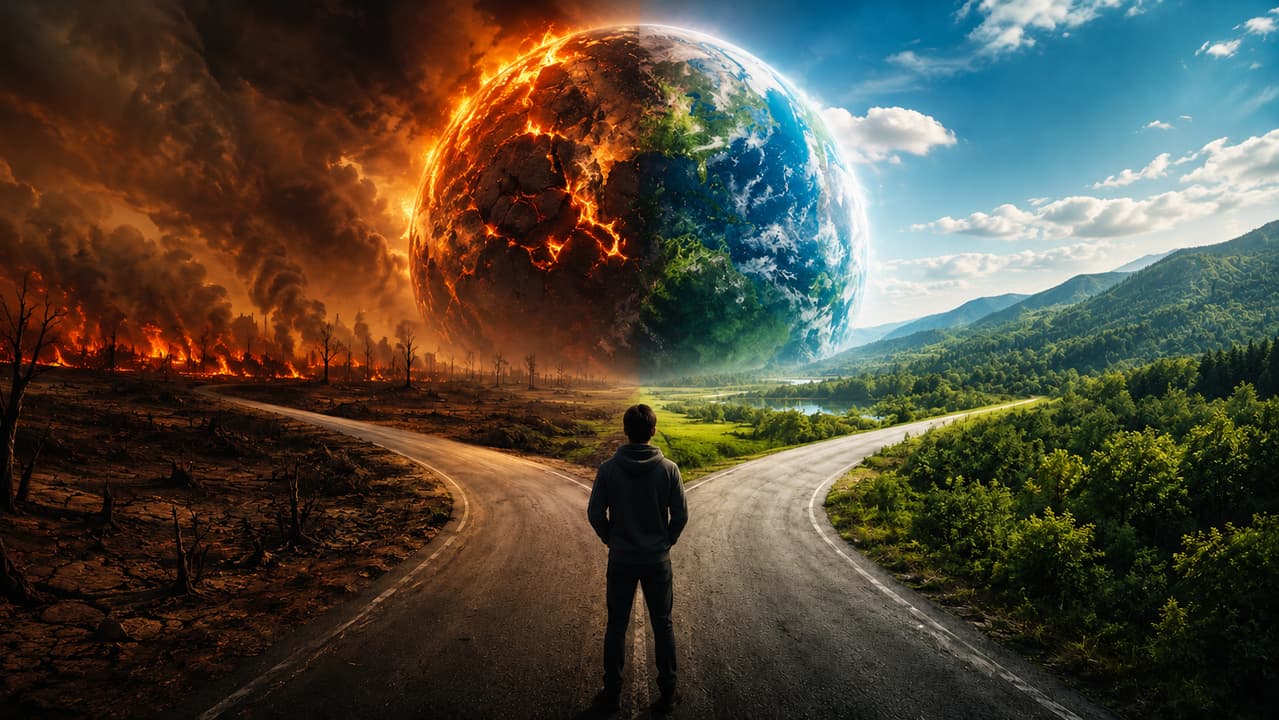
So often a question arises, why are we not able to solve the climate crisis in the same way? And that question is not just inquiry, often it becomes deceptive also because it traps us into wishful thinking. A lot of people who do not want to attach the requisite importance to climate action say, “well, four decades back you were crying hoarse over ozone but see we conquered that and similarly we will be able to conquer the climate threat also. Don't worry, not much effort is needed.”
No great effort is needed. There are several distinctions. I hope I am able to enumerate some of them. The first thing is that one was one gas, or one family of gases, the chlorofluorocarbons. This one is humanity itself. Okay, let's take the example of this hall. The ozone crisis was the air conditioning system. You take care of the air conditioning system and you have solved the ozone problem because this is the only place where CFCs exist in the cooling pipes, right? This is the only place where CFCs exist. You take care of that and you have solved the ozone crisis.
But look at the climate crisis. This is the climate (pointing towards the table). The production of this releases carbon dioxide. This is the climate (pointing towards the shirt). Not just in production, even in washing, even in dyeing. Your desires are climate. You want to fly to Switzerland for honeymoon, that is carbon dioxide. Cement is carbon dioxide. How do I forget the biggest culprit? Energy. This illumination, these photons, are carbon dioxide. These gadgets are carbon dioxide. The wood here is carbon dioxide. I hope there is no wood. I hope this just appears like wood.
Listener: Yes, it is wood.
Acharya Prashant: Good. Thank you. You know of the clear relation between deforestation and carbon emission, right? You know that. Everything is carbon dioxide here. Everything. Every single thing. And if there is milk in this tea, that is carbon dioxide. You know the relationship of dairy with carbon emissions, right? You know that animal agriculture is the second biggest contributor to carbon emissions. You know that, right? So this mug is carbon dioxide. This tea is carbon dioxide. This shirt is carbon dioxide. This energy is carbon dioxide. This cement is carbon dioxide. This wood is carbon dioxide. Basically, everything that you love is carbon dioxide. Nobody loves CFCs, but you love the tea. And that's the problem.
When CFCs were to be eliminated, all you were facing was a small CFC lobby. And when alternatives were introduced, even that lobby complied. That lobby said fine, now we have alternatives to the chemicals, the CFCs, so that's fine. But when it comes to the climate crisis, man and everything that he does is responsible. Everything that you do releases carbon. And not that you need to have zero release of carbon. You need to have net zero release of carbon, which means that there are natural carbon sinks, the forests and the oceans most notably. They keep absorbing carbon dioxide anyway.
So if to a certain extent you are releasing carbon dioxide, to the extent of let's say two tons per person per year, to that extent if you release carbon dioxide, the oceans and the other natural things like forests and even soil to some extent will absorb it. But beyond that, when it comes to your desires, every single desire, every single emotion is a carbon emitter.
The biggest contributor to climate change? Okay, tell me.
Listener: mate.
*Acharya Prashant: So elaborate. Population.
Listener: Population.
Acharya Prashant: Population. That's the biggest contributor to climate change. Population. But the population is desire. The girl wants the boy, the boy wants a girl, then the two want kids. And if the two do not want kids, then the mothers-in-law want kids. And when the mother-in-law does not want kids, then the neighbors want kids. And the priests want kids. And the religious leaders are saying if you do not produce kids, then the other side will dominate. So you increase your population and population is the biggest contributor to the climate crisis.
This was not the case with ozone. There's a great difference. Do you understand this? Ozone was a little thing. You can imagine it like this. Ozone was one bad leaf on the tree. One bad leaf on the tree. What will you do? Pluck it. Throw it away. It's easy. Climate crisis is the root of the tree. Which tree am I talking of? Man and his desires. By man, I mean mankind. Man and woman. Do you see this? Plucking one bad leaf was all right without dismantling the entire structure of our life, our institutions, our families, our concepts of happiness and success. It was easy. Just pluck one leaf and you have solved the ozone thing.
But when it comes to the climate crisis, you have to uproot the entire tree. And we are not agreeing to that because we love our lifestyle. We want to fly. We want to have babies. The very concept of happiness is if you consume more, you will be happy. If instead of a two-wheeler, you have a four-wheeler, you are considered successful. Right? So everything, the very deepest philosophy that an individual carries within, is climate change. Now to solve the climate crisis, you will have to substitute almost the DNA of man. The way we think, the way our relationships are, the way we define the good life, all of this has to be changed. And we are not ready. We are just not ready.
You know, the total investment that was needed to tackle the ozone threat was just a few billion dollars, that too spaced over several decades. Now compare. In fact, this will reveal the whole thing to you because the numbers. A few billion dollars spaced over several decades. The climate crisis, to be tackled, requires 4.5 trillion dollars per year. That kind of layout. We don't want to put in that much money because it's our money, right? And we would rather spend it on our desires. Why should I spend money tackling the climate crisis? 4.5 trillion dollars per year are needed to tackle the climate crisis. And if you put in that money, you will also accept a certain reduction in the GDP growth rates. You must be ready for that. We are not ready for that. Are you getting it?
That does not mean that you have to be scared by this large number, 4.5 trillion dollars. From where will you bring it? In fact, the entire GDP of India is just 4 trillion dollars. From where will the global 4.5 trillion come? Not a daunting task to put things in perspective. Seven trillion dollars of subsidy are provided to the fossil fuel companies by the governments of the world (source: IMF). We are subsidizing our own poison and we are saying we do not have 4 trillion dollars for climate action. We do not have 4 trillion dollars for the medicine but we have 7 trillion dollars for our poison.
Reason — desire. Fuel is good. Fuel is energy and energy fulfills desire. Whatever you want, you need energy, right? And energy is carbon. What do you do? Kids are carbon. Energy is carbon. Food is carbon. But you are entitled to release some carbon. Not that you have to come to a point of zero emission. You are entitled to release some carbon.
The average Indian, you know, still releases a sustainable level of carbon. The average Indian has still not crossed the threshold (source: Our World in Data). So you can live very coolly and even emit carbon if you are not entirely mad. But if you look at the average American—14 tons, average Indian—2 tons, average Chinese—8 tons (source: Our World in Data). Now that is where madness is. You and I would be standing at like two or three or something. In fact, given the fact that I do not have kids and would never have kids, my contribution, my long-term contribution, would be well under two tons, probably even under a ton per year. Are you getting it?
So the fundamental difference between the ozone thing and the climate thing, the ozone thing and the carbon dioxide thing, is that ozone was about tackling a gas and the climate crisis is about tackling mankind itself. It is not a technological problem. CFCs were a problem of technology.
Climate carbon dioxide is not a problem of technology. It is a problem of civilization. It is a spiritual problem.
I call it a spiritual problem because our hearts have to be changed to tackle this problem. It is a spiritual problem and that is why we are losing the climate war daily.
Instead of reduction, every successive year the global carbon emissions are only increasing (source: UN report). By 2030 we envisaged a 44% cut as per the 2015 Paris agreement (source: UN report). Instead of a cut, what we have is an increase. And it is not that we are increasing, we are increasing every year. Forget about a 44% cut, we are not going down by even 1%. We have actually gone up. Why? Because we do not know ourselves. When you do not know yourself, then you are attracted towards everything.
See, if I do not know what I am lacking in, then I will rush towards every object I can see. That is called desire. When I do not know who I am and therefore I do not know what I actually want, I will rush towards every object I can touch. That is called blind desire and that is the carbon crisis. The answer will be wisdom. The answer will have to be civilizational, rather spiritual.
Culprits like Exxon Mobile, since 1977, those guys have known. Their own scientists told them that the climate crisis is looming large. They kept hiding it. In fact, they kept funding the climate denialists. And the oil companies, the energy companies, they are funding everybody — media, universities, elections (source: The Guardian). They are funding everything and they are continuously denying that there is a climate crisis. They are calling it a hoax or they are coming up with distractions like carbon absorption.
They are saying we will build machines that will trap carbons.
Questioner: As I read in some news, one of the companies claimed that it is building bricks made out of captured carbon.
Acharya Prashant: And look at the psychological impact of that. The moment you hear that atmospheric carbon can be sequestered back into the soil or in a brick form, you feel even more licensed to emit carbon. You say, “There is no problem. A machine has been made that will absorb all the carbon from the atmosphere so I can keep releasing carbon.” And that is propaganda coming from carbon denialists. Sometimes they say, “No, no, no, we can be net zero by 2070, that is fine.” Sometimes they say, “No, no, no, there is climate change but it is not anthropogenic, which means it is not man-made, it is part of a natural cycle.”
So they are trying to divert your attention and distract your energies in all possible ways just as they did in the case of tobacco. It was known quite early on that tobacco causes cancer, but all the tobacco companies kept funding propaganda for at least two to three decades and they delayed the right action. But oil is a much, much, much bigger industry than tobacco or CFCs. So their power to fund misinformation is tremendous.
They are not just funding misinformation. They are also preventing the right information from becoming mainstream. How often do you hear carbon debates on TV channels? Even on social media, how frequently do you find climate as the centerpiece? Or on a family group, a family WhatsApp group, how often do you find that the subject being discussed is the future of the planet, carbon emissions, deforestation and the loss of biodiversity? Is that being discussed in family groups? No. Because the media has bombarded us with distractions so that we do not pay our attention to the right thing. It is a well-thought-out conspiracy.
Questioner: So we agreed that population is the biggest reason for carbon emission. But I read somewhere that if we have a birth rate of 2.1, then we can have a steady population.
Acharya Prashant: A birth rate of 2.1 will not give you a steady population. It will keep giving you a rising population, son.
Questioner: Okay, sir. But I am coming to the question. In many countries we have the birth rate below 2.1. So sir, in fact after 2069 India will also experience a decline in its population. So would not that disrupt the supply and demand chain?
Acharya Prashant: You had a lower population in 1965. Was that a problem? You are talking of Japan where the birth rates have fallen low enough for the population to actually decline. Japan had a lower population in the 1970s. Was that a problem? How has the current level of population become a sacred benchmark? Why does the current historical level of population have to be maintained? How is this a bogey? And everybody is saying the population will fall. Let it fall. What is the problem?
Questioner: So the supply and demand will disrupt, in the entire world.
Acharya Prashant: Supply and demand of what? When there is no human being to consume resources, he is not even demanding it. If he is not demanding it, on the other side there is nobody to supply it. Zero meets zero. What is the problem? It is not just that the consumer has reduced, even the producer has reduced. What is the problem? And if there are certain industries that find themselves going out of business, let them move to safer businesses, greener businesses. Why not?
And remember, mind you, all this propaganda that 2.1 and if you go beyond 2.1 fertility rate then population will drop. No, not true. 2.1 and if you go below that only means that the birth rate has dropped. That means the population will still keep on increasing though at a reduced rate. The population will still increase.
The population will start falling only four decades from today and you do not have four decades. Your generation does not have four decades. The climate is already exploding.
Do you have four decades?
Questioner: Okay sir. So do you think that the suboptimal use of the present resources that we have, is that an even bigger problem than population?
Acharya Prashant: And you will like this. The suboptimal use or disastrous use rather, suboptimal is a very kind word. The disastrous use of resources and the explosion of population often come from the same center. I will give you an example. You will relish it. Look at the super rich of the world. You will take years to emit the amount of carbon that two hours of their private jet does. And they are also the same people producing a dozen or more kids.
So that private jet and the 14 kids come from the same source, the same center. And what you have as carbon emissions is per capita emission multiplied by the number of emitters. Am I right? And if per capita emission is a function of I, the way I am, I am the super rich one, so I emit so much. Per capita emission is F(I), a function of I, and the population is also a function of I because I am the same person who has 14 kids. So total emission then is F(I) squared, which basically means that if I am the wrong kind of person, I am exponentially responsible for the carbon crisis. Do you see this?
If I am the kind of person who loves to consume everything, I will also probably love to consume somebody's body and produce a lot of kids and pass on the same value system to the kids and say, “You too must consume.” If I am a consumer, if I do not have peace within myself, if I do not know what life is, if I cannot be all right with myself in my aloneness, I will do both of these things. Not necessarily, but there is evidence that this is happening. I will first of all binge on material objects and I will also want to have as many kids as possible. Both these come from the same center, though not necessarily. We have a lot of evidence that when a society gets prosperous the birth rate falls. The women often refuse. “We do not want many kids. We want a better quality of life rather.”
But you must understand it is the interior of the human being, dissatisfied with itself, not knowing which direction to take, that decides to consume endlessly because it can do nothing else. You are dissatisfied with your job. Totally dissatisfied with your job. Five days it has been a soul-sapping job. Two days of weekend you go and binge in the mall. You say, “These two days I will extract revenge,” because even though that job is soul-sapping, it still pays you handsomely. So what to do with that money? Go and blow it up in the mall.
Do you understand where this wild consumption comes from? When you have a bad life.
When you have a bad life internally, then externally you want to consume more and more.
Have you seen when you are anxious or depressed, sometimes you want to eat a lot?
Questioner: Yes.
Acharya Prashant: And that is carbon. Instead of addressing the real reason behind your depression, you have decided to eat or shop or travel or talk endlessly on the phone. Isn’t that what you do when you are anxious? We do not address the real reason. Instead we move towards objects for consumption, and that is the climate crisis.
Questioner: Sir as you have mentioned in your book Truth Without Apology in the chapter The Earth Burns Because You Do, you have mentioned “Right life and right coexistence with the earth go together.” So can you elaborate more on that?
Acharya Prashant: The same thing that we are discussing right now. Being the right person and having the right relationship with everything around me. They will always go together. You cannot be someone who is good to people and yet not good within, though we want that to happen. We want to be seen as good. We want to be doing good without being good. You first of all have to be all right within and then all your relationships will fall in place. Then all your doing will be a reflection of your being and therefore all your actions will just be right.
Questioner: And as you mentioned that population decline is good, it will be good for us, but that will lead to an increase in the population of old age people. But the thing is that, for example, you took the example of 1970s Japan. In that era the population of young people was more, who could have produced more than they consumed. But on the other hand these old people will only consume. They are not fit for production.
Acharya Prashant: It is a very valid point. Great you brought it up, just that the definition of oldness itself will change. When you are a poor, uneducated, deprived society, you get old at 58. You go to Europe, which again is a relatively very old, very aged society compared to a young society like India, and you will find 80 or 85 years old cycling. Are you getting it? So old is not an absolute. If you are inwardly all right, you age far more slowly.
In India the life expectancy itself is in the 70s, and that too it has just entered the 70s. Therefore, you are justifiably old at 60. But there, people are living for 90 years. Japan is called the country of centenarians. So even if you are 80 or 85 there, you are still traveling, doing what you want to do, cycling, walking, jogging, you are doing all those things. Getting it? And what is more, you are still productive. The crux of the question was if the majority of a country becomes old they will become unproductive and then the young will have to carry them on their shoulders. That was the crux of the question. No. You should aim for quality of life rather than quantity.
You can be productive even at 70 or 80. Why not? Instead of having a large family and wasting yourself and falling sick and getting old quickly, maintain yourself. Have good habits. Have a prosperous country where the medical system supports you. Have clean air, clean water, and you will be productive even at 70 or 80. That is what you must aim at.
See, there was a time when the average longevity in India was less than 50 years (source: WORLD BANK GROUP), not too long back and the women on an average were giving birth to five kids, six kids, seven kids (source: FRED). Do you want a state like that? So many are being born and there is a great child mortality rate and even if somebody survives he dies on an average by the age of 32. Do you want that kind of scenario, or would you rather want a scene where few are born but those who are born are raised with great care, with great quality, they live long, they live strongly, and they live with a certain dignity?
What kind of scenario would you want?
The first scenario belongs to animals. That is the scenario of the jungle and rabbits. You know of the term litter. What is a litter? Animals produce lots of kids. Have you wondered why so many animals in one go produce so many babies — pigs, dogs, rabbits?
Listener: They have a great mortality rate.
Acharya Prashant: They have great mortality.
Listener: So that they can ensure.
Acharya Prashant: Yes, because when there is a litter of six, then one will survive. Do you want human beings to be like that? And even if in that litter two or three survive, some dog gets crushed under the wheels, some rabbit is taken away by the wolf. Getting it? You want a life like that for human beings or would you rather want like lions — one, one but the king. It is an example, do not stretch it too much.
Questioner: Sir, actually I have a question. It is generally stated that in the 1800s, if you take a man from the 1800s and put him in the 21st century, he cannot survive this much 40 – 45°C and this much heat. Now the sun is so harsh to us and the climate has changed a lot. But right now we are seeing that people are not bothered about it. They say that it is just an adaptation of mankind and we can adapt too. What are your views regarding it? This is a confusing statement.
Acharya Prashant: The climate has just started changing, son. We have barely touched a 1.5° rise (source: Copernicus). A 5° rise is yet to come, wait (source: Climate Central). You are saying the climate has already changed so much. No, this is just the beginning, the tip of the iceberg. The way we are, we will rush to 5°. Don’t worry, in your lifetime you will see 5°. And that is 5° average, not 5° extreme. The extreme will be 15° over the average.
Questioner: I got that.
Acharya Prashant: We will get it. You still didn’t get it. Temperature, as you know, is energy. What will all that excess energy in the atmosphere do?
Listener: Energy will convert into heat.
Acharya Prashant: So heat is there, we know from temperature. What else will it do?
Listener: It will disrupt our systems.
Acharya Prashant: Wind. You won’t be able to fly. Air travel will become a nightmare. First thing, so much energy in the atmosphere, what do you think it will do to the winds? The wind systems are loaded with so much more energy now. What will it do to the oceans?
Listener: Ocean acidification as well as deep-sea heat waves.
Acharya Prashant: What will it do to the precipitation, rain?
Questioner: Rain would be acidic.
Acharya Prashant: Not just acidic, acidic is now a small problem.
Listener: It will disrupt the pattern of rains. Nowadays we have floods in Rajasthan. Meanwhile, the northeastern states. Recently I read that even Meghalaya has a 50% deficit of rainfall.
Acharya Prashant: Yes sir. What will it do to the crops?
Listener: The crops which we are used to, their patterns will also be disrupted.
Acharya Prashant: Therefore, what will it do to those who are dependent on those crops?
Listener: We’ll get diseases from the infected crops.
Acharya Prashant: There would be no crops, ma’am — mass migration. And India is a country where still more than 50%, almost two-thirds of the population, is directly or indirectly dependent on agriculture. And the fields won’t give you what they used to give. So there would be mass migration. Where will they go? Mass migrations and mass deaths. And what will that do? Now you’ll have to think about this one. What will that do to the jungles and the billions of species in the jungles? What will that do? Think.
Listener: There will be mass extinction.
*Acharya Prashant: Why?
Listener: Because we will take their space. We will occupy.
Acharya Prashant: First of all, you will occupy their space. Secondly, they do not have defense mechanisms like you do. They are naked beings and they are products of a certain climatic condition. There would be massive habitat loss. You do not need to wipe out a species by killing it actually. You just take away its habitat and the entire species would be silently gone. You will not even come to know.
Even today, the rate of extinction of species is 100 times the normal rate (Source: World Health Organization). Even as we have been speaking here, maybe 50, maybe 100, maybe 200 species went extinct forever in just this duration (Source: B10NUMB3R5). They have disappeared never to return. And that is not the natural rate. The natural rate is 100 times lower. And this is when the temperature rise is just 1.4 or 1.5°. Think of the 5° scenario.
And 1.5 and 5 is not 1.5 into 3. something. 1.5 and 5 is x raised to the power 1.5 versus x raised to the power 5. There is an exponential difference there.
Questioner: Sir, we have also witnessed some historical events like the cold age, cold era, when weather suddenly changed, climate suddenly changed, and all the species got extinct. Like in the dinosaur era, the species that existed at that time were different, and after the sudden climate change, the species are different. Can we not say about this runaway climate change you are talking about that new species will come?
Acharya Prashant: We can say that. But do you want to say that? It is almost like saying — in this house you live with your family, let us kill all of you, and later somebody else will come and their family will be living here. How does it matter? Will you agree to this? But that is the argument. When all this happens, then new life forms will evolve. Do you know how much time evolution takes to come up with a brand new life form? Please tell me. Ten years? Twenty years? A hundred years? Ten thousand years?
Questioner: Millions of years.
Acharya Prashant: Millions of years. What you are saying is we will evacuate this planet for millions of years and then slowly some amoeba will come up, a new life form, because that is how life starts — with single-celled creatures. And then from that amoeba, slowly, some other more intelligent species will arise. You like hearing this? Do you like hearing this?
Questioner: No sir.
Acharya Prashant: Let us kill every one of us, and in due course of time, in the process of evolution, this hall will be occupied by somebody else after millions of years. Does that sound good at all?
Questioner: No sir.
Listener: Sir, another question. We know that we are having a discussion on climate change and no action is being taken on that. We know what is going on. But why is it a tendency of all of us to wait till the water is to the brink of our nose?
Acharya Prashant: You know what is going on there (pointing towards the outside) because you have instruments. You do not know what is going on here (pointing inward) because there are no instruments. And that is why there can be no solution to the crisis if you only know what is going on there. You also have to know that here there is something going on which is causing the problem over there. That problem is not originating there, but rather here. And we have no instruments that can look inwards. That is the problem.
Questioner: Sir, my question is regarding climate change. Example — Bhutan. Bhutan is a carbon negative country. So, if we also plant trees just like Bhutan, we can excel over this climate change.
Acharya Prashant: Yes. And how much carbon dioxide does a tree, a full-grown adult tree, absorb in its lifetime?
Listener: Hundreds or thousands.
Acharya Prashant: Figure that out. This is greenwashing. Planting trees will not take you anywhere. Your lifestyle is such that, for the sake of your lifestyle, entire forests are being cleared out every day. Planting one tree, two trees, four trees, five trees will not take you anywhere. There is not much carbon that a tree can absorb. A tree is a very small thing, right? But you very coolly bail yourself out. You say, I am a mass consumer, I have three kids, I do this, I do that. But to compensate for all of that, I have planted five trees. Those five trees amount to nothing.
Just Google the amount of carbon that a full-grown tree can absorb. It is a very small amount compared to the carbon that a single person emits per year. Also, the tree will take at least 10–15 years to become fully mature. Do that calculation. How many trees are needed just to absorb the carbon output of a single individual?
Tree plantation is greenwashing. That will not help. It is much like driving EVs. When 72% of India’s energy comes from coal-fired plants, what is the point in driving EVs? Your EV is de facto coal-driven. It is still better than driving a diesel vehicle or a petrol vehicle, I agree. But it is not the magic solution you assume it to be. The carbon footprint, end to end — from production till scrapping of an EV — is just about 20 to 30% lower than that of a traditional vehicle when it comes to India. But when you are riding an EV, you feel, I am a green person. Even the number plate is green. That is not really the truth.