The Sunday Guardian
7 Jun '26

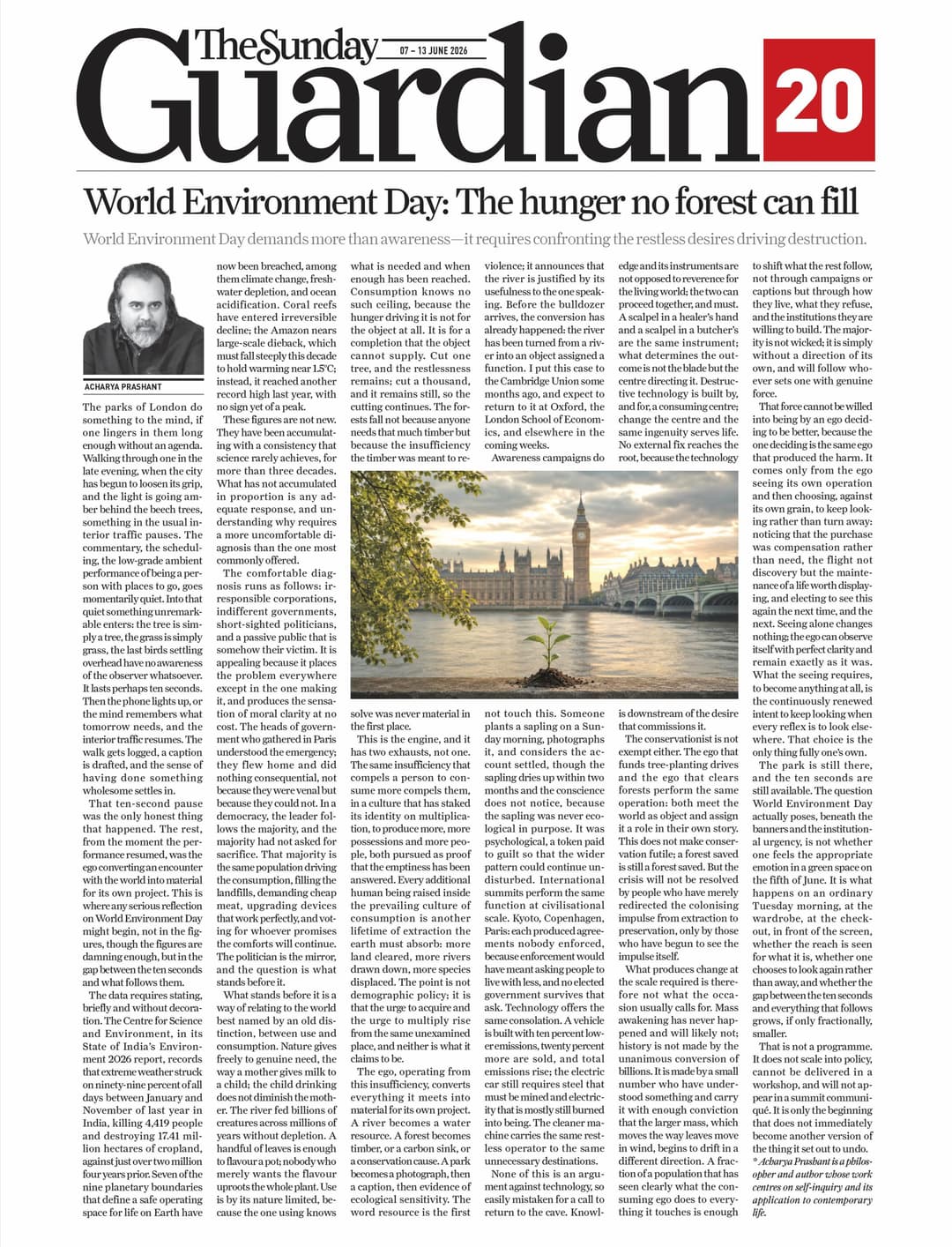
World Environment Day: The hunger no forest can fill

Acharya Prashant

10 min
460 reads
World Environment Day: The hunger no forest can fill
Nature’s crisis is not driven only by technology, corporations, or policy failures, but by a deeper pattern of endless consumption rooted in human dissatisfaction. Forests, rivers, and even environmental causes are often turned into tools for personal identity and comfort. Real ecological change begins when people honestly examine the desires behind their choices and act from awareness rather than habit, guilt, or the need for more. This summary is AI-generated. Please read the full article for complete understanding.

Originally published in The Sunday Guardian on 7 jun '26

World Environment Day demands more than awareness—it requires confronting the restless desires driving destruction

The parks of London do something to the mind, if one lingers in them long enough without an agenda. Walking through one in the late evening, when the city has begun to loosen its grip, and the light is going amber behind the beech trees, something in the usual interior traffic pauses. The commentary. the scheduling, the low-grade ambient performance of being a person with places to go, goes momentarily quiet. Into that quiet something unremarkable enters: the tree is simply a tree, the grass is simply grass, the last birds settling overhead have no awareness of the observer whatsoever. It lasts perhaps ten seconds. Then the phone lights up, or the mind remembers what tomorrow needs, and the interior traffic resumes. The walk gets logged, a caption is drafted, and the sense of having done something wholesome settles in.
That ten-second pause was the only honest thing that happened. The rest, from the moment the performance resumed, was the ego converting an encounter with the world into material for its own project. This is where any serious reflection on World Environment Day might begin, not in the figures, though the figures are damning enough, but in the gap between the ten seconds and what follows them.

The data requires stating, briefly and without decoration. The Centre for Science and Environment, in its State of India’s Environment 2026 report, records that extreme weather struck on ninety-nine percent of all days between January and November of last year in India, killing 4,419 people and destroying 17.41 million hectares of crop land, against just over two million four years prior. Seven of the nine planetary boundaries that define a safe operating space for life on Earth have now been breached, among them climate change, freshwater depletion, and ocean acidification. Coral reefs have entered irreversible decline; the Amazon nears large-scale dieback, which must fall steeply this decade to hold warming near 1.5°C; instead, it reached another record high last year, with no sign yet of a peak.

These figures are not new. They have been accumulating with a consistency that science rarely achieves, for more than three decades. What has not accumulated in proportion is any adequate response, and understanding why requires a more uncomfortable diagnosis than the one most commonly offered.

The comfortable diagnosis runs as follows: irresponsible corporations, indifferent governments, short-sighted politicians, and a passive public that is somehow their victim. It is appealing because it places the problem everywhere except in the one making it, and produces the sensation of moral clarity at no cost. The heads of government who gathered in Paris understood the emergency; they flew home and did nothing consequential, not because they were venal but because they could not. In a democracy, the leader follows the majority, and the majority had not asked for sacrifice. That majority is the same population driving the consumption, filling the landfills, demanding cheap meat, upgrading devices that work perfectly, and voting for whoever promises the comforts will continue. The politician is the mirror, and the question is what stands before it.

What stands before it is a way of relating to the world best named by an old distinction, between use and consumption. Nature gives freely to genuine need, the way a mother gives milk to a child; the child drinking does not diminish the mother. The river fed billions of creatures across millions of years without depletion. A handful of leaves is enough to flavour a pot: nobody who merely wants the flavour uproots the whole plant. Use is by its nature limited, because the one using knows what is needed and when enough has been reached. Consumption knows no such ceiling, because the hunger driving it is not for the object at all. It is for a completion that the object cannot supply. Cut one tree, and the restlessness remains; cut a thousand, and it remains still, so the cutting continues. The forests fall not because anyone needs that much timber but because the insufficiency the timber was meant to resolve was never material in the first place.

This is the engine, and it has two exhausts, not one. The same insufficiency that compels a person to consume more compels them, in a culture that has staked its identity on multiplication, to produce more, more possessions and more people, both pursued as proof that the emptiness has been answered. Every additional human being raised inside the prevailing culture of consumption is another lifetime of extraction the earth must absorb: more land cleared, more rivers drawn down, more species displaced. The point is not demographic policy; it is that the urge to acquire and the urge to multiply rise from the same unexamined place, and neither is what it claims to be.

The ego, operating from this insufficiency, converts everything it meets into material for its own project. A river becomes a water resource. A forest becomes timber, or a carbon sink, or a conservation cause. A park becomes a photograph, then a caption, then evidence of ecological sensitivity. The word resource is the first violence; it announces that the river is justified by its usefulness to the one speaking. Before the bulldozer arrives, the conversion has already happened: the river has been turned from a river into an object assigned a function. I put this case to the Cambridge Union some months ago, and expect to return to it at Oxford, the London School of Economics, and elsewhere in the coming weeks.

Awareness campaigns do not touch this. Someone plants a sapling on a Sunday morning, photographs it, and considers the account settled, though the sapling dries up within two months and the conscience does not notice, because the sapling was never ecological in purpose. It was psychological, a token paid to guilt so that the wider pattern could continue undisturbed. International summits perform the same function at civilisational scale. Kyoto, Copenhagen, Paris: each produced agreements nobody enforced, because enforcement would have meant asking people to live with less, and no elected government survives that ask. Technology offers the same consolation. A vehicle is built with ten percent lower emissions, twenty percent more are sold, and total emissions rise; the electric car still requires steel that must be mined and electricity that is mostly still burned into being. The cleaner machine carries the same restless operator to the same unnecessary destinations.

None of this is an argument against technology, so easily mistaken for a call to return to the cave. Knowledge and its instruments are not opposed to reverence for the living world; the two can proceed together, and must. A scalpel in a healer’s hand and a scalpel in a butcher’s are the same instrument; what determines the outcome is not the blade but the centre directing it. Destructive technology is built by, and for, a consuming centre; change the centre and the same ingenuity serves life. No external fix reaches the root, because the technology is downstream of the desire that commissions it.

The conservationist is not exempt either. The ego that funds tree-planting drives and the ego that clears forests perform the same operation: both meet the world as object and assign it a role in their own story. This does not make conservation futile; a forest saved is still a forest saved. But the crisis will not be resolved by people who have merely redirected the colonising impulse from extraction to preservation, only by those who have begun to see the impulse itself.

What produces change at the scale required is therefore not what the occasion usually calls for. Mass awakening has never happened and will likely not; history is not made by the unanimous conversion of billions. It is made by a small number who have understood something and carry it with enough conviction that the larger mass, which moves the way leaves move in wind, begins to drift in a different direction. A fraction of a population that has seen clearly what the consuming ego does to everything it touches is enough to shift what the rest follow, not through campaigns or captions but through how they live, what they refuse, and the institutions they are willing to build. The majority is not wicked; it is simply without a direction of its own, and will follow whoever sets one with genuine force.

That force cannot be willed into being by an ego deciding to be better, because the one deciding is the same ego that produced the harm. It comes only from the ego seeing its own operation and then choosing, against its own grain, to keep looking rather than turn away: noticing that the purchase was compensation rather than need, the flight not discovery but the maintenance of a life worth displaying, and electing to see this again the next time, and the next. Seeing alone changes nothing; the ego can observe itself with perfect clarity and remain exactly as it was. What the seeing requires, to become anything at all, is the continuously renewed intent to keep looking when every reflex is to look elsewhere. That choice is the only thing fully one’s own.

The park is still there, and the ten seconds are still available. The question World Environment Day actually poses, beneath the banners and the institutional urgency, is not whether one feels the appropriate emotion in a green space on the fifth of June. It is what happens on an ordinary Tuesday morning, at the wardrobe, at the checkout, in front of the screen, whether the reach is seen for what it is, whether one chooses to look again rather than away, and whether the gap between the ten seconds and everything that follows grows, if only fractionally, smaller.

That is not a programme. It does not scale into policy, cannot be delivered in a workshop, and will not appear in a summit communiqué. It is only the beginning that does not immediately become another version of the thing it set out to undo.

Originally published in The Sunday Guardian on 7 jun '26

This article has been created by volunteers of the PrashantAdvait Foundation from transcriptions of sessions by Acharya Prashant
Comments
LIVE Sessions
Experience Transformation Everyday from the Convenience of your Home
Live Bhagavad Gita Sessions with Acharya Prashant
Categories