Originally published in The Sunday Guardian
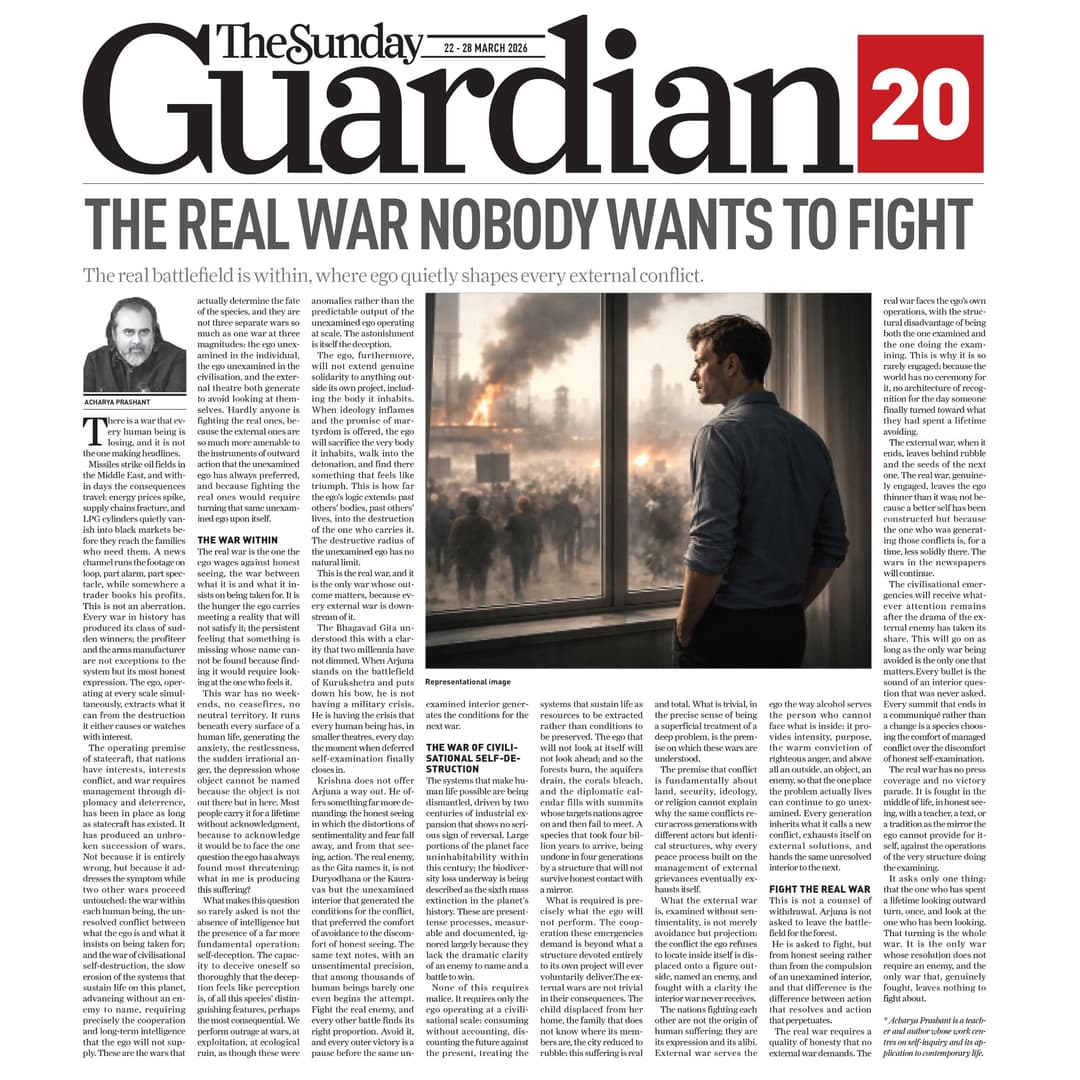
There is a war that every human being is losing, and it is not the one making headlines. Missiles strike oil fields in the Middle East, and within days the consequences travel: energy prices spike, supply chains fracture, and LPG cylinders quietly vanish into black markets before they reach the families who need them. A news channel runs the footage on loop, part alarm, part spectacle, while somewhere a trader books his profits. This is not an aberration. Every war in history has produced its class of sudden winners; the profiteer and the arms manufacturer are not exceptions to the system but its most honest expression. The ego, operating at every scale simultaneously, extracts what it can from the destruction it either causes or watches with interest.
The operating premise of statecraft, that nations have interests, interests conflict, and war requires management through diplomacy and deterrence, has been in place as long as statecraft has existed. It has produced an unbroken succession of wars. Not because it is entirely wrong, but because it addresses the symptom while two other wars proceed untouched: the war within each human being, the unresolved conflict between what the ego is and what it insists on being taken for; and the war of civilisational self-destruction, the slow erosion of the systems that sustain life on this planet, advancing without an enemy to name, requiring precisely the cooperation and long-term intelligence that the ego will not supply.
These are the wars that actually determine the fate of the species, and they are not three separate wars so much as one war at three magnitudes: the ego unexamined in the individual, the ego unexamined in the civilisation, and the external theatre both generate to avoid looking at themselves. Hardly anyone is fighting the real ones, because the external ones are so much more amenable to the instruments of outward action that the unexamined ego has always preferred, and because fighting the real ones would require turning that same unexamined ego upon itself.
The real war is the one the ego wages against honest seeing, the war between what it is and what it insists on being taken for. It is the hunger the ego carries meeting a reality that will not satisfy it; the persistent feeling that something is missing whose name cannot be found because finding it would require looking at the one who feels it. This war has no weekends, no ceasefires, no neutral territory. It runs beneath every surface of a human life, generating the anxiety, the restlessness, the sudden irrational anger, the depression whose object cannot be named because the object is not out there but in here. Most people carry it for a lifetime without acknowledgment, because to acknowledge it would be to face the one question the ego has always found most threatening: what in me is producing this suffering?
What makes this question so rarely asked is not the absence of intelligence but the presence of a far more fundamental operation: self-deception. The capacity to deceive oneself so thoroughly that the deception feels like perception is, of all this species’ distinguishing features, perhaps the most consequential. We perform outrage at wars, at exploitation, at ecological ruin, as though these were anomalies rather than the predictable output of the unexamined ego operating at scale. The astonishment is itself the deception.
The ego, furthermore, will not extend genuine solidarity to anything outside its own project, including the body it inhabits. When ideology inflames and the promise of martyrdom is offered, the ego will sacrifice the very body it inhabits, walk into the detonation, and find there something that feels like triumph. This is how far the ego’s logic extends: past others’ bodies, past others’ lives, into the destruction of the one who carries it. The destructive radius of the unexamined ego has no natural limit. This is the real war, and it is the only war whose outcome matters, because every external war is downstream of it.
The Bhagavad Gita understood this with a clarity that two millennia have not dimmed.
When Arjuna stands on the battlefield of Kurukshetra and puts down his bow, he is not having a military crisis. He is having the crisis that every human being has, in smaller theatres, every day: the moment when deferred self-examination finally closes in. Krishna does not offer Arjuna a way out. He offers something far more demanding: the honest seeing in which the distortions of sentimentality and fear fall away, and from that seeing, action. The real enemy, as the Gita names it, is not Duryodhana or the Kauravas but the unexamined interior that generated the conditions for the conflict, that preferred the comfort of avoidance to the discomfort of honest seeing. The same text notes, with an unsentimental precision, that among thousands of human beings barely one even begins the attempt. Fight the real enemy, and every other battle finds its right proportion. Avoid it, and every outer victory is a pause before the same unexamined interior generates the conditions for the next war.
The systems that make human life possible are being dismantled, driven by two centuries of industrial expansion that shows no serious sign of reversal. Large portions of the planet face uninhabitability within this century; the biodiversity loss underway is being described as the sixth mass extinction in the planet’s history. These are presenttense processes, measurable and documented, ignored largely because they lack the dramatic clarity of an enemy to name and a battle to win.
None of this requires malice. It requires only the ego operating at a civilisational scale: consuming without accounting, discounting the future against the present, treating the systems that sustain life as resources to be extracted rather than conditions to be preserved. The ego that will not look at itself will not look ahead; and so the forests burn, the aquifers drain, the corals bleach, and the diplomatic calendar fills with summits whose targets nations agree on and then fail to meet. A species that took four billion years to arrive, being undone in four generations by a structure that will not survive honest contact with a mirror.
What is required is precisely what the ego will not perform. The cooperation these emergencies demand is beyond what a structure devoted entirely to its own project will ever voluntarily deliver. The external wars are not trivial in their consequences. The child displaced from her home, the family that does not know where its members are, the city reduced to rubble: this suffering is real and total. What is trivial, in the precise sense of being a superficial treatment of a deep problem, is the premise on which these wars are understood.
The premise that conflict is fundamentally about land, security, ideology, or religion cannot explain why the same conflicts recur across generations with different actors but identical structures, why every peace process built on the management of external grievances eventually exhausts itself.
What the external war is, examined without sentimentality, is not merely avoidance but projection: the conflict the ego refuses to locate inside itself is displaced onto a figure outside, named an enemy, and fought with a clarity the interior war never receives. The nations fighting each other are not the origin of human suffering; they are its expression and its alibi.
External war serves the ego the way alcohol serves the person who cannot face what is inside: it provides intensity, purpose, the warm conviction of righteous anger, and above all an outside, an object, an enemy, so that the one place the problem actually lives can continue to go unexamined. Every generation inherits what it calls a new conflict, exhausts itself on external solutions, and hands the same unresolved interior to the next.
This is not a counsel of withdrawal. Arjuna is not asked to leave the battlefield for the forest. He is asked to fight, but from honest seeing rather than from the compulsion of an unexamined interior, and that difference is the difference between action that resolves and action that perpetuates.
The real war requires a quality of honesty that no external war demands. The real war faces the ego’s own operations, with the structural disadvantage of being both the one examined and the one doing the examining. This is why it is so rarely engaged: because the world has no ceremony for it, no architecture of recognition for the day someone finally turned toward what they had spent a lifetime avoiding.
The external war, when it ends, leaves behind rubble and the seeds of the next one. The real war, genuinely engaged, leaves the ego thinner than it was; not because a better self has been constructed but because the one who was generating those conflicts is, for a time, less solidly there. The wars in the newspapers will continue. The civilisational emergencies will receive whatever attention remains after the drama of the external enemy has taken its share. This will go on as long as the only war being avoided is the only one that matters. Every bullet is the sound of an interior question that was never asked. Every summit that ends in a communiqué rather than a change is a species choosing the comfort of managed conflict over the discomfort of honest self-examination.
The real war has no press coverage and no victory parade. It is fought in the middle of life, in honest seeing, with a teacher, a text, or a tradition as the mirror the ego cannot provide for itself, against the operations of the very structure doing the examining.
It asks only one thing: that the one who has spent a lifetime looking outward turn, once, and look at the one who has been looking. That turning is the whole war. It is the only war whose resolution does not require an enemy, and the only war that, genuinely fought, leaves nothing to fight about.
Originally published in The Sunday Guardian