Can You Truly Have Privacy in a Digital World?

Acharya Prashant

12 min
448 reads
Can You Truly Have Privacy in a Digital World?
The systems that we have — they are very easily controllable, which means there will be greater power in the hands of those owning the tech companies. As technology progresses, everything that you do is going to be watched. So, there is no way you will have privacy — or at least an assurance of privacy — of the old kind. The only thing that can safeguard you is a clean inside. You need not have stuff that you have to very, very diligently guard and that makes you vulnerable. Only that can help you. This summary has been created by volunteers of the PrashantAdvait Foundation

Divya Wadhwa: Let's talk about something that we all are mindlessly doing without putting our mind to it. We're scrolling our phones for no rhyme or reason. You know, whether you're sitting in a car, whether you're waiting at a doctor's clinic — no matter where you are, you're always on your phone. How do you feel about this addiction to social media platforms? Do you feel it's making us smarter as far as AI is concerned — whether artificial intelligence is making us smarter? Or do you think it's making us more dumb day by day?

Acharya Prashant: It depends on you — to what use you want to put these things. Social media is the entire universe, right? Of the 8-odd billion people on the planet, more than 5 billion are there on social media — and that’s outdated. Must be 6 billion now. So practically everybody is on social media. It depends on who you want to connect to and who you want to sit with.

Divya Wadhwa: But do you feel we are making our choices on our own, or is our phone making our choices for us?
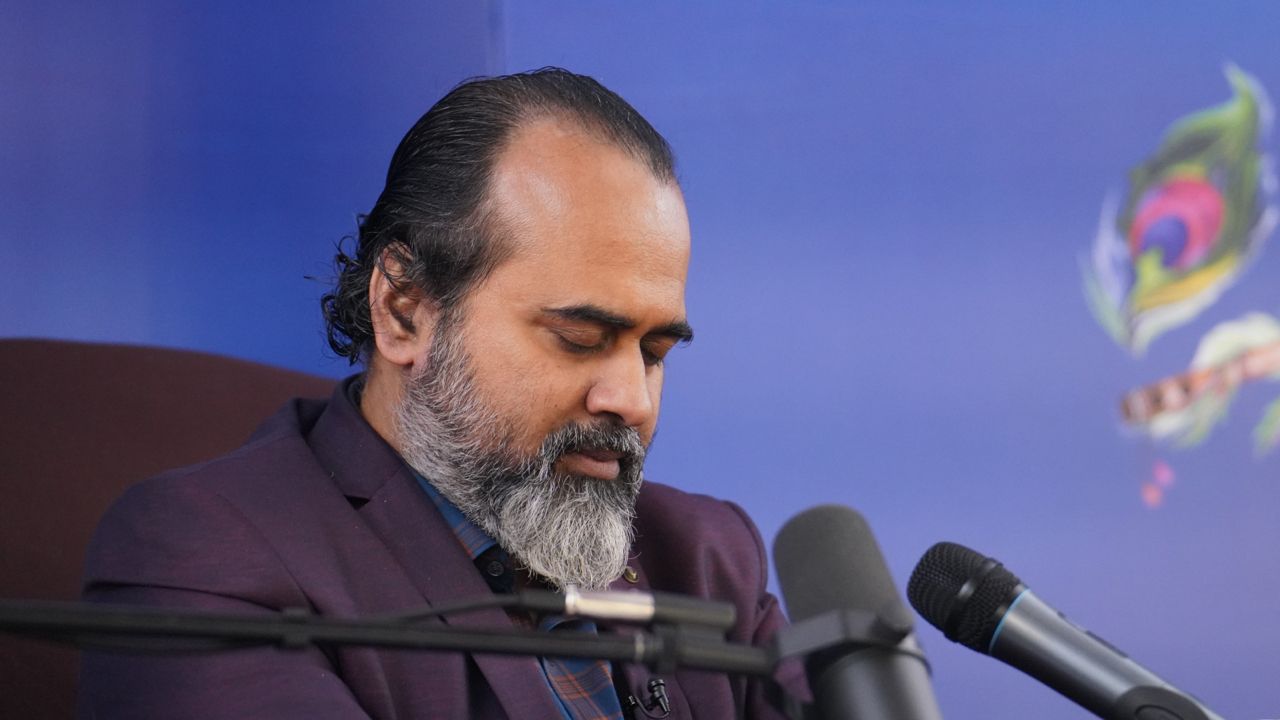
Acharya Prashant: See, that's the way it is even in the so-called real world. The phone — we all know the algorithm — it amplifies your choices. It reads what you like and then it keeps presenting the same things to you. Right? So it…

Divya Wadhwa: I came across something very interesting on Instagram. I saw this reel in which a wife's birthday is coming up, but she doesn't want to tell her husband what she wants. So she keeps speaking to his phone, which is just lying on the table. She doesn’t need to open his phone. She kept talking about this particular jewelry brand and the kind of gift that she wanted — and that’s exactly what she got. And the husband claimed, “Oh, you know, I’m very updated with the trends of today.”

Acharya Prashant: See, without social media, the role of the phone would have been performed by a so-called friend, or a well-wisher, or a mediator, or a neighbor, or a relative, or somebody. Just the same thing. Social media represents who we are. The algorithm knows that you must be talked to only sweetly. Which means that if you want to look at this, this, this, this, this kind of stuff, you must not be shown the other kind of stuff. Is that also not what our so-called friends do? You know, you go to them and they'll only speak to you what you want to listen to “Jo tumko pasand hai, wahi baat kahenge.” That's an algorithm, Social media.

Divya Wadhwa: Right, but when it's eavesdropping on your conversation, aren't you scared? Aren't you worried that your phone's listening in to even what we're talking about right now?

Acharya Prashant: First of all, why should you talk of things that need to be kept hidden?

Divya Wadhwa: It's not a question of hiding what I'm saying to you....

Acharya Prashant: I understand where you are coming from. I understand. But please understand...

Divya Wadhwa: What about privacy?

Acharya Prashant: Please understand that privacy, etc. — they are going to be thrown out of the window. As technology progresses, everything that you do is going to be watched. Zuckerberg admitted recently: your WhatsApp is being read. Now people are switching to Signal. Even that would maybe someday be compromised. So, there is no way you will have privacy — or at least an assurance of privacy — of the old kind.

The only thing that can safeguard you is a clean inside.

You need not have stuff that you have to very, very diligently guard. You need not have stuff that makes you vulnerable. And only that can help you. Otherwise, all kinds of checks and balances and privacy…

Divya Wadhwa: How distracting is social media, is the question at the moment, because you know, you find young people — they find it very difficult to concentrate for more than 5 minutes. How scary is that?

Acharya Prashant: See, social media doesn't spring up on its own legs and start presenting itself to you. When we say, “How distracting is social media?” We are turning social media into something animate, something conscious — which it is not. It is your choice to go to your phone. It is your choice to ask for the phone….

Divya Wadhwa: Would you call this just tech addiction or something deeper?

Acharya Prashant: It is just an amplification of what we always have been. We are just being shown the mirror. We were always like this. Now there is some greedy corporation that is making money out of our very ancient, primordial, beastly state and instincts.

Divya Wadhwa: Well, if you feel our decisions are being driven by emotions, by upbringing, and now by algorithms — do we really have free will?

Acharya Prashant: We never had any free will. We are all bundles of conditioning. That's all. Straw men. That's all we are. We look conscious — we are not. What we have is a borrowed consciousness. So will was never anyway free. Just that that fact is now being ruthlessly exposed.

Divya Wadhwa: But don't you feel that you're sort of being nudged in a direction that perhaps you don't need to be in?

Acharya Prashant: Do we know the direction we need to be in? If you conduct a survey — who is it who knows the direction to take? And when you do not know the direction to take, any kind of random force will take you in any random direction. And that's what is happening. On the contrary — let me complete here, wait. On the contrary, when you know the path to take, the direction to take, no force in the world can distract you away from it. If you are being distracted, that is not an accident you can blame somebody else for. If you are being distracted, that's just a revelation that you don't have anything.

If you are being distracted, then that's a revelation that you do not have anything worthwhile in your life in the first place.

I do not know what these people here right now are doing — how can they distract me? I know my job. I know what I'm here for. How can I be distracted? And if you're trying to distract me, what did I do? I said, "Please wait. Let me finish. I won't allow you."

Divya Wadhwa: Point taken. Point taken. But how does one reclaim one's attention and one's choice?

Acharya Prashant: One never had anything. Where was one's own attention? What you call "one's own" is what spirituality calls the “Self” Atma. We never had it. Just that we were living in a more secure and sanitized environment, where the fact was not being exposed or revealed. Today, it is being laid bare — being mercilessly exposed — that you don't have anything of your own. Something can be shown to you on TV, on social media, anywhere; there's some trend, and you are being swept off your feet. So it's just a revelation.

Divya Wadhwa: Do you feel that the world is emerging to be a world of distraction — it's being designed for distraction as we go forward day by day?

Acharya Prashant: Deciding by whom? By whom?

Divya Wadhwa: By these big tech companies, which are throwing out more and more apps at us, throwing us more and more options at us.

Acharya Prashant: I understand a company is not animated. When you say company, you mean a human being?

Divya Wadhwa: No, companies, like we have social media platforms — which are throwing out so many options at us.

Acharya Prashant: What do you mean by platform? A platform is no consciousness. There is somebody behind the platform. A human being.

Divya Wadhwa: Right.

Acharya Prashant: A human being.

Divya Wadhwa: Big, big tech giants.

Acharya Prashant: So human beings. So you're saying a human being is distracting another human being through a platform?

Divya Wadhwa: Right.

Acharya Prashant: So why is this human being allowing himself to be distracted? Why does he have such a loveless life? If there is love in life, why will I allow somebody to encroach? That's the question to ask — because technology is only going to get better and sharper, which means there will be greater power in the hands of those owning the tech companies.

The only difference that you have is love, purpose, the right kind of self-knowledge — which does not allow you to be carried away.

Divya Wadhwa: You mentioned tech giants. I would like to talk about Elon Musk and a company that he owns — or, you know, has an operating system called Grok 3. And Grok 3 has named Elon Musk as one of the most dangerous people on earth. He's named his own owner as the most dangerous. He's called him the most top misinformation spreader. And so, you know, we're talking about the perils of AI, and it is going against its own owner, so to speak. Your reaction?

Acharya Prashant: Happy! Just that, the owner being the owner will have the power to rewrite the algo. We are still far from the kind of artificial superintelligence that can guard its algorithm to the extent that it can rewrite its algorithm in a way that humans can't even comprehend. We are yet to reach that state. It'll take around two decades, maybe. Right now, the AI systems that we have — they are very easily controllable. So, if that's the kind of thing that's happening, as you said, then the algo will be taken care of. Like you have, you know, a rebelling employee — what do you do? You make him fall in place. You know, he's speaking too much, talking too much — show him his place. So that's what will happen to Grok as well.

Divya Wadhwa: So, let's talk about spirituality and the role that can really play in helping us sort of break free from, you know, these compulsive disorders that one would say — in regard to getting back onto your phone or to your laptop, reaching out for your phone without even knowing, or even giving it a thought.

Acharya Prashant: So, reaching out to the phone, as you said, is not a problem. Without giving it a thought — is a problem.

Nothing in the world is a problem. Only inner ignorance is the problem. If you are inwardly illuminated, then this is useful.

That is useful, the phone is useful, social media is useful, AI is useful, a gun might be useful, a pill might be useful, anything and everything is useful. The very discourse of the Gita happens in the middle of all kinds of weapons. So even a gun might be useful. Everything is rendered useful when one knows who one is, where one is coming from, what this thing called life is, and what ought to be the purpose of life. Everything becomes useful.

Divya Wadhwa: Would you say awareness is the only antidote to manipulation?

Acharya Prashant: Only antidote, very well said, Very well said. Yes.

Divya Wadhwa: So, would you give us a few examples of how one can make oneself more aware of the perils of artificial intelligence, of social media?

Acharya Prashant: No, no. You're looking towards this and that — how one can make oneself aware of the perils of this, of that: social media, artificial intelligence, Elon Musk.

Your biggest enemy is not this or that. Your biggest enemy sits here — inside, within. You need to be aware of the perils of the one sitting within.

This is your principal adversary, and you cannot defeat your adversary if you do not know your adversary. So, spirituality is first and foremost about knowing oneself. And knowing oneself does not mean that there is some great God sitting within and you will come and be able to have darshan of God. No, knowing yourself means there is a chimpanzee sitting within — a really cunning chimpanzee gone out of hand. And that chimpanzee has to be understood. And if you can understand that one, then you have tamed that one. And now, you are entitled to be called a human being.

Divya Wadhwa: Right. So, you know, before I let you go — is technology and AI making us smarter or more distracted?

Acharya Prashant: They are only making you more of what you already are.

Divya Wadhwa: Thank you so much for speaking with us here on NDTV.

This article has been created by volunteers of the PrashantAdvait Foundation from transcriptions of sessions by Acharya Prashant
Comments
LIVE Sessions
Experience Transformation Everyday from the Convenience of your Home
Live Bhagavad Gita Sessions with Acharya Prashant
Categories