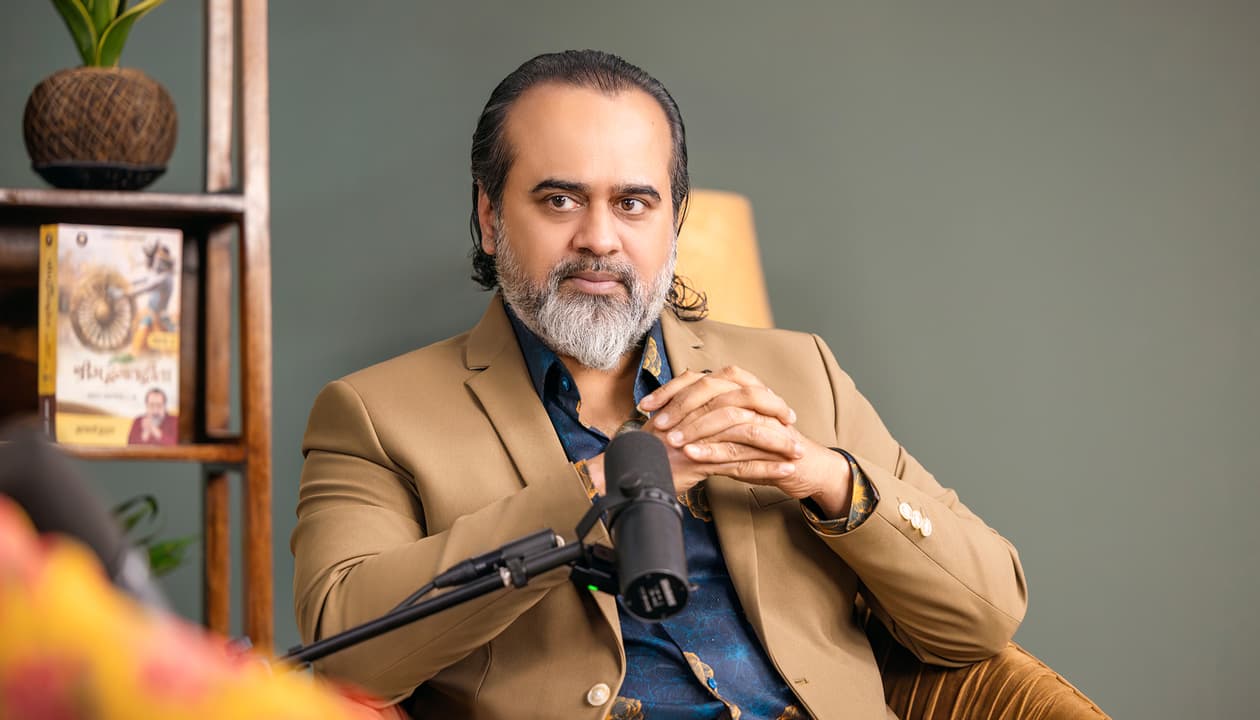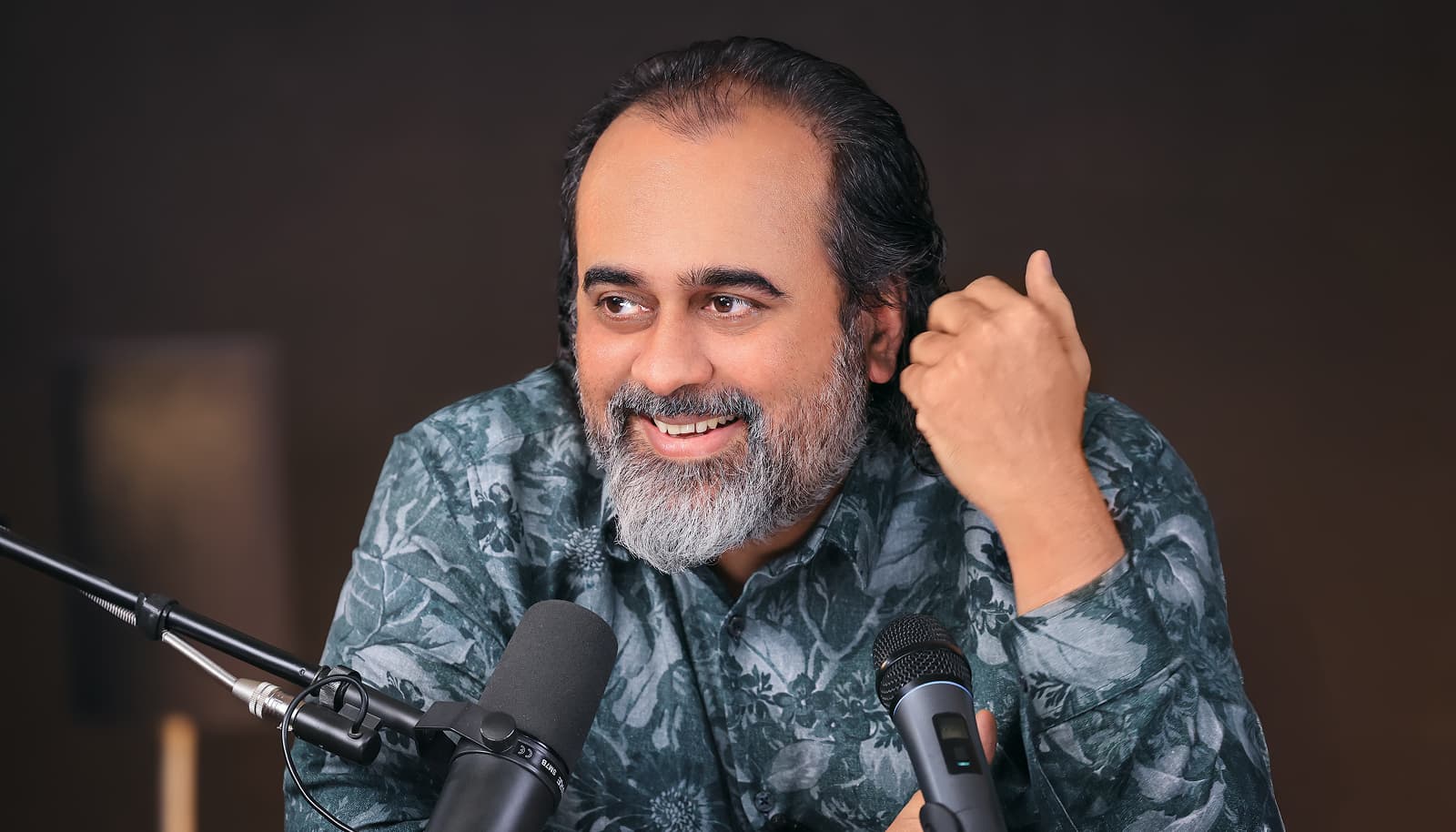
Preeti Dahiya: Hello and welcome once again to this special feature on NDTV. My name is Preeti Dahiya and I am in conversation with Acharya Prashant. Acharya Ji, your latest book release, Truth Without Apology. This is a fantastic read, an essential, easy-breezy book for any age group, any generation.
Acharya Prashant: Yeah, that's what the purpose was: to bring the highest to everyone in a form of their choice, in words they can relate to, in matters that are consequential to them. So I wrote this keeping the general person, the common man, the usual reader in mind, and it does not require any kind of background to understand. It does not demand continuity in terms of long chapters. Every chapter, as you would have seen, is a standalone and complete entity in itself, and it spans over just one or two pages.
Preeti Dahiya: The topics of the book are wide-ranging: fear, ambition, love, loneliness, desire, self-worth, you name it, and you face it in daily life.
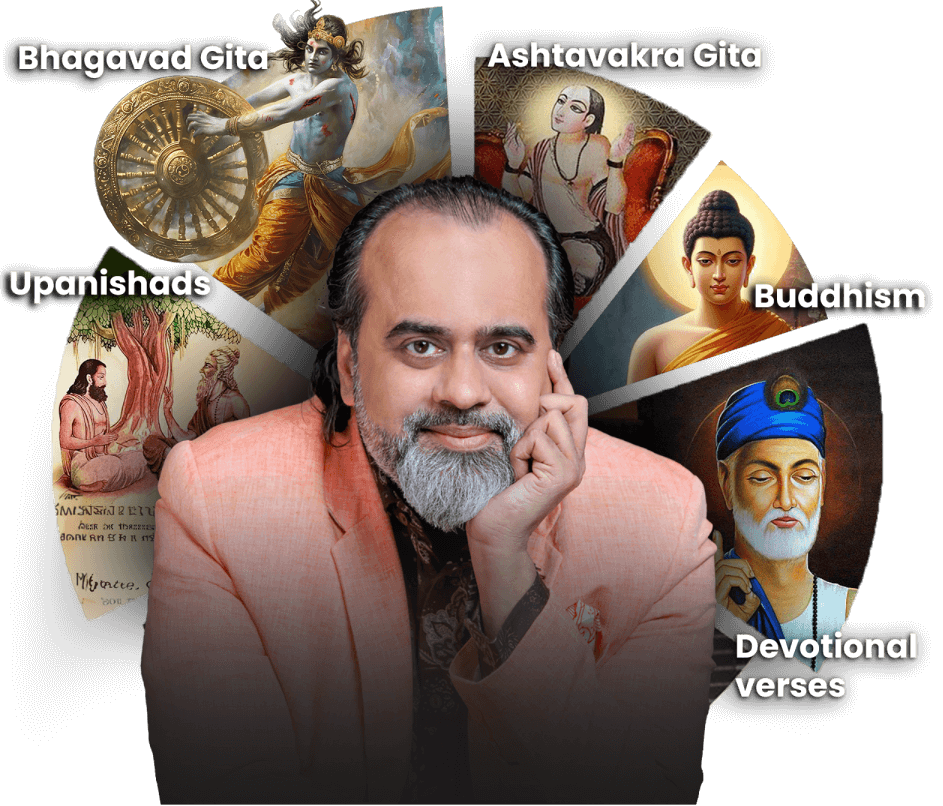
Acharya Prashant: That was the condition I set on myself: can you answer the most common and sometimes the toughest questions as briefly as possible and as usefully as possible? I took the challenge, and let's see what has come out of it.
Preeti Dahiya: I'm going to put my finger on this particular segment that talks about people like me, the corporate slaves. We are in a rot, if I can say that. We are every day going for a certain job, chasing a certain dream, getting a certain pay package, and then burning that pay package on some other dreams. So this is a constant cycle. Does it ever get over? Are you trying to show us a mirror, or are you also trying to give us some way out of it?
Acharya Prashant: You see, the way out is not difficult because the way out is the way in, and that's why the mirror is the only instrument that can help. We do not require to reach somewhere, a particular place of solution, bliss, ambition, or achievement. Right? What we need to see is whether the ways that we have taken are really giving us that which we want. You asked, does this whole thing ever end? I do not know, but life does end. We are creatures of limited time, and being creatures of limited time, it's very important to invest ourselves wisely.
One question that I often ask my audiences is: all these things that you do throughout the day, had you not been told to do them, would you have done even one of these? Is there anything that you do that is really original and, in that sense, your own? Is there anything that you know of, held as an idea or a thing or a matter or a conclusion in your mind, that you have not been told by others? So what's the point in investing your life on things set by others?
After all, if you are ambitious, if you are a corporate hustler, what you want is something for yourself. No? You think you have desires, you think they are your desires, and you think your desires will fulfill you. What if, even if the desires get fulfilled, you don't get fulfilled because those desires were really never your own? It's almost like the waiter serving dishes on a table. Right? The waiter brought the food. Somebody else would get situated. Somebody else would be fulfilled.
Maybe we are successful in a lot of things. But are those things really ours?
The Buddha gives the example of the spoon in the soup. The spoon fetches the soup to so many people, so many mouths. But the spoon never gets to taste the soup. Though the spoon is dipped in it, and it is incredibly successful.
Preeti Dahiya: Yeah.
Acharya Prashant: It will have a long CV: I did this, I did this, I did this, I did this. Then finally, the question life would ask is, what did all this give to you? And to answer that question, you must first of all know what you really want.
Preeti Dahiya: So we fail to ask that question to ourselves?
Acharya Prashant: Yes.
Preeti Dahiya: Is that where the feeling of emptiness and being incomplete comes from?
Acharya Prashant: That emptiness comes from being overfulfilled, because it's not that you failed to ask that question. You have been given pre-existing, readymade answers. So that's over and above what you really need. That's an additional burden you never must have.
Why would you ask a question if you're already loaded with so many answers? And is that not what our culture, our conditioning, our education, our family, our media, our society, our religion constantly do? They give ourselves ready-made answers. And when you have those ready-made answers, where is the question? What is the point in then inquiring?
Preeti Dahiya: But it's also true that at some point in your life, you do come across that question, maybe while you are looking in the mirror, getting ready, or whatever, and you do have that sense of being incomplete.
Acharya Prashant: Yes. Because the answers that you have been given are burdensome, heavy, enormous, but never fulfilling. Never fulfilling.
Now, what do you do? You are unmistakably incomplete from within, and you ask yourself, so what to do? There are readymade answers even to that question. Are you getting it?
Preeti Dahiya: People counter-question: What are you lacking? Why are you feeling that way? It's an unnecessary emotion.
Acharya Prashant: Yes. The point there is not to start from "what am I lacking." The way there is to start from "what am I having," not from the lack, but from the presence. See, you could start by asking, "What more do I want?" That is one approach, and the usual one.
The other approach is, “I already have this much. Maybe there are a lot of things that I still aspire for, but I already do have this much. Why do I have this much? Of what use is this? What happened to all the energy, and the time, and the attention I gave? What is the real ROI?”
That's the way you start.
Preeti Dahiya: Maybe people will understand more in ROI terms.
Acharya Prashant: ROI terms. So, I have accumulated all this. Yes. All this is there, and I'm supposed to have all this. So I feel good, but let me very bluntly ask myself, the question of the mirror: what do you really get by having all this? Once that question is asked, you don't really need to then travel far and wide to get any answer. You realize that the center you accumulated all your present stuff from is a wasteful center, and anything that you do continuing as the same person will be even more wasteful.
Why should I fascinate about the future? Why not start from what I have already become today? I have been on a journey of accumulation, and I have become something today. I have become something today. Why should I ask myself, what am I getting by becoming what I have?
Preeti Dahiya: Right.
Acharya Prashant: And it's a factual question because this leaves no scope for speculation. You have your job, you have this, you have your car, you have your hustling, you have your competition, you have your dreams and desires, you have all these things. Then the question is, even if I succeed in this, and I have succeeded many times, what really do I get?
Preeti Dahiya: There is a slight confusion here. What is the value of ambition in one's life? Why? Or is it at all important to have ambition? And if we don't have a certain goal in our mind, then again, is a goalless life worthless?
Acharya Prashant: No. The question is not whether there should be a goal. The question is, where is the goal coming from?
Preeti Dahiya: What if you very strongly feel about what you desire, or your ambition is?
Acharya Prashant: Where is the feeling coming from? Ambition is desire. Desire will have goals. So ambition, desire, goal, target — they all belong to the same family, don't they? The question is, where are those targets or goals or ambitions coming from? I strongly feel to have something. Where is that feeling coming from? Do I really know? And if I don't know, then it's an empty and blind feeling. It could be physical conditioning. It could be a social imprint. It could be anything. But for certain, it's not me.
Preeti Dahiya: So give me an example of purposeful ambition. How would that come? How would someone know that this is my own original, authentic self which is aspiring to get a certain thing?
Acharya Prashant: When you are clear with the facts of life, when you are not just saying, "I feel like doing it," and somebody asks you, "But why do you feel like doing this?" and she says, "no, no, it just feels good. It's an emotion, it's an instinct, or it's an intuition that this must happen.” This kind of vague and hazy expression is a strong indicator that you are coming from an inner place of ignorance. You don't have facts. You only have feelings. That's one thing.
The second indicator is, when you want to achieve things and you find that the achievement would benefit only you or your inner circle, then probably there is a problem. When you are coming from a place of clarity, you can still have goals. Goals, ambitions, or targets are not a problem. The place they are coming from might be the problem.
When you have the right place to set goals from, then your goals are rarely just for yourself. You find that they benefit everybody in general, and not just your species, sometimes all other species.
So there are indicators.
Preeti Dahiya: Can we say that sometimes our ambition also gets its roots in our heart and mind from what we have been through? I'm just going to quote a random example. A boy who's lived his childhood in poverty and has managed to get an education to make it big in life. Let's say he's become a graduate or whatever, and his ambition is to earn big numbers, big bucks, so that his family doesn't have to live in that poverty. The future generations don't have to do that. Is that the right way of having an ambition, or again that's affected?
Acharya Prashant: No. He is reacting to his past. And in that sense, he's again spoiling his life. There is poverty that can spoil your life, and there is plenty that can spoil your life.
Preeti Dahiya: So what do you advise to such a person?
Acharya Prashant: What if that person has a special talent for arts?
I understand if the family is still poor, he needs to provide for them. But the fact remains that real needs, actual needs, do not take much. You ought to provide for your family, that's fine. But it's not that in reaction to abject poverty, you then unleash a spree of accumulation, which is often the case, and people narrate it with pride. They say, "You know, I come from such a poor background and now I have millions." No, no, no, sir. This is just a reaction, and you have spoiled a lot of things for you. Yes, poverty is not something that we want to be there. But at the same time, we do not want the opposite of poverty.
I come from a background where, let's say, the father was what you can call a weak man. As a son, I suffered because the father was weak — not assertive, not dominating, not powerful. That was my sense, and I feel I suffered because my father was that way. So when I beget a son, I become an authoritarian. That's a reaction. You're allowing the past to dictate your present and your future, in the opposite way.
See, the past extends itself but in very curious ways, sometimes as a continuity and sometimes as an opposite, because we have been very tolerant people in the past and suffered because of that. So let's now become very jingoistic, very bigoted, and very violent. That's a reaction. So that's not the way.
The way to ask yourself is: I value this thing so much. Where did I learn to value it, and when and how? Who told me that such a thing is actually valuable? It's a very important question to ask. I'm investing myself fully in this. It could be a job. It could be a belief, an ideology, a relationship. You want to build a house, and you're investing yourself totally into it. You want to have a bigger car. You want to settle abroad. You have desires. You have something, or you are a missionary. You are investing yourself into it. It pays to ask this question: Where did this thought come to me from? Is it really mine? Have I investigated it?
Preeti Dahiya: But Acharya Ji, tell me one thing. When we are all young, every child has a set of parents who, in the first initial years, maybe even till the time you become a teenager and become more assertive and start identifying yourself, you are told by your parents: "Oh, you are very active, you'll be good in sports," or "I see you making good dance moves, you'll be a good dancer, why don't you try this activity class, that activity class," and that drives a child towards a certain potential. Or somebody's good in maths, "Oh, you will be a very good banker, so pay more attention to this," etc.
For those young listeners right now, what would you say is the right age to identify your true self? Is there an age to it? Is there a process to it? When should they realize, "Okay, now I've done enough of what my parents were telling me to do. I should come out of that circle now?”
Acharya Prashant: It's a process, and it starts at a very early age, and that's the hallmark of right parenting: to start that process as early as possible. I would say 3 years, 4 years, 5 years, 7 years.
Preeti Dahiya: That young.
Acharya Prashant: That young. I mean, why shouldn't you talk to the other as a conscious being? Right? Okay, do you understand this? Do you like this? Why? I'm keeping four things in front of you. Do you want to choose? Okay, Why did you choose this one? Wow. And how is this choice different from the one you made yesterday? You remember what you chose yesterday, by the way? “No, mama.” Okay, yesterday you went for the apple, and today the grapes. Okay, what has changed between yesterday and today? “Actually, my friend was eating grapes.” Okay, fine. So because the friend was eating grapes, today you're going for the grapes? “Yeah.” Okay. So you really admire your friend, you want to emulate your friend? “No. She's not very good.” Okay. If you don't admire her, why are you emulating her? “I didn't see that, mama.”
You see, it can start very early.
Preeti Dahiya: So encourage an inquisitive mind at a very early age.
Acharya Prashant: Yes. And let there be no holy cows. Nothing you have been told is too sacred to be questioned. You can question everything. You can ask any questions. There is nothing forbidden. That has to be the attitude. Take nothing as sacred. Yes, you are told a lot of things. Take them as things told, not as things absolute. There is nothing absolute about life here. All of it is a construct, and all constructs stand vulnerable to questions. The right questions. Where does it come from? What are its limits? To what extent do I cooperate with it?
Preeti Dahiya: So, we've spoken about how an early start is important. It can play a big role in shaping someone's personality in the longer run. Is there a point of no return as well? Is it ever too late?
Acharya Prashant: Practically, there is a point of no return, but I don't want to admit it. I would rather want to fight it. But practically, yes.
Preeti Dahiya: There is.
Acharya Prashant: It happens that there is a line, there is a threshold, and if you have crossed that, it requires a superhuman effort to redeem you. It requires energy beyond imagination to pull you back. Don't cross that line.
But at the same time, it is inhuman to accept that there exists somebody, or a lot of people, maybe most of the population of this planet, that has already crossed that line. I don't want to admit that, I want to fight on. But practically, yes, that's true. There is a line, and one should be conscious enough to never cross it. Once crossed, it is difficult, very difficult. Just that it's not a random action or a stray episode; this crossing of the line is a progression. You move towards that boundary. You inch towards it day after day. Then slowly, gradually, the thing worsens to a point of no repair, no return. You become incorrigible and life scraps you. It's just so ugly to even mention and so hurtful to see. I don't want to admit it.
Preeti Dahiya: So practical advice is to identify it before it's too late. Makes a lot of sense. But let's lighten up the topic a bit here because that went to very deep territory, and I think I'll need personal guidance when the cameras are off. But let's now come to this very interesting chapter wherein you are talking about, “The myth of free time.” This hit me hard personally.
“Life deserves purpose and passion. True freedom is found in meaningful work, not empty idleness.”
Now again, I'm going to connect it to a very woman-centered experience. A person who is working from dawn to dusk is just neck-deep in household chores, has her own career as well, has a lot of responsibilities for the elderly in the house, and everything. Is it bad for her to expect some free time and idleness?
Acharya Prashant: Not bad for her within her own paradigm, within the framework of her existing life. Idle time is not just required. It is a necessity.
Preeti Dahiya: Yeah. System reboot.
Acharya Prashant: It's a system reboot. Without this, she will just exhaust out. But the qualifier is within the framework of her life. What I'm emphasizing on is — why live such a life where the work requires compensation in the form of recovery time.
Preeti Dahiya: But sleep is also part of our recovery.
Acharya Prashant: That is fine. And I'm not talking of sleep as idle time.
*Preeti Dahiya: I'm just saying that the system is such that all day somehow your work consumes you, and repeatedly you are doing it.
Acharya Prashant: Within that paradigm work will consume you. There is another paradigm in which work actually rejuvenates you. And then you do not require idle time.
Preeti Dahiya: But not everyone has that luxury.
Acharya Prashant: That's not a luxury. That's the basic prerogative of life. That's your fundamental responsibility towards yourself.
See, obviously, if one has a soul-sapping job, one has to log out at some time. One has to say enough of it for the day, and now I must go and relax and rather recover and repair myself. That's needed. So I totally accept that in most of the jobs that people have, and in the kind of lives that most of us lead, idle time is a necessity.
What I'm asking rather is, why must we lead that kind of a life? Why can't work be so alluring that you demand neither recovery nor remuneration? Why can't work be such that you can work even without salary.
Preeti Dahiya: That's tricky.
Acharya Prashant: And say, "I'm prepared to pay for working here. I'm prepared to pay for having this kind of work." It's another question. Where would you pay?
Preeti Dahiya: I'm going to assume I didn't listen, that I didn't hear that one.
Acharya Prashant: So, I mean, just trying to take things to that extent to drive a point. But please understand. If I can live from the heart, do I require remuneration? Do I require recovery? Yes, recovery might be needed in the physical sense. I mean, I'm a tennis player. Obviously, I can't keep playing five hours every day. So in that sense, recovery might be needed. But would I ever be inwardly tired if I am leading the right life and I have submitted myself to the right mission? Would I ever be inwardly fatigued and just fed up with everything? No, I would never log out. In that sense, it would be a punishment to not work. I would not look forward to Sundays. I would not try to have offs or holidays.
No, I'm not blaming those who take offs or enjoy their holidays. Within the framework of their life as it is, it is very important to take offs. It is very important to have holidays within the framework of their life. But I'm challenging that framework itself.
Preeti Dahiya: Why have such a life?
Acharya Prashant: Why have that kind of work that makes it important for you to leave the office, swipe the card, and say, "I'm out. I'm off. I'm done for the day."
Preeti Dahiya: DND mode.
Acharya Prashant: DND mode. And rather, I have these many paid leaves for the year, and I'll utilize each single one of them, and such things. Why can't work be a love affair? Why can't the entire life be a love affair? Why must we put up with things? Why must things be of a nature that requires toleration? This is not something my heart is into yet. "I'll put up with it. I have to somehow bear this." Why must these statements exist at all?
Preeti Dahiya: Because of the needs, several needs that we have in our life. We have to put up with these kinds of circumstances.
Acharya Prashant: But the thin line between a genuine need and a borrowed need, a real need versus a desire, that line is the output of self-observation. When you know what you really need in life. And I'm not talking of the frugal kind of simplicity here. I'm not saying one must live on one-tenth of her salary because that's what wisdom and spirituality are about. No, none of that. We all have real needs, but have we identified them?
Instead of that, we might be investing ourselves in fulfilling random, shallow, borrowed desires, and to fulfill those desires, then we need to slog and hustle.
Preeti Dahiya: I feel that we corporate slaves are in a race to accumulate.
Acharya Prashant: To accumulate for what?
Preeti Dahiya: Just to fit into the structures that are around us. Like, I see a lot of competition. Let's say, it's summer break. Everyone is putting up Instagram stories that we are going on holidays to this country or that state or whatever. Immediately, there is a sense of competition: "Oh, I'm sitting at home, I'm missing out on the bus or the train or the aeroplane." That sense of being left behind.
When you hear someone, "Oh, I've bought a new 3BHK in an so-and-so society apartment complex or whatever," you feel, "Oh my God, I just have one. What am I leaving for my children?" So this race of accumulation, is it something that is holding us back from truly identifying what we need?
Acharya Prashant: It's not really the first thing the race for accumulation. It is a race away from oneself, because I do not know a thing about myself and my real needs. Therefore, it becomes necessary for me to run behind others and emulate them. Somebody went to Switzerland, you too followed the next season, and you said, "Another box ticked." Isn't it important to be honest and ask, "What am I getting out of this?" Right?
You have n number of ACs in your house, and then there is a place where you don't even need it, but because somebody else has it, you decide to go for one, or cars, or whatever the normal corporate person strives for.
So it's an inner darkness, inner darkness which means that you follow every point source of light that you see anywhere. It's almost like, must have happened to you sometime, or you would have heard of it: on a dark highway, you find your headlights are gone. What do you do then?
Preeti Dahiya: Trust your instinct.
Acharya Prashant: You want to follow some other vehicle.
Preeti Dahiya: Follow the line on the road maybe.
Acharya Prashant: * Follow the line on the road, or you tag behind that vehicle. Because you don't have your own lights, you have to follow someone else.
You don't have your own light, so you follow someone else.
The problem then is not accumulation. The problem then is those headlights, and they are not faulty, just that you have been taught that it's all right to follow others. The switch is here.
Preeti Dahiya: You might be safe.
Acharya Prashant: The dashboard is there. Put them on, put the lights on, and drive your own car, your own way, your own route.
Preeti Dahiya: It's a fascinating topic, Acharya Ji. Before we wrap up this discussion, I want you to give the viewer a takeaway from this discussion. You know, what should they take away from this discussion? How to reach out?
Acharya Prashant: The book.
Preeti Dahiya: Of course, the book is the answer. No doubt about it. Definitely. But how to reach out for that button on the dashboard which you are missing so far?
Acharya Prashant: Be sensitive to your own condition. You're following that goddamn truck, right? You're getting nothing out of it, and you know it. Just be honest and admit it.
We all are a big pile of grief within. We just have found defense mechanisms to distract ourselves from our real condition. The fact is, we're not joyful. We are not all right. We know that. That's why we need so much entertainment. That's why we avoid depth, because the moment you go deep, all you find is misery and grief.
Be sensitive to yourself. See, the way you are living is giving you even deeper hurt. Why subject yourself to needless hurt? And then you reach out to the dashboard and switch on the light.
Preeti Dahiya: On that note, I don't think I have anything else to add, really. The words of wisdom have been said, have been written. So reach out for your button on the dashboard and perhaps try to rewire your life if it requires it. Thank you once again Acharya Ji, for a wonderful conversation.
Acharya Prashant: Welcome.