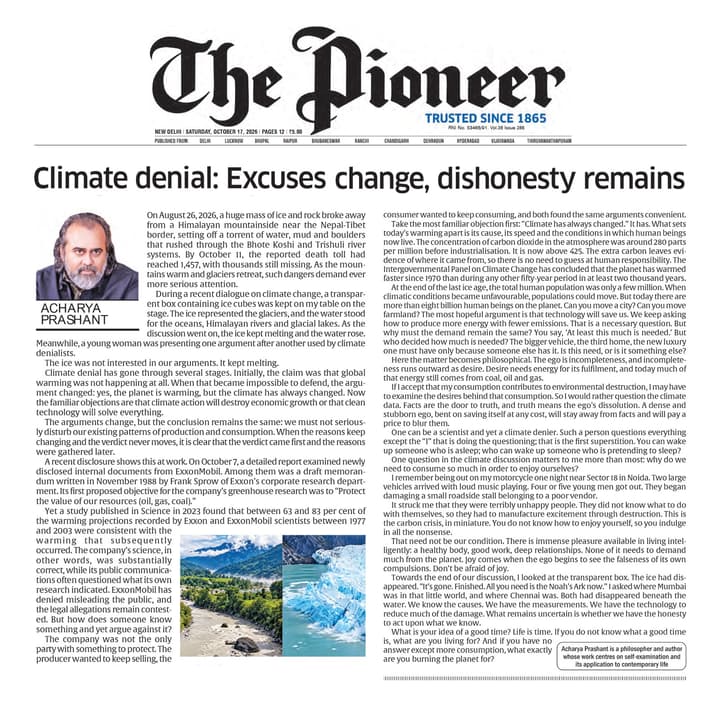
Originally published in [The Pioneer]
Every few years, Bihar votes with great enthusiasm. Yet when the noise settles, the same questions return: about jobs, education, and dignity.
Bihar’s tragedy is not that it is poor; it is that it refuses to wake up. A state cannot rise if its voters remain inwardly unaware. The quality of the government is never higher than the quality of the people who elect it. When people vote unconsciously, by habit, caste, or anger, elections become nothing but a ritual. A sleeping mind elects a snoring system.
The realities of Bihar can be seen clearly in the accompanied checklist. Each number in it is not merely a statistic, but a mirror held to our collective state of awareness. The data only gives form to what the mind has long neglected: education, law, livelihood, dignity. These are not separate issues of governance but symptoms of a deeper inner disorder.
A land that once gave the world the Buddha now struggles to give its children even a decent classroom. Bihar’s literacy rate is 71 per cent against India’s 77 per cent; female literacy barely 61 per cent.
According to India’s Annual Status of Education Report, over half of Class 5 students in Bihar cannot read a Class 2 text, and nearly 40 per cent of schools lack toilets for girls. The Gross Enrolment Ratio in higher education is below 15 per cent, far behind the national 27 per cent. Girls drop out early, and many never return.
The gravest injustice to a human being is to keep him uneducated, for then he cannot even know that he is in chains. To rebuild Bihar is to rebuild the classroom.
Per-capita income in Bihar is ?54,000 a year, barely one-third of the national average of ?1.7 lakh. Over 25 lakh Biharis migrate annually to other states for work. Youth unemployment hovers around 30 to 35 per cent, and more than 80 per cent of the workforce remains informal and insecure. Industrialisation has bypassed the state; its share of national manufacturing is under 1 per cent. Private investment remains almost absent because infrastructure is weak, electricity unreliable, and law and order unpredictable.Each year, Bihar exports its talent and imports its despair.
Bihar was once synonymous with “jungle raj.” Crime rates have fallen since the 1990s but remain high, especially against women and property. More than three crore cases are pending in its courts, many dragging on for decades. Transparency International’s 2023 survey ranks Bihar among the top five most corruption-prone states. The same disorder flows through every sector, only changing its disguise.
Connectivity has improved but remains uneven. About 60 per cent of villages have all-weather roads. Per-capita power consumption is around 400 kWh a year, one-third the national average. Flood management is inadequate; 76 per cent of north Bihar is flood-prone.
Public healthcare is overwhelmed, with just 0.3 doctors per 1,000 people against the WHO norm of 1. Hospitals lack equipment, and rural areas depend on untrained practitioners. Progress that does not reach the last home is only decoration. Without inner order, even outer infrastructure crumbles into misuse.
Bihar packs over 1,200 people into every square kilometre, three times the national average. It remains India’s fastest-growing state, projected to touch 150 million by 2041.
When the population multiplies without proportionate education, employment, or healthcare, every reform becomes futile. No economy can outpace the womb forever. Women’s education and family planning are not charity; they are survival.
Infant mortality in Bihar is 37 per 1,000 live births against India’s 28, and maternal mortality is among the highest in the country. Over 42 per cent of children under five are stunted (NFHS-5). Rural primary health centres operate with less than half the required staff. Illness still means debt for the poor. These are not mere statistics but a humanitarian crisis.
Female labour participation rate in Bihar is around 25 per cent, one of the lowest in the world. Girls’ drop-out rates after primary school are high because of distance, safety, and social barriers. Crimes against women, especially domestic violence and trafficking, persist.
In the same home that worships goddesses, daughters are confined for safety. When women are denied education, employment, and security, even fertility becomes bondage. The freedom of the woman is not a social issue; it is the barometer of a civilisation’s core.
Seventy per cent of Bihar’s workforce depends on farming, yet agriculture contributes less than 20 per cent of GSDP. Only about 57 per cent of land is irrigated; yields lag national averages. Post-harvest losses are massive due to lack of cold storage and processing facilities. Most farmers earn barely a few thousand rupees a month, surviving on hope and habit. Farmers remain at the mercy of middlemen and weather. Without irrigation, storage, or fair markets, farming becomes like gambling. Modernising agriculture is not a luxury; it is survival.
The greatest corruption in Bihar is not in offices or tenders; it is in the act of voting without awareness. Caste, freebies, anger, and emotion still guide the hand at the ballot. The mind votes every day for comfort over clarity, for greed over gratitude; the EVM is only the final act of that inner disorder.
In this election too, headlines revolve around alliances, castes, and freebies, not literacy, law, or livelihoods. When such things dominate the ballot, democracy becomes ritual, not renewal.
Do not vote for those who only tell you what you want to hear. The leader who dares to speak the uncomfortable truth, even at the cost of votes, is the one who truly deserves them. The one who flatters you prepares to exploit you. Before you cast your vote, ask not which caste they belong to, but whether their actions arise from clarity or compulsion.
Bihar will begin to rise the day its citizens stop voting to be pleased and start voting to be awakened.
Bihar’s heritage is luminous: Buddha, Mahavira, Nalanda. But luminous memory is not lived understanding. Knowledge lives only when it cuts the false inside us.
This is how legacy turns into liability. The very texts meant to question our assumptions become shields for them. Ritual takes the place of reflection, citation replaces conscience, and tradition is used to sanctify what should have been discarded long ago. A living legacy asks for proof in conduct. If learning does not produce honesty in public life, safety for women, schools that teach thinking, and courts that deliver justice, then what we call “heritage” is merely an alibi. Let Bihar remember rightly: knowledge is a blade for inner surgery, not an ornament for the shelf.
Every external change begins with an internal one. If you do not first reform the voter within, the system outside will keep repeating its old patterns.
External poverty can be cured; inner poverty cannot. Bihar will rise the day its citizens refuse to be herded by identity, the day they ask, “What kind of state do I want to live in, and what kind of person must I be for that state to exist?”
Bihar does not need another ruler; it requires a teacher — one who can awaken the inner voter before the outer vote is cast.
Awareness itself is the highest action; when the voter sees clearly, governance corrects itself.
The real awakening is not political or social; it is the awakening of vision. From that, all reform follows naturally. The real election is not between parties; it is between clarity and confusion, between light and darkness, between awakening and apathy.
Originally published in [The Pioneer]