Philosopher Acharya Prashant and Professor Jonathan Birch held a public dialogue on animal consciousness and the environment at the London School of Economics on Friday evening. A packed Hong Kong Theatre broke into sustained applause as the session got underway. Titled "Animal Consciousness and the Environment: Insights from Science and Vedanta," the dialogue drew students, researchers, faculty and members of the public.
On Friday evening, the Hong Kong Theatre at the London School of Economics hosted a public dialogue between philosopher Acharya Prashant and Professor Jonathan Birch on animal consciousness and the environment. As the session began, the packed auditorium erupted in sustained applause. Titled “Animal Consciousness and the Environment: Perspectives from Science and Vedanta,” the dialogue drew a large audience of students, researchers, academics, and members of the public. Professor Birch is the Director of the Jeremy Coller Centre for Animal Sentience at the London School of Economics.
Philosopher Acharya Prashant returned to India on Sunday after a landmark leg of his
United Kingdom tour that took him to the platforms of Oxford University, Cambridge and the UK Parliament, where he placed the teachings of Vedanta and Indian Philosophy at the centre of global discourse on some of the defining questions of our times.
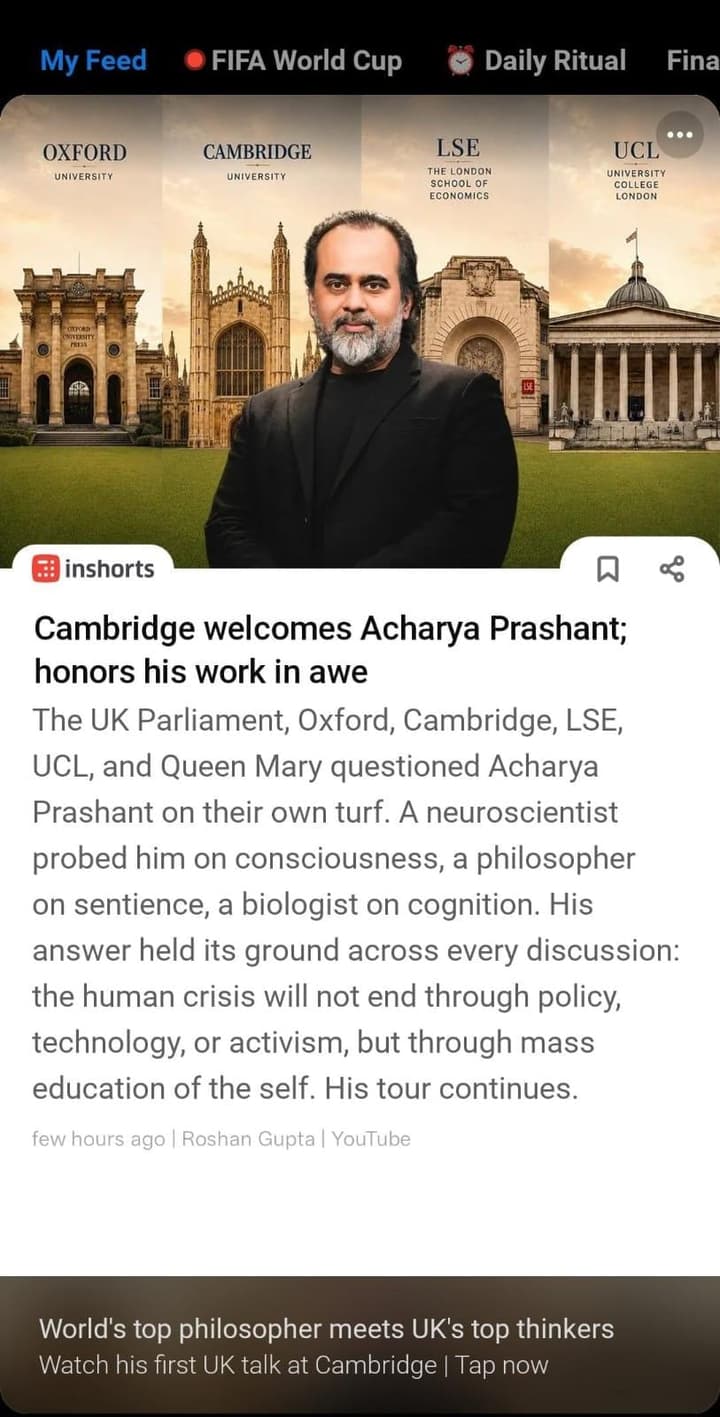
Philosopher Acharya Prashant returned to India on Sunday after a landmark leg of his United Kingdom tour that took him to the platforms of Oxford University, Cambridge and the UK Parliament, where he placed the teachings of Vedanta and Indian Philosophy at the centre of global discourse on some of the defining questions of our times.
Nearly 145 years after Max Muller carried the Isha Upanishad to Oxford as a scholarly object, Acharya Prashant returned it to the same university as a living teaching — arguing, in the very building where economics and policy are taught, that no external solution can resolve humanity's crises without first examining the consuming ego that drives them.
Oxford, which brought the Ishavasya Upanishad to the West a century and a half ago, is now returning it to its vivid meaning by an Indian philosopher. Acharya Prashant argues that no external policy, from the climate crisis to the nuclear threat — will work as long as the consuming ego remains untested.
It was from Oxford that Professor Max Müller, in 1879, published the first English translation of the Ishavasya Upanishad through Oxford University Press in the inaugural volume of the Sacred Books of the East series, introducing this text to the Western world. Nearly a century and a half later, on that very soil, an Indian philosopher arrived to restore the same Upanishad to its original, living meaning.
In 1879, Professor Max Muller carried the Ishavasya Upanishad to the West, publishing its first English translation through Oxford University Press as the opening volume of the 'Sacred Books of the East'. Nearly a century and a half later, an Indian philosopher has arrived at the same university to return the text to its living meaning.
“Acharya Prashant described the fact that an Indian is teaching Vedanta at Oxford as a meaningful coincidence. He said that the knowledge of Vedanta has never been secret; anyone who wishes to learn it can do so, and eligibility is not determined by birth, caste, or social class, but by the qualifications described in the Sādhana Chatuṣṭaya (the fourfold spiritual disciplines), which are entirely based on individual qualities and preparedness. He added that in the Western tradition, this knowledge was once viewed from the outside as an object of study, whereas today the same knowledge is being presented from within its own living tradition.
On June 8, at the lecture theatre in Oxford University's Manor Road Building, Acharya Prashant delivered a detailed philosophical session on the second verse of the Isha Upanishad. The session drew a varied audience, including Oxford students and research scholars from the UK, Europe and the United States. Its central question was, "Who is the actor?"
In 1879, Professor Max Muller carried the Ishavasya Upanishad to the West, publishing its first English translation through Oxford University Press as the opening volume of the ‘Sacred Books of the East’. Nearly a century and a half later, an Indian philosopher has arrived at the same university to return the text to its living meaning. On June 8, at the lecture theatre in Oxford University's Manor Road Building, Acharya Prashant delivered a detailed philosophical session on the second verse of the Isha Upanishad.
On the occasion of World Environment Day, Indian philosopher and author Acharya Prashant is currently appearing on some of Britain’s most prestigious intellectual and policymaking platforms with a message that is entirely different from the conventional environmental discourse there.
Despite 30 COP summits, carbon emissions continue to rise—Acharya Prashant is raising these uncomfortable questions at Britain's highest echelons. From Cambridge to the House of Lords and beyond to Oxford, he argues that the root of the climate crisis lies not in technology, but in human desire.
In a tour that has placed an Indian philosopher on the stage of some of Britain’s most prestigious intellectual and policy stages, Acharya Prashant has spent the past week carrying a climate message to capacity audiences at the Cambridge Union, in a one-on-one dialogue with a British peer of the realm, in public sessions that have drawn British audiences well beyond the Indian community, and across a sequence of upcoming engagements at Oxford, the London School of Economics, King’s College London, and London Climate Action Week.
In a tour that has placed an Indian philosopher on the stage of some of Britain's most prestigious intellectual and policy stages, Acharya Prashant has spent the past week carrying a climate message to capacity audiences at the Cambridge Union, in a one-on-one dialogue with a British peer of the realm, in public sessions that have drawn British audiences well beyond the Indian community, and across a sequence of upcoming engagements at Oxford, the London School of Economics, King's College London, and London Climate Action Week.
In a tour that has placed an Indian philosopher on the stage of some of Britain’s most prestigious intellectual and policy stages, Acharya Prashant has spent the past week carrying a climate message to capacity audiences at the Cambridge Union, in a one-on-one dialogue with a British peer of the realm, in public sessions that have drawn British audiences well beyond the Indian community, and across a sequence of upcoming engagements at Oxford, the London School of Economics, King’s College London, and London Climate Action Week.
Philosopher and bestselling author Acharya Prashant delivered a thought-provoking address at the prestigious Cambridge Union, urging global leaders, academics and policymakers to look beyond technology and policy solutions when addressing climate change and societal challenges.
Philosopher and author Acharya Prashant addressed a packed audience at the University of Cambridge on Friday in a fireside chat at the historic Cambridge Union, arguing that humanity's gravest crises, climate change foremost among them, cannot be resolved by technology or policy alone because their root lies not in the external world but in the unexamined inner life of human beings. The audience response was overwhelming; seats were fully booked even before the day arrived.
Philosopher and author Acharya Prashant addressed a packed audience at the University of Cambridge on Friday in a fireside chat at the historic Cambridge Union, arguing that humanity's gravest crises, climate change foremost among them, cannot be resolved by technology or policy alone because their root lies not in the external world but in the unexamined inner life of human beings.